




Monday, May 18, 2026
SAVED POSTS
  • Login
  • Register
RathBiotaClan
No Result
View All Result
  • HOME
  • HEALTH SCIENCE

    TRENDING ON HEALTH (TOP)

    Cycling Linked to Lower Dementia Risk in Study of Nearly 480,000 Adults

    First oral GLP-1 weight-loss pill approved a new era for accessible treatment

    Chewing gum releases thousands of microplastic particles directly into your mouth with every piece you chew

    Single-Cell Study of Over a Million Immune Cells Reveals Why Women Are More Prone to Autoimmune Disease

    NOW ON AIR (RBC)

    A new study has found that menโ€™s brains shrink faster than womenโ€™s as they age.
    NEUROSCIENCE

    12,638 MRI Scans Confirm Men’s Brains Shrink Faster in PNAS Study

    May 14, 2026
    ENVIRONMENTAL SCIENCE

    Volcanic Eruptions Can Destroy Their Own Methane โ€” Tonga’s Plume Shows How

    May 13, 2026
    3 men standing on rocky shore during daytime
    MOLECULAR BIOLOGY

    For Future Space Missions, Molecular Ecology Finally Offers a Clear Biosignature Target

    May 12, 2026
    Babies Yawn in the Womb
    DEVELOPMENTAL BIOLOGY

    Scientists Say Babies May Learn to Yawn Before Birth

    May 11, 2026
  • NEUROSCIENCE
    • PHYSIOLOGY
    • IMMUNOLOGY
    • CANCER
  • DISCOVERIES
    • SPOTLIGHTS
    • STUDENT PORTAL
    • SCIENCE FEATURED
  • MOLECULAR BIOLOGY
    • GENETICS
    • BIOTECHNOLOGY
    • BIOINFORMATICS
    • BIOCHEMISTRY
    • BIOPHYSICS
  • ZOOLOGY & ECOLOGY
    • ENVIRONMENTAL SCIENCE
    • ECOLOGY
    • EVOLUTION
  • MICRO & PLANT SCIENCE
    • MICROBIOLOGY
    • CELL BIOLOGY
    • DEVELOPMENTAL BIOLOGY
  • PSYCHOLOGY
RathBiotaClan
RathBiotaClan
No Result
View All Result
Home DISCOVERIES

First-Ever Fossilized Stomach Reveals Pterosaurs Had a Plant-Based Diet

Shibasis Rath by Shibasis Rath
July 16, 2025
in DISCOVERIES, EVOLUTION, ZOOLOGY
Reading Time: 5 mins read
0
A A
0
dinosaur fossil
Hey there, ever wonder what ancient flying reptiles ate?

Turns out, our ideas about them just got a pretty wild update! For ages, paleontologists kind of assumed that pterosaursโ€”those fierce-looking, winged reptiles and almost all were meat-lovers. Researchers determined that these creatures primarily consumed fish, insects, and possibly other reptiles. This conclusion is backed by fossilized stomach contents from a genus known as Rhamphorhynchus, which consistently showed that its diet was primarily composed of fish.

But a discovery from China is flipping the script.

In northeastern China, around 120 million years ago, a pterosaurโ€”specifically a species called Sinopterus atavismusโ€”crash-landed into a shallow pond and died. Whatโ€™s incredible is that this fossil didnโ€™t just preserve its bonesโ€”it also kept its stomach contents intact. Thatโ€™s a big deal. This is the first time scientists have ever gotten a glimpse inside the stomach of this kind of pterosaur.

Some scientists had guessed plant-eating might be possibleโ€ฆ

Long before this fossil was discovered, some researchers began to question whether certain pterosaurs were exclusively carnivorous. They highlighted characteristics such as their beaks, particularly the toothless varieties found in a group known as tapejarids, which includes Sinopterus atavismus. These tapejarids had beaks shaped a lot like parrotsโ€™, perfect for chomping on fruit or cracking open nuts. But without hard proof, it remained a theory most paleontologists didnโ€™t buy into.

ADVERTISEMENT
This fossil of the pterosaur Sinopterus atavismus preserves the creatureโ€™s stomach, which contains hundreds of mineral deposits associated with plant matterโ€”suggesting it died with a belly full of plants. Shunxing Jiang

Now, things have changedโ€”because theyโ€™ve finally got the proof.

When researchers, including Xinjun Zhang and Shunxing Jiang, took a closer look at this particular Sinopterus atavismus specimen (a juvenile that was about 1.5 meters acrossโ€”still small compared to the full-grown ones that could reach 2 to 4 meters), they used super high-resolution x-ray scans to peer inside. And what they found inside its stomach was completely unexpected.

READ ALSO

Fossil Penguins From New Zealand Reveal Stages of the Birds’ Long Evolutionary History

Critically Endangered Blue Tarantula Surveyed in Indiaโ€™s Largest Tiger Reserve

Evidence one: quartz crystals that hint at tough diets.

Right at the top of its stomach, the team found a bunch of large quartz crystals. These kinds of stones are usually seen in animals that swallow gastrolithsโ€”stomach stones that help grind up food. Think of it like a built-in food processor. Today, many birds and lizards use these stones to help digest tough plant material, which means the pterosaur mightโ€™ve been doing the same thing.

ADVERTISEMENT

Evidence two: phytolithsโ€”tiny plant fingerprints.

Even deeper in the stomach, they spotted hundreds of phytoliths. These are microscopic mineral structures that form between plant cells. Theyโ€™re like the fingerprints of the plant world, and finding them is like catching a plant in the act of being eaten. Before this, phytoliths had only ever been found twice in dinosaursโ€”once in fossilized poop, and once stuck to teethโ€”both times in clear herbivores. So finding them in a pterosaurโ€™s belly? Thatโ€™s basically a smoking gun that proves this pterosaur was munching on plants.

Even skeptics are changing their minds.

David Martill, a well-known paleontologist who wasnโ€™t involved in the study, admitted the discovery completely changed his thinking. He used to believe those delicate beaks were made for snapping up tiny creatures like water fleas or insects. But this fossil proved otherwise. He even called it a โ€œonce-in-a-hundred-years discovery.โ€

The debate is finally settled.

This jaw-dropping discovery, recently published in Science Bulletin, is now considered strong enough to close the debate about whether pterosaurs ate plants. The answer? At least some of them absolutely did. And not just a bite here and thereโ€”they had full-on plant-based diets. This means scientists now have to reconsider how pterosaurs fit into ancient ecosystems. Were they seed-spreaders? Competitors to early herbivorous dinosaurs?

ADVERTISEMENT

The plant clues point to woody favorites.

The types of phytoliths found in the pterosaurโ€™s belly suggest it was mainly munching on woody plants, though there were traces of flowering plants and maybe conifers too. So these creatures may have had more sophisticated diets than anyone imagined, capable of handling tough vegetation just like some modern herbivores.

A discovery almost missed.

This remarkable story could have faded into history, but the exceptional preservation of this fossil, combined with the right tools and expertise, brought it to light. This discovery highlights the vast knowledge still to be gained from fossils and reveals that even the most intimidating creatures may have simply been enjoying a leafy salad.
REFERENCE 

ScienceDirect

  • Share on WhatsApp (Opens in new window) WhatsApp
  • Share on Facebook (Opens in new window) Facebook
  • Share on Reddit (Opens in new window) Reddit
  • Share on X (Opens in new window) X
  • Print (Opens in new window) Print
Shibasis Rath

Shibasis Rath

"๐“’๐“ธ๐“ท๐“ท๐“ฎ๐“ฌ๐“ฝ๐“ฒ๐“ท๐“ฐ ๐“ก๐“ฎ๐“ผ๐“ฎ๐“ช๐“ป๐“ฌ๐“ฑ ๐“ฃ๐“ธ ๐“ก๐“ฎ๐“ช๐“ต๐“ฒ๐“ฝ๐”‚" ๐“ฒ๐“ผ๐“ท'๐“ฝ ๐“™๐“พ๐“ผ๐“ฝ ๐“ช ๐“œ๐“ธ๐“ฝ๐“ฝ๐“ธ - ๐“˜๐“ฝ'๐“ผ ๐“œ๐”‚ ๐“œ๐“ฒ๐“ผ๐“ผ๐“ฒ๐“ธ๐“ท

Related Posts

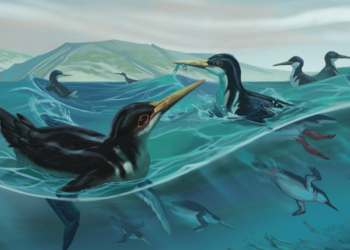
The oldest penguin species yet discovered, Daniadyptes primaevus, was a flightless bird that spent much of its time in the ocean, just like modern penguins. However, fossil evidence of the speciesโ€™ long beaks suggests that it used hunting practices more like those of modern seabirds, such as cormorants, which stay near the waterโ€™s surface because they cannot swallow their prey underwater. Traces of the many varieties of ancient penguins that lived in New Zealand are al- lowing paleontologists to track their evolution into the semiaquatic birds found today.
DISCOVERIES

Fossil Penguins From New Zealand Reveal Stages of the Birds’ Long Evolutionary History

May 1, 2026
Rare Peacock Tarantula Image
NEWS

Critically Endangered Blue Tarantula Surveyed in Indiaโ€™s Largest Tiger Reserve

April 30, 2026
Cannibal killer whales in Russian waters
ECOLOGY

Scientists spot signs of cannibal killer whales in Russian waters

April 30, 2026

RathBiotaClan – RBC

RathBiotaClan – Connecting Research To Reality

Your trusted source for life science news, biology research & discoveries. Covering neuroscience, genetics, ecology, and more โ€” connecting research to reality.

Privacy Policies

Contact Us

About Us

Editorial Standards

Latest Posts

  • 12,638 MRI Scans Confirm Men’s Brains Shrink Faster in PNAS Study
  • Volcanic Eruptions Can Destroy Their Own Methane โ€” Tonga’s Plume Shows How
  • For Future Space Missions, Molecular Ecology Finally Offers a Clear Biosignature Target
  • Scientists Say Babies May Learn to Yawn Before Birth

SHIBASIS RATH

Contact Mail

rathbiotaclan@gmail.com

No Result
View All Result
MSME (Udyam) Certified Science Platform
Govt. of India

Get Us On PlayStore

playstore app for rathbiotaclan
  • About Us
  • Advertise With Us
  • Cancellation and Refund Policy
  • Contact Us
  • Contribute
  • Editorial Standards
  • Home
  • Pricing Details
  • Privacy Policies
  • Shipping Policy
  • Terms & Conditions

ยฉ 2026 RathBiotaClan. All rights reserved.

Welcome Back!

Sign In with Google
OR

Login to your account below

Forgotten Password? Sign Up

Create New Account!

Sign Up with Google
OR

Fill the forms bellow to register

*By registering into our website, you agree to the Terms & Conditions and Privacy Policy.
All fields are required. Log In

Retrieve your password

Please enter your username or email address to reset your password.

Log In

Add New Playlist

No Result
View All Result
  • HOME
  • HEALTH SCIENCE
  • NEUROSCIENCE
    • PHYSIOLOGY
    • IMMUNOLOGY
    • CANCER
  • DISCOVERIES
    • SPOTLIGHTS
    • STUDENT PORTAL
    • SCIENCE FEATURED
  • MOLECULAR BIOLOGY
    • GENETICS
    • BIOTECHNOLOGY
    • BIOINFORMATICS
    • BIOCHEMISTRY
    • BIOPHYSICS
  • ZOOLOGY & ECOLOGY
    • ENVIRONMENTAL SCIENCE
    • ECOLOGY
    • EVOLUTION
  • MICRO & PLANT SCIENCE
    • MICROBIOLOGY
    • CELL BIOLOGY
    • DEVELOPMENTAL BIOLOGY
  • PSYCHOLOGY
  • Login
  • Sign Up
SAVED POSTS

ยฉ 2026 RathBiotaClan. All rights reserved.

This website uses cookies. By continuing to use this website you are giving consent to cookies being used. Visit our Privacy and Cookie Policy.