






Monday, May 18, 2026
SAVED POSTS
  • Login
  • Register
RathBiotaClan
No Result
View All Result
  • HOME
  • HEALTH SCIENCE

    TRENDING ON HEALTH (TOP)

    Cycling Linked to Lower Dementia Risk in Study of Nearly 480,000 Adults

    First oral GLP-1 weight-loss pill approved a new era for accessible treatment

    Chewing gum releases thousands of microplastic particles directly into your mouth with every piece you chew

    Single-Cell Study of Over a Million Immune Cells Reveals Why Women Are More Prone to Autoimmune Disease

    NOW ON AIR (RBC)

    A new study has found that men’s brains shrink faster than women’s as they age.
    NEUROSCIENCE

    12,638 MRI Scans Confirm Men’s Brains Shrink Faster in PNAS Study

    May 14, 2026
    ENVIRONMENTAL SCIENCE

    Volcanic Eruptions Can Destroy Their Own Methane — Tonga’s Plume Shows How

    May 13, 2026
    3 men standing on rocky shore during daytime
    MOLECULAR BIOLOGY

    For Future Space Missions, Molecular Ecology Finally Offers a Clear Biosignature Target

    May 12, 2026
    Babies Yawn in the Womb
    DEVELOPMENTAL BIOLOGY

    Scientists Say Babies May Learn to Yawn Before Birth

    May 11, 2026
  • NEUROSCIENCE
    • PHYSIOLOGY
    • IMMUNOLOGY
    • CANCER
  • DISCOVERIES
    • SPOTLIGHTS
    • STUDENT PORTAL
    • SCIENCE FEATURED
  • MOLECULAR BIOLOGY
    • GENETICS
    • BIOTECHNOLOGY
    • BIOINFORMATICS
    • BIOCHEMISTRY
    • BIOPHYSICS
  • ZOOLOGY & ECOLOGY
    • ENVIRONMENTAL SCIENCE
    • ECOLOGY
    • EVOLUTION
  • MICRO & PLANT SCIENCE
    • MICROBIOLOGY
    • CELL BIOLOGY
    • DEVELOPMENTAL BIOLOGY
  • PSYCHOLOGY
RathBiotaClan
RathBiotaClan
No Result
View All Result
Home DEVELOPMENTAL BIOLOGY

Is Gen Z the First Generation Less Intelligent Than Their Parents?

Shibasis Rath by Shibasis Rath
February 5, 2026
in DEVELOPMENTAL BIOLOGY, HEALTH SCIENCE, NEUROSCIENCE, NEWS, SPOTLIGHTS
Reading Time: 6 mins read
0
A A
0
a group of gen Z kids walking down a street

Gen Z intelligence decline is emerging as a serious concern among neuroscientists and education researchers. For over a century, each generation showed rising IQ scores, a pattern known as the Flynn effect. New data from the U.S., Europe, and global assessments now suggest this trend may be reversing raising urgent questions about how modern environments are shaping the developing brain.

In January 2026, a U.S. Senate hearing delivered a startling claim. Cognitive neuroscientist Dr. Jared Cooney Horvath testified that Generation Z those born roughly between 1997 and 2012 may be the first generation in modern history to show lower cognitive performance than their parents at the same age. According to Horvath, this decline is not anecdotal or cultural pessimism; it is measurable across IQ, memory, literacy, numeracy, attention, and problem-solving abilities.

For more than a century, human intelligence appeared to move in only one direction: upward. Now, multiple datasets from across the globe suggest that this long-standing trend has stalled—or even reversed. Researchers call this phenomenon the reverse Flynn effect, and its implications could shape education, innovation, and society for decades to come.

The Rise and Reversal of the Flynn Effect

The Flynn effect, named after psychologist James Flynn, describes the steady rise in average IQ scores throughout the 20th century. From the 1930s onward, many countries saw gains of roughly three IQ points per decade. Improved nutrition, longer schooling, smaller family sizes, and exposure to increasingly complex environments all played a role. Importantly, these gains were environmental, not genetic.

ADVERTISEMENT

Children became better at abstract reasoning, pattern recognition, and problem-solving the very skills IQ tests measure. As a result, IQ tests had to be renormalized regularly to prevent score inflation.

READ ALSO

12,638 MRI Scans Confirm Men’s Brains Shrink Faster in PNAS Study

For Future Space Missions, Molecular Ecology Finally Offers a Clear Biosignature Target

However, around the late 1990s and early 2000s, the upward curve flattened. In countries such as Norway, Denmark, and Finland, IQ scores began to decline among cohorts born after the mid-1970s. By the 2010s, similar patterns emerged in the United States, the United Kingdom, and parts of Western Europe.

ADVERTISEMENT

One of the most influential findings came from a large Norwegian study involving over 730,000 men. It showed a drop of roughly seven IQ points per generation among younger cohorts. Crucially, the decline occurred even among siblings raised in the same families, strongly implicating environmental factors rather than genetics.
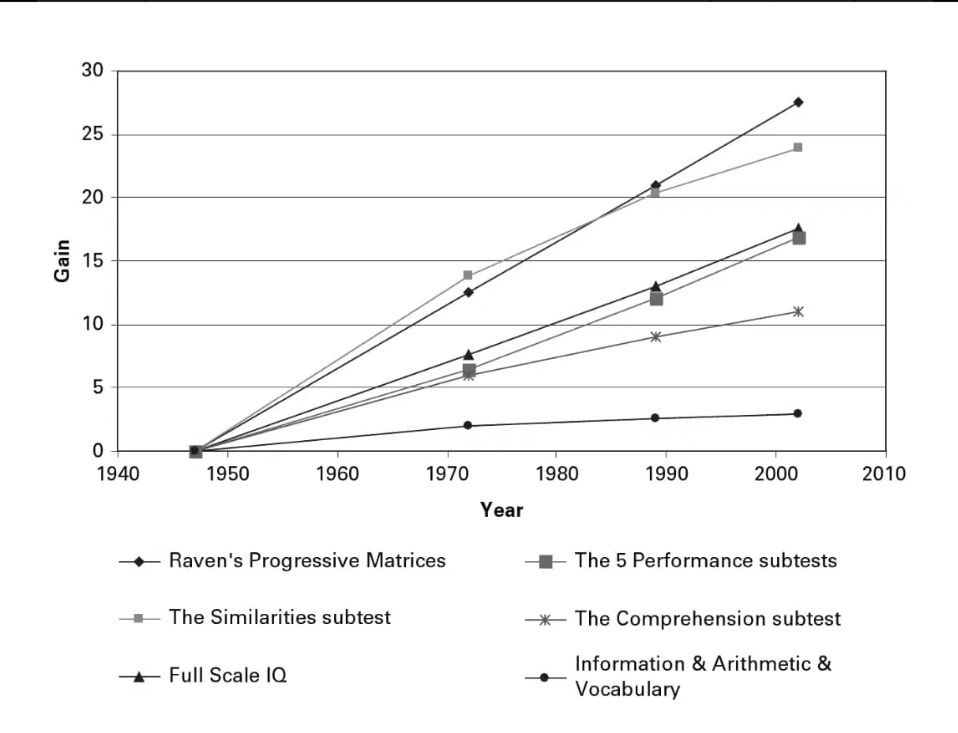
graph of rise and fall of the flynn effect

Evidence from the United States and Beyond

U.S. data mirror these international trends. A large analysis of nearly 400,000 American adults tested between 2006 and 2018 found declines in verbal reasoning, numerical reasoning, and matrix reasoning—key markers of fluid intelligence, or the ability to solve novel problems. Spatial reasoning showed modest improvement, but overall composite scores fell, with the sharpest declines among young adults aged 18 to 22.

ADVERTISEMENT

International assessments such as PISA reveal similar patterns. Despite spending more years in formal education than any previous generation, today’s adolescents and young adults often perform worse than millennials on measures of reading comprehension, sustained attention, working memory, executive function, and mathematical reasoning.

Some researchers caution against alarmism, arguing that intelligence may simply be plateauing or that IQ tests fail to capture modern cognitive skills. Yet the consistency of declines across countries, test formats, and age groups makes the trend difficult to dismiss as mere measurement error or cultural bias.
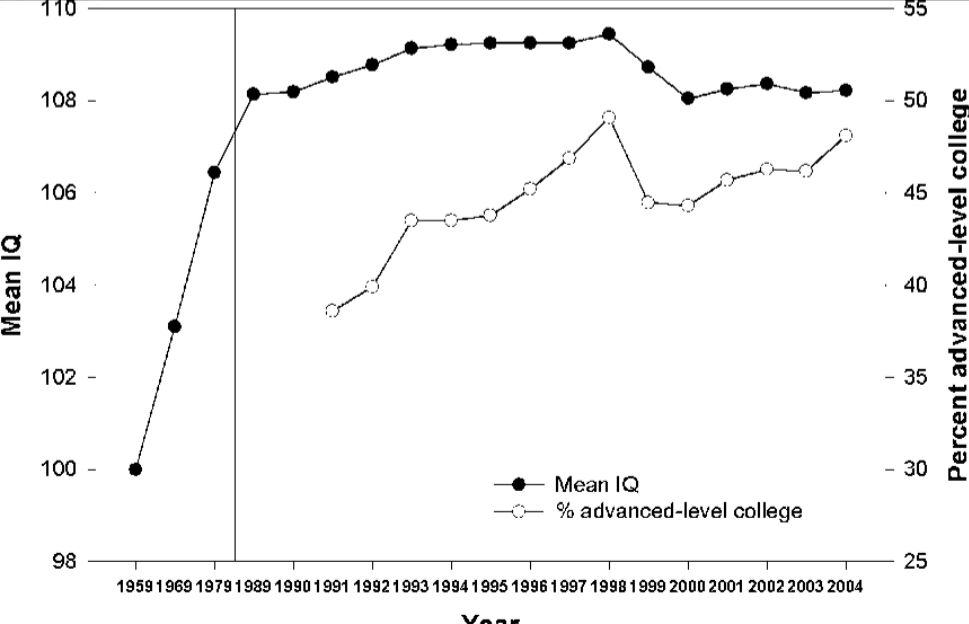
graph of evidence from us

Gen Z and the Role of Screens

Dr. Horvath and others point to a major environmental shift that coincides closely with the cognitive downturn: the rapid integration of digital technology into education.

Around 2010, laptops, tablets, and educational software became widespread in classrooms. These tools were marketed as solutions for personalized learning and efficiency. Instead, evidence increasingly suggests they may undermine deep cognitive processing. Screen-based learning fragments attention, encourages rapid task-switching, and reduces the need for memory consolidation.

Studies show that students who spend several hours per day using computers for learning often score substantially lower on standardized tests than peers with limited screen exposure. Outside school, smartphones and social media compound the problem. Many Gen Z individuals spend more than seven hours per day on screens, training their brains for constant stimulation rather than sustained focus.

Other contributing factors may include declining reading habits, curriculum shifts toward test preparation, and environmental exposures. However, the timing and scale of EdTech adoption align strikingly well with the observed cognitive declines.

Notably, countries such as Denmark have begun reversing course by limiting classroom screen use and emphasizing hands-on, social, and play-based learning with early signs of cognitive stabilization.

What a Cognitive Decline Could Mean

If these trends persist, the consequences could extend far beyond test scores. Lower average cognitive ability may affect innovation, economic productivity, scientific problem-solving, and democratic decision-making. Complex global challenges from climate change to public health require sustained reasoning and deep understanding.

At the same time, Gen Z excels in areas traditional IQ tests often miss, including digital navigation, visual information processing, and rapid information filtering. This suggests not a loss of intelligence per se, but a reconfiguration of cognitive skills shaped by modern environments.

The critical takeaway is that the reverse Flynn effect appears to be environmentally driven and therefore reversible. Educational policy, screen exposure limits, reading-focused curricula, and evidence-based technology use could restore cognitive gains in future generations.

As Horvath warned lawmakers, intelligence is not fixed, but it is fragile. How societies choose to educate children in the digital age may determine whether the reverse Flynn effect becomes a temporary dip or a lasting legacy.

References

  1. Written Testimony of Dr. Jared Cooney Horvath, U.S. Senate Committee on Commerce, Science, and Transportation
    https://www.commerce.senate.gov/services/files/A19DF2E8-3C69-4193-A676-430CF0C83DC2
  2. Neuroscientist Reveals First Generation in History to Be Less Intelligent Than Their Parents
    https://www.msn.com/en-us/news/technology/neuroscientist-reveals-first-generation-in-history-to-be-less-intelligent-than-their-parents/ar-AA1VvYQF
  3. Gen Z Is the First Generation Less Cognitively Capable Than Their Parents — But Denmark Has a Solution
    https://www.upworthy.com/gen-z-technology-schools
  4. Americans’ IQ Scores Are Lower in Some Areas, Higher in One
    https://news.northwestern.edu/stories/2023/03/americans-iq-scores-are-lower-in-some-areas-higher-in-one
  5. New Study Reveals Sharp Decline in American IQ Scores as the “Reverse Flynn Effect” Takes Center Stage
    https://thedebrief.org/new-study-reveals-sharp-decline-in-american-iq-scores-as-the-reverse-flynn-effect-takes-center-stage
  6. Thinking in the Age of Machines: Global IQ Decline and the Rise of AI-Assisted Thinking
    https://thequantumrecord.com/philosophy-of-technology/global-iq-decline-rise-of-ai-assisted-thinking
  7. Declining Global IQ: Reality or Moral Panic?
    https://www.polytechnique-insights.com/en/columns/society/declining-global-iq-reality-or-moral-panic
  8. Flynn Effect
    https://en.wikipedia.org/wiki/Flynn_effect
  9. Generational IQ Test Score Changes and the Positive Manifold of Intelligence: Evidence from Austrian Air Force Pilots and Air Traffic Controllers (1992–2016)
    https://pmc.ncbi.nlm.nih.gov/articles/PMC12118355

  • Share on WhatsApp (Opens in new window) WhatsApp
  • Share on Facebook (Opens in new window) Facebook
  • Share on Reddit (Opens in new window) Reddit
  • Share on X (Opens in new window) X
  • Print (Opens in new window) Print
Shibasis Rath

Shibasis Rath

"𝓒𝓸𝓷𝓷𝓮𝓬𝓽𝓲𝓷𝓰 𝓡𝓮𝓼𝓮𝓪𝓻𝓬𝓱 𝓣𝓸 𝓡𝓮𝓪𝓵𝓲𝓽𝔂" 𝓲𝓼𝓷'𝓽 𝓙𝓾𝓼𝓽 𝓪 𝓜𝓸𝓽𝓽𝓸 - 𝓘𝓽'𝓼 𝓜𝔂 𝓜𝓲𝓼𝓼𝓲𝓸𝓷

Related Posts

A new study has found that men’s brains shrink faster than women’s as they age.
NEUROSCIENCE

12,638 MRI Scans Confirm Men’s Brains Shrink Faster in PNAS Study

May 14, 2026
3 men standing on rocky shore during daytime
MOLECULAR BIOLOGY

For Future Space Missions, Molecular Ecology Finally Offers a Clear Biosignature Target

May 12, 2026
Babies Yawn in the Womb
DEVELOPMENTAL BIOLOGY

Scientists Say Babies May Learn to Yawn Before Birth

May 11, 2026

POPULAR NEWS

Chewing gum releases thousands of microplastic particles directly into your mouth with every piece you chew

Chewing gum releases thousands of microplastic particles directly into your mouth with every piece you chew

by Shibasis Rath
May 8, 2026
0

Microplastics are turning up in places researchers never expected: deep-sea sediments, Arctic ice, and human blood. Now, a UCLA pilot...

Yelling Isn’t Just Yelling: How a Hostile Home Rewires a Child’s Brain for Constant Alert

Yelling Isn’t Just Yelling: How a Hostile Home Rewires a Child’s Brain for Constant Alert

by Shibasis Rath
March 8, 2026
0

To a parent in the heat of the moment, a raised voice may feel like simple frustration. To a child...

a group of gen Z kids walking down a street

Is Gen Z the First Generation Less Intelligent Than Their Parents?

by Shibasis Rath
February 5, 2026
0

Gen Z intelligence decline is emerging as a serious concern among neuroscientists and education researchers. For over a century, each...

Whole Brain Emulation Achieved: Scientists Run a Fruit Fly Brain in Simulation

by Shibasis Rath
March 9, 2026
0

Scientists have copied an entire biological brain neuron by neuron and synapse by synapse and made it control a simulated...

Global Sperm Counts Have Dropped 50% in 50 Years Now 128 Men Are Racing Their Way to a $100,000 Prize to Prove the Point

Global Sperm Counts Have Dropped 50% in 50 Years Now 128 Men Are Racing Their Way to a $100,000 Prize to Prove the Point

by Staff Writer
May 5, 2026
0

A group of technology entrepreneurs is staging a competitive event in San Francisco in which semen samples from 128 men...

EDITOR CHOICE‘S

  • All
  • NEWS
  • SPOTLIGHTS
A new study has found that men’s brains shrink faster than women’s as they age.

12,638 MRI Scans Confirm Men’s Brains Shrink Faster in PNAS Study

by Staff Writer
May 14, 2026
0

A large-scale analysis of brain scans taken over time has found that men's brains shrink faster than women's across a...

Volcanic Eruptions Can Destroy Their Own Methane — Tonga’s Plume Shows How

Volcanic Eruptions Can Destroy Their Own Methane — Tonga’s Plume Shows How

by Shibasis Rath
May 13, 2026
0

A study published in Nature Communications analyzed the Hunga Tonga-Hunga Ha'apai volcano eruption's impact on methane in the atmosphere. It...

3 men standing on rocky shore during daytime

For Future Space Missions, Molecular Ecology Finally Offers a Clear Biosignature Target

by Shibasis Rath
May 12, 2026
0

When the next generation of probes scoops up dust from the icy shell of Europa or the surface of Mars,...

Babies Yawn in the Womb

Scientists Say Babies May Learn to Yawn Before Birth

by Shibasis Rath
May 11, 2026
0

Mothers can spread yawns to their yet-to-be-born offspring during pregnancy, researchers report May 5 in Current Biology  the first empirical evidence...

ADVERTISEMENT

RathBiotaClan – RBC

RathBiotaClan – Connecting Research To Reality

Your trusted source for life science news, biology research & discoveries. Covering neuroscience, genetics, ecology, and more — connecting research to reality.

Privacy Policies

Contact Us

About Us

Editorial Standards

Latest Posts

  • 12,638 MRI Scans Confirm Men’s Brains Shrink Faster in PNAS Study
  • Volcanic Eruptions Can Destroy Their Own Methane — Tonga’s Plume Shows How
  • For Future Space Missions, Molecular Ecology Finally Offers a Clear Biosignature Target
  • Scientists Say Babies May Learn to Yawn Before Birth

SHIBASIS RATH

Contact Mail

rathbiotaclan@gmail.com

No Result
View All Result
MSME (Udyam) Certified Science Platform
Govt. of India

Get Us On PlayStore

playstore app for rathbiotaclan
  • About Us
  • Advertise With Us
  • Cancellation and Refund Policy
  • Contact Us
  • Contribute
  • Editorial Standards
  • Home
  • Pricing Details
  • Privacy Policies
  • Shipping Policy
  • Terms & Conditions

© 2026 RathBiotaClan. All rights reserved.

Welcome Back!

Sign In with Google
OR

Login to your account below

Forgotten Password? Sign Up

Create New Account!

Sign Up with Google
OR

Fill the forms bellow to register

*By registering into our website, you agree to the Terms & Conditions and Privacy Policy.
All fields are required. Log In

Retrieve your password

Please enter your username or email address to reset your password.

Log In

Add New Playlist

No Result
View All Result
  • HOME
  • HEALTH SCIENCE
  • NEUROSCIENCE
    • PHYSIOLOGY
    • IMMUNOLOGY
    • CANCER
  • DISCOVERIES
    • SPOTLIGHTS
    • STUDENT PORTAL
    • SCIENCE FEATURED
  • MOLECULAR BIOLOGY
    • GENETICS
    • BIOTECHNOLOGY
    • BIOINFORMATICS
    • BIOCHEMISTRY
    • BIOPHYSICS
  • ZOOLOGY & ECOLOGY
    • ENVIRONMENTAL SCIENCE
    • ECOLOGY
    • EVOLUTION
  • MICRO & PLANT SCIENCE
    • MICROBIOLOGY
    • CELL BIOLOGY
    • DEVELOPMENTAL BIOLOGY
  • PSYCHOLOGY
  • Login
  • Sign Up
SAVED POSTS

© 2026 RathBiotaClan. All rights reserved.

This website uses cookies. By continuing to use this website you are giving consent to cookies being used. Visit our Privacy and Cookie Policy.