



Monday, May 18, 2026
SAVED POSTS
  • Login
  • Register
RathBiotaClan
No Result
View All Result
  • HOME
  • HEALTH SCIENCE

    TRENDING ON HEALTH (TOP)

    Cycling Linked to Lower Dementia Risk in Study of Nearly 480,000 Adults

    First oral GLP-1 weight-loss pill approved a new era for accessible treatment

    Chewing gum releases thousands of microplastic particles directly into your mouth with every piece you chew

    Single-Cell Study of Over a Million Immune Cells Reveals Why Women Are More Prone to Autoimmune Disease

    NOW ON AIR (RBC)

    A new study has found that men’s brains shrink faster than women’s as they age.
    NEUROSCIENCE

    12,638 MRI Scans Confirm Men’s Brains Shrink Faster in PNAS Study

    May 14, 2026
    ENVIRONMENTAL SCIENCE

    Volcanic Eruptions Can Destroy Their Own Methane — Tonga’s Plume Shows How

    May 13, 2026
    3 men standing on rocky shore during daytime
    MOLECULAR BIOLOGY

    For Future Space Missions, Molecular Ecology Finally Offers a Clear Biosignature Target

    May 12, 2026
    Babies Yawn in the Womb
    DEVELOPMENTAL BIOLOGY

    Scientists Say Babies May Learn to Yawn Before Birth

    May 11, 2026
  • NEUROSCIENCE
    • PHYSIOLOGY
    • IMMUNOLOGY
    • CANCER
  • DISCOVERIES
    • SPOTLIGHTS
    • STUDENT PORTAL
    • SCIENCE FEATURED
  • MOLECULAR BIOLOGY
    • GENETICS
    • BIOTECHNOLOGY
    • BIOINFORMATICS
    • BIOCHEMISTRY
    • BIOPHYSICS
  • ZOOLOGY & ECOLOGY
    • ENVIRONMENTAL SCIENCE
    • ECOLOGY
    • EVOLUTION
  • MICRO & PLANT SCIENCE
    • MICROBIOLOGY
    • CELL BIOLOGY
    • DEVELOPMENTAL BIOLOGY
  • PSYCHOLOGY
RathBiotaClan
RathBiotaClan
No Result
View All Result
Home SCIENCE FEATURED

Tasmanian Tiger Extinction: What Happened & Why Sightings Persist

Shibasis Rath by Shibasis Rath
May 18, 2025
in SCIENCE FEATURED, ZOOLOGY
Reading Time: 6 mins read
0
A A
0
tasmanian tiger

Thylacine

Extinct species of marsupial

The Tasmanian tiger, or thylacine (Thylacinus cynocephalus), was once a dreadful predator roaming Australia, New Guinea, and Tasmania. However during 1936, human activity, habitat loss, and disease had led this unique marsupial to extinction. With the successful genome altering of a gray wolf to look like the long-lost dire wolf, scientists are now exploring similar techniques to bring back the thylacine. This breakthrough raises hope that one day, the Tasmanian tiger might roam the wild again in our wild.

Scientific name:

Thylacinus cynocephalus

Scientific classification:

ADVERTISEMENT

Phylum: Chordata

READ ALSO

Volcanic Eruptions Can Destroy Their Own Methane — Tonga’s Plume Shows How

Scientists Say Babies May Learn to Yawn Before Birth

Class: Mammalia

ADVERTISEMENT

Order: Dasyuromorphia

Family: Thylacinidae

When did it become extinct?

ADVERTISEMENT

It became extinct in the year 1936, although unconfirmed sightings are still reported.

Where did it live?

The thylacine was native to Australia and New Guinea, but in relatively recent times, its range was limited to Tasmania, the island off the southeastern tip of Australia.

a skully animal skull with a skull head

The soft tissue of the specimen that researchers dubbed ‘head in a bucket’ contains preserved long RNA molecules, which are crucial to reconstructing the thylacine genome. Photograph: Andrew Pask/University of Melbourne and Museums Victoria

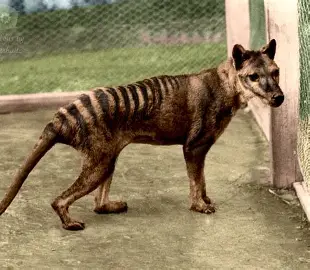
A short, black-and-white, silent film showing an unusual doglike animal pacing up and down in a zoo enclosure is a poignant reminder of the last known thylacine, known affectionately as Benjamin. The film was shot in 1933 at Hobart Zoo in Tasmania, and three years after the film was shot, Benjamin died—some say through neglect, but whatever the cause, his demise was the end of the species.

The range of the thylacine, also inaccurately known as the Tasmanian wolf or Tasmanian tiger, once encompassed the forests of New Guinea and most of Australia, as bones and other remains testify. However, at least 40,000 years ago, humans reached these lands, and the demise of the thylacine began. When European explorers first reached this part of the world, the thylacine was restricted to the island of Tasmania, and it was already quite rare.

The reason for its disappearance from the mainland is a bone of contention, but Aboriginal hunting is thought to be a factor and, much later, competition with the dingoes that first found their way to Australia via Aboriginal trading with Southeast Asian people around 4,000 years ago.

From the black-and-white film and numerous photos and accounts of the thylacine, we know exactly what it looked like and some of its behavior. In appearance, it was quite doglike, but it was a marsupial, and like all marsupials, it had a pouch; however, unlike some other flesh-eating marsupials, the thylacine’s pouch opened to the rear, and it was to this cozy pocket that the young crawled after being born, fixing themselves onto one of the four teats in its confines.

As its appearance suggests, the thylacine was a predator in the same vein as other large, terrestrial, mammalian carnivores, but it had some unique features. Its jaws, operated by powerful muscles, could open very wide indeed, and its muscular, relatively rigid tail, similar to a kangaroo’s, acted like a prop so the thylacine could balance quite easily on its back legs, and even hop when it needed to.

We can only make educated guesses as to the animals it preyed on, but on the Australian mainland, it may have favored kangaroos and wallabies, whereas its diet on Tasmania probably consisted of just about any animal smaller than itself as well as carrion.

How did the thylacine catch its prey?

Again, we have to rely on accounts from the nineteenth and early twentieth century, but these vary, with some suggesting the thylacine would pursue its prey over long distances, while others report that it was an ambush predator. In Tasmania, it may have relied on both of these predatory tactics depending on the habitat in which it was hunting.

Records of the behavior of the thylacine suggest that it was active at dusk and dawn and during the night; however, this behavior may have been unnatural a response to human persecution. During the day, thylacines built a nest of twigs and ferns in a large hollow tree or a suitable rocky crevice, and when the dusk came, they would leave these retreats in the forested hills to look for food on the open heaths.

Sadly, the thylacine’s predatory nature brought it into conflict with the European settlers who started to raise livestock on the productive island of Tasmania. The killing of sheep and poultry was attributed to the thylacine, even though they were rarely seen. The authorities at the time initiated a bounty scheme in which farmers and hunters could collect a reward for the thylacines they killed. Between 1888 and 1909, this bounty was £1 per thylacine, and records show that 2,184 bounties were paid out, but it is very likely that the bounty was left unclaimed on many occasions.

By the 1920s, the thylacine was very rare in the wild, and the species clung to survival as a few scattered individuals in the former strongholds of its range. Although human persecution was the final blow for this animal, it was probably also suffering from competition with introduced dogs and the diseases they carried. Benjamin was the last known thylacine, and after 50 years with no evidence of any surviving individuals, the species was declared extinct in 1986.

Many people cling to the hope that a remnant population of thylacines still survives in Tasmania. Tasmania is a large, rugged, and sparsely populated island, and there is a very faint possibility that the thylacine has somehow clung to existence. The last person to photograph a living thylacine, David Fleay, searched Tasmania with a colleague, and the evidence they found suggests that the thylacine was hanging on into the 1960s. Sightings are still reported today, not only from Tasmania, but also from mainland Australia and the Indonesian portion of New Guinea. Until a live specimen of the thylacine is presented or other irrefutable evidence is declared, we have to conclude that this enigmatic species is sadly extinct.

Key Facts:

  • The demise of the thylacine on the Australian mainland is attributed to the arrival and dispersal of Aborigines and the animals they brought with them, notably the dingo.
  • This may only be part of the picture as the striped coat of the thylacine suggests this animal was adapted to forest. A drying of the global climate thousands of years ago may have caused Australian forest habitats to contract, and the thylacine may have been forced into areas to which it was not well adapted. This loss of habitat was compounded by the large-scale changes that followed in the wake of the first human invasion of Australia.
  • The thylacine, when compared to the wolf, is one of the best examples of convergent evolution, the phenomenon by which two unrelated animals from widely separated locations have a striking resemblance to one another because of the similar niches to which they have had to adapt. In Australasia, the thylacine filled the niche of a running predator that is occupied by canid predators in the Northern Hemisphere, and as a result, it came to look like them.
  • There are several preserved fetuses of the thylacine in museum collections around the world, and scientists had suggested that it would be possible to bring the thylacine back from extinction using the DNA from these specimens and the technology of cloning. DNA was extracted from these specimens, but it was badly degraded, and therefore cloning would have been impossible.
  • Share on WhatsApp (Opens in new window) WhatsApp
  • Share on Facebook (Opens in new window) Facebook
  • Share on Reddit (Opens in new window) Reddit
  • Share on X (Opens in new window) X
  • Print (Opens in new window) Print
Shibasis Rath

Shibasis Rath

"𝓒𝓸𝓷𝓷𝓮𝓬𝓽𝓲𝓷𝓰 𝓡𝓮𝓼𝓮𝓪𝓻𝓬𝓱 𝓣𝓸 𝓡𝓮𝓪𝓵𝓲𝓽𝔂" 𝓲𝓼𝓷'𝓽 𝓙𝓾𝓼𝓽 𝓪 𝓜𝓸𝓽𝓽𝓸 - 𝓘𝓽'𝓼 𝓜𝔂 𝓜𝓲𝓼𝓼𝓲𝓸𝓷

Related Posts

Volcanic Eruptions Can Destroy Their Own Methane — Tonga’s Plume Shows How
ENVIRONMENTAL SCIENCE

Volcanic Eruptions Can Destroy Their Own Methane — Tonga’s Plume Shows How

May 13, 2026
Babies Yawn in the Womb
DEVELOPMENTAL BIOLOGY

Scientists Say Babies May Learn to Yawn Before Birth

May 11, 2026
Low Sexual Frequency Linked to Worse Cardiovascular Outcomes, Two US Studies Find
SCIENCE FEATURED

Low Sexual Frequency Linked to Worse Cardiovascular Outcomes, Two US Studies Find

May 5, 2026

POPULAR NEWS

Chewing gum releases thousands of microplastic particles directly into your mouth with every piece you chew

Chewing gum releases thousands of microplastic particles directly into your mouth with every piece you chew

by Shibasis Rath
May 8, 2026
0

Microplastics are turning up in places researchers never expected: deep-sea sediments, Arctic ice, and human blood. Now, a UCLA pilot...

Yelling Isn’t Just Yelling: How a Hostile Home Rewires a Child’s Brain for Constant Alert

Yelling Isn’t Just Yelling: How a Hostile Home Rewires a Child’s Brain for Constant Alert

by Shibasis Rath
March 8, 2026
0

To a parent in the heat of the moment, a raised voice may feel like simple frustration. To a child...

a group of gen Z kids walking down a street

Is Gen Z the First Generation Less Intelligent Than Their Parents?

by Shibasis Rath
February 5, 2026
0

Gen Z intelligence decline is emerging as a serious concern among neuroscientists and education researchers. For over a century, each...

Whole Brain Emulation Achieved: Scientists Run a Fruit Fly Brain in Simulation

by Shibasis Rath
March 9, 2026
0

Scientists have copied an entire biological brain neuron by neuron and synapse by synapse and made it control a simulated...

Global Sperm Counts Have Dropped 50% in 50 Years Now 128 Men Are Racing Their Way to a $100,000 Prize to Prove the Point

Global Sperm Counts Have Dropped 50% in 50 Years Now 128 Men Are Racing Their Way to a $100,000 Prize to Prove the Point

by Staff Writer
May 5, 2026
0

A group of technology entrepreneurs is staging a competitive event in San Francisco in which semen samples from 128 men...

EDITOR CHOICE‘S

  • All
  • NEWS
  • SPOTLIGHTS
A new study has found that men’s brains shrink faster than women’s as they age.

12,638 MRI Scans Confirm Men’s Brains Shrink Faster in PNAS Study

by Staff Writer
May 14, 2026
0

A large-scale analysis of brain scans taken over time has found that men's brains shrink faster than women's across a...

Volcanic Eruptions Can Destroy Their Own Methane — Tonga’s Plume Shows How

Volcanic Eruptions Can Destroy Their Own Methane — Tonga’s Plume Shows How

by Shibasis Rath
May 13, 2026
0

A study published in Nature Communications analyzed the Hunga Tonga-Hunga Ha'apai volcano eruption's impact on methane in the atmosphere. It...

3 men standing on rocky shore during daytime

For Future Space Missions, Molecular Ecology Finally Offers a Clear Biosignature Target

by Shibasis Rath
May 12, 2026
0

When the next generation of probes scoops up dust from the icy shell of Europa or the surface of Mars,...

Babies Yawn in the Womb

Scientists Say Babies May Learn to Yawn Before Birth

by Shibasis Rath
May 11, 2026
0

Mothers can spread yawns to their yet-to-be-born offspring during pregnancy, researchers report May 5 in Current Biology  the first empirical evidence...

ADVERTISEMENT

RathBiotaClan – RBC

RathBiotaClan – Connecting Research To Reality

Your trusted source for life science news, biology research & discoveries. Covering neuroscience, genetics, ecology, and more — connecting research to reality.

Privacy Policies

Contact Us

About Us

Editorial Standards

Latest Posts

  • 12,638 MRI Scans Confirm Men’s Brains Shrink Faster in PNAS Study
  • Volcanic Eruptions Can Destroy Their Own Methane — Tonga’s Plume Shows How
  • For Future Space Missions, Molecular Ecology Finally Offers a Clear Biosignature Target
  • Scientists Say Babies May Learn to Yawn Before Birth

SHIBASIS RATH

Contact Mail

rathbiotaclan@gmail.com

No Result
View All Result
MSME (Udyam) Certified Science Platform
Govt. of India

Get Us On PlayStore

playstore app for rathbiotaclan
  • About Us
  • Advertise With Us
  • Cancellation and Refund Policy
  • Contact Us
  • Contribute
  • Editorial Standards
  • Home
  • Pricing Details
  • Privacy Policies
  • Shipping Policy
  • Terms & Conditions

© 2026 RathBiotaClan. All rights reserved.

Welcome Back!

Sign In with Google
OR

Login to your account below

Forgotten Password? Sign Up

Create New Account!

Sign Up with Google
OR

Fill the forms bellow to register

*By registering into our website, you agree to the Terms & Conditions and Privacy Policy.
All fields are required. Log In

Retrieve your password

Please enter your username or email address to reset your password.

Log In

Add New Playlist

No Result
View All Result
  • HOME
  • HEALTH SCIENCE
  • NEUROSCIENCE
    • PHYSIOLOGY
    • IMMUNOLOGY
    • CANCER
  • DISCOVERIES
    • SPOTLIGHTS
    • STUDENT PORTAL
    • SCIENCE FEATURED
  • MOLECULAR BIOLOGY
    • GENETICS
    • BIOTECHNOLOGY
    • BIOINFORMATICS
    • BIOCHEMISTRY
    • BIOPHYSICS
  • ZOOLOGY & ECOLOGY
    • ENVIRONMENTAL SCIENCE
    • ECOLOGY
    • EVOLUTION
  • MICRO & PLANT SCIENCE
    • MICROBIOLOGY
    • CELL BIOLOGY
    • DEVELOPMENTAL BIOLOGY
  • PSYCHOLOGY
  • Login
  • Sign Up
SAVED POSTS

© 2026 RathBiotaClan. All rights reserved.

This website uses cookies. By continuing to use this website you are giving consent to cookies being used. Visit our Privacy and Cookie Policy.