





A new conservation survey has begun for the Peacock Tarantula (Poecilotheria metallica) inside the Nagarjunasagar Srisailam Tiger Reserve (NSTR). This effort marks one of the first structured attempts to assess the species within a major protected forest in India and could provide much-needed baseline data on its presence and habitat use.
Scientists first described the Peacock Tarantula in 1899, when Reginald Innes Pocock documented a specimen collected near Gooty in Andhra Pradesh. After that initial record, the species nearly disappeared from scientific observation. For more than a century, researchers rarely encountered it in the wild, leaving large gaps in its ecological and distributional history. Between 1899 and 2013, only two confirmed sightings occurred. In 2013, researchers found a dead specimen in the Seshachalam Biosphere Reserve, confirming that the species still persisted in its native range.
A significant development came in 2019, when scientists reported a range extension and recorded multiple adult individuals in the Pakkam Malai Reserve Forest. This discovery marked the first confirmed presence outside Andhra Pradesh. However, subsequent surveys failed to establish stable populations in Tamil Nadu as of 2025. As of 2026, no formal population estimate exists, and researchers consider the species extremely rare based on its limited range and low encounter rates.
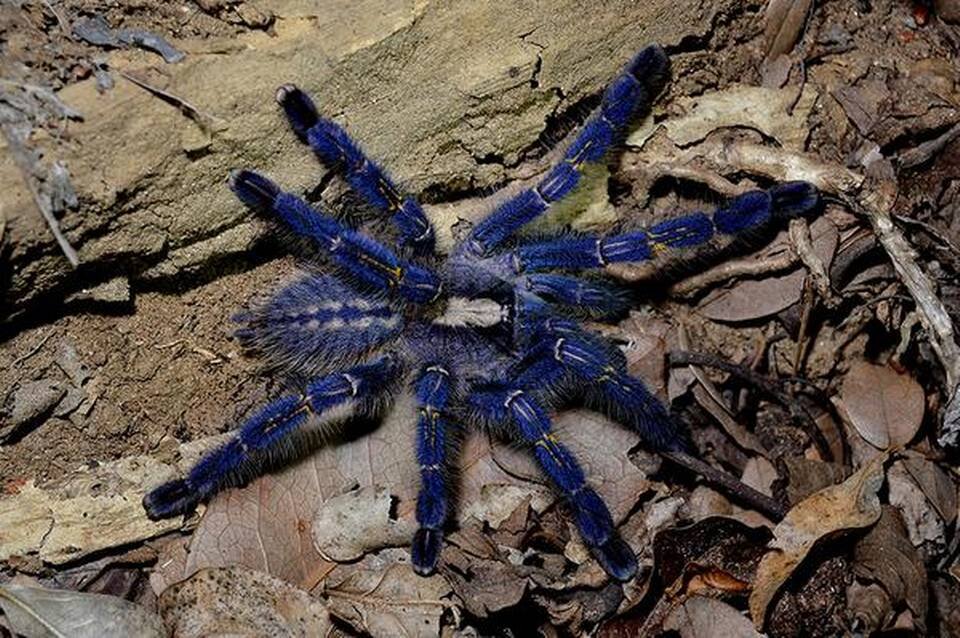
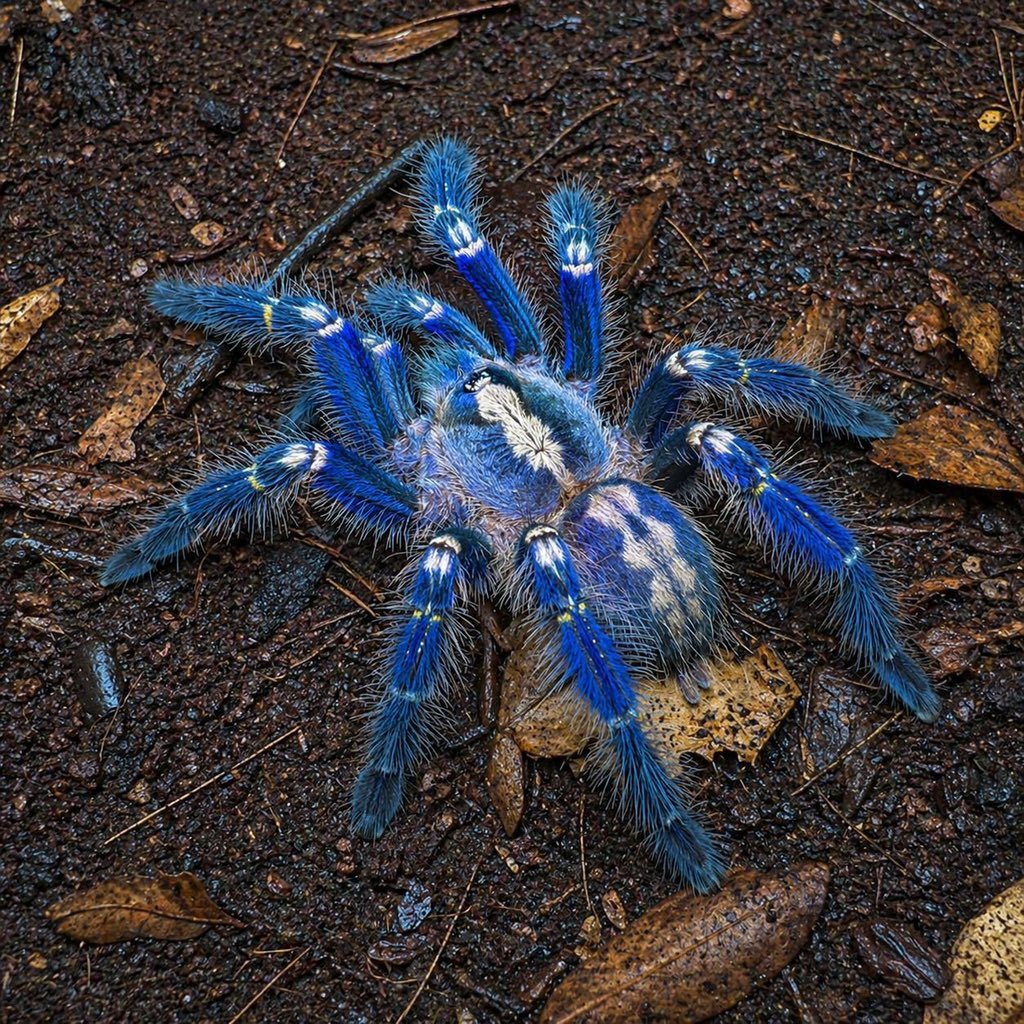
Poecilotheria metallica stands out as the only blue species in its genus. It lives high in trees and shelters inside natural hollows, where it constructs funnel-shaped webs. The spider preys mainly on flying insects and avoids light, retreating quickly when disturbed. Adults measure around 4–5 cm in body length, with leg spans reaching 15–18 cm. Females tend to be larger and more vividly coloured than males. Its striking blue colour does not come from pigments but from structural colouration, where microscopic surface structures reflect light to produce an intense metallic blue. This effect ranks among the most saturated blues observed in terrestrial arthropods.
The Nagarjunasagar Srisailam Tiger Reserve spans the Nallamala hills in the Eastern Ghats and forms one of India’s largest protected forest landscapes. The Krishna River cuts through the reserve, creating deep valleys, while elevation ranges from 100 to 917 metres. The forest consists mainly of southern tropical dry deciduous vegetation and supports one of the largest tiger populations in the Eastern Ghats. The reserve also lies within the known native range of the Peacock Tarantula, making it a critical landscape for its conservation.
The International Union for Conservation of Nature classifies P. metallica as Critically Endangered due to its extremely restricted range, which covers less than 100 square kilometres. Habitat loss continues to threaten the species, as logging and firewood collection reduce the availability of mature trees with natural hollows. At the same time, collectors target the spider for the exotic pet trade because of its vivid colouration. In 2016, authorities placed the genus Poecilotheria under CITES Appendix II, requiring permits for international trade, though enforcement remains uneven. A major challenge persists: scientists still lack a reliable population estimate, making it difficult to design effective conservation strategies.
Researchers designed the current survey to detect presence and assess habitat use rather than produce a full population count. Field teams conduct searches at night, when the spider is most active, and examine tree hollows and bark crevices in mature forest areas. Detection remains difficult because the species moves quickly, hides deep within tree cavities, and occurs at very low densities. Even in suitable habitats, encounter rates remain low, which makes the survey labour-intensive.
So far, scientists have not released results from the survey, and details about methodology, coverage, and timeline remain unavailable. Even if the survey confirms the species within NSTR, challenges will persist. The spider depends heavily on old trees with natural cavities, and ongoing disturbance continues to reduce these critical microhabitats. Protected status alone does not guarantee suitable conditions. Long-term conservation will require habitat protection, consistent monitoring, and carefully regulated breeding efforts.
Poecilotheria metallica belongs to a group of arboreal tarantulas found across India and Sri Lanka. These spiders play an important ecological role as insect predators, helping regulate populations of crickets, grasshoppers, and other invertebrates. Despite this, conservation programs rarely prioritise large invertebrates. The Peacock Tarantula has drawn attention mainly because of its striking appearance and extremely narrow range. The ongoing survey reflects a shift in approach, highlighting the growing recognition that lesser-known species also require systematic monitoring within major ecosystems.
Species: Poecilotheria metallica (Pocock, 1899). Family: Theraphosidae. IUCN Red List Status: Critically Endangered (CR). CITES: Appendix II (2016). Endemic range: Eastern Ghats, Andhra Pradesh, India; single confirmed range extension in Tamil Nadu (2019). Survey location: Nagarjunasagar Srisailam Tiger Reserve, Eastern Ghats, Andhra Pradesh/Telangana.