





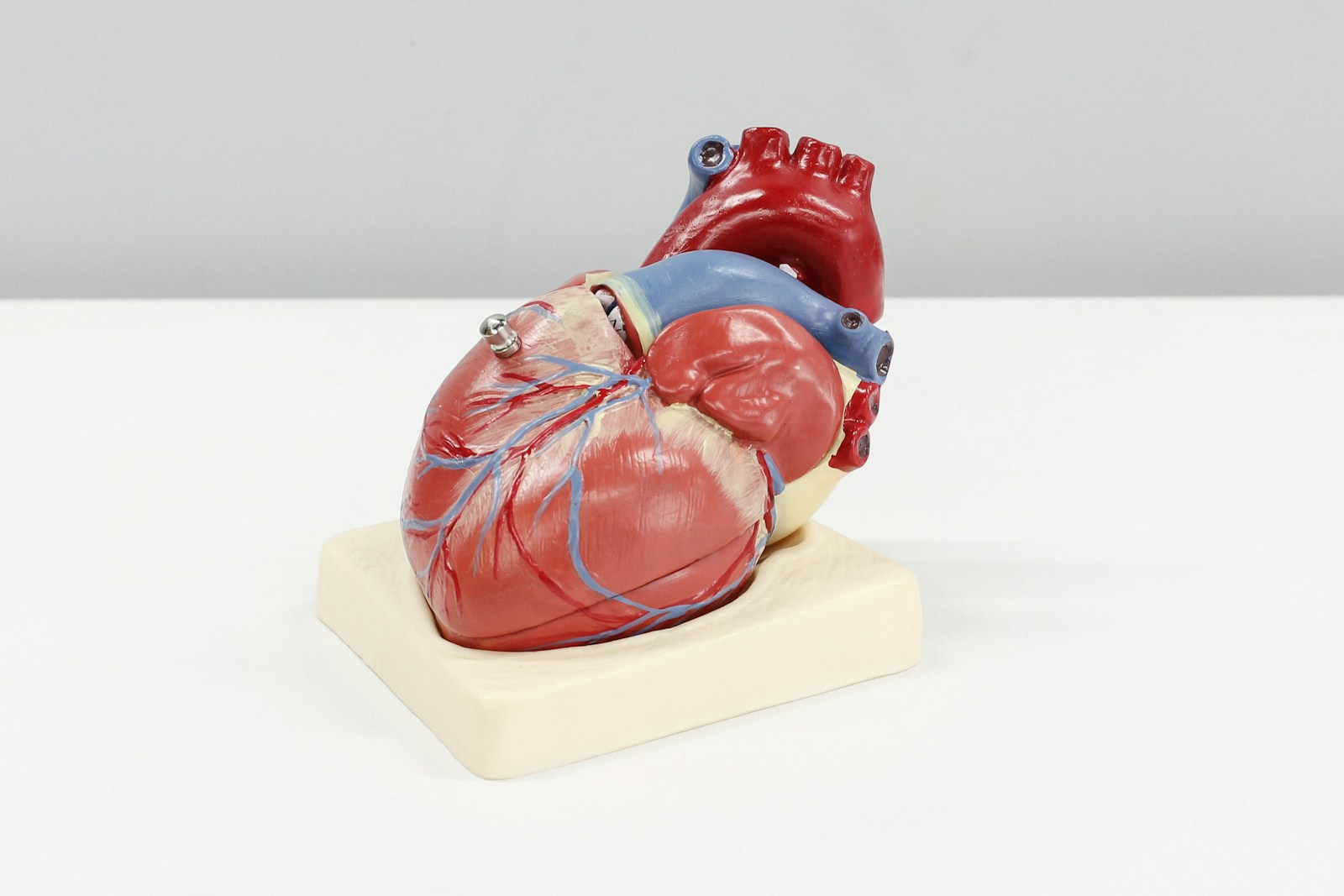
The heart is composed of three major types of cardiac muscle: atrial muscle, ventricular muscle, and specialized excitatory and conductive muscle fibers. The atrial and ventricular types of muscle contract in much the same way as skeletal muscle, except that the duration of contraction is much longer. The specialized excitatory and conductive fibers, however, contract only feebly because they contain few contractile fibrils; instead, they exhibit automatic rhythmical electrical discharge or conduction of action potentials through the heart, providing an excitatory system that controls the rhythmical beating.
Microscopic Structure: The Syncytium
Histologically, cardiac muscle fibers are arranged in a latticework, with the fibers dividing, recombining, and then spreading again. Cardiac muscle is striated in the same manner as skeletal muscle and has typical myofibrils containing actin and myosin filaments that slide along one another during contraction. However, cardiac muscle functions as a syncytium. The fibers are crossed by dark areas called intercalated discs, which are actually cell membranes separating individual cardiac muscle cells. At each intercalated disc, the cell membranes fuse to form permeable “communicating” junctions (gap junctions) that allow rapid diffusion of ions. Because of this, ions move with ease in the intracellular fluid along the longitudinal axes of the fibers, allowing action potentials to travel easily from one cell to the next. Thus, when one cell becomes excited, the action potential spreads to all of them throughout the latticework interconnections.
Functional Division: Atrial and Ventricular Syncytiums
The heart is actually composed of two distinct syncytiums: the atrial syncytium, which constitutes the walls of the two atria, and the ventricular syncytium, which constitutes the walls of the two ventricles. The atria are separated from the ventricles by fibrous tissue that surrounds the atrioventricular (A-V) valvular openings. Normally, potentials are not conducted directly from the atrial syncytium into the ventricular syncytium through this fibrous tissue. Instead, they are conducted only by way of a specialized conductive system called the A-V bundle. This division of the muscle of the heart into two functional syncytiums allows the atria to contract a short time ahead of ventricular contraction, which is important for the effectiveness of heart pumping.
Valves and Supporting Structures
The heart contains valves that direct blood flow: the A-V valves (tricuspid and mitral) prevent backflow of blood from the ventricles to the atria during systole, and the semilunar valves (aortic and pulmonary) prevent backflow from the aorta and pulmonary arteries into the ventricles during diastole. These valves close and open passively based on pressure gradients. The A-V valves are thin and filmy, whereas the semilunar valves are much heavier and constructed with strong, pliable fibrous tissue to withstand extra physical stresses. The A-V valves are attached to papillary muscles by the chordae tendineae. The papillary muscles contract when the ventricular walls contract; however, they do not help the valves to close. Instead, they pull the vanes of the valves inward toward the ventricles to prevent their bulging too far backward toward the atria during ventricular contraction.
Coronary circulation
Physiologic Anatomy of the Coronary Blood Supply
The main coronary arteries lie on the surface of the heart, and smaller arteries then penetrate from the surface into the cardiac muscle mass. It is almost entirely through these arteries that the heart receives its nutritive blood supply. The left coronary artery supplies mainly the anterior and left lateral portions of the left ventricle, whereas the right coronary artery supplies most of the right ventricle, as well as the posterior part of the left ventricle in 80 to 90 per cent of people.
Most of the coronary venous blood flow from the left ventricular muscle returns to the right atrium of the heart by way of the coronary sinus, which accounts for about 75 per cent of the total coronary blood flow. Most of the coronary venous blood from the right ventricular muscle returns through small anterior cardiac veins that flow directly into the right atrium, not by way of the coronary sinus. A very small amount of coronary venous blood also flows back into the heart through very minute thebesian veins, which empty directly into all chambers of the heart.
Normal Blood Flow and Phasic Changes
The resting coronary blood flow in the resting human being averages 70 ml/min/100 g heart weight, or about 225 ml/min, which is about 4 to 5 per cent of the total cardiac output. During strenuous exercise, the coronary blood flow increases threefold to fourfold to supply the extra nutrients needed by the heart.
Coronary capillary blood flow in the left ventricular muscle falls to a low value during systole, which is opposite to flow in vascular beds elsewhere in the body. The reason for this is strong compression of the left ventricular muscle around the intramuscular vessels during systolic contraction. During diastole, the cardiac muscle relaxes and no longer obstructs blood flow through the left ventricular muscle capillaries, so blood flows rapidly during all of diastole. Blood flow through the coronary capillaries of the right ventricle also undergoes phasic changes, but because the force of contraction of the right ventricular muscle is far less, the inverse phasic changes are only partial.
Control of Coronary Flow: Local Metabolism
Blood flow through the coronary system is regulated mostly by local arteriolar vasodilation in response to the nutritional needs of cardiac muscle. Whenever the vigor of cardiac contraction is increased, the rate of coronary blood flow also increases. Blood flow in the coronary arteries usually is regulated almost exactly in proportion to the need of the cardiac musculature for oxygen. Because not much oxygen is left in the blood after passing through the heart muscle, very little additional oxygen can be supplied unless the coronary blood flow increases.
It is speculated that a decrease in the oxygen concentration in the heart causes vasodilator substances to be released from the muscle cells. A substance with great vasodilator propensity is adenosine. In the presence of very low concentrations of oxygen in the muscle cells, a large proportion of the cell’s ATP degrades to adenosine monophosphate; then small portions of this are further degraded and release adenosine into the tissue fluids of the heart muscle, with resultant increase in local coronary blood flow. Other vasodilator products include potassium ions, hydrogen ions, carbon dioxide, prostaglandins, and nitric oxide.
Nervous Control of Coronary Blood Flow
Stimulation of the autonomic nerves to the heart can affect coronary blood flow both directly and indirectly. The indirect effects, which are mostly opposite to the direct effects, play a far more important role in normal control. Sympathetic stimulation releases norepinephrine and epinephrine, which increases heart rate, heart contractility, and the rate of metabolism of the heart. In turn, the increased metabolism sets off local blood flow regulatory mechanisms for dilating the coronary vessels. Conversely, vagal (parasympathetic) stimulation slows the heart and has a slight depressive effect on contractility, which decreases cardiac oxygen consumption and indirectly constricts the coronary arteries.
The direct effects result from the action of nervous transmitter substances on the coronary vessels themselves. The acetylcholine released by parasympathetic stimulation has a direct effect to dilate the coronary arteries. Sympathetic stimulation can have either vascular constrictor or vascular dilator effects, depending on the presence of alpha (constrictor) or beta (dilator) receptors. In general, the epicardial coronary vessels have a preponderance of alpha receptors, whereas the intramuscular arteries may have a preponderance of beta receptors. Therefore, sympathetic stimulation usually causes slight overall coronary constriction.
Structure and working of conducting myocardial fibers
Nature and Composition
The heart is composed of three major types of cardiac muscle: atrial muscle, ventricular muscle, and specialized excitatory and conductive muscle fibres.
- Contractile Properties: Unlike atrial and ventricular muscle, which contract similarly to skeletal muscle, the specialized excitatory and conductive fibres contract only feebly.
- Structural Composition: They contract feebly because they contain few contractile fibrils.
- Primary Function: Instead of force generation, they function as an excitatory system that controls the rhythmical beating of the heart. They do this by exhibiting automatic rhythmical electrical discharge (in the form of action potentials) or by conducting these action potentials through the heart.
Structural Connectivity: The Syncytium
Functionally, cardiac muscle fibres are arranged in a latticework, dividing, recombining, and spreading again.
- Intercalated Discs: The dark areas crossing cardiac fibres are called intercalated discs; these are cell membranes that separate individual muscle cells.
- Gap Junctions: At each intercalated disc, cell membranes fuse to form permeable “communicating” junctions, known as gap junctions.
- Rapid Ion Movement: These junctions allow rapid diffusion of ions, meaning ions move with ease in the intracellular fluid along the longitudinal axes of the fibres. Consequently, action potentials travel easily from one cell to the next, allowing the signal to spread to all interconnected cells.
Mechanism of Conduction and Velocity
The conductive system ensures the efficient transmission of excitatory signals.
- Conduction Velocity: The velocity of signal conduction varies significantly between muscle types. While the excitatory signal travels along atrial and ventricular muscle fibres at about 0.3 to 0.5 m/sec, the velocity in the Purkinje fibres (the specialized conductive system) is as high as 4 m/sec.
- Rapid Transmission: This high velocity—roughly 1/10 the speed in skeletal muscle but much faster than cardiac muscle—allows for reasonably rapid conduction of the excitatory signal to different parts of the heart.
Pathway of Excitation
The heart consists of two separate functional syncytiums: the atrial syncytium and the ventricular syncytium, separated by fibrous tissue surrounding the A-V valve openings.
- Signal Initiation: The cardiac cycle is initiated by the spontaneous generation of an action potential in the sinus node.
- A-V Bundle Delay: Potentials are not conducted directly between the atria and ventricles through the fibrous tissue. Instead, they pass through a specialized conductive system called the A-V bundle.
- Function of the Delay: There is a delay of more than 0.1 second as the impulse passes from the atria into the ventricles. This delay is critical because it allows the atria to contract a short time ahead of the ventricles, pumping blood into the ventricles before strong ventricular contraction begins.
Physiological Mechanism of the Action Potential
The “working” of these fibres relies on unique membrane properties that create prolonged action potentials.
- Slow Calcium Channels: In addition to fast sodium channels, cardiac muscle has a population of slow calcium-sodium channels. These remain open for several tenths of a second, allowing a large quantity of calcium and sodium ions to flow into the fibre. This maintains a prolonged period of depolarization, creating a plateau in the action potential.
- Decreased Potassium Permeability: Immediately after the onset of the action potential, the permeability of the membrane to potassium ions decreases about fivefold. This prevents the rapid outflux of positively charged potassium ions, preventing the action potential from returning to its resting level early.
- Repolarization: When the slow calcium-sodium channels close after 0.2 to 0.3 second, membrane permeability for potassium increases rapidly, returning the membrane potential to its resting level.