




Thursday, April 30, 2026
SAVED POSTS
  • Login
  • Register
RathBiotaClan
No Result
View All Result
  • HOME
  • HEALTH SCIENCE
    • NEUROSCIENCE
    • PHYSIOLOGY
    • IMMUNOLOGY
    • CANCER
  • DISCOVERIES
    • SPOTLIGHTS
    • STUDENT PORTAL
    • SCIENCE FEATURED
  • MOLECULAR BIOLOGY
    • GENETICS
    • BIOTECHNOLOGY
    • BIOINFORMATICS
    • BIOCHEMISTRY
    • BIOPHYSICS
  • ZOOLOGY & ECOLOGY
    • ENVIRONMENTAL SCIENCE
    • ECOLOGY
    • EVOLUTION
  • MICRO & PLANT SCIENCE
    • MICROBIOLOGY
    • CELL BIOLOGY
    • DEVELOPMENTAL BIOLOGY
  • PSYCHOLOGY
  • E STORE
No Result
View All Result
RathBiotaClan
No Result
View All Result
Home NEWS

Colossal Biosciences Announces De-Extinction of Bluebuck Antelope, 226 Years After Its Extinction

Staff Writer by Staff Writer
April 30, 2026
in NEWS, ZOOLOGY
Reading Time: 3 mins read
0
A A
0
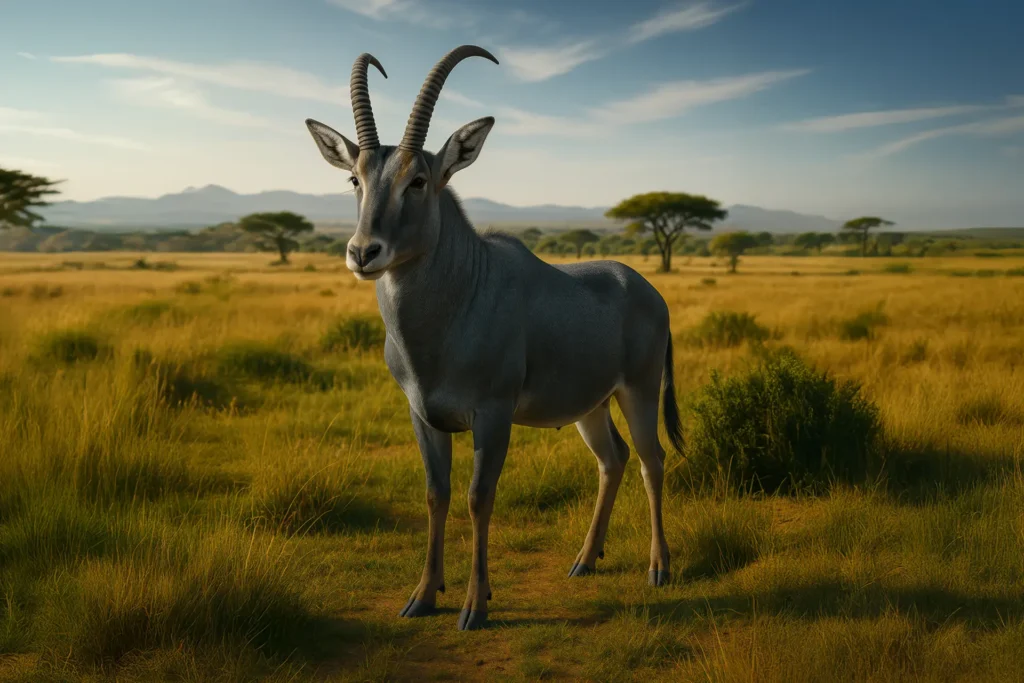
Bluebuck antelope with silvery-blue coat and curved horns running across open South African grassland, representing extinct species targeted for de-extinction by scientists

It has been 226 years since humans last saw a living bluebuck, an elegant antelope species native to South Africa that was driven to extinction by European hunters. Now, Colossal Biosciences the company that successfully de-extincted the dire wolf last year has announced it will attempt to resurrect the bluebuck using advanced gene-editing technology.

The bluebuck was a striking animal, standing about four feet tall at the shoulder and stretching up to ten feet from nose to rump. It possessed long, sharp, backward-curving horns measuring around 22 inches, a white belly, a brown face, and a distinctive silvery-gray-blue coat that shimmered across its body. When running at speeds of up to 50 miles per hour, it appeared like a streak of pale blue sky moving across the landscape.

READ ALSO

Critically Endangered Blue Tarantula Surveyed in India’s Largest Tiger Reserve

Scientists spot signs of cannibal killer whales in Russian waters

European colonists began hunting the bluebuck intensively shortly after arriving in South Africa in the mid-1600s. Prized for its unique pelt, the species was wiped out in roughly 150 years, with the last individuals disappearing around 1800. Today, the bluebuck exists only in historical drawings and a handful of preserved specimens in natural history museums.
Colossal Biosciences revealed the new de-extinction project on Thursday, adding the bluebuck to its growing list of target species that already includes the woolly mammoth, dodo, Tasmanian tiger, moa, and the recently revived dire wolf.

ADVERTISEMENT

“African antelopes have long been neglected in global conservation,” said Beth Shapiro, Chief Science Officer at Colossal Biosciences. “The bluebuck de-extinction project changes that. We’re bringing back a species that played a vital role in its ecosystem and building the scientific foundation for antelope conservation before more of its relatives are lost.”

The project will use the company’s proven gene-editing approach. Researchers have already sequenced the genome of the extinct bluebuck using a tissue sample from the Swedish Museum of Natural History and compared it with the genome of its closest living relative, the roan antelope. While the two species differ by about 3 percent of their DNA — roughly 18 million sequence variants — Colossal’s team has narrowed the critical differences down to approximately 20,000 key functional regions that define the bluebuck’s appearance and physical traits.

ADVERTISEMENT

Scientists will edit the DNA of roan antelope cells to incorporate these bluebuck-specific traits. The edited nucleus will then be inserted into an enucleated roan egg cell, which will be developed into an embryo and implanted into a roan surrogate mother. After a gestation period of about 278 days, the surrogate is expected to give birth to a bluebuck calf.

In addition to the de-extinction work, Colossal has successfully reprogrammed adult roan cells into induced pluripotent stem cells (iPSCs). This breakthrough will allow researchers to test genetic edits on different tissue types without experimenting on live animals, an important advancement for conservation efforts involving rare species.

Of the world’s 90 antelope species, 55 are experiencing population declines and 29 are currently threatened with extinction. Colossal hopes the technologies developed for the bluebuck project will also help strengthen genetic diversity in surviving antelope populations.

ADVERTISEMENT

Company CEO and co-founder Ben Lamm stressed that bringing the species back is only part of the challenge. “The other half is making sure the world is ready to protect it when it returns,” he said. Colossal is partnering with the nonprofit Advanced Conservation Strategies to identify suitable habitats and navigate regulatory requirements for eventual reintroduction in southern Africa.

The first bluebuck calves are expected to be born in secure enclosures, similar to the three dire wolf pups currently living in a protected 2,000-acre habitat. Long-term, the goal is to establish viable wild populations across appropriate landscapes in southern Africa.


  • Share on WhatsApp (Opens in new window) WhatsApp
  • Share on Facebook (Opens in new window) Facebook
  • Share on Reddit (Opens in new window) Reddit
  • Share on X (Opens in new window) X
  • Print (Opens in new window) Print

Did you like this read? Turn on notifications so we can let you know the second a new post goes live.

Turn off Alerts
Staff Writer

Staff Writer

Related Posts

Rare Peacock Tarantula Image
NEWS

Critically Endangered Blue Tarantula Surveyed in India’s Largest Tiger Reserve

April 30, 2026
Cannibal killer whales in Russian waters
ECOLOGY

Scientists spot signs of cannibal killer whales in Russian waters

April 30, 2026
great white shark
ENVIRONMENTAL SCIENCE

Mesothermic fish face rising energy stress and overheating risk in warming oceans

April 20, 2026
Scientists remain unclear about how the hectocotylus detects a mate, or delivers sperm to the right location. Photograph: Alexis Rosenfeld/c/o Visa Pour L'Image Perpignan
NEWS

Male Octopuses Sense Progesterone With Mating Arm, Study Finds

April 7, 2026
BIOTECHNOLOGY

Organ-on-a-Chip Ages Human Fat and Liver Tissue in 4 Days Using Old Blood Serum

April 2, 2026
handwriting difference in men and women
NEUROSCIENCE

Why Do Men Tend to Have Worse Handwriting Than Women?

April 27, 2026

Leave a Reply Cancel reply

Your email address will not be published. Required fields are marked *

I agree to the Terms & Conditions and Privacy Policy.

POPULAR NEWS

Yelling Isn’t Just Yelling: How a Hostile Home Rewires a Child’s Brain for Constant Alert

Yelling Isn’t Just Yelling: How a Hostile Home Rewires a Child’s Brain for Constant Alert

by Shibasis Rath
March 9, 2026
0

To a parent in the heat of the moment, a raised voice may feel like simple frustration. To a child...

a group of gen Z kids walking down a street

Is Gen Z the First Generation Less Intelligent Than Their Parents?

by Shibasis Rath
March 14, 2026
0

Gen Z intelligence decline is emerging as a serious concern among neuroscientists and education researchers. For over a century, each...

Whole Brain Emulation Achieved: Scientists Run a Fruit Fly Brain in Simulation

by Shibasis Rath
March 9, 2026
0

Scientists have copied an entire biological brain neuron by neuron and synapse by synapse and made it control a simulated...

Male G-spot isn’t where we thought it was

Male G-Spot Found: New Study Identifies Frenular Delta as Penis’s Most Sensitive Area

by Staff Writer
April 27, 2026
0

The study found that human penile innervation develops in distinct fetal stages and shows region-specific patterns in adults, with the...

Bluebuck antelope with silvery-blue coat and curved horns running across open South African grassland, representing extinct species targeted for de-extinction by scientists

Colossal Biosciences Announces De-Extinction of Bluebuck Antelope, 226 Years After Its Extinction

by Staff Writer
April 30, 2026
0

It has been 226 years since humans last saw a living bluebuck, an elegant antelope species native to South Africa...

EDITOR CHOICE‘S

  • All
  • NEWS
  • SPOTLIGHTS
Bluebuck antelope with silvery-blue coat and curved horns running across open South African grassland, representing extinct species targeted for de-extinction by scientists

Colossal Biosciences Announces De-Extinction of Bluebuck Antelope, 226 Years After Its Extinction

by Staff Writer
April 30, 2026
0

It has been 226 years since humans last saw a living bluebuck, an elegant antelope species native to South Africa...

Group of seniors walking down a city street.

Researchers Identify a Hidden Memory Risk Hiding in Plain Sight for Older Adults

by Shibasis Rath
April 30, 2026
0

More and more research suggests that psychological and behavioral factors can play a role in cognitive decline as people get...

Why Scientists Are Turning to Fish Scales to Restore Human Vision

Why Scientists Are Turning to Fish Scales to Restore Human Vision

by Shibasis Rath
April 30, 2026
0

Researchers at the University of Granada tested decellularized fish scales. They used these scales to create bioartificial corneas. Laboratory and...

Rare Peacock Tarantula Image

Critically Endangered Blue Tarantula Surveyed in India’s Largest Tiger Reserve

by Shibasis Rath
April 30, 2026
0

A new conservation survey has begun for the Peacock Tarantula (Poecilotheria metallica) inside the Nagarjunasagar Srisailam Tiger Reserve (NSTR). This...

ADVERTISEMENT

RathBiotaClan – RBC

RathBiotaClan – Connecting Research To Reality

Your trusted source for life science news, biology research & discoveries. Covering neuroscience, genetics, ecology, and more — connecting research to reality.

Privacy Policies

Shipping Policy

Cancellation & Refund Policy

Pricing Details

Contact Us

Latest Posts

  • Colossal Biosciences Announces De-Extinction of Bluebuck Antelope, 226 Years After Its Extinction
  • Researchers Identify a Hidden Memory Risk Hiding in Plain Sight for Older Adults
  • Why Scientists Are Turning to Fish Scales to Restore Human Vision
  • Critically Endangered Blue Tarantula Surveyed in India’s Largest Tiger Reserve

SHIBASIS RATH

Contact Mail

rathbiotaclan@gmail.com

No Result
View All Result
MSME (Udyam) Certified Science Platform
Govt. of India

Get Us On PlayStore

playstore app for rathbiotaclan
  • About Us
  • Advertise With Us
  • Cancellation and Refund Policy
  • Contact Us
  • Contribute
  • Editorial Standards
  • Home
  • Pricing Details
  • Privacy Policies
  • Shipping Policy
  • Terms & Conditions

© 2026 RathBiotaClan. All rights reserved.

Welcome Back!

Sign In with Google
OR

Login to your account below

Forgotten Password? Sign Up

Create New Account!

Sign Up with Google
OR

Fill the forms below to register

*By registering into our website, you agree to the Terms & Conditions and Privacy Policy.
All fields are required. Log In

Retrieve your password

Please enter your username or email address to reset your password.

Log In
No Result
View All Result
  • HOME
  • HEALTH SCIENCE
    • NEUROSCIENCE
    • PHYSIOLOGY
    • IMMUNOLOGY
    • CANCER
  • DISCOVERIES
    • SPOTLIGHTS
    • STUDENT PORTAL
    • SCIENCE FEATURED
  • MOLECULAR BIOLOGY
    • GENETICS
    • BIOTECHNOLOGY
    • BIOINFORMATICS
    • BIOCHEMISTRY
    • BIOPHYSICS
  • ZOOLOGY & ECOLOGY
    • ENVIRONMENTAL SCIENCE
    • ECOLOGY
    • EVOLUTION
  • MICRO & PLANT SCIENCE
    • MICROBIOLOGY
    • CELL BIOLOGY
    • DEVELOPMENTAL BIOLOGY
  • PSYCHOLOGY
  • E STORE
  • Login
  • Sign Up
SAVED POSTS

© 2026 RathBiotaClan. All rights reserved.

This website uses cookies. By continuing to use this website you are giving consent to cookies being used. Visit our Privacy and Cookie Policy.
Are you sure want to unlock this post?
Unlock left : 0
Are you sure want to cancel subscription?