




Monday, May 4, 2026
SAVED POSTS
  • Login
  • Register
RathBiotaClan
No Result
View All Result
  • HOME
  • HEALTH SCIENCE

    TRENDING ON HEALTH (TOP)

    Dreams about loved ones can bring comfort before death

    Male G-Spot Found: New Study Identifies Frenular Delta as Penisโ€™s Most Sensitive Area

    New Stem Cell Therapy Rebuilds Bone in Osteoporosis, Shows 30% Density Gain

    Walnut Extract May Help Control Blood Sugar Naturally, New Study Finds

    NOW ON AIR (RBC)

    Smiling Female Child Showing Success While Writing Homework In Front Of Parents
    PSYCHOLOGY

    Recent Study Indicates Constant Praise May Actually Lower a Childโ€™s Academic Risk-Taking.

    May 3, 2026
    SLC38A4 expression was confirmed by western blot in multiple tumor cell lines. In mouse models, liver tissue imaging (H&E staining) showed that overexpression of SLC38A4 reduced metastatic tumor areas, while knockdown increased them across Hepa1-6, MC38, and B16F10 cells. Results were consistent in both immunocompetent and nude mice, with statistically significant differences.
    MOLECULAR BIOLOGY

    Scientists Find Molecule That Wipes Out Liver Cancer

    May 2, 2026
    DISCOVERIES

    Fossil Penguins From New Zealand Reveal Stages of the Birds’ Long Evolutionary History

    May 1, 2026
    Bluebuck antelope with silvery-blue coat and curved horns running across open South African grassland, representing extinct species targeted for de-extinction by scientists
    MOLECULAR BIOLOGY

    Colossal Biosciences Announces De-Extinction of Bluebuck Antelope, 226 Years After Its Extinction

    May 1, 2026
  • NEUROSCIENCE
    • PHYSIOLOGY
    • IMMUNOLOGY
    • CANCER
  • DISCOVERIES
    • SPOTLIGHTS
    • STUDENT PORTAL
    • SCIENCE FEATURED
  • MOLECULAR BIOLOGY
    • GENETICS
    • BIOTECHNOLOGY
    • BIOINFORMATICS
    • BIOCHEMISTRY
    • BIOPHYSICS
  • ZOOLOGY & ECOLOGY
    • ENVIRONMENTAL SCIENCE
    • ECOLOGY
    • EVOLUTION
  • MICRO & PLANT SCIENCE
    • MICROBIOLOGY
    • CELL BIOLOGY
    • DEVELOPMENTAL BIOLOGY
  • PSYCHOLOGY
RBC Interactive Sticky Bar
RathBiotaClan Logo
Shop Resources
Life Science Whole Spectrum Focus
24/7 Digital Access
Pro Resources For Students & Researchers
Premium Articles
Research-backed insights for the curious mind.
eBooks
Digital books covering lab protocols.
RBC Magazines
Deep dives and science innovations.
Research Guides
Methodologies and application frameworks.
Pro Notes PDF
High-yield study notes for quick review.
View All Resources
Browse the complete digital library.
RathBiotaClan Seal

Connecting Research to Reality

Science is our safest secret. Explore the life science spectrum with insights for the curious mind.

RathBiotaClan
No Result
View All Result
Home ECOLOGY

The Extraordinary Revival of the Northern Bald Ibis in Europe

Shibasis Rath by Shibasis Rath
July 7, 2025
in ECOLOGY, SCIENCE FEATURED, ZOOLOGY
Reading Time: 5 mins read
0
A A
0
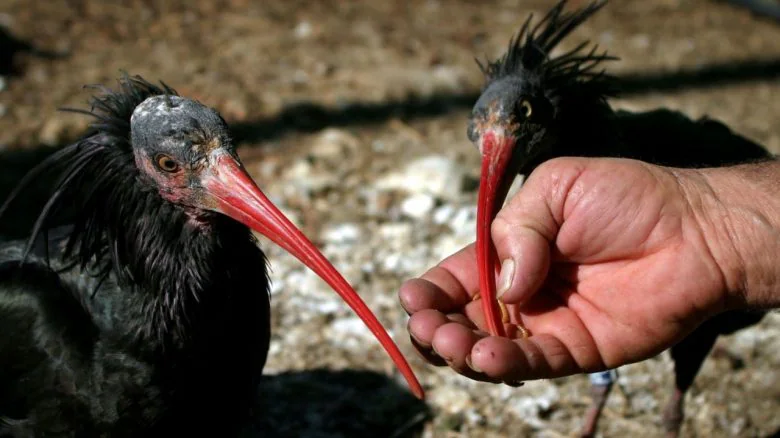
A personโ€™s hand feeds two Northern Bald Ibises with long red beaks and black feathers; the rare birds stand on rocky ground.

Once migrating majestically over Europe, North Africa, and the Arabian Peninsula, it was the northern bald ibis (Geronticus eremita) whose slaughtering for sport and habitats lost during the 17th century brought it to the brink of extinction. Its striking black and fluorescent green plumage, bald red head, and curved beak have attracted the interests of conservationists. Thanks to prodigious effort over the last two decades, scientists were successful in reviving the species in Central Europe and retrained it to migrate.

A Story from Extinction to Reintroduction

Some Background History

The northern bald ibis has a great history dating thousands of years back. It was once widespread throughout the Mediterranean. It started disappearing from the region about 2000 BCE, most probably due to the effects of human activities and climatic changes. To the ancient Egyptians, the bird was a symbol of their culture. It is often presented in hieroglyphs and frequently engaged in religious worship. Human agriculture promoted the proper quality of the habitat of the bird, but it also increased pressure on the bird and therefore disappeared gradually over time.

Overhunting reduced the species to isolated areas of Central Europe by the 17th century; it was only in places like Morocco and Syria that animals were to be found. Historical evidence stretches its wider distribution: southern Spain and the Upper Adriatic, for instance. The history of the northern bald ibis extinction is a scalding example of how the negative activities of man can wipe out wildlife populations over time

Conservation Efforts

In 2002, a passionate team called the Waldrappteam, located in Austria, began an ambitious work of rescuing the northern bald ibis from its near end. With breeding and rewilding, the population has gradually increased from zero to nearly 300 birds. As such, their classification has changed from “critically endangered” to “endangered,” a first in conservation history.

ADVERTISEMENT

Teaching Migration: The Role of Foster Parents

The Challenge of Migration

The northern bald ibis migration challenge is very challenging due to a number of significant factors that expose them to risks concerning survival and successful reintroduction back into the wild.

READ ALSO

Fossil Penguins From New Zealand Reveal Stages of the Birds’ Long Evolutionary History

Researchers Identify a Hidden Memory Risk Hiding in Plain Sight for Older Adults

Loss of Instinctual Knowledge

The northern bald ibis was once found to cover parts of Europe, North Africa, and the Arabian Peninsula. Generally, the species had dwindled to near extinction by the 17th century, mainly due to heavy hunting and destruction of habitat. The reintroduction work of Waldrappteam has faced a principal challenge: birds do not have an instinctive knowledge about the migratory routes that they would receive from wild-born elders. Without such guides many released birds got lost and died rather than returning to more suitable wintering grounds, like Tuscany, Italy.

ADVERTISEMENT

Illegal Hunting

Illegal hunting during the northern bald ibises’ migratory period is particularly risky, especially within the territories of Italy. Human-induced factors contribute to nearly 60% of the mortality rate for the reintroduced northern bald ibises. Illegal hunting is said to have caused approximately 30% of the mortality rates as established by forensic studies within the period from 2016 to 2022 in Italy.

This is the period when it is at its riskiest time as they migrate during autumn.

Effects of Climate Change

The climate change has also influenced the migratory seasons of the ibises. The birds have to cross the Alps after the season that they used to, with harsh weather conditions. Unavailable warm rising air currents called thermals make it hazardous for the birds to cross the Alps on long flights without risking exhaustion and high mortality during the migration.

ADVERTISEMENT

Response Mechanisms

To overcome such challenges, the Waldrappteam has implemented new ways of doing things. They train juvenile ibises on routes using ultralight aircraft. It helps to teach what to fly as well as building trust among the birds and their human carers. Climate change impacts compelled the team to alter some routes, as exemplified by the most recent migrations that cover from Bavaria to southern Spain, amounting to approximately 2,800 kilometers (1,740 miles EN ).

Innovative Solutions

Scientists have become adoptive parents and flying instructors to train young ibises how to fly on pre-set routes on ultralight aircraft. This will not only teach the birds where to go but will also arm them with survival skills needed in flight.

New Migration Routes

Global warming elevates the temperatures and changes the weather pattern, a new challenge for migratory birds. Migrating northern bald ibises migrated a little later in the season, moving over the Alps in more adverse conditions without the warming lift feature they seek, called thermals. The Waldrappteam used this as an opportunity for a new migratory route when the northern bald ibises migrated in 2023 from Bavaria to southern Spain in Andalusia.

“The 2023 Migration Journeyโ€

Presently, the distance is going to be approximately 2,800 kilometers (1,740 miles), some 300 kilometers longer than any previous year. Last week, a team of scientists led 36 birds into bright blue skies to favorable tailwinds from the Paterzell airfield in Bavaria, making them move faster. This new process increases their chances of survival but also enhances the birds’ resistance to climate change.

THE REVIVAL STRATEGY ๐Ÿชถ ๐Ÿฆ

The revival of the north bald ibis is truly a triumph of conservation: proof that, indeed, conservation pays and brains in thinking. Scientists are going back to teaching these beautiful birds how to migrate once more, thus restoring a lost species while adding flavor to our natural heritage. As climate change continues to challenge the very existence of wildlife across the globe, efforts like the ones undertaken by the Waldrappteam represent the very best hopes for endangered species everywhere. Further dedication and ingenuity may eventually see more success stories in conservation efforts as far afield as Europe and beyond.

  • Share on WhatsApp (Opens in new window) WhatsApp
  • Share on Facebook (Opens in new window) Facebook
  • Share on Reddit (Opens in new window) Reddit
  • Share on X (Opens in new window) X
  • Print (Opens in new window) Print

Did you like this read? Turn on notifications so we can let you know the second a new post goes live.

Turn off Alerts
Shibasis Rath

Shibasis Rath

"๐“’๐“ธ๐“ท๐“ท๐“ฎ๐“ฌ๐“ฝ๐“ฒ๐“ท๐“ฐ ๐“ก๐“ฎ๐“ผ๐“ฎ๐“ช๐“ป๐“ฌ๐“ฑ ๐“ฃ๐“ธ ๐“ก๐“ฎ๐“ช๐“ต๐“ฒ๐“ฝ๐”‚" ๐“ฒ๐“ผ๐“ท'๐“ฝ ๐“™๐“พ๐“ผ๐“ฝ ๐“ช ๐“œ๐“ธ๐“ฝ๐“ฝ๐“ธ - ๐“˜๐“ฝ'๐“ผ ๐“œ๐”‚ ๐“œ๐“ฒ๐“ผ๐“ผ๐“ฒ๐“ธ๐“ท

Related Posts

Fossil Penguins From New Zealand Reveal Stages of the Birds’ Long Evolutionary History
DISCOVERIES

Fossil Penguins From New Zealand Reveal Stages of the Birds’ Long Evolutionary History

May 1, 2026
Group of seniors walking down a city street.
NEUROSCIENCE

Researchers Identify a Hidden Memory Risk Hiding in Plain Sight for Older Adults

April 30, 2026
Rare Peacock Tarantula Image
NEWS

Critically Endangered Blue Tarantula Surveyed in Indiaโ€™s Largest Tiger Reserve

April 30, 2026

POPULAR NEWS

Yelling Isnโ€™t Just Yelling: How a Hostile Home Rewires a Childโ€™s Brain for Constant Alert

Yelling Isnโ€™t Just Yelling: How a Hostile Home Rewires a Childโ€™s Brain for Constant Alert

by Shibasis Rath
March 9, 2026
0

To a parent in the heat of the moment, a raised voice may feel like simple frustration. To a child...

a group of gen Z kids walking down a street

Is Gen Z the First Generation Less Intelligent Than Their Parents?

by Shibasis Rath
March 14, 2026
0

Gen Z intelligence decline is emerging as a serious concern among neuroscientists and education researchers. For over a century, each...

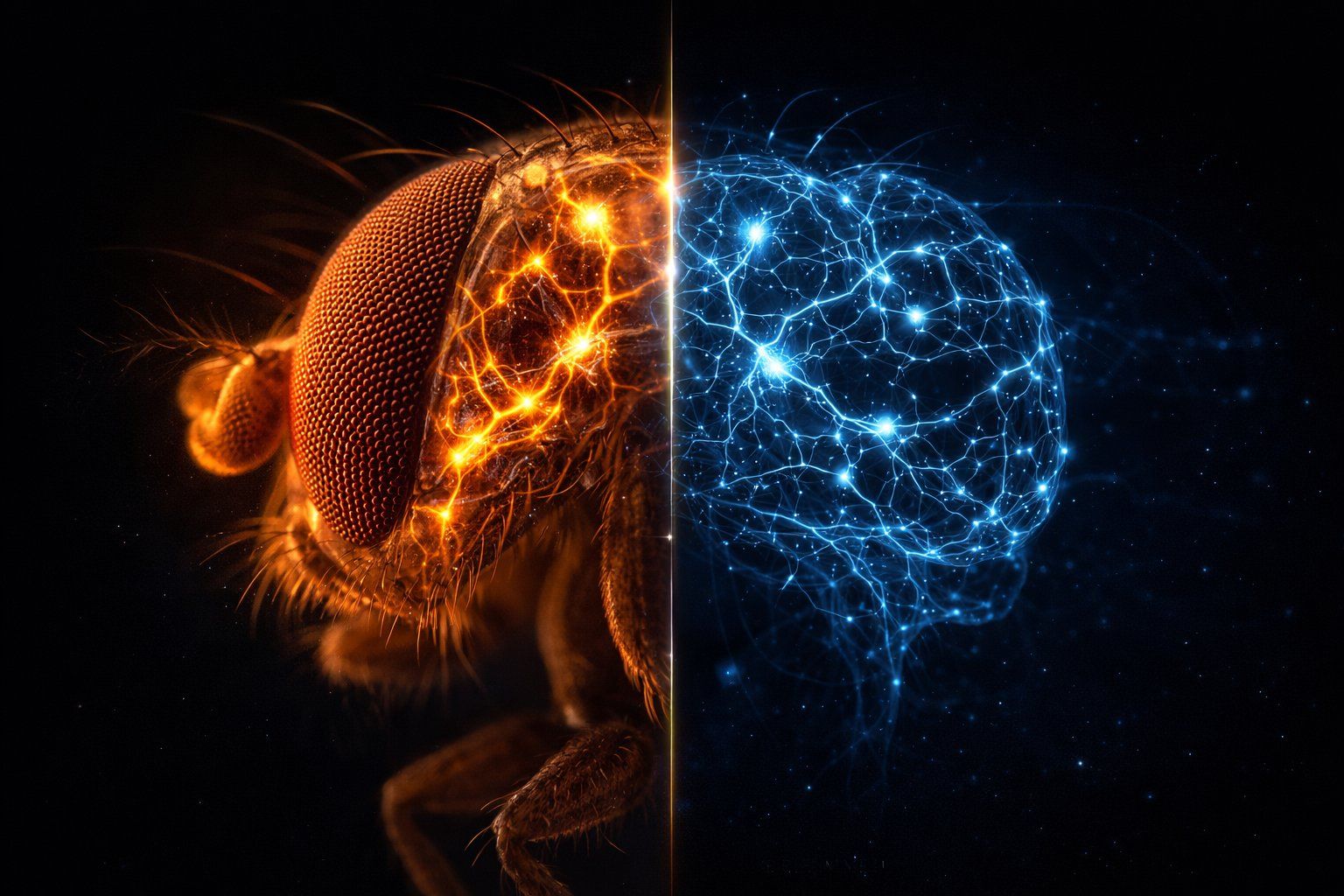
Whole Brain Emulation Achieved: Scientists Run a Fruit Fly Brain in Simulation

by Shibasis Rath
March 9, 2026
0

Scientists have copied an entire biological brain neuron by neuron and synapse by synapse and made it control a simulated...

Male G-spot isnโ€™t where we thought it was

Male G-Spot Found: New Study Identifies Frenular Delta as Penisโ€™s Most Sensitive Area

by Staff Writer
April 27, 2026
0

The study found that human penile innervation develops in distinct fetal stages and shows region-specific patterns in adults, with the...

A personโ€™s hand feeds two Northern Bald Ibises with long red beaks and black feathers; the rare birds stand on rocky ground.

The Extraordinary Revival of the Northern Bald Ibis in Europe

by Shibasis Rath
July 7, 2025
0

Once migrating majestically over Europe, North Africa, and the Arabian Peninsula, it was the northern bald ibis (Geronticus eremita) whose...

EDITOR CHOICEโ€˜S

  • All
  • NEWS
  • SPOTLIGHTS
Recent Study Indicates Constant Praise May Actually Lower a Childโ€™s Academic Risk-Taking.

Recent Study Indicates Constant Praise May Actually Lower a Childโ€™s Academic Risk-Taking.

by Staff Writer
May 3, 2026
0

Recent studies on types of praise and children's academic motivation show that constantly praising a child's fixed traits, such as their intelligence...

SLC38A4 expression was confirmed by western blot in multiple tumor cell lines. In mouse models, liver tissue imaging (H&E staining) showed that overexpression of SLC38A4 reduced metastatic tumor areas, while knockdown increased them across Hepa1-6, MC38, and B16F10 cells. Results were consistent in both immunocompetent and nude mice, with statistically significant differences.

Scientists Find Molecule That Wipes Out Liver Cancer

by Shibasis Rath
May 2, 2026
0

Researchers investigated this question because metastasis causes most cancer deaths, and the liver is a frequent site of spread for...

Fossil Penguins From New Zealand Reveal Stages of the Birds’ Long Evolutionary History

Fossil Penguins From New Zealand Reveal Stages of the Birds’ Long Evolutionary History

by Shibasis Rath
May 1, 2026
0

The discovery of four new species of fossil penguins in New Zealand in 2025 sheds light on the long evolutionary...

Bluebuck antelope with silvery-blue coat and curved horns running across open South African grassland, representing extinct species targeted for de-extinction by scientists

Colossal Biosciences Announces De-Extinction of Bluebuck Antelope, 226 Years After Its Extinction

by Staff Writer
May 1, 2026
0

It has been 226 years since humans last saw a living bluebuck, an elegant antelope species native to South Africa...

ADVERTISEMENT

RathBiotaClan – RBC

RathBiotaClan – Connecting Research To Reality

Your trusted source for life science news, biology research & discoveries. Covering neuroscience, genetics, ecology, and more โ€” connecting research to reality.

Privacy Policies

Shipping Policy

Cancellation & Refund Policy

Pricing Details

Contact Us

Latest Posts

  • Recent Study Indicates Constant Praise May Actually Lower a Childโ€™s Academic Risk-Taking.
  • Scientists Find Molecule That Wipes Out Liver Cancer
  • Fossil Penguins From New Zealand Reveal Stages of the Birds’ Long Evolutionary History
  • Colossal Biosciences Announces De-Extinction of Bluebuck Antelope, 226 Years After Its Extinction

SHIBASIS RATH

Contact Mail

rathbiotaclan@gmail.com

No Result
View All Result
MSME (Udyam) Certified Science Platform
Govt. of India

Get Us On PlayStore

playstore app for rathbiotaclan
  • About Us
  • Advertise With Us
  • Cancellation and Refund Policy
  • Contact Us
  • Contribute
  • Editorial Standards
  • Home
  • Pricing Details
  • Privacy Policies
  • Shipping Policy
  • Terms & Conditions

ยฉ 2026 RathBiotaClan. All rights reserved.

Welcome Back!

Sign In with Google
OR

Login to your account below

Forgotten Password? Sign Up

Create New Account!

Sign Up with Google
OR

Fill the forms below to register

*By registering into our website, you agree to the Terms & Conditions and Privacy Policy.
All fields are required. Log In

Retrieve your password

Please enter your username or email address to reset your password.

Log In
No Result
View All Result
  • HOME
  • HEALTH SCIENCE
  • NEUROSCIENCE
    • PHYSIOLOGY
    • IMMUNOLOGY
    • CANCER
  • DISCOVERIES
    • SPOTLIGHTS
    • STUDENT PORTAL
    • SCIENCE FEATURED
  • MOLECULAR BIOLOGY
    • GENETICS
    • BIOTECHNOLOGY
    • BIOINFORMATICS
    • BIOCHEMISTRY
    • BIOPHYSICS
  • ZOOLOGY & ECOLOGY
    • ENVIRONMENTAL SCIENCE
    • ECOLOGY
    • EVOLUTION
  • MICRO & PLANT SCIENCE
    • MICROBIOLOGY
    • CELL BIOLOGY
    • DEVELOPMENTAL BIOLOGY
  • PSYCHOLOGY
  • Login
  • Sign Up
SAVED POSTS

ยฉ 2026 RathBiotaClan. All rights reserved.

This website uses cookies. By continuing to use this website you are giving consent to cookies being used. Visit our Privacy and Cookie Policy.
Are you sure want to unlock this post?
Unlock left : 0
Are you sure want to cancel subscription?