



Thursday, June 18, 2026
SAVED POSTS
  • Login
  • Register
RathBiotaClan
No Result
View All Result
  • HOME
  • HEALTH SCIENCE

    TRENDING ON HEALTH (TOP)

    For People Antidepressants Never Helped, a 30-Minute Home Session Is Now FDA-Approved

    Scientists Say Your Next Tube of Toothpaste Could Be Made From Human Hair

    Your Lungs, Liver, and Pancreas Also Age Faster When You Sleep Wrong

    Cycling Linked to Lower Dementia Risk in Study of Nearly 480,000 Adults

    NOW ON AIR (RBC)

    NEUROSCIENCE

    Step-Synchronized Brain Stimulation Reduces Falls in Small Parkinson’s Trial

    June 16, 2026
    NEWS

    A Father’s Touch in Infancy Can Shape a Child’s Health for Years, New Science Explains Why

    June 9, 2026
    MutExpress
    BIOINFORMATICS

    South Asian Patients Have Been Left Out of Cancer Genomics for Decades & MutExpress-India Is Changing That

    June 8, 2026
    Biodiversity Loss
    ECOLOGY

    Biodiversity Loss Could Bankrupt Nations And Wall Street Hasn’t Noticed Yet

    June 5, 2026
  • NEUROSCIENCE
    • PHYSIOLOGY
    • IMMUNOLOGY
    • CANCER
  • DISCOVERIES
    • SPOTLIGHTS
    • STUDENT PORTAL
    • SCIENCE FEATURED
  • MOLECULAR BIOLOGY
    • GENETICS
    • BIOTECHNOLOGY
    • BIOINFORMATICS
    • BIOCHEMISTRY
    • BIOPHYSICS
  • ZOOLOGY & ECOLOGY
    • ENVIRONMENTAL SCIENCE
    • ECOLOGY
    • EVOLUTION
  • MICRO & PLANT SCIENCE
    • MICROBIOLOGY
    • CELL BIOLOGY
    • DEVELOPMENTAL BIOLOGY
  • PSYCHOLOGY
RathBiotaClan
RathBiotaClan
No Result
View All Result
Home PHYSIOLOGY

Mechanism Of Urine Formation

Shibasis Rath by Shibasis Rath
June 12, 2024
in PHYSIOLOGY, STUDENT PORTAL, ZOOLOGY
Reading Time: 7 mins read
0
A A
0

Glomerular Filtration

Glomerular filtration is the first step in urine formation, where blood plasma is filtered through the kidneysโ€™ glomeruli. The resulting fluid, called glomerular filtrate, enters the capsular space. Typically, about 16โ€“20% of the plasma in the afferent arterioles becomes glomerular filtrate, a value known as the filtration fraction. On average, females produce about 150 liters of filtrate daily, while males produce approximately 180 liters. Remarkably, over 99% of this filtrate is reabsorbed back into the bloodstream, and only 1โ€“2 liters are ultimately excreted as urine.

Filtration Membrane
The filtration process occurs through a specialized structure known as the filtration membrane, composed of glomerular endothelial cells and podocytes. This membrane forms a highly permeable but selective barrier that allows water and small solutes to pass while restricting plasma proteins, blood cells, and platelets. It consists of three main layers: the glomerular endothelial cells, the basal lamina, and the filtration slits between podocyte pedicels.

Glomerular endothelial cells possess large pores (0.07โ€“0.1 ยตm), which permit solutes to pass but retain blood cells and platelets. Among these cells are mesangial cells, which regulate filtration surface area. The basal lamina, a collagen and proteoglycan-rich layer, lies between the endothelium and podocytes, further restricting large proteins. The podocyte pedicels form thousands of filtration slits covered by slit membranes, allowing only molecules smaller than 0.006โ€“0.007 ยตm, such as water, glucose, and ions, to pass through. Albumin and similar large proteins are almost entirely retained.

Principle of Filtration
Filtration in the glomerulus relies on pressure to drive fluids and solutes across the membrane, operating more extensively than typical capillary filtration in other tissues. This higher filtration volume results from three factors: a large surface area of glomerular capillaries, a thin and highly permeable filtration membrane (~0.1 ยตm thick), and elevated blood pressure in the glomerular capillaries, due to a narrower efferent arteriole compared to the afferent arteriole.

ADVERTISEMENT

Net Filtration Pressure (NFP)
NFP is determined by the balance of pressures across the filtration membrane: the glomerular blood hydrostatic pressure (GBHP), which promotes filtration (around 55 mmHg), and two opposing pressuresโ€”capsular hydrostatic pressure (CHP) at ~15 mmHg and blood colloid osmotic pressure (BCOP) at ~30 mmHg. The NFP is calculated as:

READ ALSO

Human-generated electromagnetic noise has long lasting effects on light orientation in bats

Critically Endangered Blue Tarantula Surveyed in Indiaโ€™s Largest Tiger Reserve

NFP = GBHP โ€“ (CHP + BCOP) = 55 โ€“ (15 + 30) = 10 mmHg,
which drives the filtration process.

ADVERTISEMENT

Glomerular Filtration Rate (GFR)
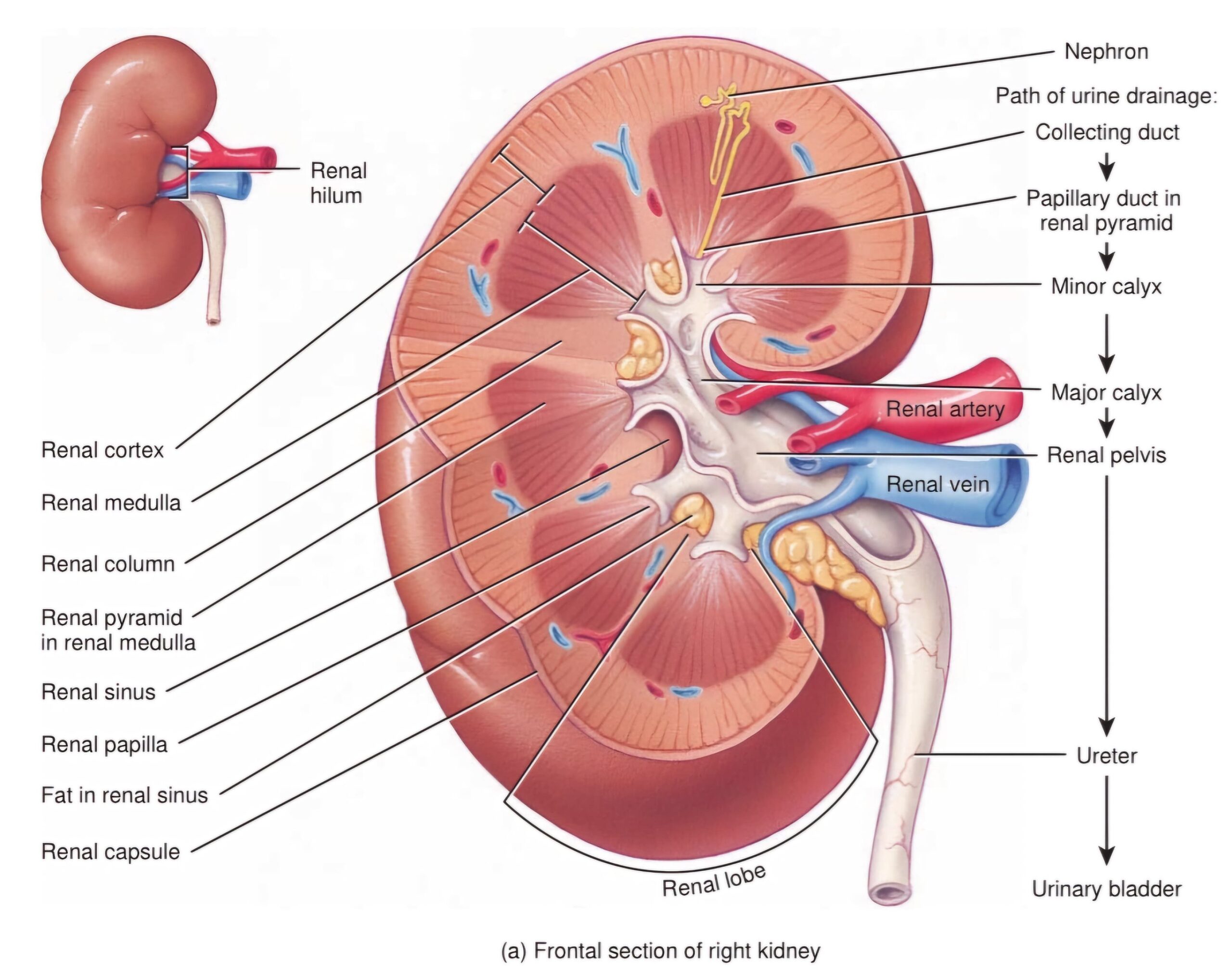
The GFR is the rate at which filtrate is formed by all renal corpuscles per minute. It averages about 125 mL/min in males and 105 mL/min in females. Maintaining GFR within a narrow range is essential for the regulation of fluid and electrolyte balance and efficient waste removal.

ADVERTISEMENT

Regulation of GFR
GFR is regulated by several mechanisms:

  1. Renal Autoregulation maintains consistent renal blood flow and GFR despite fluctuations in systemic blood pressure. It includes:
    • Myogenic mechanism: where afferent arteriole smooth muscle contracts in response to stretching.
    • Tubuloglomerular feedback: where the macula densa detects Naโบ, Clโป, and water levels to adjust arteriole tone.
  2. Neural Regulation involves sympathetic nervous input. Moderate stimulation causes equal vasoconstriction of afferent and efferent arterioles, slightly reducing GFR. In contrast, intense stimulation primarily constricts afferent arterioles, drastically reducing GFR to conserve blood volume during stress.
  3. Hormonal Regulation includes:
    • Angiotensin II, which constricts both arterioles and reduces GFR.
    • Atrial natriuretic peptide (ANP), which increases GFR by relaxing mesangial cells and expanding the filtration surface.

Reabsorption Routes and Transport Mechanisms
Filtered substances are reabsorbed via two main routes:

  • Paracellular reabsorption, where fluids pass between tubule cells, accounts for up to 50% of ion and water reabsorption.
  • Transcellular reabsorption, where substances pass through the tubule cell membranes into interstitial fluid.

Tight junctions between tubular cells help regulate the movement of substances. Solutes are transported directionally by different proteins in apical and basolateral membranes. Sodium reabsorption is vital and driven by sodium-potassium ATPase pumps on basolateral membranes. These pumps consume approximately 6% of the body’s ATP at rest.

Reabsorption occurs through:

  • Primary active transport, using ATP directly (e.g., Naโบ/Kโบ pump),
  • Secondary active transport, utilizing ion gradients:
    • Symporters move substances in the same direction.
    • Antiporters move them in opposite directions.

Water Reabsorption is osmotic, driven by solute movement:

  • Obligatory reabsorption (90%) occurs in the proximal convoluted tubule (PCT) and descending loop of Henle.
  • Facultative reabsorption (10%) occurs in collecting ducts and is regulated by ADH.

Reabsorption and Secretion in the Proximal Convoluted Tubule (PCT)
The PCT reabsorbs:

  • 65% of water, Naโบ, and Kโบ,
  • 100% of glucose and amino acids,
  • 50% of Clโป,
  • 80โ€“90% of HCOโ‚ƒโป,
  • 50% of urea, plus variable amounts of Caยฒโบ, Mgยฒโบ, and HPOโ‚„ยฒโป.

The PCT also secretes Hโบ, NHโ‚„โบ, and urea. Naโบ is reabsorbed via symporters and antiporters, including the Naโบ-glucose symporter. Naโบ/Hโบ antiporters play a key role in acid-base balance, as intracellular COโ‚‚ reacts with water to form Hโบ and HCOโ‚ƒโป (via carbonic anhydrase). HCOโ‚ƒโป is reabsorbed to maintain buffering capacity.

Solute reabsorption increases osmolarity, drawing water into peritubular capillaries through aquaporin-1. Electrochemical gradients aid in passive reabsorption of ions like Clโป, Kโบ, Caยฒโบ, and urea.

Ammonia and Urea Handling
Ammonia, produced by amino acid metabolism in the liver, is converted to urea and secreted by the PCT. Additional NHโ‚ƒ is formed from glutamine, producing NHโ‚„โบ and HCOโ‚ƒโป, aiding acid-base balance.

Reabsorption in the Loop of Henle
As fluid enters the loop at 40โ€“45 mL/min, it lacks glucose and amino acids. Reabsorption rates include 15% of water, 20โ€“30% of Naโบ and Kโบ, 35% of Clโป, and 10โ€“20% of HCOโ‚ƒโป.

The thick ascending limb actively reabsorbs ions via Naโบโ€“Kโบโ€“2Clโป symporters but is impermeable to water. Kโบ leaks back into tubular fluid, creating a gradient that facilitates reabsorption of cations via the paracellular route.

The descending limb is water-permeable, while the ascending limb is not, allowing osmolarity regulation independent of solute concentration.

Hormonal Regulation of Tubular Reabsorption and Secretion
Several hormones tightly regulate renal function:

  • Angiotensin II: Reduces GFR and enhances Naโบ, Clโป, and water reabsorption.
  • Aldosterone: Promotes Naโบ and Clโป reabsorption and Kโบ secretion, increasing blood volume.
  • ADH: Increases water permeability in the distal tubules and collecting ducts, reducing urine output.
  • ANP: Inhibits Naโบ and water reabsorption, increases urine output, and reduces blood volume.
  • PTH: Stimulates Caยฒโบ reabsorption and inhibits phosphate reabsorption.

Production of Dilute and Concentrated Urine
The kidneys adjust urine concentration based on fluid intake and ADH levels.

In dilute urine formation, filtrate begins isotonic, but as it descends the loop of Henle, water is reabsorbed. In the thick ascending limb, solutes are reabsorbed without water, diluting the fluid. Without ADH, collecting ducts remain impermeable to water, and urine can become as dilute as 65โ€“70 mOsm/L.

In concentrated urine formation, high ADH levels increase water reabsorption. An osmotic gradient, maintained by Naโบ, Clโป, and urea, spans from 300 mOsm/L in the cortex to 1200 mOsm/L in the medulla. Countercurrent mechanisms, including multiplication in the loop of Henle and exchange in the vasa recta, help maintain this gradient and concentrate the urine efficiently.
  • Share on WhatsApp (Opens in new window) WhatsApp
  • Share on Facebook (Opens in new window) Facebook
  • Share on Reddit (Opens in new window) Reddit
  • Share on X (Opens in new window) X
  • Print (Opens in new window) Print
Shibasis Rath

Shibasis Rath

"๐“’๐“ธ๐“ท๐“ท๐“ฎ๐“ฌ๐“ฝ๐“ฒ๐“ท๐“ฐ ๐“ก๐“ฎ๐“ผ๐“ฎ๐“ช๐“ป๐“ฌ๐“ฑ ๐“ฃ๐“ธ ๐“ก๐“ฎ๐“ช๐“ต๐“ฒ๐“ฝ๐”‚" ๐“ฒ๐“ผ๐“ท'๐“ฝ ๐“™๐“พ๐“ผ๐“ฝ ๐“ช ๐“œ๐“ธ๐“ฝ๐“ฝ๐“ธ - ๐“˜๐“ฝ'๐“ผ ๐“œ๐”‚ ๐“œ๐“ฒ๐“ผ๐“ผ๐“ฒ๐“ธ๐“ท

Related Posts

Soprano pipistrelle (Pipistrellus pygmaeus) emerging from a tree hollow at the moment of take-off.
ECOLOGY

Human-generated electromagnetic noise has long lasting effects on light orientation in bats

June 4, 2026
Rare Peacock Tarantula Image
NEWS

Critically Endangered Blue Tarantula Surveyed in Indiaโ€™s Largest Tiger Reserve

April 30, 2026
Cannibal killer whales in Russian waters
ECOLOGY

Scientists spot signs of cannibal killer whales in Russian waters

April 30, 2026

POPULAR NEWS

Chewing gum releases thousands of microplastic particles directly into your mouth with every piece you chew

Chewing gum releases thousands of microplastic particles directly into your mouth with every piece you chew

by Shibasis Rath
May 8, 2026
0

Microplastics are turning up in places researchers never expected: deep-sea sediments, Arctic ice, and human blood. Now, a UCLA pilot...

New Studys Says Gen Z is the least sexually active young cohort in modern recorded history

New Studys Says Gen Z is the least sexually active young cohort in modern recorded history

by Shibasis Rath
January 24, 2026
0

A generation that grew up with dating apps in their pockets, pornography a tap away, and sex discussed more openly...

Yelling Isnโ€™t Just Yelling: How a Hostile Home Rewires a Childโ€™s Brain for Constant Alert

Yelling Isnโ€™t Just Yelling: How a Hostile Home Rewires a Childโ€™s Brain for Constant Alert

by Shibasis Rath
March 8, 2026
0

To a parent in the heat of the moment, a raised voice may feel like simple frustration. To a child...

a group of gen Z kids walking down a street

Is Gen Z the First Generation Less Intelligent Than Their Parents?

by Shibasis Rath
February 5, 2026
0

Gen Z intelligence decline is emerging as a serious concern among neuroscientists and education researchers. For over a century, each...

Whole Brain Emulation Achieved: Scientists Run a Fruit Fly Brain in Simulation

by Shibasis Rath
March 9, 2026
0

Scientists have copied an entire biological brain neuron by neuron and synapse by synapse and made it control a simulated...

EDITOR CHOICEโ€˜S

  • All
  • NEWS
  • SPOTLIGHTS
Step-Synchronized Brain Stimulation Reduces Falls in Small Parkinson’s Trial

Step-Synchronized Brain Stimulation Reduces Falls in Small Parkinson’s Trial

by Staff Writer
June 16, 2026
0

Researchers have reported encouraging results from a small feasibility study testing a new form of adaptive deep brain stimulation (aDBS)...

A Father’s Touch in Infancy Can Shape a Child’s Health for Years, New Science Explains Why

A Father’s Touch in Infancy Can Shape a Child’s Health for Years, New Science Explains Why

by Staff Writer
June 9, 2026
0

A study from Penn State University has revealed something startling beneath that simplicity those early interactions carry biological consequences that...

MutExpress

South Asian Patients Have Been Left Out of Cancer Genomics for Decades & MutExpress-India Is Changing That

by Staff Writer
June 8, 2026
0

The databases that underpin modern cancer genomics have a geography problem. The gnomAD database the gold standard for allele frequency...

Biodiversity Loss

Biodiversity Loss Could Bankrupt Nations And Wall Street Hasn’t Noticed Yet

by Staff Writer
June 5, 2026
0

Every year, governments borrow trillions of dollars to function. The interest rate they pay depends almost entirely on their credit...

ADVERTISEMENT

RathBiotaClan – RBC

RathBiotaClan – Connecting Research To Reality

Your trusted source for life science news, biology research & discoveries. Covering neuroscience, genetics, ecology, and more โ€” connecting research to reality.

About Us

Privacy Policies

Contact Us

Editorial Standard

Latest Posts

  • Step-Synchronized Brain Stimulation Reduces Falls in Small Parkinson’s Trial
  • A Father’s Touch in Infancy Can Shape a Child’s Health for Years, New Science Explains Why
  • South Asian Patients Have Been Left Out of Cancer Genomics for Decades & MutExpress-India Is Changing That
  • Biodiversity Loss Could Bankrupt Nations And Wall Street Hasn’t Noticed Yet

SHIBASIS RATH

Contact Mail

rathbiotaclan@gmail.com

No Result
View All Result
MSME (Udyam) Certified Science Platform
Govt. of India

Get Us On PlayStore

playstore app for rathbiotaclan
  • About Us
  • Advertise With Us
  • Cancellation and Refund Policy
  • Contact Us
  • Contribute
  • Editorial Standards
  • Home
  • Pricing Details
  • Privacy Policies
  • Shipping Policy
  • Terms & Conditions

ยฉ 2026 RathBiotaClan. All rights reserved.

Welcome Back!

Sign In with Google
OR

Login to your account below

Forgotten Password? Sign Up

Create New Account!

Sign Up with Google
OR

Fill the forms below to register

*By registering into our website, you agree to the Terms & Conditions and Privacy Policy.
All fields are required. Log In

Retrieve your password

Please enter your username or email address to reset your password.

Log In

Add New Playlist

No Result
View All Result
  • HOME
  • HEALTH SCIENCE
  • NEUROSCIENCE
    • PHYSIOLOGY
    • IMMUNOLOGY
    • CANCER
  • DISCOVERIES
    • SPOTLIGHTS
    • STUDENT PORTAL
    • SCIENCE FEATURED
  • MOLECULAR BIOLOGY
    • GENETICS
    • BIOTECHNOLOGY
    • BIOINFORMATICS
    • BIOCHEMISTRY
    • BIOPHYSICS
  • ZOOLOGY & ECOLOGY
    • ENVIRONMENTAL SCIENCE
    • ECOLOGY
    • EVOLUTION
  • MICRO & PLANT SCIENCE
    • MICROBIOLOGY
    • CELL BIOLOGY
    • DEVELOPMENTAL BIOLOGY
  • PSYCHOLOGY
  • Login
  • Sign Up
SAVED POSTS

ยฉ 2026 RathBiotaClan. All rights reserved.

This website uses cookies. By continuing to use this website you are giving consent to cookies being used. Visit our Privacy and Cookie Policy.