





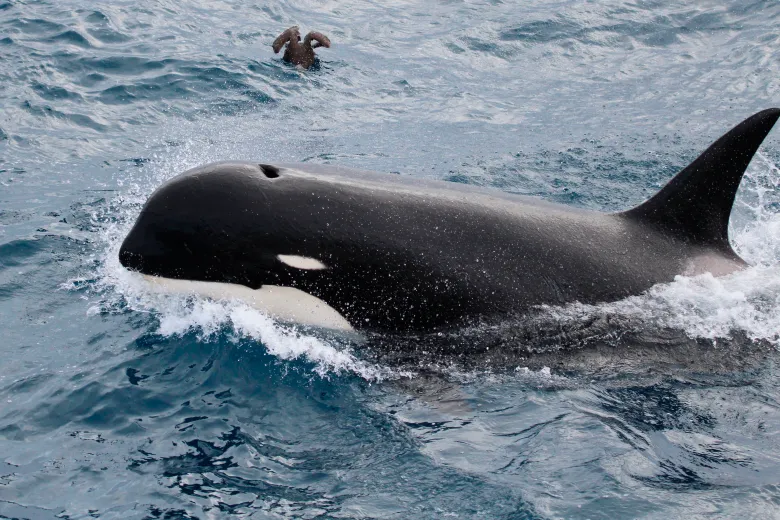
A new study presents physical evidence that mammal-eating killer whales may be preying on fish-eating killer whales in the North Pacific, and proposes this predation pressure could help explain the unusually tight social bonds of resident orca populations.
Killer whales in the North Pacific come in two fundamentally different varieties. Resident orcas eat fish, live in large multigenerational family groups, and are known for one of the most stable social structures of any non-human mammal offspring of both sexes remain with their mothers for life. Bigg’s orcas (also called transients) hunt other marine mammals, travel in smaller groups, and behave differently enough that many researchers have long argued the two should be considered separate species entirely. They occupy the same waters, yet do not socialize or interbreed. As of 2024, they have been formally reclassified as distinct subspecies: Orcinus orca ater (residents) and Orcinus orca rectipinnus (Bigg’s).
What is killer whale cannibalism?
Killer whale “cannibalism” refers to instances where one killer whale kills and eats another. Because all killer whales belong to a single species Orcinus orca such predation technically qualifies as cannibalism. However, researchers note that the two main North Pacific ecotypes, resident and Bigg’s orcas, behave so differently they likely do not recognise each other as the same animal.
What nobody had documented before, with physical evidence, was one type hunting and eating the other.
Bigg’s orcas are well-established hunters of large marine mammals, including minke whales and Baird’s beaked whales. Severed fins from those species, bearing killer whale tooth marks, have been found before on Bering Island beaches which is precisely why field researcher Sergey Fomin recognized the pattern when he found something unexpected. Resident orcas, for their part, were largely thought to be avoided rather than targeted by Bigg’s orcas. The two types have been observed keeping distance from each other in the wild. Prior explanations for the resident orca’s unusually cohesive social structure focused primarily on foraging efficiency and the benefits of kinship networks.
In July 2022, Fomin found a severed dorsal fin on a beach on Bering Island, a remote Russian island off the Kamchatka Peninsula in the western North Pacific. The fin was bloodied and covered with tooth marks consistent with those made by another killer whale. In July 2024, he found a second fin approximately two kilometres from the first location. That fin was somewhat larger and came from a young male.
Genetic analysis was performed on tissue from both fins. The results confirmed that both animals were resident orcas. The researchers then examined the tooth mark patterns. The spacing and morphology of the marks were consistent with those made by Bigg’s orcas rather than residents. The researchers also noted that the fins had been severed rather than simply bitten: this is consistent with how Bigg’s orcas typically feed on large prey, removing low-calorie appendages like fins to access the energy-dense muscle and blubber beneath. The fins are then discarded.
Fomin also documented that a large gathering of resident killer whale families the kind that occurs when unrelated individuals come together to find mates had taken place in the same area just days before the second fin was found.
The paper’s authors are Olga A. Filatova of the University of Southern Denmark, Ivan D. Fedutin, and Sergey V. Fomin.
The genetic data established that both fins came from resident orcas. The physical characteristics of the tooth marks and the pattern of fin removal led the researchers to conclude that Bigg’s orcas were the most likely perpetrators, though the attacks were not directly observed. Both fins came from young animals. Filatova noted that the fins of large prey animals are routinely discarded by Bigg’s orcas, making their presence on a beach a recognisable signature of a predation event. “If it was just aggression,” she said, “they wouldn’t bother to tear off the fin.”
The proximity of a resident gathering to the second find is consistent with the researchers’ proposed mechanism: during these mating assemblies, which can span several kilometres, juveniles may become separated from the adults in their family group.
“I think this is the easiest way for mammal-eaters to attack the young ones, just because everybody else is busy,”
Filatova said.
The researchers argue that the two finds represent rare direct evidence of lethal predation between the two subspecies what is technically classified as cannibalism, since both belong to the same species under current taxonomy, Orcinus orca. Filatova was explicit, however, that the label may not reflect the biological reality. “They almost certainly do not perceive themselves as belonging to the same species. For the transient groups, the resident killer whales are simply prey,” she said in a statement accompanying the paper’s release.
The paper’s broader argument goes further: that ongoing predation pressure from Bigg’s orcas may be a significant driver of the resident orca’s distinctive social structure — specifically, the lifelong bonds between family members and the fact that individuals almost never permanently leave their natal group. In ecosystems where such predation pressure does not exist, the researchers note, killer whale populations tend to have more flexible social arrangements. The paper describes this as a potential example of how predator prey dynamics can shape complex social behaviour in marine mammals. “So, it looks like this defense strategy is really working,” Filatova told Live Science.
The researchers also situate the findings within the ongoing debate about killer whale taxonomy. “We are witnessing an evolutionary process: these two groups, which never mix, are becoming increasingly distinct,” Filatova said.
The study is based on two specimens. The attacks themselves were not witnessed, and the identity of the perpetrators while strongly inferred from the morphology of the tooth marks and the known behaviour of Bigg’s orcas in the region was not directly confirmed. The researchers acknowledge that reports of this kind of predation are “exceptionally rare,” and Filatova noted that she believes it is “not super common.” The proposed link between predation pressure and the evolution of resident orca social structure is a hypothesis supported by the physical evidence and comparative patterns across killer whale populations, but it was not experimentally tested in this study. The sample is too small to support claims about frequency or population-level impact.
Reference
Filatova, O. A., Fedutin, I. D., & Fomin, S. V. (2026). Predation by Mammal-Eating Bigg’s Killer Whales (Orcinus orca rectipinnus) May Shape the Unique Social Structure of “Resident” Fish-Eating Killer Whales (O. o. ater) in the North Pacific. Marine Mammal Science, 42(2). https://doi.org/10.1111/mms.70142