

Friday, July 17, 2026
SAVED POSTS
  • Login
  • Register
RathBiotaClan
No Result
View All Result
  • HOME
  • HEALTH SCIENCE

    TRENDING ON HEALTH (TOP)

    Fick Method Underestimates Heart Problems in Children After Heart Transplant, Study Finds

    For Women on Antidepressants, Creatine Showed a Possible Extra Boost

    Did the iPhone Quietly Reshape When and Whether Americans Have Children?

    For People Antidepressants Never Helped, a 30-Minute Home Session Is Now FDA-Approved

    NOW ON AIR (RBC)

    The parsimony criterion
    BIOINFORMATICS

    The Parsimony Criterion in Phylogenetics: Morphological & Molecular Methods

    July 15, 2026
    maximum-likelihood-criterion
    BIOINFORMATICS

    Maximum Likelihood Criterion in Phylogenetic Tree Reconstruction

    July 15, 2026
    Tree Optimization Criteria and Search Methods in Phylogenetics – NNI, SPR, TBR Explained
    BIOINFORMATICS

    Tree Optimization Criteria and Tree Search Methods in Phylogenetics

    July 15, 2026
    Bootstrapping in Phylogenetics
    BIOINFORMATICS

    Bootstrapping in Phylogenetics – Tree Reliability, Resampling & Bootstrap Values

    July 15, 2026
  • NEUROSCIENCE
    • PHYSIOLOGY
    • IMMUNOLOGY
    • CANCER
  • DISCOVERIES
    • SPOTLIGHTS
    • STUDENT PORTAL
    • SCIENCE FEATURED
  • MOLECULAR BIOLOGY
    • GENETICS
    • BIOTECHNOLOGY
    • BIOINFORMATICS
    • BIOCHEMISTRY
    • BIOPHYSICS
  • ZOOLOGY & ECOLOGY
    • ENVIRONMENTAL SCIENCE
    • ECOLOGY
    • EVOLUTION
  • MICRO & PLANT SCIENCE
    • MICROBIOLOGY
    • CELL BIOLOGY
    • DEVELOPMENTAL BIOLOGY
  • PSYCHOLOGY
RathBiotaClan
RathBiotaClan
No Result
View All Result
Home GENETICS

The Y Chromosome: Why Some Scientists Think It Might Go Extinct

Shibasis Rath by Shibasis Rath
March 20, 2025
in GENETICS, NEWS
Reading Time: 5 mins read
0
A A
1
y chromosome

Over millions of years, the human Y chromosome, which decides if you’re male, has been losing stuff. It’s often called the Y chromosome crisis because this thing just keeps on recurring. Kind of like fish that can’t swim uphill but the Y chromosomes fight hard to improve themselves uphill. That worries some because it could really mess up having babies and even the future of men. Even though our Y chromosome is getting smaller a little bit over the generations, that has pretty complicated implications about how we change with time and how diverse our genes get. Looking at reproduction and how it works becomes a bit muddled. Even a neat thing like chromosomes goes funny when stuff gets small.

So, what’s the Y chromosome? It’s one of the two chromosomes that decide your sex; the other is the X chromosome.

Guys usually have one X and one Y, making them develop male traits, while girls have two Xs. The Y chromosome has a gene called SRY that kicks off the process of making testicles and male hormones like testosterone. But, the Y chromosome is way smaller than the X chromosome and doesn’t have as many genes. It only has about 45 genes that code for proteins, while the X chromosome has over 1,000.

Decline of the Y Chromosome through Evolution

It would always have such restricted size or function on the Y chromosome. Some 300 million years ago, the ancestors of mammals had two similar, so-called homologous, chromosomes. These gradually evolved into the distinct X and Y chromosomes. In that process, however, the Y chromosome suffered extensive genetic decay, shaving hundreds of functional genes as its role became specialized in male development.

ADVERTISEMENT

The degradation of the Y chromosome is due to genetic recombination, where, in the process of reproduction, exchange of genetic material between chromosomes occurs. It serves as a repair mechanism for damaged DNA and prevents the accumulation of mutations. The Y chromosome, on the other hand, undergoes recombination along only a tiny region of its length. It remains insulated and, over time, loses genetics that are not essential for the survival of the element.

READ ALSO

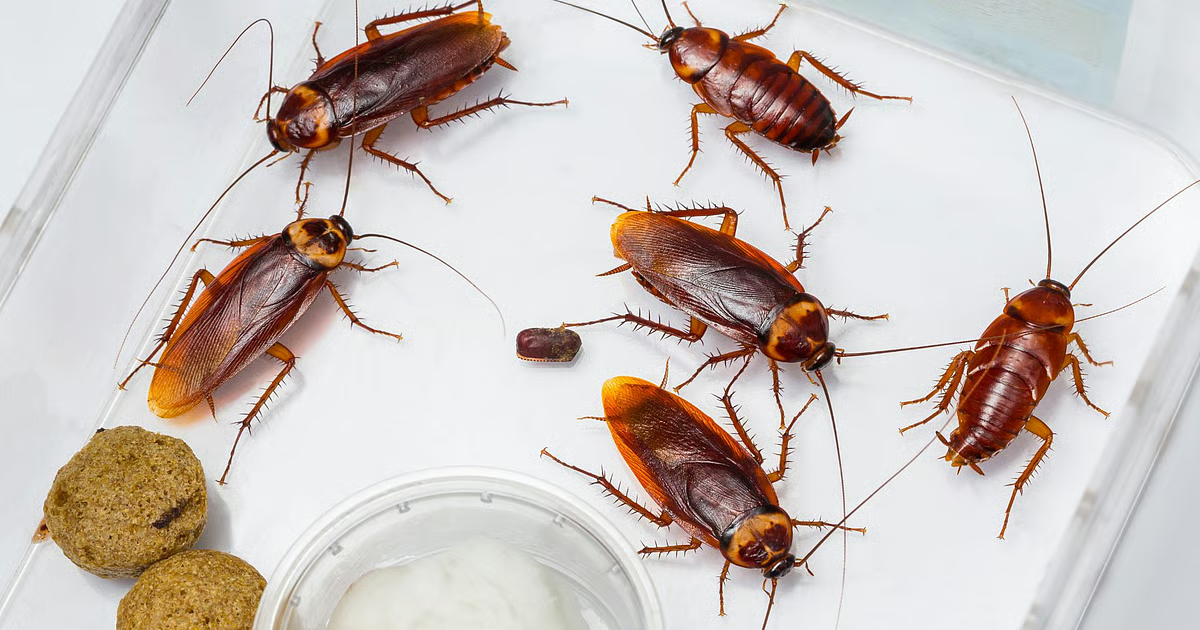
Scientists say cockroach milk is 3x more nutritious than human breast milk

Negotiating with women builds more trust, even in anonymous online chats, Study finds

At the heart of this process is the genetic degeneration of genes. Not being capable of recombination, mutations accumulate and redundant genes are often entirely lost. The process of shrinkage has been ongoing for many millions of years, with the modern Y chromosome carrying only a small number of genes compared to what it did in ancestral times.

ADVERTISEMENT

Key Genes and Functions

Yet, this small chromosome contains some very important genes linked with reproduction and survival in males. One such gene is the SRY gene, which is responsible for sex determination due to its role in the initiation of testicular development in the embryo. Another highly important gene is DAZ, with implication in spermatogenesis, thus directly affecting male fertility.

ADVERTISEMENT

However, many of the genes that once existed on the Y chromosome have either become redundant or taken over by genes on the X chromosome. Fears were then raised that the Y chromosome might one day disappear with its ongoing loss of genetic material.

Will the Y Chromosome Disappear ?

KICKPOINT

It is one of the hottest topics: whether the Y chromosome is on a path to disappearance.

According to some scientists’ predictions, the Y chromosome might disappear in the next 4.6 million years, provided it continues degrading at this rate. On the other hand, some other experts say that for now, the decline in the Y chromosome has stabilized and it may last much longer than previously predicted.

Research on some rodent species, such as spiny rats, sheds light on this question. In some populations, spiny rats have completely lost their Y chromosome; males are still living and reproducing among the population, and other mechanisms of sex determination become employed by the genome. This is because male development and reproduction could actually unfold even if the human Y chromosome were to disappear, as had been romantically posited-just through another pathway that would evolve.

The Role of Palindromes and Genetic Stability

While the Y chromosome is subject to genetic decay, it has developed strategies by which its genes are safeguarded.

The genes safeguard themselves via a process called palindromic sequences in which segments of DNA read exactly the same forwards and backwards. The palindromes facilitate the Y chromosome repairing damage by folding over and allowing one arm to copy the intact genetic sequence from the other. This strange self-repairing method has probably slowed down the process of degeneration and fixed essential genes.

Regions such as the AZF, or Azoospermia Factor, on the contrary, are highly palindromic and are crucial to avert male sterility by maintaining spermatozoa production. The structural intricacy in that respect indicates the resilience of the Y chromosome, considering its overall decay.

Implications for Human Fertility and Evolution

The shrinking Y chromosome certainly does raise some interesting questions concerning the future of human reproduction and evolution. For instance, suppose the Y chromosome disappeared completely.

What would be the effects on male development and fertility thereafter?

One possibility is that other chromosomes, X or autosomes, take over the functions currently performed by the Y chromosome. Alternatively, new genetic mechanisms could be developed by evolution in order to maintain the male sex-determining and reproductive functions.

Another factor to take into account is the impact on genetic diversity. The Y chromosome passes on from father to son. This implies that its decline might reduce genetic variation among the males, thereby lessening the diversity. This reduced diversity could impact disease susceptibility and overall health.

The Future of the Y Chromosome

This fact-the decline of the Y chromosome-is an interesting part of human evolution but is truly nothing to be really concerned about. Genetic mechanisms like palindromes and the evolution of alternative sex-determination systems would support that the human species can adapt to and is resilient against this problem. It is unlikely that the Y chromosome will completely disappear anytime soon, but even when that happens, human biology should find a way to compensate.

While science is continuing to explore intricacies of our genetic makeup, so does the future of the Y chromosome represent an open and exciting field of study. Whether it will survive or blur into evolutionary history, the Y chromosome will continue to play a formidable role in shaping biological differences between males and females for generations to come.
  • Share on WhatsApp (Opens in new window) WhatsApp
  • Share on Facebook (Opens in new window) Facebook
  • Share on Reddit (Opens in new window) Reddit
  • Share on X (Opens in new window) X
  • Print (Opens in new window) Print
Shibasis Rath

Shibasis Rath

"𝓒𝓸𝓷𝓷𝓮𝓬𝓽𝓲𝓷𝓰 𝓡𝓮𝓼𝓮𝓪𝓻𝓬𝓱 𝓣𝓸 𝓡𝓮𝓪𝓵𝓲𝓽𝔂" 𝓲𝓼𝓷'𝓽 𝓙𝓾𝓼𝓽 𝓪 𝓜𝓸𝓽𝓽𝓸 - 𝓘𝓽'𝓼 𝓜𝔂 𝓜𝓲𝓼𝓼𝓲𝓸𝓷

Related Posts

Scientists say cockroach milk is 3x more nutritious than human breast milk
NEWS

Scientists say cockroach milk is 3x more nutritious than human breast milk

July 12, 2026
Negotiating with women builds more trust, even in anonymous online chats, Study finds
NEWS

Negotiating with women builds more trust, even in anonymous online chats, Study finds

July 3, 2026
fick principle
HEALTH SCIENCE

Fick Method Underestimates Heart Problems in Children After Heart Transplant, Study Finds

July 2, 2026

POPULAR NEWS

Chewing gum releases thousands of microplastic particles directly into your mouth with every piece you chew

Chewing gum releases thousands of microplastic particles directly into your mouth with every piece you chew

by Shibasis Rath
May 8, 2026
0

Microplastics are turning up in places researchers never expected: deep-sea sediments, Arctic ice, and human blood. Now, a UCLA pilot...

grayscale photo of girl in polka dot long sleeve shirt

Yelling Isn’t Just Yelling: How a Hostile Home Rewires a Child’s Brain for Constant Alert

by Shibasis Rath
March 8, 2026
0

To a parent in the heat of the moment, a raised voice may feel like simple frustration. To a child...

72-Hour Fasting Can Reset Your Entire Immune System, USC Study Shows

72-Hour Fasting Can Reset Your Entire Immune System, USC Study Shows

by Shibasis Rath
February 28, 2026
0

A 72-hour fast can trigger a powerful immune system reset. Scientists call this stem cell regeneration. The process clears old...

woman in white tank top lying on bed

New Studys Says Gen Z is the least sexually active young cohort in modern recorded history

by Shibasis Rath
January 24, 2026
0

A generation that grew up with dating apps in their pockets, pornography a tap away, and sex discussed more openly...

a group of gen Z kids walking down a street

Is Gen Z the First Generation Less Intelligent Than Their Parents?

by Shibasis Rath
February 5, 2026
0

Gen Z intelligence decline is emerging as a serious concern among neuroscientists and education researchers. For over a century, each...

EDITOR CHOICE‘S

  • All
  • NEWS
  • SPOTLIGHTS
The parsimony criterion

The Parsimony Criterion in Phylogenetics: Morphological & Molecular Methods

by Shibasis Rath
July 15, 2026
0

The parsimony criterion is one of the oldest and most widely used methods of constructing phylogenetic trees, having its roots...

maximum-likelihood-criterion

Maximum Likelihood Criterion in Phylogenetic Tree Reconstruction

by Shibasis Rath
July 15, 2026
0

The maximum-likelihood (ML) criterion is one of the most important and statistically rigorous approaches used for phylogenetic tree reconstruction, first...

Tree Optimization Criteria and Search Methods in Phylogenetics – NNI, SPR, TBR Explained

Tree Optimization Criteria and Tree Search Methods in Phylogenetics

by Shibasis Rath
July 15, 2026
0

Distance-matrix clustering methods such as UPGMA and Neighbor-Joining construct a phylogenetic tree directly through a fixed, well-defined algorithm, without explicitly...

Bootstrapping in Phylogenetics

Bootstrapping in Phylogenetics – Tree Reliability, Resampling & Bootstrap Values

by Shibasis Rath
July 15, 2026
0

Bootstrapping is a statistical method used to assess the reliability of a phylogenetic tree, introduced by Felsenstein in 1985. Since...

ADVERTISEMENT

RathBiotaClan – RBC

RathBiotaClan – Connecting Research To Reality

Your trusted source for life science news, biology research & discoveries. Covering neuroscience, genetics, ecology, and more — connecting research to reality.

About Us

Privacy Policies

Contact Us

Editorial Standard

Latest Posts

  • The Parsimony Criterion in Phylogenetics: Morphological & Molecular Methods
  • Maximum Likelihood Criterion in Phylogenetic Tree Reconstruction
  • Tree Optimization Criteria and Tree Search Methods in Phylogenetics
  • Bootstrapping in Phylogenetics – Tree Reliability, Resampling & Bootstrap Values

SHIBASIS RATH

Contact Mail

rathbiotaclan@gmail.com

No Result
View All Result
MSME (Udyam) Certified Science Platform
Govt. of India

Get Us On PlayStore

playstore app for rathbiotaclan
  • About Us
  • Advertise With Us
  • Cancellation and Refund Policy
  • Contact Us
  • Contribute
  • Editorial Standards
  • Home
  • Pricing Details
  • Privacy Policies
  • Shipping Policy
  • Terms & Conditions

© 2026 RathBiotaClan. All rights reserved.

Welcome Back!

Sign In with Google
OR

Login to your account below

Forgotten Password? Sign Up

Create New Account!

Sign Up with Google
OR

Fill the forms below to register

*By registering into our website, you agree to the Terms & Conditions and Privacy Policy.
All fields are required. Log In

Retrieve your password

Please enter your username or email address to reset your password.

Log In

Add New Playlist

No Result
View All Result
  • HOME
  • HEALTH SCIENCE
  • NEUROSCIENCE
    • PHYSIOLOGY
    • IMMUNOLOGY
    • CANCER
  • DISCOVERIES
    • SPOTLIGHTS
    • STUDENT PORTAL
    • SCIENCE FEATURED
  • MOLECULAR BIOLOGY
    • GENETICS
    • BIOTECHNOLOGY
    • BIOINFORMATICS
    • BIOCHEMISTRY
    • BIOPHYSICS
  • ZOOLOGY & ECOLOGY
    • ENVIRONMENTAL SCIENCE
    • ECOLOGY
    • EVOLUTION
  • MICRO & PLANT SCIENCE
    • MICROBIOLOGY
    • CELL BIOLOGY
    • DEVELOPMENTAL BIOLOGY
  • PSYCHOLOGY
  • Login
  • Sign Up
SAVED POSTS

© 2026 RathBiotaClan. All rights reserved.

This website uses cookies. By continuing to use this website you are giving consent to cookies being used. Visit our Privacy and Cookie Policy.