




Japan’s summers have grown severe enough that the government recently coined new terminology just to describe days when temperatures climb past 40 degrees Celsius. The urgency isn’t abstract: in Tokyo alone, 48 people were hospitalized for heatstroke on July 15 this year. Construction crews, factory floor staff, warehouse handlers, and event workers can’t simply step into an air-conditioned office, so for them that heat is a daily occupational hazard rather than an inconvenience. This gap, between people who need relief and workplaces where central air conditioning isn’t practical, is what the Do Hiemon Box was built to fill and it arrives at a moment when extreme-heat days are becoming routine rather than rare across the country.
The booth looks like an oversized vending machine, and that’s not a coincidence. SDRS, the company that developed it, also manufactures refrigeration units and vending machines, and the unit is sold through the industrial equipment distributor Trusco Nakayama. Its design borrows directly from the refrigerated vending machines seen on nearly every street corner in Japan.
Step inside, and the chamber already holds an interior temperature of around 15 degrees Celsius. Sit down on the built-in chair, and the system directs air chilled to roughly 5 degrees Celsius toward the head, neck, shoulders, and back — the areas where cooling has the fastest effect on core body temperature. According to the manufacturer, users notice a cooling effect within about five minutes, and a 10-minute session can help relieve symptoms of heat exhaustion by lowering body temperature quickly. These are the company’s own claims rather than results from an independent clinical trial, so they should be read as manufacturer specifications, not medical findings.
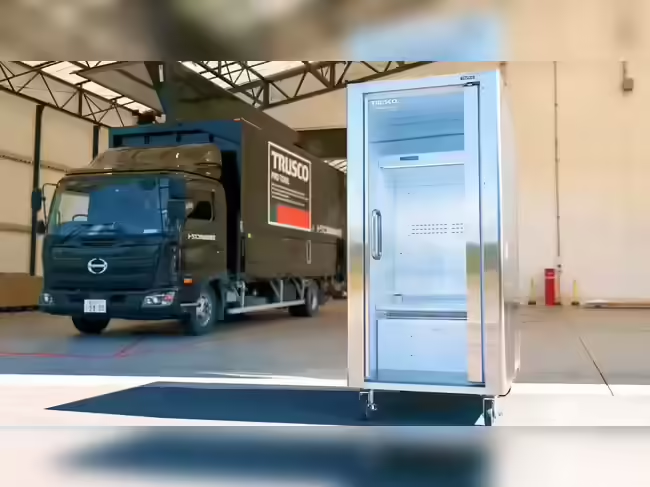
The unit offers three airflow and cooling settings and shuts off automatically after 20 minutes, a built-in limit meant to prevent overcooling. It also runs on roughly half the electricity of a conventional portable air conditioner, needs no installation, works indoors or outdoors, and sits on wheels so it can be rolled between job sites or into storage.
The Do Hiemon Box went on sale in April and has already started showing up in public spaces. One unit was donated to Maebashi City Hall in Gunma Prefecture, where visitors can step in and cool down free of charge during opening hours. That placement points to a second use case beyond factories and construction sites: general public cooling stations, not just workplace equipment.
The standard model sells for 1.5 million yen (about $9,326), plus tax, through industrial equipment distributors. That price point puts it squarely in reach of business and institutional buyers — factories, construction firms, municipal offices — rather than individual households. Whether it stays that way depends on how Japan’s summers continue to trend; if extreme heat keeps intensifying, cheaper or smaller consumer versions wouldn’t be a surprising next step, though nothing like that has been announced.
It’s worth being clear about scope here. The Do Hiemon Box is a recovery tool, not a substitute for preventive measures like shaded rest areas, scheduled breaks, and proper hydration — all of which Japanese and other governments have separately urged employers to adopt. A single booth also serves one person at a time, which limits how many workers on a large site can use it during a shift. None of the coverage so far includes independent physiological data on how much the device actually lowers core body temperature, or how it compares with simpler interventions like cold-water immersion and shaded cooling stations, which remain the standard heatstroke first-response methods.
Reference:
Oona McGee, “Japan now has human refrigerators inspired by Japanese vending machines,” SoraNews24, July 17–18, 2026, citing Yahoo! News Japan.