



Thursday, June 18, 2026
SAVED POSTS
  • Login
  • Register
RathBiotaClan
No Result
View All Result
  • HOME
  • HEALTH SCIENCE

    TRENDING ON HEALTH (TOP)

    For People Antidepressants Never Helped, a 30-Minute Home Session Is Now FDA-Approved

    Scientists Say Your Next Tube of Toothpaste Could Be Made From Human Hair

    Your Lungs, Liver, and Pancreas Also Age Faster When You Sleep Wrong

    Cycling Linked to Lower Dementia Risk in Study of Nearly 480,000 Adults

    NOW ON AIR (RBC)

    NEUROSCIENCE

    Step-Synchronized Brain Stimulation Reduces Falls in Small Parkinson’s Trial

    June 16, 2026
    NEWS

    A Father’s Touch in Infancy Can Shape a Child’s Health for Years, New Science Explains Why

    June 9, 2026
    MutExpress
    BIOINFORMATICS

    South Asian Patients Have Been Left Out of Cancer Genomics for Decades & MutExpress-India Is Changing That

    June 8, 2026
    Biodiversity Loss
    ECOLOGY

    Biodiversity Loss Could Bankrupt Nations And Wall Street Hasn’t Noticed Yet

    June 5, 2026
  • NEUROSCIENCE
    • PHYSIOLOGY
    • IMMUNOLOGY
    • CANCER
  • DISCOVERIES
    • SPOTLIGHTS
    • STUDENT PORTAL
    • SCIENCE FEATURED
  • MOLECULAR BIOLOGY
    • GENETICS
    • BIOTECHNOLOGY
    • BIOINFORMATICS
    • BIOCHEMISTRY
    • BIOPHYSICS
  • ZOOLOGY & ECOLOGY
    • ENVIRONMENTAL SCIENCE
    • ECOLOGY
    • EVOLUTION
  • MICRO & PLANT SCIENCE
    • MICROBIOLOGY
    • CELL BIOLOGY
    • DEVELOPMENTAL BIOLOGY
  • PSYCHOLOGY
RathBiotaClan
RathBiotaClan
No Result
View All Result
Home EVOLUTION

Parasite Evolution: Histories, Host Dynamics, and Molecular Adaptation

Shibasis Rath by Shibasis Rath
September 7, 2024
in EVOLUTION, MICROBIOLOGY, SCIENCE FEATURED
Reading Time: 6 mins read
0
A A
0
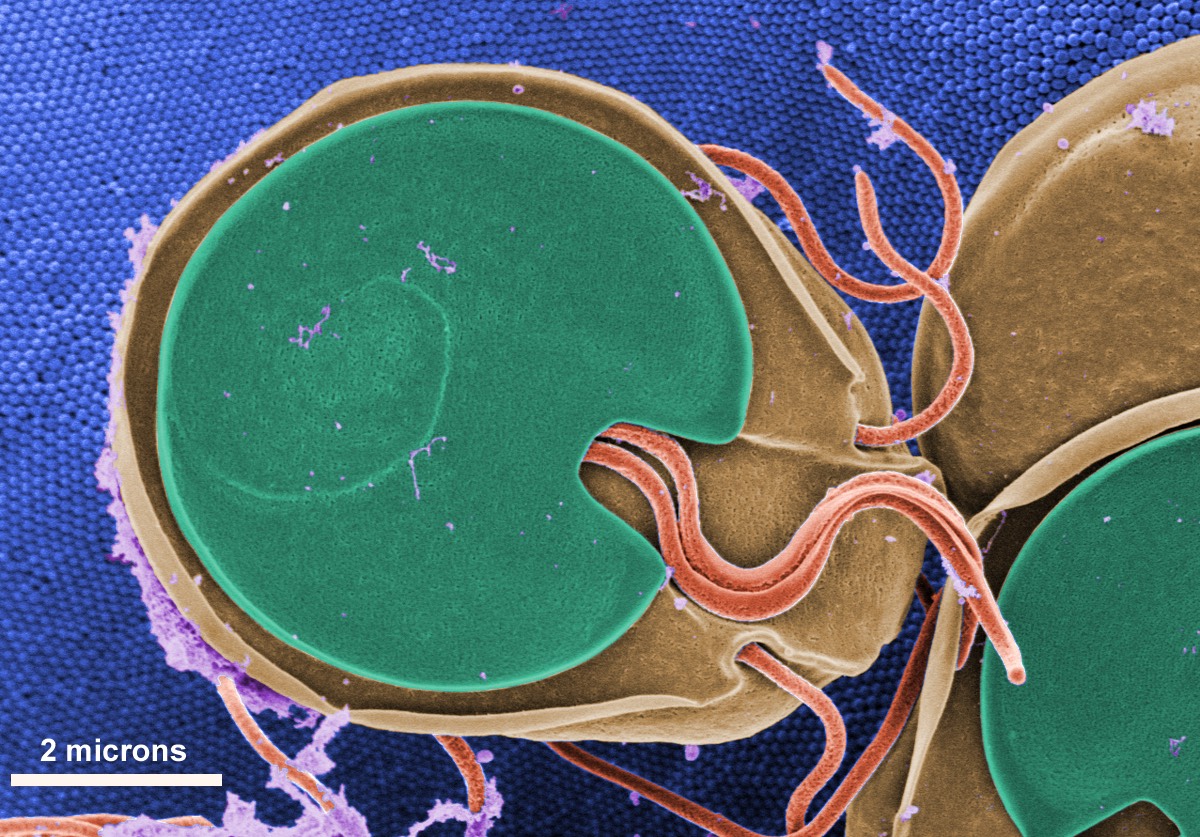
Colored scanning electron microscope image of a parasitic microorganism (green) interacting with a host cell (brown) and thread-like structures (red), illustrating parasite evolution; scale shows 2 microns; blue, textured background.

1999 Dr. Stan Erlandsen; Dr. Carol Wells This scanning electron micrograph (SEM) revealed the ventral surface of a Giardia muris trophozoite that had settled atop the mucosal surface of a ratโ€™s intestine. Note the microvilli, which can be seen in the background, as tiny rounded structures that are approximately 0.15 microns in diameter. These microvilli cover the surface of each intestinal epithelial cell. The Giardiaโ€™s ventral adhesive disk resembles a suction cup, where overlapping microtubules in the cytoplasm form a number-6-shaped figure. The edge of the suction cup, called the ventrolateral flange, partially encircles the adhesive disk and is absent posteriorly where a ventral pair of flagella emerges from above, dorsal to the disk. Giardia muris has four pairs of flagella that are responsible for the organismโ€™s motility. The adhesive disk facilitates adherence to the intestinal surface. The protozoan Giardia causes the diarrheal disease called giardiasis. Giardia species exist as free-swimming (by means of flagella) trophozoites, and as egg-shaped cysts. It is the cystic stage, which facilitates the survival of these organisms under harsh environmental conditions. The cyst is considered the infective form, and disease is often transmitted by drinking contaminated water. As depicted in these SEMs, in the intestine, cysts are stimulated to liberate trophozoites. Cysts can be shed in fecal material, and can, thereafter, remain viable for several months in appropriate environmental conditions. Cysts can also be transferred directly from person-to-person, as a result of poor hygiene.

The world of parasites represents an evolutionary labyrinth of the most intricate relations between them and their hosts.

These relationships are much more than vital to parasitologists but underpin so much of the wider ecological and evolutionary processes in place. In this blog, we dive deep into the fascinating world of parasite evolution-a world where evolutionary history, geographical distribution, and host-parasite interactions come together in molding survival and adaptability for parasites.

Central in the study of parasite evolution is a dichotomy between the two main driving forces in parasite-host relationships: descent versus colonization. Descent suggests a deep phylogenetic relationship between parasite and host, with a history of the two evolving together over a very long period. This typically results in very specialized parasite-host relationships. Conversely, colonization or host switching occurs when a parasite takes up residence in a new host, much as species colonize new islands. Determining whether a parasite is associated with a host due to descent or due to colonization is an important part of deciphering the history of evolutionary interactions.

Geological Effects on Host-Parasite Interactions

Continental drift, mountain building (orogeny), and island formation are some of the geological events that have played an important role in the distribution of hosts and parasites. The interaction of evolutionary and geological change is captured under the term phylogeography. For instance, work by Perkins on lizard malaria in the Caribbean, demonstrates how geographical isolation and geological history shape host-parasite interactions. Different strains of Plasmodium azurophilum in Anolis lizards exhibited asymmetric dispersal across the Lesser Antilles, illustrating how island archipelagos distort the relative colonization dynamics of hosts and parasites.

ADVERTISEMENT

Evolutionary Histories of Cladistics and Phylogenetics

Parasitologists apply the methodology called cladistics or sometimes referred to as phylogenetic systematics in order to build evolutionary histories. This methodology would involve the development of phylogenies, which are tree-like diagrams showing the evolutionary relationships of species based on shared derived characteristics. Shared derived traits, or synapomorphies, are used to define monophyletic groups, which include a common ancestor and all of its descendants. Paraphyletic groups contain a common ancestor but exclude some descendants; polyphyletic groups exclude the common ancestor altogether. These diagrams are produced using different phylogenetic software, which in turn aids in classification and learning of evolutionary relationships between parasites and their respective hosts.

READ ALSO

Psychology Study Says, Why People Who Enjoy Being Alone Often Build Stronger Minds and Deeper Connections

Volcanic Eruptions Can Destroy Their Own Methane โ€” Tonga’s Plume Shows How

Case Study: Elasmobranch Tapeworms

Work done by Janine Caira and colleagues on tapeworms in elasmobranchs-terms referred to various sharks, rays, and skates-provide examples of parasite evolution. Their focus was based on the family Onchobothriidae; they evaluated characteristics like monophyly and host specificity. Through the process, the study found that the distribution of tapeworm species did not always precisely correspond to the evolutionary history of their shark hosts. Such a finding points to an underlying complexity in host-parasite relationships and extensive colonization events beyond simple common descent. That one shark species may host many tapeworm genera and species testifies to the dynamism of such interactions.

ADVERTISEMENT

Molecular Adaptation into Parasite Evolution

Molecular biology has contributed in great measure to understanding the evolution of parasites by providing tools that can unravel even the most intricate aspects of the host-parasite relationship. For example, molecular studies of the common gut parasite, Giardia duodenalis, have shown how molecular techniques can reveal hidden diversity. Molecular studies have indeed shown various assemblages of Giardia exhibiting differences in virulence and growth requirements among isolates originating from different hosts. This molecular approach was able to reveal cryptic species, which morphology alone could not discriminate, therefore increasing our understanding of parasite evolution.

ADVERTISEMENT

The Role of Parasitism in Sexual Selection

Parasitism also has an immense influence on the host reproductive biology. The effects of parasitism on reproductive behavior and success are quite well documented across a wide range of species. For example, parasitic infections can affect mate choice; usually, females choose their mates based on their immune competence. However, mathematical models have suggested that fluctuating prevalence of a pathogen

changes these selective pressures. In some species of birds, such as swallows, females may choose males based on ornamentation changes caused by parasitism. In other mammals, female choice is expressed as avoidance of infected males with particular parasites. These behaviors illustrate various interactions between parasitism and strategies of reproduction.

Maintenance of Genetic Diversity Parasitism

Parasitism contributes to the genetic variability of host populations. In numerous studies, it has been demonstrated that hosts with higher genetic variability show increased resistance against parasitic infections. For instance, in deer mice, Capillaria hepatica-infected populations demonstrated a lower prevalence of the parasite when genetic heterozygosity was higher. Similar trends observed in other species have also led to the suggestion that genetic variability increases resistance against parasitism and maintains health within populations.

Evolution of Virulence

The evolution of parasite virulence-be it benign or highly virulent-is a much studied area. The traditional view states that parasites should evolve to become avirulent to avoid killing their hosts. On the other hand, some theoretical approaches suppose that parasites would evolve an optimal virulence level that balances transmission with survival. While vertical transmission between parent and offspring often selects for avirulent strains, horizontal transmission among members of a given generation may favor more virulent forms. Indeed, studies continue to reveal exactly how host genetic diversity, transmission dynamics, and resultant evolutionary pressures drive virulence.

Conclusion

The evolutionary dynamics of parasites weave a rich tapestry born from evolutionary history, geographical change, and ecological flux. Descent and colonization patterns, the use of molecular techniques, and knowledge concerning parasitism’s role in sexual selection and genetic diversity have, each in turn, added depth to the already intricate interactions between parasites and their hosts. Ongoing research is continuously unraveling the secrets of parasite evolution and offers research knowledge in everything from ecology to medicine.

Engage with Us:

Stay tuned for more captivating insights and News. Visit our Blogs , Science paper , Study Portal and Follow Us on social media to never miss an update. Together, let’s unravel the mysteries of the natural world.


  • Share on WhatsApp (Opens in new window) WhatsApp
  • Share on Facebook (Opens in new window) Facebook
  • Share on Reddit (Opens in new window) Reddit
  • Share on X (Opens in new window) X
  • Print (Opens in new window) Print
Shibasis Rath

Shibasis Rath

"๐“’๐“ธ๐“ท๐“ท๐“ฎ๐“ฌ๐“ฝ๐“ฒ๐“ท๐“ฐ ๐“ก๐“ฎ๐“ผ๐“ฎ๐“ช๐“ป๐“ฌ๐“ฑ ๐“ฃ๐“ธ ๐“ก๐“ฎ๐“ช๐“ต๐“ฒ๐“ฝ๐”‚" ๐“ฒ๐“ผ๐“ท'๐“ฝ ๐“™๐“พ๐“ผ๐“ฝ ๐“ช ๐“œ๐“ธ๐“ฝ๐“ฝ๐“ธ - ๐“˜๐“ฝ'๐“ผ ๐“œ๐”‚ ๐“œ๐“ฒ๐“ผ๐“ผ๐“ฒ๐“ธ๐“ท

Related Posts

woman in black jacket sitting on gray concrete wall during daytime
PSYCHOLOGY

Psychology Study Says, Why People Who Enjoy Being Alone Often Build Stronger Minds and Deeper Connections

May 21, 2026
Volcanic Eruptions Can Destroy Their Own Methane โ€” Tonga’s Plume Shows How
ENVIRONMENTAL SCIENCE

Volcanic Eruptions Can Destroy Their Own Methane โ€” Tonga’s Plume Shows How

May 13, 2026
Babies Yawn in the Womb
DEVELOPMENTAL BIOLOGY

Scientists Say Babies May Learn to Yawn Before Birth

May 11, 2026

POPULAR NEWS

Chewing gum releases thousands of microplastic particles directly into your mouth with every piece you chew

Chewing gum releases thousands of microplastic particles directly into your mouth with every piece you chew

by Shibasis Rath
May 8, 2026
0

Microplastics are turning up in places researchers never expected: deep-sea sediments, Arctic ice, and human blood. Now, a UCLA pilot...

New Studys Says Gen Z is the least sexually active young cohort in modern recorded history

New Studys Says Gen Z is the least sexually active young cohort in modern recorded history

by Shibasis Rath
January 24, 2026
0

A generation that grew up with dating apps in their pockets, pornography a tap away, and sex discussed more openly...

Yelling Isnโ€™t Just Yelling: How a Hostile Home Rewires a Childโ€™s Brain for Constant Alert

Yelling Isnโ€™t Just Yelling: How a Hostile Home Rewires a Childโ€™s Brain for Constant Alert

by Shibasis Rath
March 8, 2026
0

To a parent in the heat of the moment, a raised voice may feel like simple frustration. To a child...

a group of gen Z kids walking down a street

Is Gen Z the First Generation Less Intelligent Than Their Parents?

by Shibasis Rath
February 5, 2026
0

Gen Z intelligence decline is emerging as a serious concern among neuroscientists and education researchers. For over a century, each...

Whole Brain Emulation Achieved: Scientists Run a Fruit Fly Brain in Simulation

by Shibasis Rath
March 9, 2026
0

Scientists have copied an entire biological brain neuron by neuron and synapse by synapse and made it control a simulated...

EDITOR CHOICEโ€˜S

  • All
  • NEWS
  • SPOTLIGHTS
Step-Synchronized Brain Stimulation Reduces Falls in Small Parkinson’s Trial

Step-Synchronized Brain Stimulation Reduces Falls in Small Parkinson’s Trial

by Staff Writer
June 16, 2026
0

Researchers have reported encouraging results from a small feasibility study testing a new form of adaptive deep brain stimulation (aDBS)...

A Father’s Touch in Infancy Can Shape a Child’s Health for Years, New Science Explains Why

A Father’s Touch in Infancy Can Shape a Child’s Health for Years, New Science Explains Why

by Staff Writer
June 9, 2026
0

A study from Penn State University has revealed something startling beneath that simplicity those early interactions carry biological consequences that...

MutExpress

South Asian Patients Have Been Left Out of Cancer Genomics for Decades & MutExpress-India Is Changing That

by Staff Writer
June 8, 2026
0

The databases that underpin modern cancer genomics have a geography problem. The gnomAD database the gold standard for allele frequency...

Biodiversity Loss

Biodiversity Loss Could Bankrupt Nations And Wall Street Hasn’t Noticed Yet

by Staff Writer
June 5, 2026
0

Every year, governments borrow trillions of dollars to function. The interest rate they pay depends almost entirely on their credit...

ADVERTISEMENT

RathBiotaClan – RBC

RathBiotaClan – Connecting Research To Reality

Your trusted source for life science news, biology research & discoveries. Covering neuroscience, genetics, ecology, and more โ€” connecting research to reality.

About Us

Privacy Policies

Contact Us

Editorial Standard

Latest Posts

  • Step-Synchronized Brain Stimulation Reduces Falls in Small Parkinson’s Trial
  • A Father’s Touch in Infancy Can Shape a Child’s Health for Years, New Science Explains Why
  • South Asian Patients Have Been Left Out of Cancer Genomics for Decades & MutExpress-India Is Changing That
  • Biodiversity Loss Could Bankrupt Nations And Wall Street Hasn’t Noticed Yet

SHIBASIS RATH

Contact Mail

rathbiotaclan@gmail.com

No Result
View All Result
MSME (Udyam) Certified Science Platform
Govt. of India

Get Us On PlayStore

playstore app for rathbiotaclan
  • About Us
  • Advertise With Us
  • Cancellation and Refund Policy
  • Contact Us
  • Contribute
  • Editorial Standards
  • Home
  • Pricing Details
  • Privacy Policies
  • Shipping Policy
  • Terms & Conditions

ยฉ 2026 RathBiotaClan. All rights reserved.

Welcome Back!

Sign In with Google
OR

Login to your account below

Forgotten Password? Sign Up

Create New Account!

Sign Up with Google
OR

Fill the forms below to register

*By registering into our website, you agree to the Terms & Conditions and Privacy Policy.
All fields are required. Log In

Retrieve your password

Please enter your username or email address to reset your password.

Log In

Add New Playlist

No Result
View All Result
  • HOME
  • HEALTH SCIENCE
  • NEUROSCIENCE
    • PHYSIOLOGY
    • IMMUNOLOGY
    • CANCER
  • DISCOVERIES
    • SPOTLIGHTS
    • STUDENT PORTAL
    • SCIENCE FEATURED
  • MOLECULAR BIOLOGY
    • GENETICS
    • BIOTECHNOLOGY
    • BIOINFORMATICS
    • BIOCHEMISTRY
    • BIOPHYSICS
  • ZOOLOGY & ECOLOGY
    • ENVIRONMENTAL SCIENCE
    • ECOLOGY
    • EVOLUTION
  • MICRO & PLANT SCIENCE
    • MICROBIOLOGY
    • CELL BIOLOGY
    • DEVELOPMENTAL BIOLOGY
  • PSYCHOLOGY
  • Login
  • Sign Up
SAVED POSTS

ยฉ 2026 RathBiotaClan. All rights reserved.

This website uses cookies. By continuing to use this website you are giving consent to cookies being used. Visit our Privacy and Cookie Policy.