



Sunday, June 21, 2026
SAVED POSTS
  • Login
  • Register
RathBiotaClan
No Result
View All Result
  • HOME
  • HEALTH SCIENCE

    TRENDING ON HEALTH (TOP)

    Early Smartphone Counties Saw Bigger Fertility Drops Than Others After 2007

    For People Antidepressants Never Helped, a 30-Minute Home Session Is Now FDA-Approved

    Scientists Say Your Next Tube of Toothpaste Could Be Made From Human Hair

    Your Lungs, Liver, and Pancreas Also Age Faster When You Sleep Wrong

    NOW ON AIR (RBC)

    Heavy Screen Time in Toddlers Linked to Weaker Language Brain Wiring, Cincinnati Study Shows
    NEUROSCIENCE

    Heavy Screen Time in Toddlers Linked to Weaker Language Brain Wiring, Cincinnati Study Shows

    June 21, 2026
    woman sitting and leaning forward using smartphone
    HEALTH SCIENCE

    Early Smartphone Counties Saw Bigger Fertility Drops Than Others After 2007

    June 16, 2026
    new walking shark species
    DISCOVERIES

    New Walking Shark Species Hemiscyllium dudgeonae Described from Milne Bay, Papua New Guinea

    June 16, 2026
    NEUROSCIENCE

    Step-Synchronized Brain Stimulation Reduces Falls in Small Parkinson’s Trial

    June 16, 2026
  • NEUROSCIENCE
    • PHYSIOLOGY
    • IMMUNOLOGY
    • CANCER
  • DISCOVERIES
    • SPOTLIGHTS
    • STUDENT PORTAL
    • SCIENCE FEATURED
  • MOLECULAR BIOLOGY
    • GENETICS
    • BIOTECHNOLOGY
    • BIOINFORMATICS
    • BIOCHEMISTRY
    • BIOPHYSICS
  • ZOOLOGY & ECOLOGY
    • ENVIRONMENTAL SCIENCE
    • ECOLOGY
    • EVOLUTION
  • MICRO & PLANT SCIENCE
    • MICROBIOLOGY
    • CELL BIOLOGY
    • DEVELOPMENTAL BIOLOGY
  • PSYCHOLOGY
RathBiotaClan
RathBiotaClan
No Result
View All Result
Home NEUROSCIENCE

Heavy Screen Time in Toddlers Linked to Weaker Language Brain Wiring, Cincinnati Study Shows

Brain scans of 47 preschoolers link heavier screen time to weaker white matter in language pathways — but researchers urge caution on cause and effect.

Staff Writer by Staff Writer
June 21, 2026
in NEUROSCIENCE, NEWS
Reading Time: 9 mins read
0
A A
0
Heavy Screen Time in Toddlers Linked to Weaker Language Brain Wiring, Cincinnati Study Shows

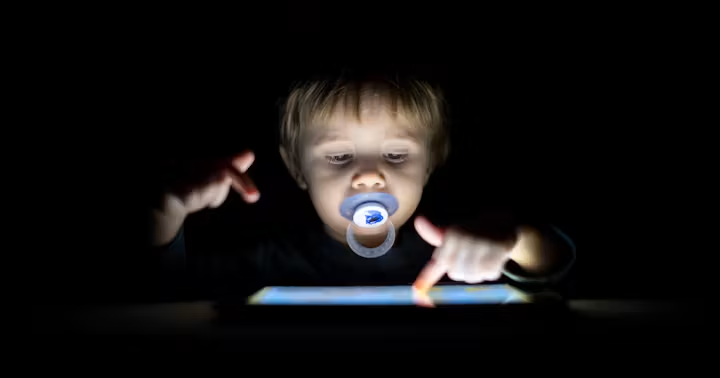
A toddler interacts with a mobile device—a daily scene now at the center of modern pediatric debate

The researchers found that toddlers and preschoolers whose screen time pushed well beyond pediatric guidelines showed measurably weaker white matter organization in the brain pathways that handle language and reading. These are the critical wiring bundles that let different regions communicate fast and clearly. The same kids also did worse on tests of vocabulary, quick naming, and early literacy. Scientists are urging caution though—no one is claiming this proves screens damage brains.

Picture a three-year-old glued to a tablet; managing toddler screen time is the modern parent’s toughest daily trade-off. For years warnings focused on what we could see—slower language growth, less sleep, fewer real conversations. But what was actually changing inside the brain stayed hidden.

Then a 2020 study in JAMA Pediatrics cracked the lid open. Researchers at Cincinnati Children’s Hospital recruited 47 healthy kids aged three to five. None had diagnosed developmental issues. They ran them through diffusion tensor imaging, a specialized MRI scan that maps the structural integrity of white matter—the dense bundles of nerve fibers linking brain regions.

Study Sample Composition

ADVERTISEMENT

47 healthy preschool-aged children (ages 3–5) who completed DTI brain scans

READ ALSO

Early Smartphone Counties Saw Bigger Fertility Drops Than Others After 2007

Step-Synchronized Brain Stimulation Reduces Falls in Small Parkinson’s Trial

Left: Gender distribution among participants. Right: Maternal education level, reflecting the sample’s predominantly high-SES composition — an important limitation when generalizing findings to broader populations.

ADVERTISEMENT

White matter is essentially the brain’s wiring system. Its microstructural organization how tightly bundled and well-insulated those fibers are reflects how efficiently signals travel between areas. During early childhood, this system is in a period of explosive development, shaped substantially by experience.

ADVERTISEMENT

To measure screen habits, parents completed the ScreenQ — a 15-item questionnaire assessing how much time children spent with screens, what content they watched, whether a parent was present, and how their usage aligned with American Academy of Pediatrics guidelines, which recommend no more than one hour of high-quality programming per day for this age group. Higher ScreenQ scores indicated greater deviation from those guidelines.

Before the MRI, each child also completed a battery of cognitive assessments targeting expressive vocabulary, rapid naming, and early literacy skills the very cognitive domains most dependent on robust language networks.

The Real-World Impact on Toddler Screen Time

Children with higher screen use scores showed measurably lower white matter integrity in several tracts associated with language, literacy, and executive function — including the arcuate fasciculus, inferior longitudinal fasciculus, and uncinate fasciculus, all largely on the left side of the brain. Specifically, these children had lower fractional anisotropy (a marker of structural organization) and higher radial diffusivity (associated with reduced myelination, the fatty sheath that speeds neural transmission).

White Matter Tracts With Altered Integrity

Brain pathways showing significant microstructural differences in children with higher ScreenQ scores
(p<0.05, familywise error-corrected, controlling for age and income)

White Matter TractPrimary FunctionFARDSide
Arcuate FasciculusLanguage processing & verbal working memory↓ Lower↑ HigherLeft
Inferior Longitudinal FasciculusVisual processing & semantic language↓ Lower↑ HigherLeft
Uncinate FasciculusEmotional processing & verbal learning↓ Lower↑ HigherLeft

FA (Fractional Anisotropy) — lower values indicate less organized fiber tract structure.  |  RD (Radial Diffusivity) — higher values suggest reduced myelin sheath development. Source: Hutton et al., JAMA Pediatrics, 2020.

In simpler terms: the more a child’s screen time deviated from pediatric guidelines, the less organized and mature-appearing certain communication pathways in their brain appeared to be.

The behavioral findings pointed in the same direction. Higher ScreenQ scores were associated with lower scores on expressive vocabulary, rapid naming, and emergent literacy tests. Some of these cognitive associations weakened when household income was factored in — a signal that socioeconomic context plays a meaningful role that the study wasn’t fully powered to untangle.

Screen Time & Cognitive Performance: How Strongly Linked?

Proportion of variance in cognitive test scores explained by ScreenQ (R²), controlling for child age. All associations p<0.01.

A higher R² means more of the variation in a child’s test score is statistically associated with their screen time. EVT-2 = Expressive Vocabulary Test; CTOPP-2 = Rapid Naming; GRTR = Get Ready to Read (emergent literacy). Note: some associations weakened after adjusting for household income. Source: Hutton et al., JAMA Pediatrics, 2020.


How does screen time affect a child’s brain?

Here is where scientific discipline becomes essential.

This was a cross-sectional study a snapshot in time. That design cannot establish causation or even directionality. It is equally plausible, for example, that children with slightly less developed language networks are less engaged with conversation and more drawn to passive screen content. Or that unmeasured household factors parental stress, stimulation-poor environments, limited book access — drive both higher screen use and weaker language development simultaneously.

John S. Hutton, MD
“The findings suggest further study is needed, particularly during the rapid early stages of brain development.”
John S. Hutton, MD
Cincinnati Children’s Hospital Medical Center

The sample was also small: 47 children, drawn predominantly from middle- to upper-income families where 78% of mothers held college degrees or higher. This is not the population where screen-related developmental disparities are largest, and the findings may look different — or stronger in communities with fewer resources.

ScreenQ itself, while a validated tool, depends on parent self-report, which is vulnerable to social desirability bias. Parents who already feel uneasy about their child’s screen time may underreport it.

DTI is powerful, but not without limitations. The technique struggles in regions where nerve fibers cross, and translating imaging metrics into real-world developmental consequences requires careful interpretation. Hutton acknowledged these constraints directly — the results are correlational, consistent with behavioral literature, but not proof of harm.

The Hidden Link to Early Language Development

Even with its limitations, the study breaks new ground. Prior research had established behavioral associations between screen time and language outcomes. This is among the first studies to document a corresponding signal at the level of brain structure in preschoolers — and to show it in tracts specifically implicated in the skills most affected.

White matter organization in early childhood is experience-dependent. The brain builds itself partly in response to what it encounters: conversation, play, reading, exploration. Time spent passively absorbing content may simply be time not spent on the interactions that build these pathways most robustly.

That’s not a reason for alarm. It is, perhaps, a reason to pay attention to what young children are doing with their time and, more precisely, what they might be doing instead.

The tablet isn’t going anywhere. But understanding what sits behind that glowing screen, inside the small heads staring at it, has never been more important. Ultimately, while the device is here to stay, protecting their long-term language development starts with shifting our focus from what we take out of their hands, to what we put back into their days. It starts with the humble realization that a developing brain doesn’t just need the screen turned off—it needs the conversation turned back on.


Reference:

Hutton JS, Dudley J, Horowitz-Kraus T, DeWitt T, Holland SK. Associations Between Screen-Based Media Use and Brain White Matter Integrity in Preschool-Aged Children. JAMA Pediatr. 2020;174(1):e193869. doi:10.1001/jamapediatrics.2019.3869)


  • Share on WhatsApp (Opens in new window) WhatsApp
  • Share on Facebook (Opens in new window) Facebook
  • Share on Reddit (Opens in new window) Reddit
  • Share on X (Opens in new window) X
  • Print (Opens in new window) Print
Staff Writer

Staff Writer

Related Posts

woman sitting and leaning forward using smartphone
HEALTH SCIENCE

Early Smartphone Counties Saw Bigger Fertility Drops Than Others After 2007

June 16, 2026
Step-Synchronized Brain Stimulation Reduces Falls in Small Parkinson’s Trial
NEUROSCIENCE

Step-Synchronized Brain Stimulation Reduces Falls in Small Parkinson’s Trial

June 16, 2026
A Father’s Touch in Infancy Can Shape a Child’s Health for Years, New Science Explains Why
NEWS

A Father’s Touch in Infancy Can Shape a Child’s Health for Years, New Science Explains Why

June 9, 2026

Leave a Reply Cancel reply

Your email address will not be published. Required fields are marked *

I agree to the Terms & Conditions and Privacy Policy.

POPULAR NEWS

Chewing gum releases thousands of microplastic particles directly into your mouth with every piece you chew

Chewing gum releases thousands of microplastic particles directly into your mouth with every piece you chew

by Shibasis Rath
May 8, 2026
0

Microplastics are turning up in places researchers never expected: deep-sea sediments, Arctic ice, and human blood. Now, a UCLA pilot...

New Studys Says Gen Z is the least sexually active young cohort in modern recorded history

New Studys Says Gen Z is the least sexually active young cohort in modern recorded history

by Shibasis Rath
January 24, 2026
0

A generation that grew up with dating apps in their pockets, pornography a tap away, and sex discussed more openly...

Yelling Isn’t Just Yelling: How a Hostile Home Rewires a Child’s Brain for Constant Alert

Yelling Isn’t Just Yelling: How a Hostile Home Rewires a Child’s Brain for Constant Alert

by Shibasis Rath
March 8, 2026
0

To a parent in the heat of the moment, a raised voice may feel like simple frustration. To a child...

a group of gen Z kids walking down a street

Is Gen Z the First Generation Less Intelligent Than Their Parents?

by Shibasis Rath
February 5, 2026
0

Gen Z intelligence decline is emerging as a serious concern among neuroscientists and education researchers. For over a century, each...

Whole Brain Emulation Achieved: Scientists Run a Fruit Fly Brain in Simulation

by Shibasis Rath
March 9, 2026
0

Scientists have copied an entire biological brain neuron by neuron and synapse by synapse and made it control a simulated...

EDITOR CHOICE‘S

  • All
  • NEWS
  • SPOTLIGHTS
Heavy Screen Time in Toddlers Linked to Weaker Language Brain Wiring, Cincinnati Study Shows

Heavy Screen Time in Toddlers Linked to Weaker Language Brain Wiring, Cincinnati Study Shows

by Staff Writer
June 21, 2026
0

The researchers found that toddlers and preschoolers whose screen time pushed well beyond pediatric guidelines showed measurably weaker white matter...

woman sitting and leaning forward using smartphone

Early Smartphone Counties Saw Bigger Fertility Drops Than Others After 2007

by Staff Writer
June 16, 2026
0

The U.S. fertility rate began falling in 2007 and has not meaningfully recovered since. For years, economists assumed the 2008...

new walking shark species

New Walking Shark Species Hemiscyllium dudgeonae Described from Milne Bay, Papua New Guinea

by Staff Writer
June 16, 2026
0

The study sits within research on the genus Hemiscyllium, a group of small carpet sharks endemic to Australia and New...

Step-Synchronized Brain Stimulation Reduces Falls in Small Parkinson’s Trial

Step-Synchronized Brain Stimulation Reduces Falls in Small Parkinson’s Trial

by Staff Writer
June 16, 2026
0

Researchers have reported encouraging results from a small feasibility study testing a new form of adaptive deep brain stimulation (aDBS)...

ADVERTISEMENT

RathBiotaClan – RBC

RathBiotaClan – Connecting Research To Reality

Your trusted source for life science news, biology research & discoveries. Covering neuroscience, genetics, ecology, and more — connecting research to reality.

About Us

Privacy Policies

Contact Us

Editorial Standard

Latest Posts

  • Heavy Screen Time in Toddlers Linked to Weaker Language Brain Wiring, Cincinnati Study Shows
  • Early Smartphone Counties Saw Bigger Fertility Drops Than Others After 2007
  • New Walking Shark Species Hemiscyllium dudgeonae Described from Milne Bay, Papua New Guinea
  • Step-Synchronized Brain Stimulation Reduces Falls in Small Parkinson’s Trial

SHIBASIS RATH

Contact Mail

rathbiotaclan@gmail.com

No Result
View All Result
MSME (Udyam) Certified Science Platform
Govt. of India

Get Us On PlayStore

playstore app for rathbiotaclan
  • About Us
  • Advertise With Us
  • Cancellation and Refund Policy
  • Contact Us
  • Contribute
  • Editorial Standards
  • Home
  • Pricing Details
  • Privacy Policies
  • Shipping Policy
  • Terms & Conditions

© 2026 RathBiotaClan. All rights reserved.

Welcome Back!

Sign In with Google
OR

Login to your account below

Forgotten Password? Sign Up

Create New Account!

Sign Up with Google
OR

Fill the forms below to register

*By registering into our website, you agree to the Terms & Conditions and Privacy Policy.
All fields are required. Log In

Retrieve your password

Please enter your username or email address to reset your password.

Log In

Add New Playlist

No Result
View All Result
  • HOME
  • HEALTH SCIENCE
  • NEUROSCIENCE
    • PHYSIOLOGY
    • IMMUNOLOGY
    • CANCER
  • DISCOVERIES
    • SPOTLIGHTS
    • STUDENT PORTAL
    • SCIENCE FEATURED
  • MOLECULAR BIOLOGY
    • GENETICS
    • BIOTECHNOLOGY
    • BIOINFORMATICS
    • BIOCHEMISTRY
    • BIOPHYSICS
  • ZOOLOGY & ECOLOGY
    • ENVIRONMENTAL SCIENCE
    • ECOLOGY
    • EVOLUTION
  • MICRO & PLANT SCIENCE
    • MICROBIOLOGY
    • CELL BIOLOGY
    • DEVELOPMENTAL BIOLOGY
  • PSYCHOLOGY
  • Login
  • Sign Up
SAVED POSTS

© 2026 RathBiotaClan. All rights reserved.

This website uses cookies. By continuing to use this website you are giving consent to cookies being used. Visit our Privacy and Cookie Policy.