

Tuesday, June 16, 2026
SAVED POSTS
  • Login
  • Register
RathBiotaClan
No Result
View All Result
  • HOME
  • HEALTH SCIENCE

    TRENDING ON HEALTH (TOP)

    For People Antidepressants Never Helped, a 30-Minute Home Session Is Now FDA-Approved

    Scientists Say Your Next Tube of Toothpaste Could Be Made From Human Hair

    Your Lungs, Liver, and Pancreas Also Age Faster When You Sleep Wrong

    Cycling Linked to Lower Dementia Risk in Study of Nearly 480,000 Adults

    NOW ON AIR (RBC)

    NEWS

    A Father’s Touch in Infancy Can Shape a Child’s Health for Years, New Science Explains Why

    June 9, 2026
    MutExpress
    BIOINFORMATICS

    South Asian Patients Have Been Left Out of Cancer Genomics for Decades & MutExpress-India Is Changing That

    June 8, 2026
    Biodiversity Loss
    ECOLOGY

    Biodiversity Loss Could Bankrupt Nations And Wall Street Hasn’t Noticed Yet

    June 5, 2026
    Soprano pipistrelle (Pipistrellus pygmaeus) emerging from a tree hollow at the moment of take-off.
    ECOLOGY

    Human-generated electromagnetic noise has long lasting effects on light orientation in bats

    June 4, 2026
  • NEUROSCIENCE
    • PHYSIOLOGY
    • IMMUNOLOGY
    • CANCER
  • DISCOVERIES
    • SPOTLIGHTS
    • STUDENT PORTAL
    • SCIENCE FEATURED
  • MOLECULAR BIOLOGY
    • GENETICS
    • BIOTECHNOLOGY
    • BIOINFORMATICS
    • BIOCHEMISTRY
    • BIOPHYSICS
  • ZOOLOGY & ECOLOGY
    • ENVIRONMENTAL SCIENCE
    • ECOLOGY
    • EVOLUTION
  • MICRO & PLANT SCIENCE
    • MICROBIOLOGY
    • CELL BIOLOGY
    • DEVELOPMENTAL BIOLOGY
  • PSYCHOLOGY
RathBiotaClan
RathBiotaClan
No Result
View All Result
Home SCIENCE FEATURED

The Worlds Most Problematic Invasive Animal Species

Staff Writer by Staff Writer
August 24, 2025
in SCIENCE FEATURED, SPOTLIGHTS
Reading Time: 6 mins read
0
A A
0

Here’s the thing about invasive species: nobody ever really plans for them. Sometimes they sneak in by accident, tucked away in a cargo ship. Other times, people bring them in thinking they’ll solve a problem. But once they settle in? They flip the script. They spread fast, eat everything in sight, and completely rewrite the rules of the ecosystem. One cat, one snake, one tiny mussel—that’s all it takes to tip the balance.

Let’s view some of the most notorious troublemakers—the so-called “dirtiest dozen.”

Feral Swine: Smart, Ruthless, and Everywhere

Wild pigs might look like just big farm animals gone rogue, but they’re a nightmare for farmers. They rip up fields, chomp down crops, spread diseases, and even tear up forests by uprooting young trees. The damage they cause racks up to more than $1.5 billion a year in the U.S. alone. Texas is ground zero—so much so that people can hunt or trap them year-round with no limit. But here’s the catch: they’re insanely smart, so wiping them out completely is almost impossible.

Burmese Pythons: Florida’s Monster Snakes

ADVERTISEMENT

Down in the Florida Everglades, massive Burmese pythons—some stretching up to 20 feet—have turned the wetlands into their personal buffet. With no natural predators around, they’ve wiped out small mammal populations by up to 90%. Trapping them doesn’t really work because they’re sneaky ambush hunters. So researchers came up with a clever trick: implanting radio transmitters into captured males (nicknamed “Judas snakes”) and releasing them, hoping they’ll lead straight to the females, who can lay up to 100 eggs at once.

READ ALSO

South Asian Patients Have Been Left Out of Cancer Genomics for Decades & MutExpress-India Is Changing That

PubMed Research Finder for Life Science Students

Zebra Mussels: Tiny Invaders, Big Trouble

Amy Benson – U.S. Geological Survey

They’re no bigger than a fingernail, but zebra mussels have clogged power plants, outcompeted native mussels, and cost millions in damage. One female can release nearly a million eggs in a single year. To make matters worse, their eggs are microscopic, making eradication nearly impossible. The best hope? Prevention. That’s why boaters are constantly told to wash their gear and hulls before leaving a lake.

ADVERTISEMENT

Asian Carp: The Jumping Giants

ADVERTISEMENT

Brought to America in the 1970s to clean fish ponds, Asian carp broke free and took over rivers. Some, like the silver carp, can grow to 80 pounds, eat as much as their body weight every single day, and even leap out of the water—sometimes smacking unlucky boaters in the process. Now they threaten the Great Lakes, where their appetite and rapid breeding outcompete native fish.

European Starlings: Shakespeare Gone Wrong

In the 1890s, a man decided to release 100 starlings in New York because Shakespeare once mentioned them in a play. Today, there are 200 million of them across North America. They swarm farms, steal animal feed, spread diseases, and even caused a deadly plane crash in 1960 when a flock flew into an engine. What started as a literary tribute turned into one of the biggest bird blunders in history.

Nutria: Swamp Wreckers

Nutria are resilient. The South American mammals have been thriving in their non-native North American habitats over the last 70 years, often at the expense of the local ecosystem. (Image credit: Shutterstock)

Imagine a giant rat with orange teeth—that’s the nutria. Originally brought in for the fur trade, they’ve now taken over wetlands across 17 U.S. states. They chew through crops and swamp plants, leaving behind collapsing wetlands and eroding shorelines. Their underground burrows can stretch more than 150 feet, weakening bridges, streets, and dams. And if that wasn’t bad enough, they carry diseases, too.

Lionfish: Beautiful but Deadly
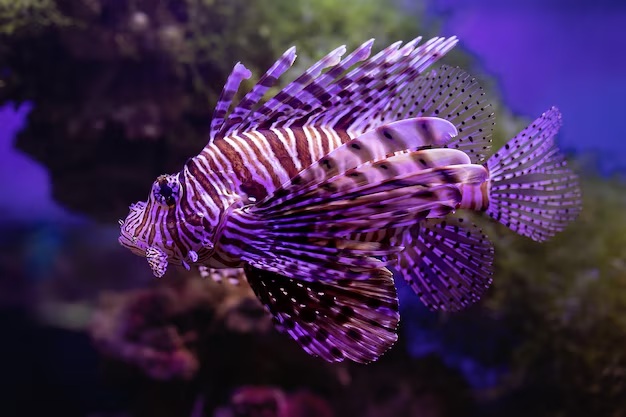
They look like living fireworks—striped, spiny, and stunning. But in the Caribbean and along the U.S. coast, lionfish are wiping out reef fish populations and upsetting the balance of coral ecosystems. With no natural predators in these waters, they eat almost anything, including species vital for commercial fishing. Their venomous spines don’t help, either. Divers now spear them on hunts, and chefs are even trying to turn them into seafood to keep numbers down.

Brown Tree Snakes: Guam’s Worst Mistake

Brown Tree Snake in striking position

When brown tree snakes arrived in Guam in the 1950s, they found paradise—no predators and plenty to eat. Within decades, they wiped out nearly all of the island’s native birds. They’ve also become a menace for people, causing hundreds of power outages by crawling over electrical lines, costing millions each year. Hawaii fears them most; if they ever get there, the damage could reach $1.7 billion annually.

Feral Cats: The Cute Killers
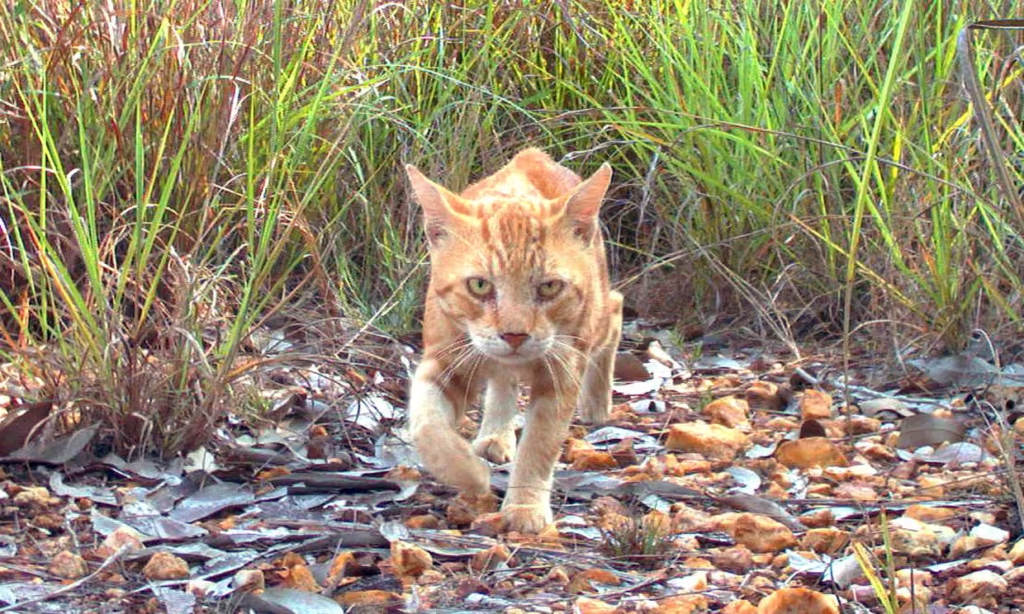
Feral cat-free areas of Australia are limited to a few islands, of which 12 had feral cat populations until they were eradicated, and 16 fenced-in cat-free reserves. Photograph: AFP/Getty Images

We love our cats, but when they go feral, they’re absolute killing machines. Studies estimate they kill billions of birds and small mammals every year and have driven dozens of species to extinction. On top of that, they spread rabies more than any other domestic animal. Keeping cats indoors isn’t just safer for wildlife—it gives the cats themselves a much longer life.

Gypsy Moths: Forest Strippers

They were first brought to Massachusetts in 1869 by a scientist experimenting with silk. But they escaped, and now their caterpillars strip leaves from over 300 types of trees. Entire forests have been left bare, and control programs cost tens of millions each year. The government’s “Slow the Spread” campaign is one of the few things keeping them in check.

The Never-Ending Battle

From pythons in Florida to pigs in Texas, these invasive species are proof of how quickly ecosystems can unravel when the balance is broken. Total eradication is rare. Most of the time, it’s about managing the chaos, slowing the spread, and trying to protect what’s left. One thing’s for sure: once an invader digs in, the fight to reclaim nature is uphill all the way.


RECENT POSTS

  • A Father’s Touch in Infancy Can Shape a Child’s Health for Years, New Science Explains Why
  • South Asian Patients Have Been Left Out of Cancer Genomics for Decades & MutExpress-India Is Changing That
  • Biodiversity Loss Could Bankrupt Nations And Wall Street Hasn’t Noticed Yet
  • Human-generated electromagnetic noise has long lasting effects on light orientation in bats
  • PubMed Research Finder for Life Science Students
  • For People Antidepressants Never Helped, a 30-Minute Home Session Is Now FDA-Approved

  • Share on WhatsApp (Opens in new window) WhatsApp
  • Share on Facebook (Opens in new window) Facebook
  • Share on Reddit (Opens in new window) Reddit
  • Share on X (Opens in new window) X
  • Print (Opens in new window) Print
Staff Writer

Staff Writer

Related Posts

MutExpress
BIOINFORMATICS

South Asian Patients Have Been Left Out of Cancer Genomics for Decades & MutExpress-India Is Changing That

June 8, 2026
PubMed Research Finder for Life Science Students
BIOINFORMATICS

PubMed Research Finder for Life Science Students

May 26, 2026
woman in black jacket sitting on gray concrete wall during daytime
PSYCHOLOGY

Psychology Study Says, Why People Who Enjoy Being Alone Often Build Stronger Minds and Deeper Connections

May 21, 2026

POPULAR NEWS

Chewing gum releases thousands of microplastic particles directly into your mouth with every piece you chew

Chewing gum releases thousands of microplastic particles directly into your mouth with every piece you chew

by Shibasis Rath
May 8, 2026
0

Microplastics are turning up in places researchers never expected: deep-sea sediments, Arctic ice, and human blood. Now, a UCLA pilot...

New Studys Says Gen Z is the least sexually active young cohort in modern recorded history

New Studys Says Gen Z is the least sexually active young cohort in modern recorded history

by Shibasis Rath
January 24, 2026
0

A generation that grew up with dating apps in their pockets, pornography a tap away, and sex discussed more openly...

Yelling Isn’t Just Yelling: How a Hostile Home Rewires a Child’s Brain for Constant Alert

Yelling Isn’t Just Yelling: How a Hostile Home Rewires a Child’s Brain for Constant Alert

by Shibasis Rath
March 8, 2026
0

To a parent in the heat of the moment, a raised voice may feel like simple frustration. To a child...

a group of gen Z kids walking down a street

Is Gen Z the First Generation Less Intelligent Than Their Parents?

by Shibasis Rath
February 5, 2026
0

Gen Z intelligence decline is emerging as a serious concern among neuroscientists and education researchers. For over a century, each...

Whole Brain Emulation Achieved: Scientists Run a Fruit Fly Brain in Simulation

by Shibasis Rath
March 9, 2026
0

Scientists have copied an entire biological brain neuron by neuron and synapse by synapse and made it control a simulated...

EDITOR CHOICE‘S

  • All
  • NEWS
  • SPOTLIGHTS
A Father’s Touch in Infancy Can Shape a Child’s Health for Years, New Science Explains Why

A Father’s Touch in Infancy Can Shape a Child’s Health for Years, New Science Explains Why

by Staff Writer
June 9, 2026
0

A study from Penn State University has revealed something startling beneath that simplicity those early interactions carry biological consequences that...

MutExpress

South Asian Patients Have Been Left Out of Cancer Genomics for Decades & MutExpress-India Is Changing That

by Staff Writer
June 8, 2026
0

The databases that underpin modern cancer genomics have a geography problem. The gnomAD database the gold standard for allele frequency...

Biodiversity Loss

Biodiversity Loss Could Bankrupt Nations And Wall Street Hasn’t Noticed Yet

by Staff Writer
June 5, 2026
0

Every year, governments borrow trillions of dollars to function. The interest rate they pay depends almost entirely on their credit...

Soprano pipistrelle (Pipistrellus pygmaeus) emerging from a tree hollow at the moment of take-off.

Human-generated electromagnetic noise has long lasting effects on light orientation in bats

by Shibasis Rath
June 4, 2026
0

A new study has found that soprano pipistrelle bats exposed to low-intensity broadband radiofrequency noise fly in random directions when...

ADVERTISEMENT

RathBiotaClan – RBC

RathBiotaClan – Connecting Research To Reality

Your trusted source for life science news, biology research & discoveries. Covering neuroscience, genetics, ecology, and more — connecting research to reality.

About Us

Privacy Policies

Contact Us

Editorial Standard

Latest Posts

  • A Father’s Touch in Infancy Can Shape a Child’s Health for Years, New Science Explains Why
  • South Asian Patients Have Been Left Out of Cancer Genomics for Decades & MutExpress-India Is Changing That
  • Biodiversity Loss Could Bankrupt Nations And Wall Street Hasn’t Noticed Yet
  • Human-generated electromagnetic noise has long lasting effects on light orientation in bats

SHIBASIS RATH

Contact Mail

rathbiotaclan@gmail.com

No Result
View All Result
MSME (Udyam) Certified Science Platform
Govt. of India

Get Us On PlayStore

playstore app for rathbiotaclan
  • About Us
  • Advertise With Us
  • Cancellation and Refund Policy
  • Contact Us
  • Contribute
  • Editorial Standards
  • Home
  • Pricing Details
  • Privacy Policies
  • Shipping Policy
  • Terms & Conditions

© 2026 RathBiotaClan. All rights reserved.

Welcome Back!

Sign In with Google
OR

Login to your account below

Forgotten Password? Sign Up

Create New Account!

Sign Up with Google
OR

Fill the forms bellow to register

*By registering into our website, you agree to the Terms & Conditions and Privacy Policy.
All fields are required. Log In

Retrieve your password

Please enter your username or email address to reset your password.

Log In

Add New Playlist

No Result
View All Result
  • HOME
  • HEALTH SCIENCE
  • NEUROSCIENCE
    • PHYSIOLOGY
    • IMMUNOLOGY
    • CANCER
  • DISCOVERIES
    • SPOTLIGHTS
    • STUDENT PORTAL
    • SCIENCE FEATURED
  • MOLECULAR BIOLOGY
    • GENETICS
    • BIOTECHNOLOGY
    • BIOINFORMATICS
    • BIOCHEMISTRY
    • BIOPHYSICS
  • ZOOLOGY & ECOLOGY
    • ENVIRONMENTAL SCIENCE
    • ECOLOGY
    • EVOLUTION
  • MICRO & PLANT SCIENCE
    • MICROBIOLOGY
    • CELL BIOLOGY
    • DEVELOPMENTAL BIOLOGY
  • PSYCHOLOGY
  • Login
  • Sign Up
SAVED POSTS

© 2026 RathBiotaClan. All rights reserved.

This website uses cookies. By continuing to use this website you are giving consent to cookies being used. Visit our Privacy and Cookie Policy.