




Monday, May 4, 2026
SAVED POSTS
  • Login
  • Register
RathBiotaClan
No Result
View All Result
  • HOME
  • HEALTH SCIENCE

    TRENDING ON HEALTH (TOP)

    Dreams about loved ones can bring comfort before death

    Male G-Spot Found: New Study Identifies Frenular Delta as Penis’s Most Sensitive Area

    New Stem Cell Therapy Rebuilds Bone in Osteoporosis, Shows 30% Density Gain

    Walnut Extract May Help Control Blood Sugar Naturally, New Study Finds

    NOW ON AIR (RBC)

    Smiling Female Child Showing Success While Writing Homework In Front Of Parents
    PSYCHOLOGY

    Recent Study Indicates Constant Praise May Actually Lower a Child’s Academic Risk-Taking.

    May 3, 2026
    SLC38A4 expression was confirmed by western blot in multiple tumor cell lines. In mouse models, liver tissue imaging (H&E staining) showed that overexpression of SLC38A4 reduced metastatic tumor areas, while knockdown increased them across Hepa1-6, MC38, and B16F10 cells. Results were consistent in both immunocompetent and nude mice, with statistically significant differences.
    MOLECULAR BIOLOGY

    Scientists Find Molecule That Wipes Out Liver Cancer

    May 2, 2026
    DISCOVERIES

    Fossil Penguins From New Zealand Reveal Stages of the Birds’ Long Evolutionary History

    May 1, 2026
    Bluebuck antelope with silvery-blue coat and curved horns running across open South African grassland, representing extinct species targeted for de-extinction by scientists
    MOLECULAR BIOLOGY

    Colossal Biosciences Announces De-Extinction of Bluebuck Antelope, 226 Years After Its Extinction

    May 1, 2026
  • NEUROSCIENCE
    • PHYSIOLOGY
    • IMMUNOLOGY
    • CANCER
  • DISCOVERIES
    • SPOTLIGHTS
    • STUDENT PORTAL
    • SCIENCE FEATURED
  • MOLECULAR BIOLOGY
    • GENETICS
    • BIOTECHNOLOGY
    • BIOINFORMATICS
    • BIOCHEMISTRY
    • BIOPHYSICS
  • ZOOLOGY & ECOLOGY
    • ENVIRONMENTAL SCIENCE
    • ECOLOGY
    • EVOLUTION
  • MICRO & PLANT SCIENCE
    • MICROBIOLOGY
    • CELL BIOLOGY
    • DEVELOPMENTAL BIOLOGY
  • PSYCHOLOGY
RBC Interactive Sticky Bar
RathBiotaClan Logo
Shop Resources
Life Science Whole Spectrum Focus
24/7 Digital Access
Pro Resources For Students & Researchers
Premium Articles
Research-backed insights for the curious mind.
eBooks
Digital books covering lab protocols.
RBC Magazines
Deep dives and science innovations.
Research Guides
Methodologies and application frameworks.
Pro Notes PDF
High-yield study notes for quick review.
View All Resources
Browse the complete digital library.
RathBiotaClan Seal

Connecting Research to Reality

Science is our safest secret. Explore the life science spectrum with insights for the curious mind.

RathBiotaClan
No Result
View All Result
Home ECOLOGY

Siphonophores: Colonies That Grow Longer Than a Blue Whale

Shibasis Rath by Shibasis Rath
August 13, 2025
in ECOLOGY, SCIENCE FEATURED, ZOOLOGY
Reading Time: 8 mins read
0
A A
0
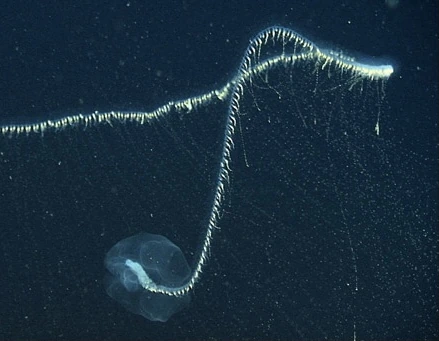
A long, glowing siphonophore ocean animal floats in dark water, its bioluminescent body forming a wavy line. A faint, translucent organism is visible in the lower left corner.

Siphonophores are one of the most fascinating and mysterious creatures in the ocean. They kindle inspiration not only in the minds of scientists but also in those of naturalists. These organisms are more than individual animals; instead, they can be colonies that have the possibility of being as long as a blue whale, the largest animal on Earth. This article will proceed to talk about the biology, behavior, ecological importance, and mysteries about siphonophores, thus bringing to light why it’s worth appreciating them.

What Is a Siphonophore?

Siphonophores belong to the class Cnidaria, consisting of jellyfish, corals, and sea anemones. Classifying siphonophores under the order Hydrozoa, these living organisms primarily exist in ocean water, specifically in warm as well as temperate waters. In contrast to any other types of jellyfish, colonies are distinguished because siphonophores are composed of several specialized individuals known as zooids or polyps. Each zooid performs specific functions aiding in the survival of the entire colony.

Body Structure of Siphonophores

Siphonophores are a wonder of adaptive evolution-their structure. A typical siphonophore has a long, buoyant gas-filled float called the pneumatophore, which floats near the water’s surface. This float often looks like the sail of a sailboat, and you might see one poking above the water.

Hanging from this float below are a string of elongated tentacles and specialized zooids serving all sorts of purposes:

ADVERTISEMENT

– Feeding Zooids (Gastrozooids):

READ ALSO

Fossil Penguins From New Zealand Reveal Stages of the Birds’ Long Evolutionary History

Researchers Identify a Hidden Memory Risk Hiding in Plain Sight for Older Adults

These are the zooids that catch prey.

ADVERTISEMENT

They have nematocysts-the stinging cells to paralyze such small fishes and planktonic organisms.

Sexual reproduction is also produced by the gametes coming out from such reproductive zooids which form new colonies.

– Locomotive Zooids (Bracts):

ADVERTISEMENT

Such zooids which are specialized pump the colony inside water because of contraction and relaxation.

With this division of labor, they are properly thriving in their marine environment with a very high level of organization and efficiency.

Length Matters:

Size of Siphonophores

One of the most stunning features of siphonophores is its size. The record-breaking length attained by the Praya Dubia is up to 40 meters or (131 feet) and up to many meters more. In some reports, lengths are said to reach up to 47 meters or more in 154 feet, making it one of the longest animals that exist on earth. Such a fantastic length is attained through the continuous growth and budding of zooids from one fertilized egg.

On the contrary, blue whales have an average length of up to 30 m. Thus, siphonophores surpass not only their own length but even surpass those of the most magnificent marine mammals, such as the blue whale. The sizes of these organisms raise a lot of questions about their biology and how such a structure could actually function properly in this aquatic environment.

The Life Cycle of Siphonophores

The life cycle of siphonophores is complex, occurring through both sexual and asexual methods of reproduction. The next chapter describes the life cycle of siphonophores in further detail to help provide better insight into their ecological role within marine ecosystems.

Asexual Reproduction

Asexual budding is the main method of reproduction by siphonophores. This process begins when a fertilized egg develops into a planula larva that settles on a substrate and matures into a new colony. The colony then grows to produce new zooids through budding. Such allows for extremely rapid growth in population size when circumstances are favorable.

Sexual Reproduction

Most siphonophores reproduce asexually although they have a sexual reproduction phase of life history. Gonozooids produce the gametes which will have to be released in the water column, fertilize and then form new planula larvae which settle to re-colonize.

Lifespan

Actually, siphonophores can last for several months or even years; this all depends on the setting, species type, and many other conditions. They can multiply so dramatically and utilize all resources available.

Habitat and Distribution

Though there exist different types of marine environments that house siphonophores, they are largely found in the open waters known as the pelagic zones. They prefer warmer waters but can also thrive in temperate regions. The distribution might vary depending on several variables including water temperature, salinity, and food resources.

Ecological Role

Siphonophores play an important role in marine ecosystems; they serve as predators but also as prey for other animals.

Predators: Such being carnivorous animals, siphonophores prey on small fish, zooplankton, and other marine animals by immobilizing the latter using paralyzing stinging tentacles before being consumed.

Prey: These are very important food for many species of marine animals including large species of fish, sea turtles as well as certain whales.

Importance in Ecosystem: The importance of the animal can be assessed from the fact that it is represented in marine food webs.

The Shining Adaptation: Perhaps the most astounding characteristic of many species of siphonophores is that they are bioluminescent. That means that light is produced as the result of biochemical reactions within their bodies. This serves a number of purposes:

Deterrent against Prey: A flash of light may scare predators or bring them away from the siphonophore.

Attraction of Prey: Other species use bioluminescence to attract prey so that it will swim closer to be struck by tentacles.

Communication: Bioluminescence can be used as a form of communication between zooids in a colony or between colonies.

Studying bioluminescence in siphonophores for ecological purposes had some spin-off effects, leading scientists to study them in medicine and biotechnology.

Interesting Species of Siphonophores

There are many over 175 described species, but some have been selected here for their special characteristics or impressive size:

1. Praya Dubia

As mentioned earlier, Praya Dubia is one of the longest animals on Earth. The species is mainly located in deep ocean waters off New Zealand and Australia but had been reported operating at depths of over 1,000 meters (3,280 feet). Its great length makes it very interesting for scientists to study deep-sea habitats.

2.Physalia Physalis (Portuguese Man o’ War)

Misidentified as a jellyfish because of its dramatic shape, the Physalia physalis is actually a colonial animal made up of four different zooids. The gas-filled float allows it to float on ocean currents, while its long tentacles can reach a length of 30 meters (98 feet). The venomous tentacles pose dangers to swimmers but are also a key means of catching prey.

3. Rhizophysa

Rhizophysa is another very interesting siphonophore, by the unique way of feeding. The species dwells in large colonies with specialized feeding zooids that catch planktonic animals in complicated webs consisting of tentacles.

Threats Faced by Siphonophores

Although siphonophores are hardy and can adjust to conditions, they are faced with a number of threats from human activities:

Climate Change

Ocean warming strains marine ecosystems to their limits. Climatic variation can alter the availability of food to the siphonophores while affecting its reproductive cycles as well.

Pollution

Marine pollution is another threat that is likely to impact large chunks of siphonophores. For example, plastics and other chemicals further interfere with the habitat and food availability of siphonophores.

Overfishing

Overfishing can also impact the catch species but also decimates the entire food web via which the siphonophores are part of as predators or prey.

Exploration of Siphonophores: Barriers and Opportunities

Research on siphonophores is immensely challenging, simply because of their elusive nature and deep-sea habitats:

Advancements in Technology

New technologies in underwater research have only in the last decade or so allowed scientists to study them as thoroughly as ever before. Submersibles equipped with cameras enable scientists to capture and study the behavior of siphonophores in the wild without harming their natural habitats.

Citizen Science Projects

Citizen science initiatives also involve citizens engaged in gathering data on observations about marine life, including siphonophores: sighting or photographs during coastline surveys or recreational scuba diving expeditions.

Conclusion

So beautiful examples like the siphonophore, occurring in nature, point to its ingenuity adapting to survival characteristics over such gigantic oceanic environments. Often bigger than a blue whale, and their complicated social structure and organization make these organisms singularly worthy of more study.

As we continue our venture into our oceans’ depths that house these magnificent creatures besides countless other wonders, efforts should go towards conserving marine ecosystems against adverse human impacts such as global warming and pollution.

It may be spread forward to make people aware of these clonal colonies as relevant in the web of the ocean and might assure generations the opportunity to marvel at these enigmatic beings below waves that are far removed from our reach!

siphonophores.jpg

Engage with Us:

Stay tuned for more captivating insights and News. Visit our Blogs , Science paper , Study Portal and Follow Us on social media to never miss an update. Together, let’s unravel the mysteries of the natural world.

  • Share on WhatsApp (Opens in new window) WhatsApp
  • Share on Facebook (Opens in new window) Facebook
  • Share on Reddit (Opens in new window) Reddit
  • Share on X (Opens in new window) X
  • Print (Opens in new window) Print

Did you like this read? Turn on notifications so we can let you know the second a new post goes live.

Turn off Alerts
Shibasis Rath

Shibasis Rath

"𝓒𝓸𝓷𝓷𝓮𝓬𝓽𝓲𝓷𝓰 𝓡𝓮𝓼𝓮𝓪𝓻𝓬𝓱 𝓣𝓸 𝓡𝓮𝓪𝓵𝓲𝓽𝔂" 𝓲𝓼𝓷'𝓽 𝓙𝓾𝓼𝓽 𝓪 𝓜𝓸𝓽𝓽𝓸 - 𝓘𝓽'𝓼 𝓜𝔂 𝓜𝓲𝓼𝓼𝓲𝓸𝓷

Related Posts

Fossil Penguins From New Zealand Reveal Stages of the Birds’ Long Evolutionary History
DISCOVERIES

Fossil Penguins From New Zealand Reveal Stages of the Birds’ Long Evolutionary History

May 1, 2026
Group of seniors walking down a city street.
NEUROSCIENCE

Researchers Identify a Hidden Memory Risk Hiding in Plain Sight for Older Adults

April 30, 2026
Rare Peacock Tarantula Image
NEWS

Critically Endangered Blue Tarantula Surveyed in India’s Largest Tiger Reserve

April 30, 2026

POPULAR NEWS

Yelling Isn’t Just Yelling: How a Hostile Home Rewires a Child’s Brain for Constant Alert

Yelling Isn’t Just Yelling: How a Hostile Home Rewires a Child’s Brain for Constant Alert

by Shibasis Rath
March 9, 2026
0

To a parent in the heat of the moment, a raised voice may feel like simple frustration. To a child...

a group of gen Z kids walking down a street

Is Gen Z the First Generation Less Intelligent Than Their Parents?

by Shibasis Rath
March 14, 2026
0

Gen Z intelligence decline is emerging as a serious concern among neuroscientists and education researchers. For over a century, each...

Whole Brain Emulation Achieved: Scientists Run a Fruit Fly Brain in Simulation

by Shibasis Rath
March 9, 2026
0

Scientists have copied an entire biological brain neuron by neuron and synapse by synapse and made it control a simulated...

Male G-spot isn’t where we thought it was

Male G-Spot Found: New Study Identifies Frenular Delta as Penis’s Most Sensitive Area

by Staff Writer
April 27, 2026
0

The study found that human penile innervation develops in distinct fetal stages and shows region-specific patterns in adults, with the...

A long, glowing siphonophore ocean animal floats in dark water, its bioluminescent body forming a wavy line. A faint, translucent organism is visible in the lower left corner.

Siphonophores: Colonies That Grow Longer Than a Blue Whale

by Shibasis Rath
August 13, 2025
0

Siphonophores are one of the most fascinating and mysterious creatures in the ocean. They kindle inspiration not only in the...

EDITOR CHOICE‘S

  • All
  • NEWS
  • SPOTLIGHTS
Recent Study Indicates Constant Praise May Actually Lower a Child’s Academic Risk-Taking.

Recent Study Indicates Constant Praise May Actually Lower a Child’s Academic Risk-Taking.

by Staff Writer
May 3, 2026
0

Recent studies on types of praise and children's academic motivation show that constantly praising a child's fixed traits, such as their intelligence...

SLC38A4 expression was confirmed by western blot in multiple tumor cell lines. In mouse models, liver tissue imaging (H&E staining) showed that overexpression of SLC38A4 reduced metastatic tumor areas, while knockdown increased them across Hepa1-6, MC38, and B16F10 cells. Results were consistent in both immunocompetent and nude mice, with statistically significant differences.

Scientists Find Molecule That Wipes Out Liver Cancer

by Shibasis Rath
May 2, 2026
0

Researchers investigated this question because metastasis causes most cancer deaths, and the liver is a frequent site of spread for...

Fossil Penguins From New Zealand Reveal Stages of the Birds’ Long Evolutionary History

Fossil Penguins From New Zealand Reveal Stages of the Birds’ Long Evolutionary History

by Shibasis Rath
May 1, 2026
0

The discovery of four new species of fossil penguins in New Zealand in 2025 sheds light on the long evolutionary...

Bluebuck antelope with silvery-blue coat and curved horns running across open South African grassland, representing extinct species targeted for de-extinction by scientists

Colossal Biosciences Announces De-Extinction of Bluebuck Antelope, 226 Years After Its Extinction

by Staff Writer
May 1, 2026
0

It has been 226 years since humans last saw a living bluebuck, an elegant antelope species native to South Africa...

ADVERTISEMENT

RathBiotaClan – RBC

RathBiotaClan – Connecting Research To Reality

Your trusted source for life science news, biology research & discoveries. Covering neuroscience, genetics, ecology, and more — connecting research to reality.

Privacy Policies

Shipping Policy

Cancellation & Refund Policy

Pricing Details

Contact Us

Latest Posts

  • Recent Study Indicates Constant Praise May Actually Lower a Child’s Academic Risk-Taking.
  • Scientists Find Molecule That Wipes Out Liver Cancer
  • Fossil Penguins From New Zealand Reveal Stages of the Birds’ Long Evolutionary History
  • Colossal Biosciences Announces De-Extinction of Bluebuck Antelope, 226 Years After Its Extinction

SHIBASIS RATH

Contact Mail

rathbiotaclan@gmail.com

No Result
View All Result
MSME (Udyam) Certified Science Platform
Govt. of India

Get Us On PlayStore

playstore app for rathbiotaclan
  • About Us
  • Advertise With Us
  • Cancellation and Refund Policy
  • Contact Us
  • Contribute
  • Editorial Standards
  • Home
  • Pricing Details
  • Privacy Policies
  • Shipping Policy
  • Terms & Conditions

© 2026 RathBiotaClan. All rights reserved.

Welcome Back!

Sign In with Google
OR

Login to your account below

Forgotten Password? Sign Up

Create New Account!

Sign Up with Google
OR

Fill the forms below to register

*By registering into our website, you agree to the Terms & Conditions and Privacy Policy.
All fields are required. Log In

Retrieve your password

Please enter your username or email address to reset your password.

Log In
No Result
View All Result
  • HOME
  • HEALTH SCIENCE
  • NEUROSCIENCE
    • PHYSIOLOGY
    • IMMUNOLOGY
    • CANCER
  • DISCOVERIES
    • SPOTLIGHTS
    • STUDENT PORTAL
    • SCIENCE FEATURED
  • MOLECULAR BIOLOGY
    • GENETICS
    • BIOTECHNOLOGY
    • BIOINFORMATICS
    • BIOCHEMISTRY
    • BIOPHYSICS
  • ZOOLOGY & ECOLOGY
    • ENVIRONMENTAL SCIENCE
    • ECOLOGY
    • EVOLUTION
  • MICRO & PLANT SCIENCE
    • MICROBIOLOGY
    • CELL BIOLOGY
    • DEVELOPMENTAL BIOLOGY
  • PSYCHOLOGY
  • Login
  • Sign Up
SAVED POSTS

© 2026 RathBiotaClan. All rights reserved.

This website uses cookies. By continuing to use this website you are giving consent to cookies being used. Visit our Privacy and Cookie Policy.
Are you sure want to unlock this post?
Unlock left : 0
Are you sure want to cancel subscription?