
Friday, May 1, 2026
SAVED POSTS
  • Login
  • Register
RathBiotaClan
No Result
View All Result
  • HOME
  • HEALTH SCIENCE
    • NEUROSCIENCE
    • PHYSIOLOGY
    • IMMUNOLOGY
    • CANCER
  • DISCOVERIES
    • SPOTLIGHTS
    • STUDENT PORTAL
    • SCIENCE FEATURED
  • MOLECULAR BIOLOGY
    • GENETICS
    • BIOTECHNOLOGY
    • BIOINFORMATICS
    • BIOCHEMISTRY
    • BIOPHYSICS
  • ZOOLOGY & ECOLOGY
    • ENVIRONMENTAL SCIENCE
    • ECOLOGY
    • EVOLUTION
  • MICRO & PLANT SCIENCE
    • MICROBIOLOGY
    • CELL BIOLOGY
    • DEVELOPMENTAL BIOLOGY
  • PSYCHOLOGY
  • E STORE
No Result
View All Result
RathBiotaClan
No Result
View All Result
Home GENETICS

Scientists Trace HIV-Resistant Gene to 9,000-Year-Old Ancestor

Shibasis Rath by Shibasis Rath
July 9, 2025
in GENETICS, NEWS
Reading Time: 4 mins read
0
A A
0

Key Findings

  • The CCR5Δ32 genetic deletion emerged on an ancestral haplotype made up of 84 distinct genetic markers.
  • This haplotype first appeared in populations of the Western Steppe around 6,700 years ago.
  • The CCR5Δ32 variant experienced positive evolutionary pressure during the Late Neolithic and Bronze Age periods.
  • These discoveries suggest a novel perspective on the medical significance of the CCR5Δ32 mutation.

Scientists have finally traced the HIV-resistant gene back to a single ancestor who lived near the Black Sea over 9,000 years ago. Modern HIV medicine is built on a ubiquitous genetic mutation. Today, researchers have deciphered where and when the mutation happened—and how it protected our ancestors from ancient diseases.

READ ALSO

Colossal Biosciences Announces De-Extinction of Bluebuck Antelope, 226 Years After Its Extinction

Critically Endangered Blue Tarantula Surveyed in India’s Largest Tiger Reserve

What links a thousand-year-old human from the Black Sea area to modern HIV medicine?

More information: Kirstine Ravn et al, Tracing the evolutionary history of the CCR5delta32 deletion via ancient and modern genomes, Cell (2025). DOI: 10.1016/j.cell.2025.04.015

ADVERTISEMENT

Plenty, it turns out, according to new University of Copenhagen research. The study is published in Cell.

About 18–25% of the Danish population carries a genetic mutation that makes them resistant or even immune to HIV. This knowledge is used to develop modern treatments for the virus.

ADVERTISEMENT

Until now, nobody knew where, when, or why the mutation occurred. But with the use of sophisticated DNA technology, scientists have now solved this genetic puzzle.

“It seems the variant arose in an individual who was living in a part of the world near the Black Sea approximately 6,700 to 9,000 years ago,” says Professor Simon Rasmussen from the Novo Nordisk Foundation Center for Basic Metabolic Research (CBMR) at the University of Copenhagen, lead author of a new paper that tracks the mutation.

“HIV is a relatively newly emerged disease—less than 100 years old—so it’s almost accidental and extremely interesting that a change in the genes that occurred thousands of years ago also protects against a modern virus like HIV.”

ADVERTISEMENT

To determine where and when the mutation first appeared, the scientists initially mapped it by examining the genetic code of 2,000 living people worldwide. They subsequently developed a novel AI-driven method to locate the mutation in ancient DNA on ancient bones.

The researchers compared information from over 900 skeletons dating from the early Stone Age to the Viking Age.

“By looking at this large dataset, we can determine where and when the mutation happened. For a period, the mutation is completely absent, but then it just pops up and spreads very quickly. If we combine that with our knowledge of human migration at the time, we can also determine where the mutation happened,” says first author Kirstine Ravn, senior researcher at CBMR.

So, the researchers were able to follow the mutation in a Black Sea dweller as far back as 9,000 years ago—a common ancestor from whom all mutation carriers descend.

But why did so many Danes inherit a thousand-year-old genetic mutation against a disease that didn’t yet exist?

The researchers believe that the mutation had appeared and evolved rapidly because it gave our ancestors an edge:

“This mutation had an advantage of surviving because it suppressed the immune system when humans were exposed to new pathogens,” says Leonardo Cobuccio, co-first author and postdoc at CBMR.

Kirstine Ravn add:

“Interestingly, the variation inactivates an immune gene. Sounds bad, but it likely was good. An overactive immune system can kill you—think allergic reactions or worst-case scenarios of viral infections like COVID-19, where the immune system likes to cause the damage that kills patients.”.

“As humans became less hunter-gatherer and more settled together in agricultural communities, infectious disease pressure increased, and a better-balanced immune system might have been advantageous.”

REFERENCE JOURNAL

More information: Kirstine Ravn et al, Tracing the evolutionary history of the CCR5delta32 deletion via ancient and modern genomes, Cell (2025). DOI: 10.1016/j.cell.2025.04.015

Journal: Cell

  • Share on WhatsApp (Opens in new window) WhatsApp
  • Share on Facebook (Opens in new window) Facebook
  • Share on Reddit (Opens in new window) Reddit
  • Share on X (Opens in new window) X
  • Print (Opens in new window) Print

Did you like this read? Turn on notifications so we can let you know the second a new post goes live.

Turn off Alerts
Shibasis Rath

Shibasis Rath

"𝓒𝓸𝓷𝓷𝓮𝓬𝓽𝓲𝓷𝓰 𝓡𝓮𝓼𝓮𝓪𝓻𝓬𝓱 𝓣𝓸 𝓡𝓮𝓪𝓵𝓲𝓽𝔂" 𝓲𝓼𝓷'𝓽 𝓙𝓾𝓼𝓽 𝓪 𝓜𝓸𝓽𝓽𝓸 - 𝓘𝓽'𝓼 𝓜𝔂 𝓜𝓲𝓼𝓼𝓲𝓸𝓷

Related Posts

Bluebuck antelope with silvery-blue coat and curved horns running across open South African grassland, representing extinct species targeted for de-extinction by scientists
NEWS

Colossal Biosciences Announces De-Extinction of Bluebuck Antelope, 226 Years After Its Extinction

April 30, 2026
Rare Peacock Tarantula Image
NEWS

Critically Endangered Blue Tarantula Surveyed in India’s Largest Tiger Reserve

April 30, 2026
great white shark
ENVIRONMENTAL SCIENCE

Mesothermic fish face rising energy stress and overheating risk in warming oceans

April 20, 2026
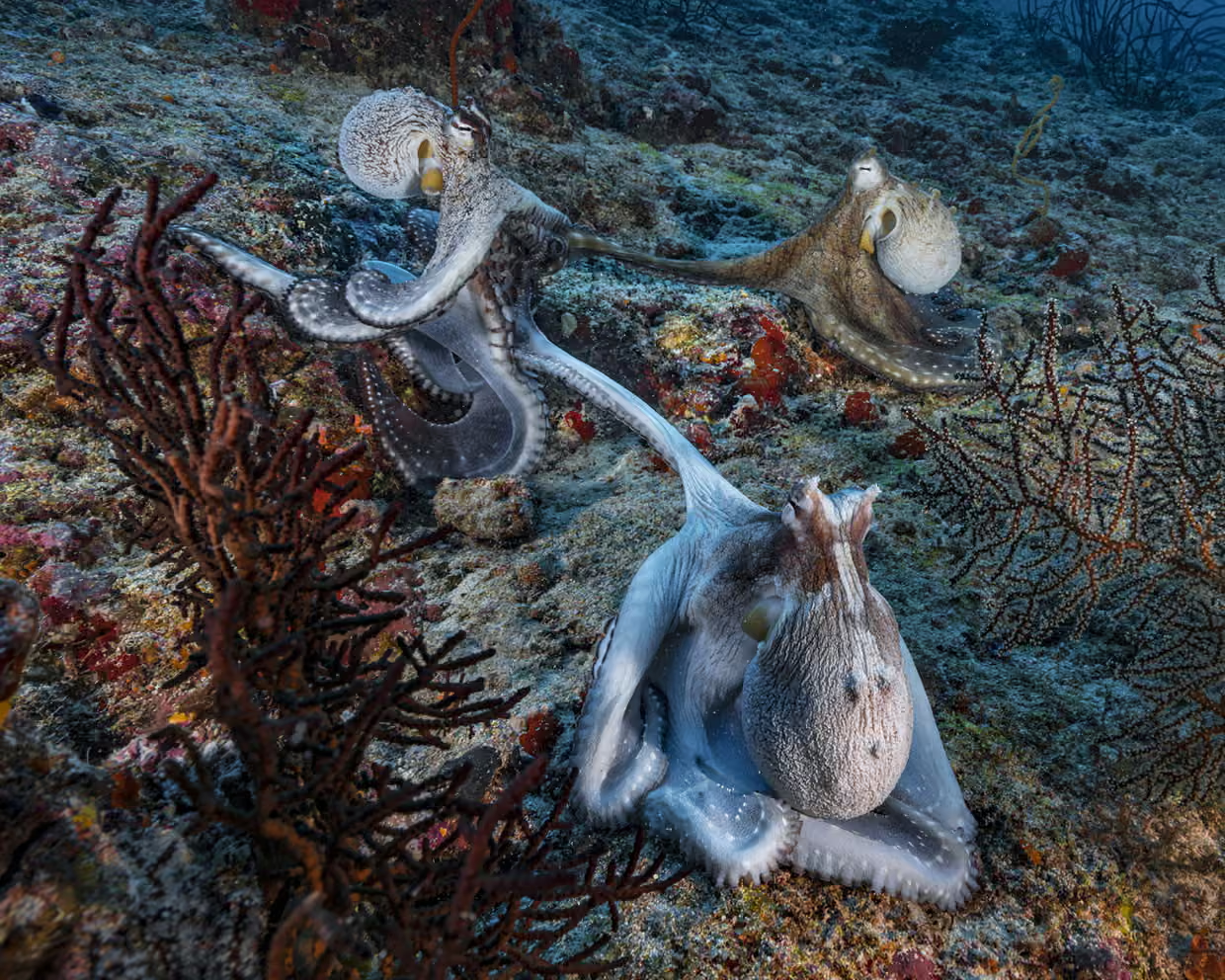
Scientists remain unclear about how the hectocotylus detects a mate, or delivers sperm to the right location. Photograph: Alexis Rosenfeld/c/o Visa Pour L'Image Perpignan
NEWS

Male Octopuses Sense Progesterone With Mating Arm, Study Finds

April 7, 2026
BIOTECHNOLOGY

Organ-on-a-Chip Ages Human Fat and Liver Tissue in 4 Days Using Old Blood Serum

April 2, 2026
handwriting difference in men and women
NEUROSCIENCE

Why Do Men Tend to Have Worse Handwriting Than Women?

April 27, 2026

POPULAR NEWS

Yelling Isn’t Just Yelling: How a Hostile Home Rewires a Child’s Brain for Constant Alert

Yelling Isn’t Just Yelling: How a Hostile Home Rewires a Child’s Brain for Constant Alert

by Shibasis Rath
March 9, 2026
0

To a parent in the heat of the moment, a raised voice may feel like simple frustration. To a child...

a group of gen Z kids walking down a street

Is Gen Z the First Generation Less Intelligent Than Their Parents?

by Shibasis Rath
March 14, 2026
0

Gen Z intelligence decline is emerging as a serious concern among neuroscientists and education researchers. For over a century, each...

Whole Brain Emulation Achieved: Scientists Run a Fruit Fly Brain in Simulation

by Shibasis Rath
March 9, 2026
0

Scientists have copied an entire biological brain neuron by neuron and synapse by synapse and made it control a simulated...

Male G-spot isn’t where we thought it was

Male G-Spot Found: New Study Identifies Frenular Delta as Penis’s Most Sensitive Area

by Staff Writer
April 27, 2026
0

The study found that human penile innervation develops in distinct fetal stages and shows region-specific patterns in adults, with the...

Scientists Trace HIV-Resistant Gene to 9,000-Year-Old Ancestor

by Shibasis Rath
July 9, 2025
0

Key Findings The CCR5Δ32 genetic deletion emerged on an ancestral haplotype made up of 84 distinct genetic markers. This haplotype...

EDITOR CHOICE‘S

  • All
  • NEWS
  • SPOTLIGHTS
Bluebuck antelope with silvery-blue coat and curved horns running across open South African grassland, representing extinct species targeted for de-extinction by scientists

Colossal Biosciences Announces De-Extinction of Bluebuck Antelope, 226 Years After Its Extinction

by Staff Writer
April 30, 2026
0

It has been 226 years since humans last saw a living bluebuck, an elegant antelope species native to South Africa...

Group of seniors walking down a city street.

Researchers Identify a Hidden Memory Risk Hiding in Plain Sight for Older Adults

by Shibasis Rath
April 30, 2026
0

More and more research suggests that psychological and behavioral factors can play a role in cognitive decline as people get...

Why Scientists Are Turning to Fish Scales to Restore Human Vision

Why Scientists Are Turning to Fish Scales to Restore Human Vision

by Shibasis Rath
April 30, 2026
0

Researchers at the University of Granada tested decellularized fish scales. They used these scales to create bioartificial corneas. Laboratory and...

Rare Peacock Tarantula Image

Critically Endangered Blue Tarantula Surveyed in India’s Largest Tiger Reserve

by Shibasis Rath
April 30, 2026
0

A new conservation survey has begun for the Peacock Tarantula (Poecilotheria metallica) inside the Nagarjunasagar Srisailam Tiger Reserve (NSTR). This...

ADVERTISEMENT

RathBiotaClan – RBC

RathBiotaClan – Connecting Research To Reality

Your trusted source for life science news, biology research & discoveries. Covering neuroscience, genetics, ecology, and more — connecting research to reality.

Privacy Policies

Shipping Policy

Cancellation & Refund Policy

Pricing Details

Contact Us

Latest Posts

  • Colossal Biosciences Announces De-Extinction of Bluebuck Antelope, 226 Years After Its Extinction
  • Researchers Identify a Hidden Memory Risk Hiding in Plain Sight for Older Adults
  • Why Scientists Are Turning to Fish Scales to Restore Human Vision
  • Critically Endangered Blue Tarantula Surveyed in India’s Largest Tiger Reserve

SHIBASIS RATH

Contact Mail

rathbiotaclan@gmail.com

No Result
View All Result
MSME (Udyam) Certified Science Platform
Govt. of India

Get Us On PlayStore

playstore app for rathbiotaclan
  • About Us
  • Advertise With Us
  • Cancellation and Refund Policy
  • Contact Us
  • Contribute
  • Editorial Standards
  • Home
  • Pricing Details
  • Privacy Policies
  • Shipping Policy
  • Terms & Conditions

© 2026 RathBiotaClan. All rights reserved.

Welcome Back!

Sign In with Google
OR

Login to your account below

Forgotten Password? Sign Up

Create New Account!

Sign Up with Google
OR

Fill the forms below to register

*By registering into our website, you agree to the Terms & Conditions and Privacy Policy.
All fields are required. Log In

Retrieve your password

Please enter your username or email address to reset your password.

Log In
No Result
View All Result
  • HOME
  • HEALTH SCIENCE
    • NEUROSCIENCE
    • PHYSIOLOGY
    • IMMUNOLOGY
    • CANCER
  • DISCOVERIES
    • SPOTLIGHTS
    • STUDENT PORTAL
    • SCIENCE FEATURED
  • MOLECULAR BIOLOGY
    • GENETICS
    • BIOTECHNOLOGY
    • BIOINFORMATICS
    • BIOCHEMISTRY
    • BIOPHYSICS
  • ZOOLOGY & ECOLOGY
    • ENVIRONMENTAL SCIENCE
    • ECOLOGY
    • EVOLUTION
  • MICRO & PLANT SCIENCE
    • MICROBIOLOGY
    • CELL BIOLOGY
    • DEVELOPMENTAL BIOLOGY
  • PSYCHOLOGY
  • E STORE
  • Login
  • Sign Up
SAVED POSTS

© 2026 RathBiotaClan. All rights reserved.

This website uses cookies. By continuing to use this website you are giving consent to cookies being used. Visit our Privacy and Cookie Policy.
Are you sure want to unlock this post?
Unlock left : 0
Are you sure want to cancel subscription?