




Wednesday, May 6, 2026
SAVED POSTS
  • Login
  • Register
RathBiotaClan
No Result
View All Result
  • HOME
  • HEALTH SCIENCE

    TRENDING ON HEALTH (TOP)

    Trauma Shrinks the Brain But Science Shows Exercise Can Rebuild It from the Inside Out

    Dreams about loved ones can bring comfort before death

    Male G-Spot Found: New Study Identifies Frenular Delta as Penis’s Most Sensitive Area

    New Stem Cell Therapy Rebuilds Bone in Osteoporosis, Shows 30% Density Gain

    NOW ON AIR (RBC)

    SCIENCE FEATURED

    Low Sexual Frequency Linked to Worse Cardiovascular Outcomes, Two US Studies Find

    May 5, 2026
    NEWS

    Global Sperm Counts Have Dropped 50% in 50 Years Now 128 Men Are Racing Their Way to a $100,000 Prize to Prove the Point

    May 5, 2026
    a person sitting on a bench on a sidewalk
    HEALTH SCIENCE

    Trauma Shrinks the Brain But Science Shows Exercise Can Rebuild It from the Inside Out

    May 5, 2026
    Functional Lab-Grown Esophagus Successfully Implanted in Growing Pigs
    BIOTECHNOLOGY

    Functional Lab-Grown Esophagus Successfully Implanted in Growing Pigs

    May 4, 2026
  • NEUROSCIENCE
    • PHYSIOLOGY
    • IMMUNOLOGY
    • CANCER
  • DISCOVERIES
    • SPOTLIGHTS
    • STUDENT PORTAL
    • SCIENCE FEATURED
  • MOLECULAR BIOLOGY
    • GENETICS
    • BIOTECHNOLOGY
    • BIOINFORMATICS
    • BIOCHEMISTRY
    • BIOPHYSICS
  • ZOOLOGY & ECOLOGY
    • ENVIRONMENTAL SCIENCE
    • ECOLOGY
    • EVOLUTION
  • MICRO & PLANT SCIENCE
    • MICROBIOLOGY
    • CELL BIOLOGY
    • DEVELOPMENTAL BIOLOGY
  • PSYCHOLOGY
RBC Interactive Sticky Bar
RathBiotaClan Logo
Shop Resources
Life Science Whole Spectrum Focus
24/7 Digital Access
Pro Resources For Students & Researchers
Premium Articles
Research-backed insights for the curious mind.
eBooks
Digital books covering lab protocols.
RBC Magazines
Deep dives and science innovations.
Research Guides
Methodologies and application frameworks.
Pro Notes PDF
High-yield study notes for quick review.
View All Resources
Browse the complete digital library.
RathBiotaClan Seal

Connecting Research to Reality

Science is our safest secret. Explore the life science spectrum with insights for the curious mind.

RathBiotaClan
No Result
View All Result
Home MICROBIOLOGY

Scientists Find Hidden Diversity Inside Common Brain Parasite

Shibasis Rath by Shibasis Rath
February 3, 2026
in MICROBIOLOGY, NEWS, SPOTLIGHTS
Reading Time: 4 mins read
0
A A
0
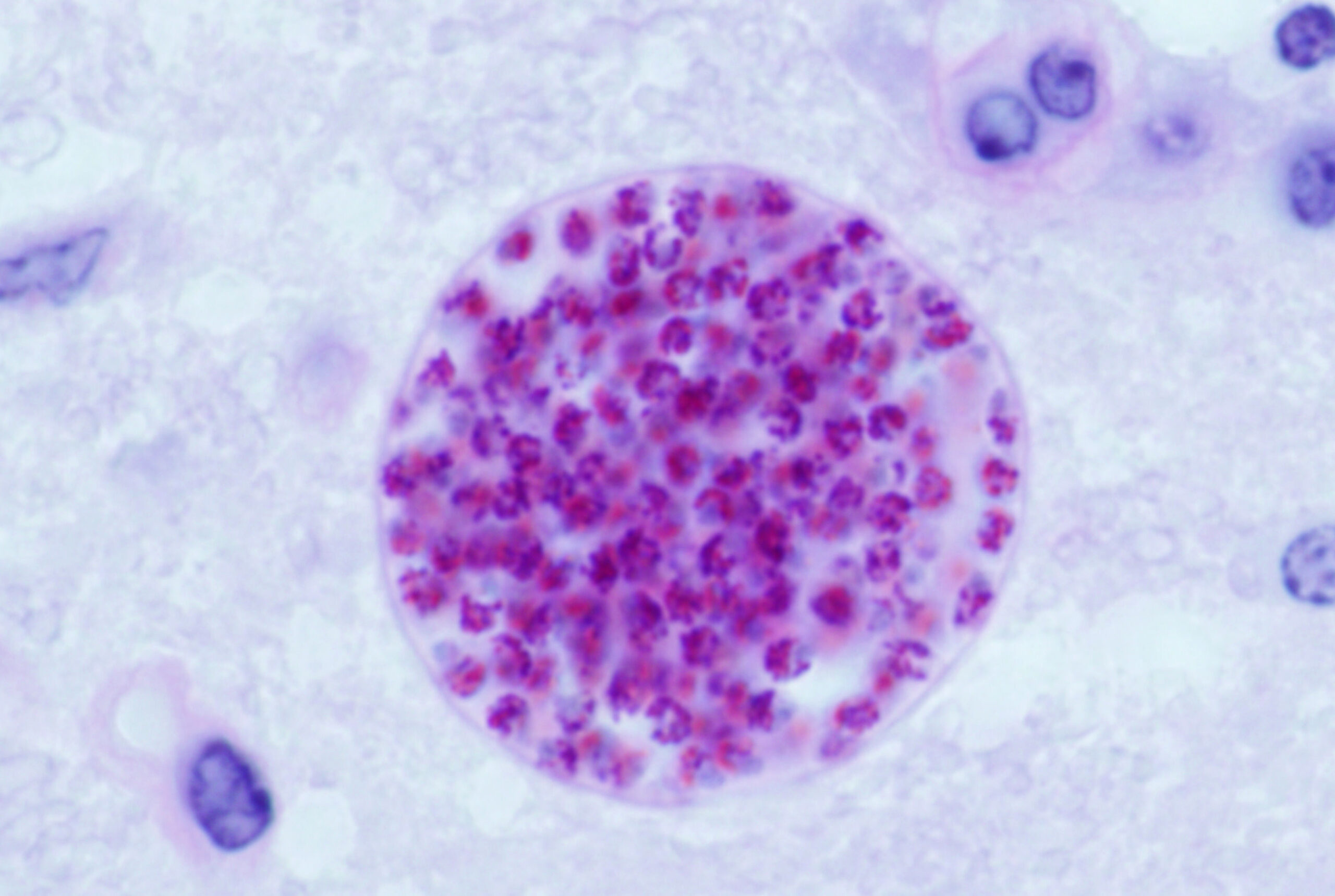
Toxoplasma gondii brain cyst

The Toxoplasma gondii parasite, often called the “cat parasite,” infects roughly one in three people worldwide, lurking quietly in the brain and muscles for years without causing noticeable symptoms in most healthy individuals. For decades, scientists believed that during this chronic phase, the parasite simply goes dormant inside tiny protective cysts essentially “sleeping” to evade the immune system.

A major new study published in January 2026 in Nature Communications has turned that view upside down. Researchers at the University of California, Riverside, led by Professors Emma Wilson and Michael White, have uncovered surprising hidden activity and diversity inside these cysts. Far from being uniform sleeping bags of identical parasites, each cyst turns out to be a bustling microscopic community with specialized roles.

“If we want to really treat toxoplasmosis, the cyst is the place to focus.”
— Professor Emma Wilson, University of California, Riverside

The Silent Invader

Toxoplasma gondii spreads mainly through undercooked meat, contact with contaminated soil, or cat feces containing oocysts. In healthy adults, the initial (acute) infection usually passes unnoticed or causes only mild flu-like symptoms. The parasite then shifts gears, forming long-lived cysts filled with slow-growing forms called bradyzoites.

These cysts embed primarily in brain neurons and muscle tissue. For decades, researchers have considered them largely inactive—a dormant stage beyond the reach of current drugs.

ADVERTISEMENT

This assumption creates a major clinical problem. In people with weakened immune systems, such as those with HIV/AIDS, organ transplant recipients, or cancer patients on chemotherapy, the cysts can reactivate. Bradyzoites then revert to fast-dividing tachyzoites. This shift triggers severe complications, including brain inflammation (toxoplasmic encephalitis) and eye damage that can progress to blindness. Congenital transmission during pregnancy can also harm developing fetuses.

READ ALSO

Global Sperm Counts Have Dropped 50% in 50 Years Now 128 Men Are Racing Their Way to a $100,000 Prize to Prove the Point

Functional Lab-Grown Esophagus Successfully Implanted in Growing Pigs

Until now, the cyst stage has been a black box for drug developers no approved treatments eliminate established cysts.

ADVERTISEMENT

Cracking Open the Cyst with New Evolving Tech

Studying cysts has always been tough. They’re small, slow-growing, wrapped in a tough wall, and hard to replicate reliably in lab dishes. Traditional cell cultures often produce incomplete or artificial versions of bradyzoites.

The UC Riverside team overcame these hurdles using a realistic mouse model of natural infection. They isolated parasites directly from brain cysts in living animals (in vivo) and applied single-cell RNA sequencing a powerful technique that reads the genetic activity of individual cells. This let them profile thousands of bradyzoites one by one, revealing their molecular identities.

The results were striking: instead of one uniform type of bradyzoite, each cyst contains at least five distinct subtypes. These aren’t minor random differences—they represent specialized populations with different gene expression profiles and likely different jobs.

ADVERTISEMENT

“Each cyst turns out to be a bustling microscopic community with specialized roles not a passive shelter, but an active hub.”
— From the Nature Communications study

  • Some subtypes appear geared toward long-term persistence and survival within the host.
  • Others may support eventual transmission (e.g., if eaten by a new host).
  • Certain ones seem “primed” for reactivation, ready to switch back to the aggressive tachyzoite form under the right conditions (like immune suppression).

The cyst, long imagined as a passive shelter, is actually an active hub. Within it, multiple parasite subtypes interact to sustain chronic infection.

A particularly important discovery emerged from this work. One major subtype dominates real, chronic mouse infections, yet it is completely absent from standard laboratory (in vitro) models of bradyzoite development. This mismatch likely explains a long-standing problem. Drugs that appear effective in petri dishes often fail in animals or humans because they are tested against an incomplete version of the parasite.

“What was once dismissed as dormancy now looks like a sophisticated, multi-role ecosystem.”

Physically, the cysts are up to about 80 microns across (visible under a microscope but tiny to the naked eye), each potentially harboring hundreds of these five-micron-long bradyzoites.

Why This Matters and What’s Next

This work reframes the cyst as the true “control center” of Toxoplasma‘s long-term strategy. By mapping the molecular signatures of these subtypes especially those prone to reactivation scientists can now design smarter, targeted therapies. These approaches focus on the vulnerable “trigger” populations that reside inside the cyst.

The findings also carry important implications for prevention and drug development. They could help reduce the risk of congenital toxoplasmosis. In addition, they highlight a critical flaw in current drug screening. Future tests must incorporate more realistic, in vivo–derived parasites to capture the full diversity present during chronic infection.

Reference

Ulu, A., Srivastava, S., Kachour, N., Le, B. H., White, M. W., & Wilson, E. H. (2026). Bradyzoite subtypes rule the crossroads of Toxoplasma development. Nature Communications.


  • Share on WhatsApp (Opens in new window) WhatsApp
  • Share on Facebook (Opens in new window) Facebook
  • Share on Reddit (Opens in new window) Reddit
  • Share on X (Opens in new window) X
  • Print (Opens in new window) Print

Did you like this read? Turn on notifications so we can let you know the second a new post goes live.

Turn off Alerts
Shibasis Rath

Shibasis Rath

"𝓒𝓸𝓷𝓷𝓮𝓬𝓽𝓲𝓷𝓰 𝓡𝓮𝓼𝓮𝓪𝓻𝓬𝓱 𝓣𝓸 𝓡𝓮𝓪𝓵𝓲𝓽𝔂" 𝓲𝓼𝓷'𝓽 𝓙𝓾𝓼𝓽 𝓪 𝓜𝓸𝓽𝓽𝓸 - 𝓘𝓽'𝓼 𝓜𝔂 𝓜𝓲𝓼𝓼𝓲𝓸𝓷

Related Posts

NEWS

Global Sperm Counts Have Dropped 50% in 50 Years Now 128 Men Are Racing Their Way to a $100,000 Prize to Prove the Point

May 5, 2026
Functional Lab-Grown Esophagus Successfully Implanted in Growing Pigs
BIOTECHNOLOGY

Functional Lab-Grown Esophagus Successfully Implanted in Growing Pigs

May 4, 2026
person seeing someone sick
NEUROSCIENCE

How Seeing Someone Sick Boosts Your Immune System: Study Says

May 4, 2026

POPULAR NEWS

Yelling Isn’t Just Yelling: How a Hostile Home Rewires a Child’s Brain for Constant Alert

Yelling Isn’t Just Yelling: How a Hostile Home Rewires a Child’s Brain for Constant Alert

by Shibasis Rath
March 9, 2026
0

To a parent in the heat of the moment, a raised voice may feel like simple frustration. To a child...

a group of gen Z kids walking down a street

Is Gen Z the First Generation Less Intelligent Than Their Parents?

by Shibasis Rath
March 14, 2026
0

Gen Z intelligence decline is emerging as a serious concern among neuroscientists and education researchers. For over a century, each...

Whole Brain Emulation Achieved: Scientists Run a Fruit Fly Brain in Simulation

by Shibasis Rath
March 9, 2026
0

Scientists have copied an entire biological brain neuron by neuron and synapse by synapse and made it control a simulated...

Male G-spot isn’t where we thought it was

Male G-Spot Found: New Study Identifies Frenular Delta as Penis’s Most Sensitive Area

by Staff Writer
April 27, 2026
0

The study found that human penile innervation develops in distinct fetal stages and shows region-specific patterns in adults, with the...

Global Sperm Counts Have Dropped 50% in 50 Years Now 128 Men Are Racing Their Way to a $100,000 Prize to Prove the Point

by Staff Writer
May 5, 2026
0

A group of technology entrepreneurs is staging a competitive event in San Francisco in which semen samples from 128 men...

EDITOR CHOICE‘S

  • All
  • NEWS
  • SPOTLIGHTS

Low Sexual Frequency Linked to Worse Cardiovascular Outcomes, Two US Studies Find

by Shibasis Rath
May 5, 2026
0

A study using over a decade of national health survey data found that adults with cardiovascular disease who also reported...

Global Sperm Counts Have Dropped 50% in 50 Years Now 128 Men Are Racing Their Way to a $100,000 Prize to Prove the Point

by Staff Writer
May 5, 2026
0

A group of technology entrepreneurs is staging a competitive event in San Francisco in which semen samples from 128 men...

a person sitting on a bench on a sidewalk

Trauma Shrinks the Brain But Science Shows Exercise Can Rebuild It from the Inside Out

by Shibasis Rath
May 5, 2026
0

The relationship between psychological trauma and the physical structure of the brain is one of the most striking discoveries in...

Functional Lab-Grown Esophagus Successfully Implanted in Growing Pigs

Functional Lab-Grown Esophagus Successfully Implanted in Growing Pigs

by Staff Writer
May 4, 2026
0

Researchers implanted autologous, cell-seeded esophageal segments into growing minipigs. The grafts integrated with host tissue. They showed contractility, remodeling, and...

ADVERTISEMENT

RathBiotaClan – RBC

RathBiotaClan – Connecting Research To Reality

Your trusted source for life science news, biology research & discoveries. Covering neuroscience, genetics, ecology, and more — connecting research to reality.

Privacy Policies

Contact Us

About Us

Editorial Standards

Latest Posts

  • Low Sexual Frequency Linked to Worse Cardiovascular Outcomes, Two US Studies Find
  • Global Sperm Counts Have Dropped 50% in 50 Years Now 128 Men Are Racing Their Way to a $100,000 Prize to Prove the Point
  • Trauma Shrinks the Brain But Science Shows Exercise Can Rebuild It from the Inside Out
  • Functional Lab-Grown Esophagus Successfully Implanted in Growing Pigs

SHIBASIS RATH

Contact Mail

rathbiotaclan@gmail.com

No Result
View All Result
MSME (Udyam) Certified Science Platform
Govt. of India

Get Us On PlayStore

playstore app for rathbiotaclan
  • About Us
  • Advertise With Us
  • Cancellation and Refund Policy
  • Contact Us
  • Contribute
  • Editorial Standards
  • Home
  • Pricing Details
  • Privacy Policies
  • Shipping Policy
  • Terms & Conditions

© 2026 RathBiotaClan. All rights reserved.

Welcome Back!

Sign In with Google
OR

Login to your account below

Forgotten Password? Sign Up

Create New Account!

Sign Up with Google
OR

Fill the forms below to register

*By registering into our website, you agree to the Terms & Conditions and Privacy Policy.
All fields are required. Log In

Retrieve your password

Please enter your username or email address to reset your password.

Log In
No Result
View All Result
  • HOME
  • HEALTH SCIENCE
  • NEUROSCIENCE
    • PHYSIOLOGY
    • IMMUNOLOGY
    • CANCER
  • DISCOVERIES
    • SPOTLIGHTS
    • STUDENT PORTAL
    • SCIENCE FEATURED
  • MOLECULAR BIOLOGY
    • GENETICS
    • BIOTECHNOLOGY
    • BIOINFORMATICS
    • BIOCHEMISTRY
    • BIOPHYSICS
  • ZOOLOGY & ECOLOGY
    • ENVIRONMENTAL SCIENCE
    • ECOLOGY
    • EVOLUTION
  • MICRO & PLANT SCIENCE
    • MICROBIOLOGY
    • CELL BIOLOGY
    • DEVELOPMENTAL BIOLOGY
  • PSYCHOLOGY
  • Login
  • Sign Up
SAVED POSTS

© 2026 RathBiotaClan. All rights reserved.

This website uses cookies. By continuing to use this website you are giving consent to cookies being used. Visit our Privacy and Cookie Policy.
Are you sure want to unlock this post?
Unlock left : 0
Are you sure want to cancel subscription?