





Thursday, June 18, 2026
SAVED POSTS
  • Login
  • Register
RathBiotaClan
No Result
View All Result
  • HOME
  • HEALTH SCIENCE

    TRENDING ON HEALTH (TOP)

    For People Antidepressants Never Helped, a 30-Minute Home Session Is Now FDA-Approved

    Scientists Say Your Next Tube of Toothpaste Could Be Made From Human Hair

    Your Lungs, Liver, and Pancreas Also Age Faster When You Sleep Wrong

    Cycling Linked to Lower Dementia Risk in Study of Nearly 480,000 Adults

    NOW ON AIR (RBC)

    NEUROSCIENCE

    Step-Synchronized Brain Stimulation Reduces Falls in Small Parkinson’s Trial

    June 16, 2026
    NEWS

    A Father’s Touch in Infancy Can Shape a Child’s Health for Years, New Science Explains Why

    June 9, 2026
    MutExpress
    BIOINFORMATICS

    South Asian Patients Have Been Left Out of Cancer Genomics for Decades & MutExpress-India Is Changing That

    June 8, 2026
    Biodiversity Loss
    ECOLOGY

    Biodiversity Loss Could Bankrupt Nations And Wall Street Hasn’t Noticed Yet

    June 5, 2026
  • NEUROSCIENCE
    • PHYSIOLOGY
    • IMMUNOLOGY
    • CANCER
  • DISCOVERIES
    • SPOTLIGHTS
    • STUDENT PORTAL
    • SCIENCE FEATURED
  • MOLECULAR BIOLOGY
    • GENETICS
    • BIOTECHNOLOGY
    • BIOINFORMATICS
    • BIOCHEMISTRY
    • BIOPHYSICS
  • ZOOLOGY & ECOLOGY
    • ENVIRONMENTAL SCIENCE
    • ECOLOGY
    • EVOLUTION
  • MICRO & PLANT SCIENCE
    • MICROBIOLOGY
    • CELL BIOLOGY
    • DEVELOPMENTAL BIOLOGY
  • PSYCHOLOGY
RathBiotaClan
RathBiotaClan
No Result
View All Result
Home BIOINFORMATICS

PROTEUS Enables Precision Protein Engineering in Mammalian Cells

Shibasis Rath by Shibasis Rath
July 11, 2025
in BIOINFORMATICS, BIOPHYSICS, BIOTECHNOLOGY, MOLECULAR BIOLOGY, SCIENCE FEATURED
Reading Time: 5 mins read
0
A A
0
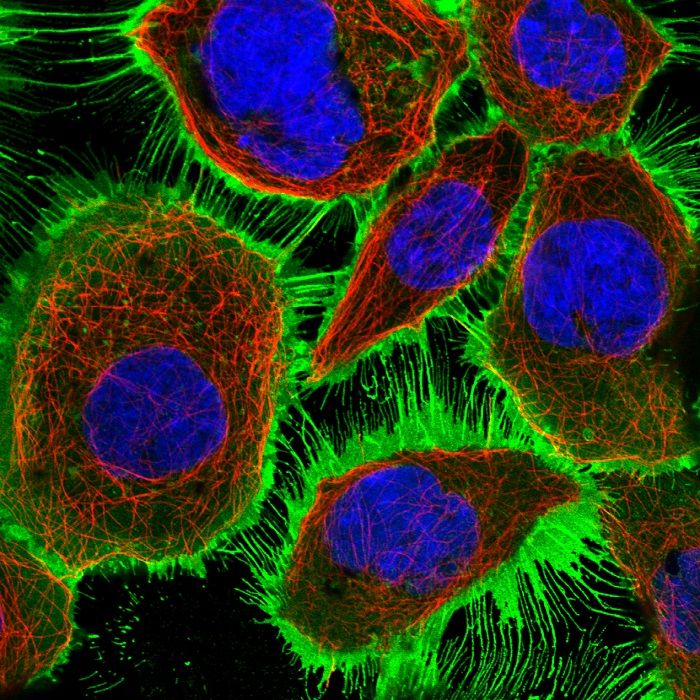
Fluorescent microscope image of cells showing blue nuclei, red cytoskeletal fibers, and green cell membranes. The web-like structures reveal intricate internal cell architecture relevant to PROTEUS protein evolution studies.

The PROTEin Evolution Using Selection (PROTEUS) platform represents a major breakthrough in biological engineering. It enables robust directed evolution of biomolecules directly within mammalian cells. Traditional methods often face challenges like instability, safety concerns, and limited functionality. PROTEUS solves these issues using capsid-deficient virus-like vesicles (VLVs), which provide a stable and reliable system. This innovation supports the evolution of proteins with enhanced, context-specific properties. By overcoming key obstacles in mammalian directed evolution, the platform opens new avenues for medical and biotechnological advances.

What Really PROTEUS Mean?

PROTEUS is a chimeric viral platform designed for prolonged directed evolution campaigns in mammalian cells. Directed evolution mimics natural selection through iterative cycles of diversification, selection, and amplification* to engineer biomolecules with novel or improved functions. Mammalian cells offer a natural environment that supports intricate post-translational modifications, protein-protein interactions, and signaling networks. This makes them ideal for developing proteins designed for use in mammalian applications, unlike prokaryotic or yeast-based systems. PROTEUS leverages these advantages to generate biomolecules with superior, context-specific performance.

Overcoming Limitations of Prior Systems

Historically, mammalian directed evolution faced significant hurdles:

  • Host genome mutations: Early cell-based systems were prone to unintended genetic changes, compromising stability.
  • Viral system limitations: Existing virus-based platforms suffered from safety risks, low mutation rates, target specificity issues, or production of non-functional “cheater particles” that undermined selection fidelity.
  • Alphavirus-based challenges: Previous alphavirus systems struggled with system integrity due to recombination or loss of selective pressure.

PROTEUS resolves these issues by using capsid-deficient VLVs derived from alphaviruses. These VLVs depend on the host cell’s production of the Indiana vesiculovirus G (VSVG) coat protein for infectivity and propagation, ensuring host-dependent propagation. This design prevents the formation of cheater particles and maintains a robust link between the target biomolecule’s activity and the VLV’s fitness, enabling continuous and precise selective pressure.

ADVERTISEMENT

Mechanism of Diversification

PROTEUS takes advantage of the error-prone RNA-dependent RNA polymerases found in alphaviruses. These enzymes naturally create mutations often. The platform has a baseline mutation rate of 2.6 mutations per 100,000 transduced cells. It shows a strong A-to-G (and U-to-C) transition bias. This bias is mainly caused by ADAR-dependent mutations. This inherent error rate diversifies the target transgene, creating a broad pool of variants for selection.

READ ALSO

South Asian Patients Have Been Left Out of Cancer Genomics for Decades & MutExpress-India Is Changing That

PubMed Research Finder for Life Science Students

To boost diversification, PROTEUS can include RNA nucleoside analogs such as molnupiravir. This compound increases the mutation rate by eight times, resulting in 22 mutations per 100,000 cells, and shifts the mutational bias to explore a broader array of protein variants. This tunable diversification mechanism allows PROTEUS to balance mutation rate and specificity, optimizing the evolution process for diverse applications.

ADVERTISEMENT

Ensuring System Integrity

A hallmark of PROTEUS is its ability to maintain system integrity.The platform connects the expression level of VSVG to the activity of the viral transgene. This ensures that only working biomolecules help with VLV propagation. This tight coupling enforces continuous selective pressure, preventing the propagation of non-functional variants and maintaining the platform’s efficiency over multiple evolutionary cycles.

ADVERTISEMENT

Demonstrated Successes

PROTEUS has proven its versatility through several high-impact applications:

Tetracycline-controlled transactivators (tTA): PROTEUS evolved tTA to become doxycycline-resistant, recovering well-characterized mutations such as R158G and the Q32R/R158G double mutant. These complex mutations, challenging to achieve through other methods, significantly enhanced resistance, demonstrating PROTEUS’s ability to generate sophisticated variants.

Reverse tetracycline-controlled transactivator (rtTA-3G): The platform optimized rtTA-3G, producing a superior variant (rtTA-4G with D5N/M59I mutations) with increased doxycycline sensitivity. This adaptation was mammalian-specific, highlighting the advantage of evolving proteins in their native cellular context, as bacterial systems could not replicate this enhancement.

 Intracellular Nanobody (Nb139): PROTEUS transformed a p53-interacting nanobody into a biosensor, with evolved variants (S26P and Y60C) improving intracellular function, nuclear localization, and detection of p53 activity in response to DNA damage. This application underscores PROTEUS’s potential for developing advanced diagnostic tools.

Limitations and Future Directions

While PROTEUS is a groundbreaking platform, it has some limitations:

Mutational bias: The platform’s diversification is primarily ADAR-mediated, which introduces a specific A-to-G bias. While molnupiravir can modulate this bias, it reduces the overall mutation rate, requiring careful optimization.

Cell-type specificity: PROTEUS currently performs best in BHK-21 cells due to their lack of a functional Type I interferon response, which suppresses antiviral defenses. Adapting PROTEUS to other mammalian cell types may require targeted inhibition of this pathway.

VSVG expression balance: Maintaining precise VSVG expression levels for complex targets or intricate circuit designs can be challenging, potentially limiting certain applications.

Future advancements could focus on expanding PROTEUS’s compatibility with diverse cell types and refining mutation strategies to minimize bias while maximizing diversity. These improvements could further broaden the platform’s applicability in therapeutic and biotechnological contexts.

Paradigm Shift in Biomolecular Engineering

PROTEUS marks a significant leap in directed evolution, providing a stable and efficient platform specifically designed for engineering biomolecules in mammals with exceptional precision. It overcomes the limitations of earlier systems by offering customized adaptations for specific applications. This innovation paves the way for new possibilities in protein engineering, including the development of advanced therapeutics and the creation of innovative biosensors. As a cornerstone of biological innovation, PROTEUS is poised to drive the next generation of biotechnological breakthroughs.


Reference

A chimeric viral platform for directed evolution in mammalian cells | Nature Communications

  • Share on WhatsApp (Opens in new window) WhatsApp
  • Share on Facebook (Opens in new window) Facebook
  • Share on Reddit (Opens in new window) Reddit
  • Share on X (Opens in new window) X
  • Print (Opens in new window) Print
Shibasis Rath

Shibasis Rath

"𝓒𝓸𝓷𝓷𝓮𝓬𝓽𝓲𝓷𝓰 𝓡𝓮𝓼𝓮𝓪𝓻𝓬𝓱 𝓣𝓸 𝓡𝓮𝓪𝓵𝓲𝓽𝔂" 𝓲𝓼𝓷'𝓽 𝓙𝓾𝓼𝓽 𝓪 𝓜𝓸𝓽𝓽𝓸 - 𝓘𝓽'𝓼 𝓜𝔂 𝓜𝓲𝓼𝓼𝓲𝓸𝓷

Related Posts

MutExpress
BIOINFORMATICS

South Asian Patients Have Been Left Out of Cancer Genomics for Decades & MutExpress-India Is Changing That

June 8, 2026
PubMed Research Finder for Life Science Students
BIOINFORMATICS

PubMed Research Finder for Life Science Students

May 26, 2026
woman in black jacket sitting on gray concrete wall during daytime
PSYCHOLOGY

Psychology Study Says, Why People Who Enjoy Being Alone Often Build Stronger Minds and Deeper Connections

May 21, 2026

POPULAR NEWS

Chewing gum releases thousands of microplastic particles directly into your mouth with every piece you chew

Chewing gum releases thousands of microplastic particles directly into your mouth with every piece you chew

by Shibasis Rath
May 8, 2026
0

Microplastics are turning up in places researchers never expected: deep-sea sediments, Arctic ice, and human blood. Now, a UCLA pilot...

New Studys Says Gen Z is the least sexually active young cohort in modern recorded history

New Studys Says Gen Z is the least sexually active young cohort in modern recorded history

by Shibasis Rath
January 24, 2026
0

A generation that grew up with dating apps in their pockets, pornography a tap away, and sex discussed more openly...

Yelling Isn’t Just Yelling: How a Hostile Home Rewires a Child’s Brain for Constant Alert

Yelling Isn’t Just Yelling: How a Hostile Home Rewires a Child’s Brain for Constant Alert

by Shibasis Rath
March 8, 2026
0

To a parent in the heat of the moment, a raised voice may feel like simple frustration. To a child...

a group of gen Z kids walking down a street

Is Gen Z the First Generation Less Intelligent Than Their Parents?

by Shibasis Rath
February 5, 2026
0

Gen Z intelligence decline is emerging as a serious concern among neuroscientists and education researchers. For over a century, each...

Whole Brain Emulation Achieved: Scientists Run a Fruit Fly Brain in Simulation

by Shibasis Rath
March 9, 2026
0

Scientists have copied an entire biological brain neuron by neuron and synapse by synapse and made it control a simulated...

EDITOR CHOICE‘S

  • All
  • NEWS
  • SPOTLIGHTS
Step-Synchronized Brain Stimulation Reduces Falls in Small Parkinson’s Trial

Step-Synchronized Brain Stimulation Reduces Falls in Small Parkinson’s Trial

by Staff Writer
June 16, 2026
0

Researchers have reported encouraging results from a small feasibility study testing a new form of adaptive deep brain stimulation (aDBS)...

A Father’s Touch in Infancy Can Shape a Child’s Health for Years, New Science Explains Why

A Father’s Touch in Infancy Can Shape a Child’s Health for Years, New Science Explains Why

by Staff Writer
June 9, 2026
0

A study from Penn State University has revealed something startling beneath that simplicity those early interactions carry biological consequences that...

MutExpress

South Asian Patients Have Been Left Out of Cancer Genomics for Decades & MutExpress-India Is Changing That

by Staff Writer
June 8, 2026
0

The databases that underpin modern cancer genomics have a geography problem. The gnomAD database the gold standard for allele frequency...

Biodiversity Loss

Biodiversity Loss Could Bankrupt Nations And Wall Street Hasn’t Noticed Yet

by Staff Writer
June 5, 2026
0

Every year, governments borrow trillions of dollars to function. The interest rate they pay depends almost entirely on their credit...

ADVERTISEMENT

RathBiotaClan – RBC

RathBiotaClan – Connecting Research To Reality

Your trusted source for life science news, biology research & discoveries. Covering neuroscience, genetics, ecology, and more — connecting research to reality.

About Us

Privacy Policies

Contact Us

Editorial Standard

Latest Posts

  • Step-Synchronized Brain Stimulation Reduces Falls in Small Parkinson’s Trial
  • A Father’s Touch in Infancy Can Shape a Child’s Health for Years, New Science Explains Why
  • South Asian Patients Have Been Left Out of Cancer Genomics for Decades & MutExpress-India Is Changing That
  • Biodiversity Loss Could Bankrupt Nations And Wall Street Hasn’t Noticed Yet

SHIBASIS RATH

Contact Mail

rathbiotaclan@gmail.com

No Result
View All Result
MSME (Udyam) Certified Science Platform
Govt. of India

Get Us On PlayStore

playstore app for rathbiotaclan
  • About Us
  • Advertise With Us
  • Cancellation and Refund Policy
  • Contact Us
  • Contribute
  • Editorial Standards
  • Home
  • Pricing Details
  • Privacy Policies
  • Shipping Policy
  • Terms & Conditions

© 2026 RathBiotaClan. All rights reserved.

Welcome Back!

Sign In with Google
OR

Login to your account below

Forgotten Password? Sign Up

Create New Account!

Sign Up with Google
OR

Fill the forms below to register

*By registering into our website, you agree to the Terms & Conditions and Privacy Policy.
All fields are required. Log In

Retrieve your password

Please enter your username or email address to reset your password.

Log In

Add New Playlist

No Result
View All Result
  • HOME
  • HEALTH SCIENCE
  • NEUROSCIENCE
    • PHYSIOLOGY
    • IMMUNOLOGY
    • CANCER
  • DISCOVERIES
    • SPOTLIGHTS
    • STUDENT PORTAL
    • SCIENCE FEATURED
  • MOLECULAR BIOLOGY
    • GENETICS
    • BIOTECHNOLOGY
    • BIOINFORMATICS
    • BIOCHEMISTRY
    • BIOPHYSICS
  • ZOOLOGY & ECOLOGY
    • ENVIRONMENTAL SCIENCE
    • ECOLOGY
    • EVOLUTION
  • MICRO & PLANT SCIENCE
    • MICROBIOLOGY
    • CELL BIOLOGY
    • DEVELOPMENTAL BIOLOGY
  • PSYCHOLOGY
  • Login
  • Sign Up
SAVED POSTS

© 2026 RathBiotaClan. All rights reserved.

This website uses cookies. By continuing to use this website you are giving consent to cookies being used. Visit our Privacy and Cookie Policy.