






Monday, May 18, 2026
SAVED POSTS
  • Login
  • Register
RathBiotaClan
No Result
View All Result
  • HOME
  • HEALTH SCIENCE

    TRENDING ON HEALTH (TOP)

    Cycling Linked to Lower Dementia Risk in Study of Nearly 480,000 Adults

    First oral GLP-1 weight-loss pill approved a new era for accessible treatment

    Chewing gum releases thousands of microplastic particles directly into your mouth with every piece you chew

    Single-Cell Study of Over a Million Immune Cells Reveals Why Women Are More Prone to Autoimmune Disease

    NOW ON AIR (RBC)

    A new study has found that men’s brains shrink faster than women’s as they age.
    NEUROSCIENCE

    12,638 MRI Scans Confirm Men’s Brains Shrink Faster in PNAS Study

    May 14, 2026
    ENVIRONMENTAL SCIENCE

    Volcanic Eruptions Can Destroy Their Own Methane — Tonga’s Plume Shows How

    May 13, 2026
    3 men standing on rocky shore during daytime
    MOLECULAR BIOLOGY

    For Future Space Missions, Molecular Ecology Finally Offers a Clear Biosignature Target

    May 12, 2026
    Babies Yawn in the Womb
    DEVELOPMENTAL BIOLOGY

    Scientists Say Babies May Learn to Yawn Before Birth

    May 11, 2026
  • NEUROSCIENCE
    • PHYSIOLOGY
    • IMMUNOLOGY
    • CANCER
  • DISCOVERIES
    • SPOTLIGHTS
    • STUDENT PORTAL
    • SCIENCE FEATURED
  • MOLECULAR BIOLOGY
    • GENETICS
    • BIOTECHNOLOGY
    • BIOINFORMATICS
    • BIOCHEMISTRY
    • BIOPHYSICS
  • ZOOLOGY & ECOLOGY
    • ENVIRONMENTAL SCIENCE
    • ECOLOGY
    • EVOLUTION
  • MICRO & PLANT SCIENCE
    • MICROBIOLOGY
    • CELL BIOLOGY
    • DEVELOPMENTAL BIOLOGY
  • PSYCHOLOGY
RathBiotaClan
RathBiotaClan
No Result
View All Result
Home GENETICS

Structure of Globin mRNA and RNA Capping

Shibasis Rath by Shibasis Rath
October 6, 2024
in GENETICS, MOLECULAR BIOLOGY, STUDENT PORTAL
Reading Time: 6 mins read
0
A A
0
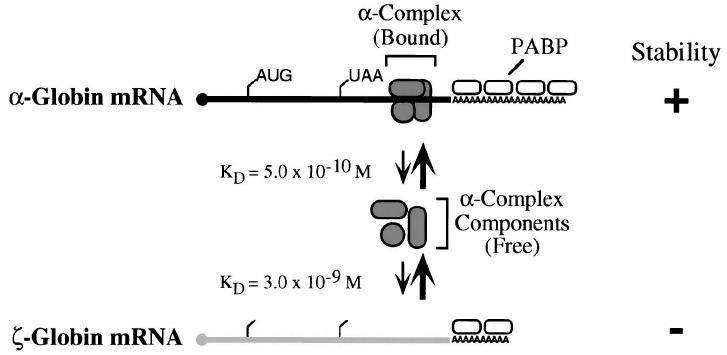
Diagram comparing the Structure of Globin mRNA: α-globin mRNA forms a stable α-complex, enhancing stability, while ζ-globin mRNA lacks this feature and is less stable. Dissociation constants are indicated.

Capping is the first modification made to RNA polymerase II-transcribed RNA and takes place co-transcriptionally in the nucleus as soon as the first 25-30 nts are incorporated into the nascent transcript.

  • Three enzymatic activities are required to generate the cap 0 structure
  1. RNA triphosphatase
  2. RNA guanylyltransferase
  3. Guanine-N7 methyltransferase.
  • The initial steps in RNA capping are catalyzed by a dimeric capping enzyme, which associates with the phosphorylated carboxyl-terminal tall domain (CTD) of RNA polymerase II.
  • RNA triphosphatase removes the-phosphate from the 5′ end of the nascent RNA. The enzyme RNA guanylyltransferase transfers the GMP moiety from GTP to the 5′-diphosphate of the nascent transcript, creating the guanosine 5-5-triphosphate structure.
  • In the final step, guanine-N7 methyltransferase transfers methyl groups from S-adenosylmethionine to the N’ position of the guanine at the 5′ end of the nascent RNA. If mRNA has a methyl group-on. N’ position of guanine at the 5′ end, then it is called cap 0. This is the first methylation step and occurs in all eukaryotes. In some higher eukaryotes, methyl group addition also occurs at second base.
  • But this happens only when the position is occupied by adenine; the reaction involves addition at the N’ position.
  • In some species, a methyl group is added to the second as well as third nucleoside of the capped mRNA.
  • mRNA with methyl groups on the N’ position of the guanine and the 2′-OH position of the second nucleotide at the 5′ end is known as cap 1.  
  • This is the predominant cap in multicellular organisms. Similarly, if methyl group is present at both second and third nucleoside then it is known as cap 2.  

FUNCTIONS OF 5’-cap

  • The 5′-cap serves as a unique molecular module that recruits cellular proteins and mediates cap-related biological functions such as
  1. pre-mRNA processing
  2. protecting mRNA from degradation
  3. nuclear export
  4. cap-dependent protein synthesis
  • It was previously thought that 5′-capping occurs exclusively in the nucleus, but RNA capping has been noticed in the cytoplasm of mammalian cells and Trypanosomes.  

Polyadenylation Process:

1. Polyadenylation Overview

Polyadenylation is one of the processes that is carried out in almost all eukaryotic mRNAs, whereby a poly-A tail consisting of approximately 200-250 residues of adenosine are added to the 3′ end of the mRNA. The reason for the poly-A tail is primarily to stabilize the mRNA and facilitate the process of nuclear export, with the main aim of ensuring efficient translation of the protein.

2. Signal for Polyadenylation

It begins with the recognition of the signal for polyadenylation, commonly AAUAAA, located between 10 to 30 nucleotides up-stream of the cleavage site. Down-stream from this it also usually includes a GU-rich or U-rich region that is also critical to the process.

3. Cleavage and enzymes involved

Pre-mRNA is cleaved at a position adjacent to the polyadenylation site, preceding the attachment of a poly-A tail. The two protein complexes concerned with this process are Cleavage Stimulation Factor (CstF) and Cleavage and Polyadenylation Specificity Factor (CPSF). After the pre-mRNA has been cleaved, it is handed over to Poly(A) Polymerase (PAP), which adds the poly-A tail to the 3′ end.

ADVERTISEMENT

4. Single vs Two Step Poly-A Tail Addication

There are two rounds of polyadenylation. In the first round, an oligo(A) tail of about 10 residues is added to it. A short tail of about 200 adenosine residues may be further elongated using PABP that binds to the tail and continues this process.

READ ALSO

For Future Space Missions, Molecular Ecology Finally Offers a Clear Biosignature Target

Scientists Find Molecule That Wipes Out Liver Cancer

5. Template Independent Process

Unlike transcription whose mRNA synthesis is template-dependent on a DNA, the addition of the poly-A tail represents a template-independent process. This occurs through the action of what is referred to as Poly(A) Polymerase that adds adenosine residues to the tail of the mRNA without any specific nucleotide sequence necessity.

ADVERTISEMENT

6. The poly-A tail has numerous important functions.

First, this tail would stabilize the mRNA and this would result in slowing the degradation of the mRNA. Another function is that it provides an easier transport of mRNA both in the cytoplasm and the nucleus, thus ensuring high rates of translation. Lastly, this functions by attracting more ribosomes to the mRNA, which enhances translation.

7. Cytoplasmic Polyadenylation

Not confined to the nucleus; it can also be performed in the cytoplasm. This is very important during oocyte and early embryo maturation for the translation of specific types of mRNA. The accomplishment of cytoplasmic polyadenylation is through Cytoplasmic Polyadenylation Element Binding Proteins, which are attached to specific sequences within the mRNA.

8. Role during Oocyte Maturation

It’s only during oocyte maturation that the poly-A tail of a few mRNAs becomes elongated hence turning these on for translation. This coincidentally is relevant during development since the proteins will be expressed in the right amounts and at the proper time.

ADVERTISEMENT

9.Alternative Polyadenylation

While there are instances where some mRNAs have more than one polyadenylation site, this typically leads to different mRNA variants because the poly-A tail varies in length. Known as alternative polyadenylation, it allows a single gene to consist of numerous transcripts, and hence protein isoforms. Indeed, the vast majority of mammalian genes are alternatively polyadenylated, and this is one mechanism by which gene expression is regulated because more than 70 percent of genes undergo alternative polyadenylation.

10. Representation in Immunoglobulin mRNAs

Here is a good representation of alternative polyadenylation in immunoglobulin mRNA which has generated the differential in polyadenylation sites within the same mRNA to create different 3′ ends transcripts. This has been illustrated to be important for the various antibody molecules produced as a response to infections by the immune system.

Polyadenylation in Bacteria

Another role in bacteria polyadenylation also has. Though, in bacteria, it marks the mRNA for degradation and not for stabilizing the mRNA, while in addition of poly-A tails which is catalyzed by Poly(A) Polymerase I (PAP I) within bacteria; through these, enzymes such as RNase E and RNase G recognize and degrade the mRNA after polyadenylating. This mechanism makes bacteria capable of degrading unwanted or defective mRNA molecules very rapidly.


  • Share on WhatsApp (Opens in new window) WhatsApp
  • Share on Facebook (Opens in new window) Facebook
  • Share on Reddit (Opens in new window) Reddit
  • Share on X (Opens in new window) X
  • Print (Opens in new window) Print
Shibasis Rath

Shibasis Rath

"𝓒𝓸𝓷𝓷𝓮𝓬𝓽𝓲𝓷𝓰 𝓡𝓮𝓼𝓮𝓪𝓻𝓬𝓱 𝓣𝓸 𝓡𝓮𝓪𝓵𝓲𝓽𝔂" 𝓲𝓼𝓷'𝓽 𝓙𝓾𝓼𝓽 𝓪 𝓜𝓸𝓽𝓽𝓸 - 𝓘𝓽'𝓼 𝓜𝔂 𝓜𝓲𝓼𝓼𝓲𝓸𝓷

Related Posts

3 men standing on rocky shore during daytime
MOLECULAR BIOLOGY

For Future Space Missions, Molecular Ecology Finally Offers a Clear Biosignature Target

May 12, 2026
SLC38A4 expression was confirmed by western blot in multiple tumor cell lines. In mouse models, liver tissue imaging (H&E staining) showed that overexpression of SLC38A4 reduced metastatic tumor areas, while knockdown increased them across Hepa1-6, MC38, and B16F10 cells. Results were consistent in both immunocompetent and nude mice, with statistically significant differences.
MOLECULAR BIOLOGY

Scientists Find Molecule That Wipes Out Liver Cancer

May 1, 2026
Bluebuck antelope with silvery-blue coat and curved horns running across open South African grassland, representing extinct species targeted for de-extinction by scientists
MOLECULAR BIOLOGY

Colossal Biosciences Announces De-Extinction of Bluebuck Antelope, 226 Years After Its Extinction

April 30, 2026

POPULAR NEWS

Chewing gum releases thousands of microplastic particles directly into your mouth with every piece you chew

Chewing gum releases thousands of microplastic particles directly into your mouth with every piece you chew

by Shibasis Rath
May 8, 2026
0

Microplastics are turning up in places researchers never expected: deep-sea sediments, Arctic ice, and human blood. Now, a UCLA pilot...

Yelling Isn’t Just Yelling: How a Hostile Home Rewires a Child’s Brain for Constant Alert

Yelling Isn’t Just Yelling: How a Hostile Home Rewires a Child’s Brain for Constant Alert

by Shibasis Rath
March 8, 2026
0

To a parent in the heat of the moment, a raised voice may feel like simple frustration. To a child...

a group of gen Z kids walking down a street

Is Gen Z the First Generation Less Intelligent Than Their Parents?

by Shibasis Rath
February 5, 2026
0

Gen Z intelligence decline is emerging as a serious concern among neuroscientists and education researchers. For over a century, each...

Whole Brain Emulation Achieved: Scientists Run a Fruit Fly Brain in Simulation

by Shibasis Rath
March 9, 2026
0

Scientists have copied an entire biological brain neuron by neuron and synapse by synapse and made it control a simulated...

Global Sperm Counts Have Dropped 50% in 50 Years Now 128 Men Are Racing Their Way to a $100,000 Prize to Prove the Point

Global Sperm Counts Have Dropped 50% in 50 Years Now 128 Men Are Racing Their Way to a $100,000 Prize to Prove the Point

by Staff Writer
May 5, 2026
0

A group of technology entrepreneurs is staging a competitive event in San Francisco in which semen samples from 128 men...

EDITOR CHOICE‘S

  • All
  • NEWS
  • SPOTLIGHTS
A new study has found that men’s brains shrink faster than women’s as they age.

12,638 MRI Scans Confirm Men’s Brains Shrink Faster in PNAS Study

by Staff Writer
May 14, 2026
0

A large-scale analysis of brain scans taken over time has found that men's brains shrink faster than women's across a...

Volcanic Eruptions Can Destroy Their Own Methane — Tonga’s Plume Shows How

Volcanic Eruptions Can Destroy Their Own Methane — Tonga’s Plume Shows How

by Shibasis Rath
May 13, 2026
0

A study published in Nature Communications analyzed the Hunga Tonga-Hunga Ha'apai volcano eruption's impact on methane in the atmosphere. It...

3 men standing on rocky shore during daytime

For Future Space Missions, Molecular Ecology Finally Offers a Clear Biosignature Target

by Shibasis Rath
May 12, 2026
0

When the next generation of probes scoops up dust from the icy shell of Europa or the surface of Mars,...

Babies Yawn in the Womb

Scientists Say Babies May Learn to Yawn Before Birth

by Shibasis Rath
May 11, 2026
0

Mothers can spread yawns to their yet-to-be-born offspring during pregnancy, researchers report May 5 in Current Biology  the first empirical evidence...

ADVERTISEMENT

RathBiotaClan – RBC

RathBiotaClan – Connecting Research To Reality

Your trusted source for life science news, biology research & discoveries. Covering neuroscience, genetics, ecology, and more — connecting research to reality.

Privacy Policies

Contact Us

About Us

Editorial Standards

Latest Posts

  • 12,638 MRI Scans Confirm Men’s Brains Shrink Faster in PNAS Study
  • Volcanic Eruptions Can Destroy Their Own Methane — Tonga’s Plume Shows How
  • For Future Space Missions, Molecular Ecology Finally Offers a Clear Biosignature Target
  • Scientists Say Babies May Learn to Yawn Before Birth

SHIBASIS RATH

Contact Mail

rathbiotaclan@gmail.com

No Result
View All Result
MSME (Udyam) Certified Science Platform
Govt. of India

Get Us On PlayStore

playstore app for rathbiotaclan
  • About Us
  • Advertise With Us
  • Cancellation and Refund Policy
  • Contact Us
  • Contribute
  • Editorial Standards
  • Home
  • Pricing Details
  • Privacy Policies
  • Shipping Policy
  • Terms & Conditions

© 2026 RathBiotaClan. All rights reserved.

Welcome Back!

Sign In with Google
OR

Login to your account below

Forgotten Password? Sign Up

Create New Account!

Sign Up with Google
OR

Fill the forms bellow to register

*By registering into our website, you agree to the Terms & Conditions and Privacy Policy.
All fields are required. Log In

Retrieve your password

Please enter your username or email address to reset your password.

Log In

Add New Playlist

No Result
View All Result
  • HOME
  • HEALTH SCIENCE
  • NEUROSCIENCE
    • PHYSIOLOGY
    • IMMUNOLOGY
    • CANCER
  • DISCOVERIES
    • SPOTLIGHTS
    • STUDENT PORTAL
    • SCIENCE FEATURED
  • MOLECULAR BIOLOGY
    • GENETICS
    • BIOTECHNOLOGY
    • BIOINFORMATICS
    • BIOCHEMISTRY
    • BIOPHYSICS
  • ZOOLOGY & ECOLOGY
    • ENVIRONMENTAL SCIENCE
    • ECOLOGY
    • EVOLUTION
  • MICRO & PLANT SCIENCE
    • MICROBIOLOGY
    • CELL BIOLOGY
    • DEVELOPMENTAL BIOLOGY
  • PSYCHOLOGY
  • Login
  • Sign Up
SAVED POSTS

© 2026 RathBiotaClan. All rights reserved.

This website uses cookies. By continuing to use this website you are giving consent to cookies being used. Visit our Privacy and Cookie Policy.