



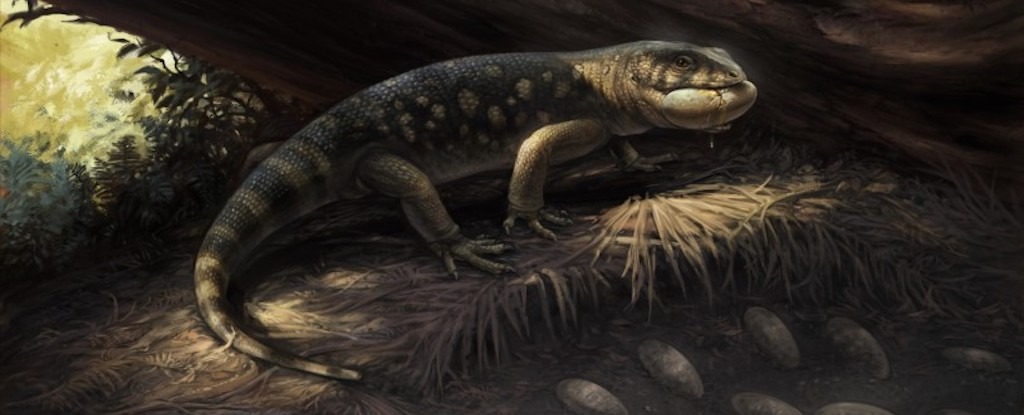
Monstersauria is an extant clade of anguimorph lizards with a long fossil record, stretching from the Cretaceous to the Present. Today, it is represented by five species of the genus Heloderma, found in the deserts of the American Southwest and northwestern Mexico. The oldest monstersaur fossils are from the Lower Cretaceous in Japan (Morohasaurus kamitakiensis) and the western United States (Primaderma nessovi).
Monstersaurs are generally bulky, osteoderm-covered lizards with blunt snouts and conical teeth. The clade achieved its highest taxonomic diversity and widest geographic distribution during the Campanian Stage (approx. 83.6–72.1 Ma) of the Late Cretaceous Period, with occurrences in Mongolia and western North America. Unlike the exceptionally complete fossils from Asia, North American monstersaur fossils are typically fragmentary. Historically, many fragmentary late Campanian lizard materials from North America were often referred to Palaeosaniwa canadensis or Parasaniwa wyomingensis, which may have underestimated taxonomic diversity.
The Kaiparowits Formation Setting
- The Kaiparowits Formation is located in south-central Utah, USA, within the Grand Staircase–Escalante National Monument.
- It is characterised by badland-forming siltstones and mudstones, representing a coastal plain environment with fluvial and floodplain deposits.
- The palaeoenvironment was likely humid and seasonally tropical/subtropical, similar to the present-day Gulf Coast of the United States.
- All specimens described in this study were recovered from the lower half of the middle unit of the upper Campanian Kaiparowits Formation, dated to approximately 75.6–74.7 Ma.
New Monstersaur Specimens from Kaiparowits Formation
- The study describes several new specimens attributed to large monstersaur lizards, including a new taxon: Bolg amondol gen. et sp. nov..
Bolg amondol gen. et sp. nov.
- Holotype: UMNH VP 16266, an associated fragmentary skeleton including cranial, axial, pectoral, pelvic, and appendicular elements.
- Etymology: The name Bolg is from the fictional goblin-prince in J.R.R. Tolkien’s The Hobbit, reflecting the monstersaurian affinities, and amondol means ‘mound-head’ in Sindarin, referencing the mound-like, fused osteoderms covering the skull.
- Unique Anatomical Features (Autapomorphies):
- Fused osteoderms on the jugal. This is considered a unique feature among monstersaurs with preserved jugals and has not been reported for any other monstersaurian.
- Presence of autotomy septa on the distal caudal vertebrae. This is a significant discovery, representing the earliest occurrence of this condition in Monstersauria’s evolutionary history. Heloderma (modern monstersaurs) notably lacks these. This suggests autotomy was likely a plesiomorphic trait that was later lost in more recent taxa.
- Other Key Features:
- Maxilla: Possesses pitted/vermiculate osteoderms fused to the external surface of the nasal process, similar to Paraderma bogerti and Primaderma nessovi. Its nasal process is shorter and more angulated than in Paraderma bogerti. The nares are unretracted, similar to Primaderma nessovi.
- Nasal: Exhibits extensive medial articular surface for the premaxilla, extending further posteriorly than in comparable taxa. Dorsal surface shows strong rugosities, suggesting osteoderm attachment.
- Dentary: Possesses a more elongate dentary than Helodermatidae and Estesia, similar to Primaderma nessovi. Modified pleurodont tooth attachment with basal enamel infoldings (plicidentine) is present.
- Vertebrae: All preserved vertebrae exhibit a procoelous centrum with no precondylar constriction. Critically, Bolg amondol vertebrae lack the ventral pit seen on other Kaiparowits monstersaur specimens and the Palaeosaniwa canadensis holotype.
- Scapulocoracoid: Fused into a single element, as seen in Gobiderma pulchrum and Heloderma horridum.

Reconstruction of UMNH VP 16266 (holotype, Bolg amondol gen. et sp. nov.). Gold: preserved skeletal elements. Grey: morphological hypotheses of reconstructed elements based on the morphology of preserved skeletal elements. Black: missing skeletal elements, based on publicly available rendered CT scans on morphosource.org of specimen UF:Herp:153328, Heloderma horridum.
SOURCE: Royal Society Of Science
cf. Palaeosaniwa canadensis
- Referred specimens: DMNH EPV.134394 (associated partial parietal and posterior dorsal vertebra) and DMNH EPV.132910 (isolated partial parietal). These are considered to belong to the same individual due to close proximity and taphonomy.
- Key Features:
- Parietals: Both parietals show pitted polygonal osteoderms fused to the dorsal surface. They are similar in overall shape, size, and the position of the parietal foramen. Differences in ventral surface and osteoderm fusion may reflect intraspecific variation or growth stage, but both share an hourglass-shaped parietal table with MOR 792, another P. canadensis specimen.
- Dorsal Vertebra: DMNH EPV.134394.2 (associated with the parietal) has a deeply excavated pit at the midline of the centrum, nearly identical to the holotype specimen of Palaeosaniwa canadensis (USNM 10864). This vertebra is also larger than those of Bolg amondol.
- Monstersauria indet.
- UMNH VP 36373, a well-preserved presacral vertebra, possesses a shallow ovoid pit along the midline of the centrum, similar to MOR 792.
- Monstersauria indet.
Phylogenetic Analyses
- Methodology: A modified, extensive morphological dataset (Conrad matrix) was used, with both unconstrained and genomics-constrained analyses.
- Results: Bolg amondol is consistently recovered within a monophyletic Monstersauria in both analyses.
- Autapomorphies for B. amondol in the analyses include the presence of fused osteoderms on the jugal and autotomy septa on distal caudal vertebrae.
- The analyses also suggest frequent sister taxon relationships between Asian and North American monstersaur taxa (e.g. Gobiderma + Bolg, Estesia + Chiangshia + Heloderma), supporting multiple biogeographic dispersal events between Asia and North America during the Cretaceous.
Conclusions
- Reconsidering Palaeosaniwa canadensis: The similarities between the vertebrae of DMNH EPV.134394 and MOR 792 (both having a ventral pit) but differences in their parietals, alongside Bolg amondol‘s distinct lack of a ventral pit, highlight a pressing need for a full reassessment of Palaeosaniwa canadensis. The historical practice of uniformly referring large lizard fossils to P. canadensis is questioned.
- Monstersaur Diversity in Kaiparowits Formation: The findings provide new evidence that at least three lineages of distinct, large-bodied monstersaurian lizards were present on the palaeolandmass of Laramidia during the Campanian Stage: Bolg amondol, cf. Palaeosaniwa canadensis, and the previously described Parasaniwa cynochoros. This supports hypotheses of regional endemism in Campanian Laramidia.
- Ecological Implications:
- Bolg amondol is inferred to have had a predominantly faunivorous diet, based on tooth attachment and enamel infoldings.
- The large body sizes of these three anguimorphs suggest they could target larger prey and would have competed for resources with other faunivorous tetrapods.
- The co-occurrence of multiple large-bodied anguimorphs suggests a productive and stable ecosystem, and they likely coexisted by partitioning habitat spatially and temporally, similar to modern lizard communities.
- The presence of both dermal armour and autotomy septa in Bolg amondol suggests that having multiple anti-predator adaptations was advantageous for large-bodied lizards in Late Cretaceous dinosaur ecosystems, contrasting with modern Heloderma.
- Apex of Monstersaur Diversity: The Campanian Stage represented the peak of monstersaur diversity and distribution globally. These findings contribute to the understanding of biogeographic connections and faunal interchange between North America and Asia during the Cretaceous. Monstersaurs have maintained similar roles as large-bodied predators in their ecosystems for at least 76 million years.
In conclusion, the study of the Kaiparowits Formation monstersaur assemblage—especially the description of Bolg amondol—offers valuable insights into the morphological diversity and evolutionary history of this lizard group. Moreover, it highlights the ancestral presence of autotomy and emphasizes the importance of conducting further detailed taxonomic research on Late Cretaceous North American monstersaurs.
Reference: https://royalsocietypublishing.org/doi/10.1098/rsos.250435
This article is based on a research publication from Royal Society Open Science. The content has been reformatted into point-wise summaries instead of traditional paragraphs to enhance readability, improve understanding, and allow for quicker reference of key findings.