




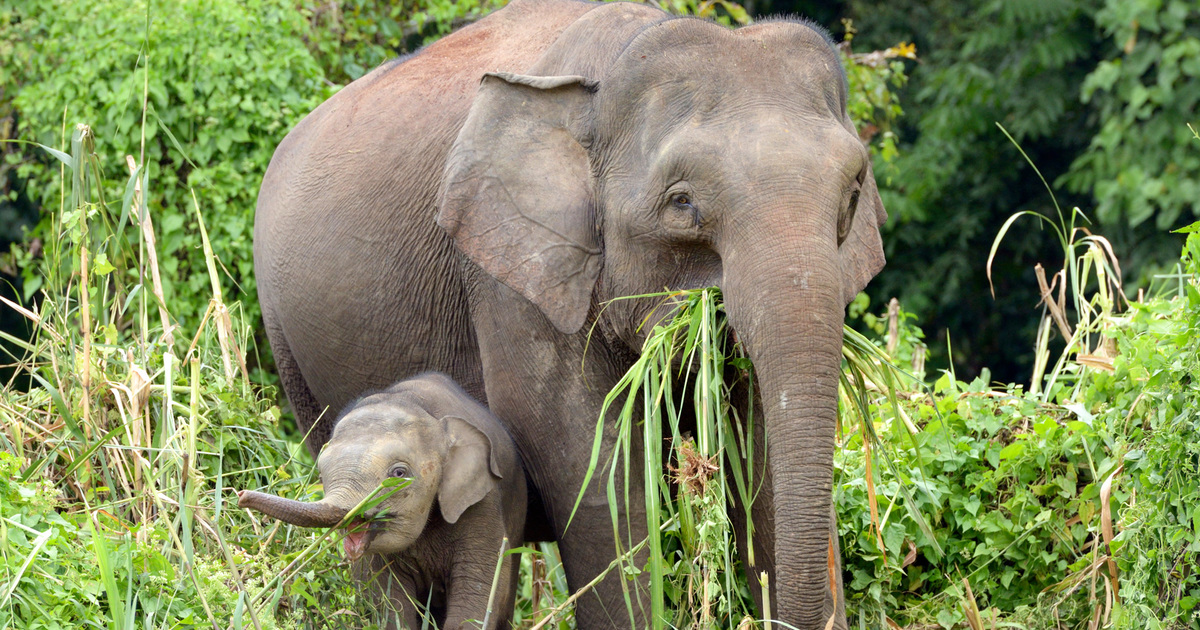
Imagine a creature that’s both majestic and miniature gentle giant no taller than a basketball hoop at the shoulder, wandering through the steamy rainforests of Borneo. These are the Bornean elephants, the smallest elephants on Earth, and they’re in deep trouble.
In June 2024, the International Union for Conservation of Nature (IUCN) officially listed them as Endangered on its Red List, a sobering update that highlights just how precarious their future has become. With only about 1,000 individuals left in the wild, these unique animals are teetering on the brink, largely due to human encroachment on their island home.
What Makes Bornean Pygmy Elephants Special?

Bornean elephants (Elephas maximus borneensis) are a subspecies of the Asian elephant, distinctly adapted to life on the tropical island of Borneo. Standing at just 2 to 3 meters (6.5 to 9.8 feet) tall, they’re noticeably smaller than their mainland cousins, earning them the nickname “pygmy elephants.” Their smaller size likely helps them navigate the dense, hilly forests of Sabah and northern Kalimantan, where they roam in search of food.
Physically, Bornean pygmy elephants display several unique characteristics. They sport larger ears relative to their body size, perfect for cooling off in the humid tropical climate. Their tusks grow straighter, and they have a longer tail that sometimes brushes the ground as they walk. Genetic studies suggest these elephants have been isolated on Borneo for over 300,000 years, evolving separately from other Asian elephants and developing their distinctive features.
Bornean elephants are highly social animals, living in matriarchal herds of up to 20 individuals. Experienced females lead the group, guiding them to water sources and feeding grounds through generations of accumulated knowledge. They communicate through low-frequency rumbles that can travel miles through the undergrowth, maintaining contact even when separated by dense forest. These elephants are voracious eaters, consuming up to 150 kilograms (330 pounds) of vegetation daily, including grasses, fruits, bark, and various forest plants.
Bornean pygmy elephants serve as “gardeners of the forest,” playing an irreplaceable ecological role. By trampling vegetation and dispersing seeds through their dung, they help maintain biodiversity in Borneo’s rainforests, which are among the oldest and most species-rich on the planet. Without them, the ecosystem could shift dramatically, affecting everything from plant regeneration to other wildlife species.
A Population in Crisis
The IUCN’s 2024 assessment marked the first time Bornean elephants were evaluated as a distinct subspecies, and the verdict was grim: Endangered. This status means they’re at a very high risk of extinction in the wild, with populations having plummeted by at least 50% over the last three generations (roughly 60-75 years).
Current estimates peg the wild population at around 1,000 animals, concentrated mostly in Sabah, Malaysia, with smaller groups in Indonesia’s North Kalimantan. That’s a far cry from historical numbers; just 75 years ago, their habitat spanned much of Borneo’s vast forests. For context, Asian elephants as a whole are also Endangered, with fewer than 52,000 left across South and Southeast Asia. But the Bornean variety faces unique pressures due to their limited range on a single island. The largest remaining herd is in the Lower Kinabatangan floodplain, where about 300-400 elephants cling to survival amid fragmented habitats.
| Aspect | Bornean Elephant | Mainland Asian Elephant |
|---|---|---|
| Height at Shoulder | 2-3 m (6.5-9.8 ft) | Up to 3.5 m (11.5 ft) |
| Population | ~1,000 | ~40,000-50,000 total |
| Habitat Range | Borneo only | Across 13 countries in Asia |
| IUCN Status | Endangered (2024) | Endangered (1986) |
Major Threats Facing Bornean Elephants
The story of the Bornean elephant’s decline is a classic tale of human progress clashing with nature. Over the past century, Borneo’s forests—once covering the entire island—have been whittled down to fragments. Extensive logging for timber kicked off the destruction in the mid-20th century, wiping out vast swaths of habitat. Today, the palm oil industry is the biggest culprit, with plantations expanding rapidly to meet global demand for this versatile oil found in everything from snacks to cosmetics. Agriculture, timber plantations, mining, and infrastructure projects like the Pan Borneo Highway further carve up the landscape, leaving elephants with shrinking corridors to move through. One study estimates that Southeast Asia has lost over 50% of its original forest cover, with deforestation rates at 1.2% per year among the highest globally.
As forests shrink, elephants venture into human areas in search of food, leading to crop raids on farms and plantations. This sparks human-elephant conflict, often resulting in retaliatory killings by farmers protecting their livelihoods, elephants being shot or poisoned as agricultural pests, increased stress on elephant populations, and economic losses for local communities.
While less rampant than in Africa, poaching for ivory adds another layer of peril for Bornean elephants. Male elephants with tusks are particularly vulnerable. Accidental deaths compound the crisis through vehicle collisions on expanding road networks, snares and traps set for other animals, ingestion of agrochemicals like pesticides, and poisoning from contaminated water sources.
Climate change exacerbates every threat, altering rainfall patterns, increasing drought frequency, and potentially reducing available forage. These environmental shifts make it harder for elephants to find adequate food and water, particularly in already fragmented habitats. In Sabah alone, human population growth has pushed elephants into increasingly tight spaces, dramatically increasing dangerous encounters between humans and wildlife.
Conservation Efforts Offer Hope
It’s not all doom and gloom conservationists are fighting back with determination and innovation. Over the last two decades, efforts have ramped up to study and protect Bornean elephants. Organizations like WWF, the Sabah Wildlife Department, and the IUCN’s Asian Elephant Specialist Group are leading the charge with several key strategies.
Establishing wildlife corridors and protected areas remains crucial. The Kinabatangan Wildlife Sanctuary serves as a critical refuge, connecting fragmented forests and allowing elephants to move between feeding grounds. These corridors are essential for maintaining genetic diversity and providing adequate space for elephant herds.
Innovative solutions for human-elephant conflict are being implemented, including electric fences around farms to deter elephants from crops, early-warning systems using elephant collars with GPS trackers, compensation programs for farmers who suffer crop losses, community-based monitoring systems, and education programs to reduce fear and promote coexistence.
Conservation teams have increased patrols in critical elephant habitat and work with local communities to reduce demand for ivory products. Scientists use genetic studies and camera traps to track populations, monitor health, and understand elephant behavior. This data informs conservation strategies and helps identify priority areas for protection.
Augustine Tuuga, Director of the Sabah Wildlife Department, has emphasized that these conservation activities are vital for balancing elephant protection with local economic development. The 2024 IUCN Red List designation as Endangered has brought renewed international attention and could unlock additional funding for conservation programs.
The Path Forward: Saving Borneo’s Gentle Giants
The clock is ticking for Bornean elephants, but extinction is not inevitable. With concerted action, these magnificent animals can be saved. Critical steps include protecting remaining forest habitat, promoting and purchasing RSPO-certified sustainable palm oil products, creating larger connected wildlife reserves, working with local people to develop economic alternatives that don’t require forest destruction, and addressing climate change to preserve the ecosystems these elephants depend on.
As keystone species, Bornean pygmy elephants are critical to the health of their entire ecosystem. Saving them means preserving Borneo’s biodiversity hotspot, which benefits countless other species and provides essential ecological services.
Individual actions matter in the fight to save Bornean elephants. You can support conservation organizations working to protect these elephants, choose RSPO-certified sustainable palm oil products, raise awareness about the plight of Bornean pygmy elephants, support policies that protect tropical forests, and reduce your overall consumption of products linked to deforestation.
Bornean pygmy elephants are a reminder that even the mightiest creatures depend on us for survival. In the grand tapestry of life, every thread counts, and these gentle giants deserve our urgent attention and action.