




Friday, July 17, 2026
SAVED POSTS
  • Login
  • Register
RathBiotaClan
No Result
View All Result
  • HOME
  • HEALTH SCIENCE

    TRENDING ON HEALTH (TOP)

    Fick Method Underestimates Heart Problems in Children After Heart Transplant, Study Finds

    For Women on Antidepressants, Creatine Showed a Possible Extra Boost

    Did the iPhone Quietly Reshape When and Whether Americans Have Children?

    For People Antidepressants Never Helped, a 30-Minute Home Session Is Now FDA-Approved

    NOW ON AIR (RBC)

    The parsimony criterion
    BIOINFORMATICS

    The Parsimony Criterion in Phylogenetics: Morphological & Molecular Methods

    July 15, 2026
    maximum-likelihood-criterion
    BIOINFORMATICS

    Maximum Likelihood Criterion in Phylogenetic Tree Reconstruction

    July 15, 2026
    Tree Optimization Criteria and Search Methods in Phylogenetics โ€“ NNI, SPR, TBR Explained
    BIOINFORMATICS

    Tree Optimization Criteria and Tree Search Methods in Phylogenetics

    July 15, 2026
    Bootstrapping in Phylogenetics
    BIOINFORMATICS

    Bootstrapping in Phylogenetics โ€“ Tree Reliability, Resampling & Bootstrap Values

    July 15, 2026
  • NEUROSCIENCE
    • PHYSIOLOGY
    • IMMUNOLOGY
    • CANCER
  • DISCOVERIES
    • SPOTLIGHTS
    • STUDENT PORTAL
    • SCIENCE FEATURED
  • MOLECULAR BIOLOGY
    • GENETICS
    • BIOTECHNOLOGY
    • BIOINFORMATICS
    • BIOCHEMISTRY
    • BIOPHYSICS
  • ZOOLOGY & ECOLOGY
    • ENVIRONMENTAL SCIENCE
    • ECOLOGY
    • EVOLUTION
  • MICRO & PLANT SCIENCE
    • MICROBIOLOGY
    • CELL BIOLOGY
    • DEVELOPMENTAL BIOLOGY
  • PSYCHOLOGY
RathBiotaClan
RathBiotaClan
No Result
View All Result
Home DISCOVERIES

Giant Salamander-like Creature In Namibia 280 Million Years Ago

Shibasis Rath by Shibasis Rath
July 9, 2024
in DISCOVERIES, ZOOLOGY
Reading Time: 3 mins read
0
A A
0

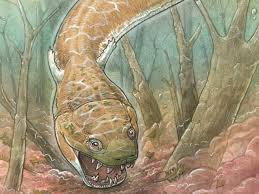
Recent discovery in Namibiaโ€™s Namib Desert has revealed a prehistoric predator resembling a giant salamander. This formidable creature, named Gaiasia jennyae, lived around 280 million years ago during the Permian Period. Measuring at least 8 feet (2.5 meters) long and potentially reaching up to 13 feet (4 meters), Gaiasia was a top predator in its swampy ecosystem.

Gaiasia jennyae thrived in the cold, glacial environment of ancient Namibia, ambushing its prey with its large, flat skull and interlocking fangs. This skull, over 2 feet (60 cm) long, allowed Gaiasia to create a powerful suction to capture its prey, which included fish and other aquatic animals.

The discovery of Gaiasia provides crucial insights into the evolution of early land vertebrates. About 100 million years before Gaiasia, the first land vertebrates, known as stem tetrapods, evolved from fish with fleshy fins. These creatures were not true amphibians but paved the way for the evolution of amphibians, reptiles, and mammals.

Despite most early tetrapods being found near the ancient equator, Gaiasia’s presence in the remote region of Namibia challenges previous assumptions. It suggests that unique and isolated ecosystems supported diverse forms of life, even in colder climates.

ADVERTISEMENT

Jason Pardo, a National Science Foundation postdoctoral fellow at the Field Museum of Natural History, emphasized the significance of Gaiasiaโ€™s discovery. “Gaiasia is unlike anything we’ve seen before, indicating a potentially vibrant ecosystem of unique animals,” he said.

READ ALSO

A Shark That Walks Out of the Water Has Been Found in Papua New Guinea And It’s New to Science

Human-generated electromagnetic noise has long lasting effects on light orientation in bats

This ancient predator existed long before dinosaurs roamed the Earth. Evolution during the Permian Period was marked by rapid changes, leading to the emergence of diverse and often bizarre creatures like Gaiasia.

ADVERTISEMENT

The well-preserved fossil remains of Gaiasia include a skull, spine, partial skulls, vertebrae, and jaw pieces. Claudia Marsicano, a researcher and professor at the University of Buenos Aires, described the shock of discovering such a large and distinct specimen.

ADVERTISEMENT

Gaiasiaโ€™s fossils depict a formidable predator with a wide, flat skull that allowed it to create a suction effect, capturing and consuming prey with its long fangs. Despite being ectothermic, relying on external temperatures to regulate its body heat, Gaiasia grew to massive sizes and likely lived for several decades.

Paleontologists continue to explore Gaiasiaโ€™s ecosystem to uncover more about its life and the environment it inhabited. Discovering more fossilized remains could provide further insights into the creatureโ€™s physical characteristics and its role in the prehistoric ecosystem.

The presence of Gaiasia in the far south highlights the diversity of life forms that thrived in ancient, isolated environments. As researchers uncover more about these ecosystems, they hope to gain a deeper understanding of the evolutionary paths that led to modern vertebrates, including mammals and reptiles.

The discovery of Gaiasia jennyae not only enriches our knowledge of prehistoric life but also underscores the complexity and diversity of ancient ecosystems, offering a glimpse into a world long before the age of dinosaurs.
Engage with Us:

Stay tuned for more captivating insights and News. Visit our Blogs and Follow Us on social media to never miss an update. Together, let’s unravel the mysteries of the natural world
  • Share on WhatsApp (Opens in new window) WhatsApp
  • Share on Facebook (Opens in new window) Facebook
  • Share on Reddit (Opens in new window) Reddit
  • Share on X (Opens in new window) X
  • Print (Opens in new window) Print
Shibasis Rath

Shibasis Rath

"๐“’๐“ธ๐“ท๐“ท๐“ฎ๐“ฌ๐“ฝ๐“ฒ๐“ท๐“ฐ ๐“ก๐“ฎ๐“ผ๐“ฎ๐“ช๐“ป๐“ฌ๐“ฑ ๐“ฃ๐“ธ ๐“ก๐“ฎ๐“ช๐“ต๐“ฒ๐“ฝ๐”‚" ๐“ฒ๐“ผ๐“ท'๐“ฝ ๐“™๐“พ๐“ผ๐“ฝ ๐“ช ๐“œ๐“ธ๐“ฝ๐“ฝ๐“ธ - ๐“˜๐“ฝ'๐“ผ ๐“œ๐”‚ ๐“œ๐“ฒ๐“ผ๐“ผ๐“ฒ๐“ธ๐“ท

Related Posts

A Shark That Walks Out of the Water Has Been Found in Papua New Guinea And It’s New to Science
SCIENCE FEATURED

A Shark That Walks Out of the Water Has Been Found in Papua New Guinea And It’s New to Science

June 16, 2026
Soprano pipistrelle (Pipistrellus pygmaeus) emerging from a tree hollow at the moment of take-off.
ECOLOGY

Human-generated electromagnetic noise has long lasting effects on light orientation in bats

June 4, 2026
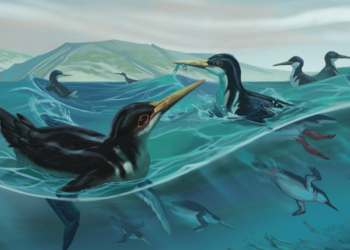
The oldest penguin species yet discovered, Daniadyptes primaevus, was a flightless bird that spent much of its time in the ocean, just like modern penguins. However, fossil evidence of the speciesโ€™ long beaks suggests that it used hunting practices more like those of modern seabirds, such as cormorants, which stay near the waterโ€™s surface because they cannot swallow their prey underwater. Traces of the many varieties of ancient penguins that lived in New Zealand are al- lowing paleontologists to track their evolution into the semiaquatic birds found today.
DISCOVERIES

Fossil Penguins From New Zealand Reveal Stages of the Birds’ Long Evolutionary History

May 1, 2026

POPULAR NEWS

Chewing gum releases thousands of microplastic particles directly into your mouth with every piece you chew

Chewing gum releases thousands of microplastic particles directly into your mouth with every piece you chew

by Shibasis Rath
May 8, 2026
0

Microplastics are turning up in places researchers never expected: deep-sea sediments, Arctic ice, and human blood. Now, a UCLA pilot...

grayscale photo of girl in polka dot long sleeve shirt

Yelling Isnโ€™t Just Yelling: How a Hostile Home Rewires a Childโ€™s Brain for Constant Alert

by Shibasis Rath
March 8, 2026
0

To a parent in the heat of the moment, a raised voice may feel like simple frustration. To a child...

72-Hour Fasting Can Reset Your Entire Immune System, USC Study Shows

72-Hour Fasting Can Reset Your Entire Immune System, USC Study Shows

by Shibasis Rath
February 28, 2026
0

A 72-hour fast can trigger a powerful immune system reset. Scientists call this stem cell regeneration. The process clears old...

woman in white tank top lying on bed

New Studys Says Gen Z is the least sexually active young cohort in modern recorded history

by Shibasis Rath
January 24, 2026
0

A generation that grew up with dating apps in their pockets, pornography a tap away, and sex discussed more openly...

a group of gen Z kids walking down a street

Is Gen Z the First Generation Less Intelligent Than Their Parents?

by Shibasis Rath
February 5, 2026
0

Gen Z intelligence decline is emerging as a serious concern among neuroscientists and education researchers. For over a century, each...

EDITOR CHOICEโ€˜S

  • All
  • NEWS
  • SPOTLIGHTS
The parsimony criterion

The Parsimony Criterion in Phylogenetics: Morphological & Molecular Methods

by Shibasis Rath
July 15, 2026
0

The parsimony criterion is one of the oldest and most widely used methods of constructing phylogenetic trees, having its roots...

maximum-likelihood-criterion

Maximum Likelihood Criterion in Phylogenetic Tree Reconstruction

by Shibasis Rath
July 15, 2026
0

The maximum-likelihood (ML) criterion is one of the most important and statistically rigorous approaches used for phylogenetic tree reconstruction, first...

Tree Optimization Criteria and Search Methods in Phylogenetics โ€“ NNI, SPR, TBR Explained

Tree Optimization Criteria and Tree Search Methods in Phylogenetics

by Shibasis Rath
July 15, 2026
0

Distance-matrix clustering methods such as UPGMA and Neighbor-Joining construct a phylogenetic tree directly through a fixed, well-defined algorithm, without explicitly...

Bootstrapping in Phylogenetics

Bootstrapping in Phylogenetics โ€“ Tree Reliability, Resampling & Bootstrap Values

by Shibasis Rath
July 15, 2026
0

Bootstrapping is a statistical method used to assess the reliability of a phylogenetic tree, introduced by Felsenstein in 1985. Since...

ADVERTISEMENT

RathBiotaClan – RBC

RathBiotaClan – Connecting Research To Reality

Your trusted source for life science news, biology research & discoveries. Covering neuroscience, genetics, ecology, and more โ€” connecting research to reality.

About Us

Privacy Policies

Contact Us

Editorial Standard

Latest Posts

  • The Parsimony Criterion in Phylogenetics: Morphological & Molecular Methods
  • Maximum Likelihood Criterion in Phylogenetic Tree Reconstruction
  • Tree Optimization Criteria and Tree Search Methods in Phylogenetics
  • Bootstrapping in Phylogenetics โ€“ Tree Reliability, Resampling & Bootstrap Values

SHIBASIS RATH

Contact Mail

rathbiotaclan@gmail.com

No Result
View All Result
MSME (Udyam) Certified Science Platform
Govt. of India

Get Us On PlayStore

playstore app for rathbiotaclan
  • About Us
  • Advertise With Us
  • Cancellation and Refund Policy
  • Contact Us
  • Contribute
  • Editorial Standards
  • Home
  • Pricing Details
  • Privacy Policies
  • Shipping Policy
  • Terms & Conditions

ยฉ 2026 RathBiotaClan. All rights reserved.

Welcome Back!

Sign In with Google
OR

Login to your account below

Forgotten Password? Sign Up

Create New Account!

Sign Up with Google
OR

Fill the forms below to register

*By registering into our website, you agree to the Terms & Conditions and Privacy Policy.
All fields are required. Log In

Retrieve your password

Please enter your username or email address to reset your password.

Log In

Add New Playlist

No Result
View All Result
  • HOME
  • HEALTH SCIENCE
  • NEUROSCIENCE
    • PHYSIOLOGY
    • IMMUNOLOGY
    • CANCER
  • DISCOVERIES
    • SPOTLIGHTS
    • STUDENT PORTAL
    • SCIENCE FEATURED
  • MOLECULAR BIOLOGY
    • GENETICS
    • BIOTECHNOLOGY
    • BIOINFORMATICS
    • BIOCHEMISTRY
    • BIOPHYSICS
  • ZOOLOGY & ECOLOGY
    • ENVIRONMENTAL SCIENCE
    • ECOLOGY
    • EVOLUTION
  • MICRO & PLANT SCIENCE
    • MICROBIOLOGY
    • CELL BIOLOGY
    • DEVELOPMENTAL BIOLOGY
  • PSYCHOLOGY
  • Login
  • Sign Up
SAVED POSTS

ยฉ 2026 RathBiotaClan. All rights reserved.

This website uses cookies. By continuing to use this website you are giving consent to cookies being used. Visit our Privacy and Cookie Policy.