In late 2025, Sydney data scientist Paul Conyngham did something that sounds like science fiction: he helped design the world’s first reported personalised mRNA cancer vaccine for a dog using little more than ChatGPT for planning, AlphaFold for protein modelling, and university labs for the heavy lifting. His rescue dog Rosie, an eight-year-old Staffordshire Bull Terrier × Shar Pei cross, had been given months to live. Today, her largest tumour has shrunk by more than half, her energy is back, and researchers are calling the case a glimpse into the future of rapid, precision oncology for pets and potentially humans.
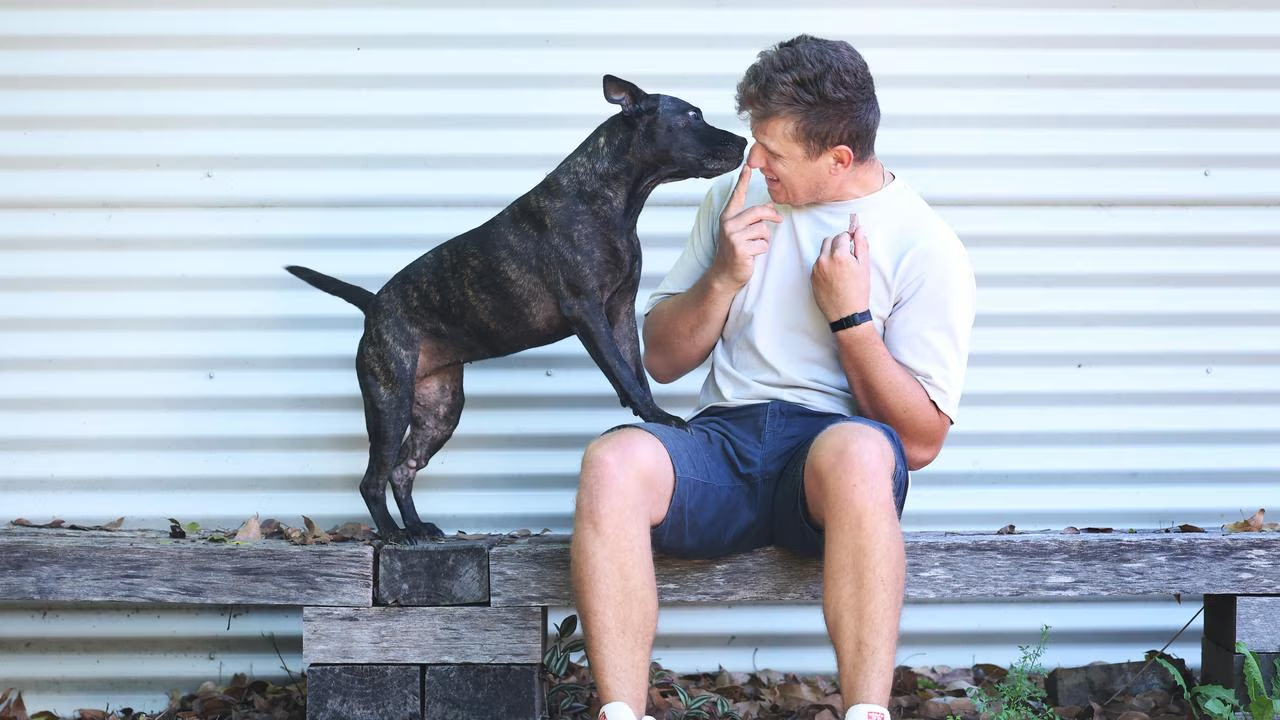
Meet Rosie: A Fighter with a Common but Deadly Enemy: Adopted from a shelter in 2019 during the pandemic lockdowns, Rosie quickly became Conyngham’s “best mate.” In 2024, multiple mast cell tumours (MCTs) appeared lumpy growths driven by rogue mast cells, the immune-system cells that normally release histamine during allergies. MCTs are the most common skin cancer in dogs, accounting for up to 20 % of canine skin tumours. Many are fuelled by mutations in the c-KIT proto-oncogene, a receptor tyrosine kinase that, when mutated (especially internal tandem duplications in exon 11), fires constantly even without its natural ligand. This leads to uncontrolled proliferation. Studies show these mutations appear in 15–50 % of MCTs, with higher-grade tumours more likely to metastasise and resist standard treatments.
Surgery, chemotherapy and tyrosine-kinase inhibitors slowed the disease but failed to shrink the tumours. A tennis-ball-sized mass on Rosie’s hock and smaller lesions elsewhere left vets predicting 1–6 months. Conventional options exhausted, Conyngham turned to the tool he knew best: artificial intelligence.
From ChatGPT Prompt to Genomic Blueprint With 17 years in machine learning but no biology degree, Conyngham asked ChatGPT for a roadmap. The AI suggested tumour biopsy, paired whole-genome sequencing (tumour versus healthy blood DNA), mutation calling, neoantigen identification, and mRNA vaccine design. It even pointed him to UNSW Sydney’s Ramaciotti Centre for Genomics.
For roughly AUD 3,000, the centre delivered hundreds of gigabytes of raw sequence data. Conyngham then fed the tumour-specific mutations into Google’s AlphaFold—the 2024 Nobel-winning AI that predicts protein 3D structures with astonishing accuracy. He modelled the mutated c-KIT protein, pinpointed surface regions altered by the cancer but absent in normal cells, and generated a concise list of neoantigen sequences. These are short peptide snippets unique to the tumour, perfect targets for the immune system because they look “foreign.”

The blueprint went to UNSW’s RNA Institute, where Prof Páll Thordarson’s team synthesised the messenger RNA encoding those neoantigens. The mRNA was encapsulated in lipid nanoparticles (LNPs) tiny fat bubbles that protect the fragile RNA, help it slip into cells, and direct it mainly to antigen-presenting cells such as dendritic cells. Inside those cells the mRNA is translated into the neoantigen proteins, which are chopped up and displayed on MHC molecules. This trains CD8+ “killer” T cells and CD4+ helper T cells to recognise and destroy any cell displaying the same markers i.e., the cancer.
Ethics approval came via the University of Queensland’s veterinary school. The first injection arrived in December 2025; boosters followed in early 2026. The entire process—from sequencing to first dose—took just months, a speed impossible with traditional vaccine platforms.

Results appeared within weeks. The primary hock tumour halved in size; many smaller lesions simply “melted away.” Photographic timelines tell the story:

Rosie regained mobility, chased rabbits again, and her coat shone. Quality-of-life scores soared. One larger tumour proved resistant common in heterogeneous cancers where subclones evade immunity—so a second tailored vaccine is now in development. No serious side effects were reported; mRNA vaccines are transient and do not alter the host genome.
For context, a typical untreated high-grade MCT has a median survival of weeks to months. Here, immune targeting of neoantigens appears to have triggered a potent, tumour-specific cytotoxic response—exactly the mechanism now being trialled in human cancers by Moderna and BioNTech.
Mast cell tumours in dogs share genetic drivers (including c-KIT mutations) with several human cancers, making canine success a valuable stepping stone. The real breakthrough, though, is the timeline and accessibility. Traditional personalised vaccines can take a year or more; mRNA platforms compress that to weeks once the sequence is known. AlphaFold removed the need for laborious lab crystallography, while ChatGPT lowered the knowledge barrier for a non-specialist.
Yet this was no solo garage project. Professional sequencing, synthesis, nanoparticle formulation and veterinary ethics oversight were essential. As Associate Professor Martin Smith at Ramaciotti noted, the request was “weird” at first but the data were real, and the collaboration genuine.
Not every tumour responded equally; cancer’s heterogeneity remains a challenge. Full peer-reviewed data are pending, and long-term survival is still being tracked. AlphaFold predictions, while exceptionally accurate, ultimately require experimental validation. Regulatory pathways for routine veterinary use will take time, and cost—though far lower than human equivalents—must come down further.
Even so, Rosie’s case proves a powerful point: accessible AI tools, paired with rigorous institutional science, can accelerate precision medicine in ways once reserved for big pharma. Dogs get cancer for the same reasons we do; successful canine therapies often pave the way for human ones.
Today Rosie is playful, energetic and, in Conyngham’s words, “living her best life.” The man who refused to accept a terminal diagnosis used curiosity, computation and collaboration to rewrite her story. In doing so, he has handed veterinary and potentially human oncology a compelling new blueprint: rapid, personalised mRNA vaccines guided by AI.
Sometimes the most profound scientific advances start not in a lab, but with a desperate owner, a rescue dog and a simple question to a chatbot: “What if we could teach her immune system to see the cancer?” Rosie’s shrinking tumours are the answer.