




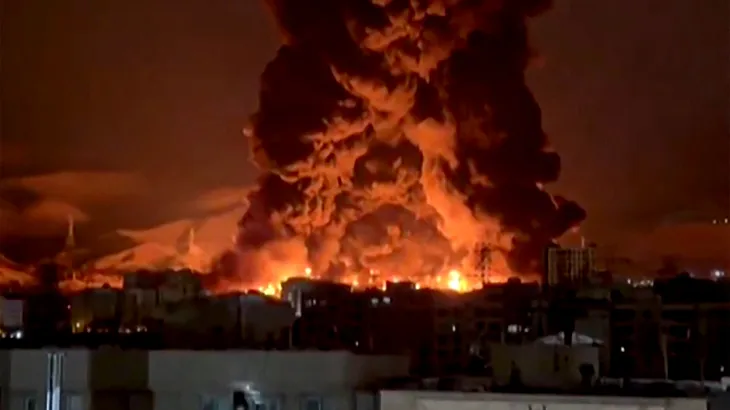
Black rain is not a metaphor. It is real precipitation oily, chemical-laden, visibly dark falling from skies choked with the products of burning petroleum. During the night of March 7 – 8, 2026, U.S.-Israeli airstrikes targeted 30 oil facilities across Iran, igniting massive fires that sent clouds of toxic black smoke into the atmosphere over Tehran a city of 10 million people. When the rain came, it brought those toxins with it.
The World Health Organization (WHO), Johns Hopkins researchers, and multiple independent scientists have been unequivocal: the resulting “black rain” poses serious, multi-layered health risks both immediately and for years to come.
JUST IN: Black rain falls over Tehran, Iran after US-Israeli strikes on oil facilities. pic.twitter.com/lgHUZp6h2w
— BRICS News (@BRICSinfo) March 8, 2026
What Is Black Rain? The Chemistry Explained
Black rain forms through a process called atmospheric scavenging — rain droplets falling through smoke-saturated air absorb suspended particles and chemical vapors, becoming carriers of concentrated toxins.
At high combustion temperatures, crude oil releases:
- Polycyclic aromatic hydrocarbons (PAHs)
- Sulfur dioxide (SO₂)
- Nitrogen oxides (NOₓ)
- Benzene
- Carbon monoxide (CO)
- Fine particulate matter (PM2.5 and black carbon)
The sulfur dioxide in crude oil converts to sulfuric acid (H₂SO₄) inside raindrops. Nitrogen oxides form nitric acid (HNO₃). This is why WHO spokesperson Christian Lindmeier described the rain as having “strong acidic properties” it is, chemically, acid rain.
Chemical Breakdown Table
Chemical Risk Profile
| Chemical | Source | Effect | Risk |
|---|---|---|---|
| PM2.5 Fine particles | Incomplete combustion | Penetrates deep into lung alveoli; triggers cardiovascular events. | High |
| Benzene C₆H₆ | Volatile organics | Known human carcinogen; linked to bone marrow damage. | Very High |
PM2.5 – Why Particle Size Is the Key Danger
One of the most critical factors in this type of pollution is particle size. PM2.5 refers to particles with a diameter of 2.5 micrometres or less about 30 times smaller than a human hair. These particles are too small to be filtered by the nose or throat. They travel deep into the tiny air sacs of the lungs (alveoli) and pass directly into the bloodstream, where they can circulate to every organ in the body.
According to Nature’s scientific coverage of the Tehran fires, toxicologist Rashi Kastury confirmed that breathing PM2.5 may lead to cardiovascular disease, stroke, increased blood pressure, and decreased cognitive function.
PM2.5 particles are 30× smaller than a human hair. They bypass the body’s natural filters, penetrate into the deepest part of the lungs, and enter the bloodstream—reaching the heart and brain.
Immediate Health Effects: What Happens Right Away
Johns Hopkins Bloomberg School of Public Health researcher Marsha Wills-Karp told The New York Times that people near burning oil facilities may show early symptoms of suffocation almost immediately. These are the body’s alarm responses:
Airways and Lungs: Coughing, chest tightness, wheezing, and shortness of breath as airways attempt to expel toxic particles. In severe cases, airways can swell shut.
Eyes: Burning, redness, and watering. SO₂ and NOₓ react with moisture on the eye surface to form irritating acids. Prolonged contact risks corneal damage.
Skin: Direct contact with black rain can cause chemical burns. The WHO specifically warned of “strong acidic properties” in the rainfall that “could cause chemical burns to the skin.”
Brain and Heart: Carbon monoxide displaces oxygen in the blood, causing dizziness, headaches, and confusion. Those with pre-existing heart conditions face elevated risk of cardiac events.
Crucially: The WHO noted that wind can carry these pollutants for miles and even across borders, meaning people far from the fires are not safe.
The Timeline of Harm From Hours to Decades
Pulmonary edema and chemical pneumonitis. NO₂ effects are often delayed—patients may feel transiently better before rapid deterioration.
Chronic inflammation and reduced lung function. Children’s developing respiratory systems are disproportionately affected, risking lifelong capacity deficits.
PM2.5 promotes arterial plaque buildup, significantly increasing the risk of hypertension, myocardial infarction, and stroke.
Chronic exposure to Benzene and PAHs is linked to leukemia and lung cancer, alongside measurably decreased cognitive function.
Does Staying Indoors Help?
Iranian authorities issued guidance urging residents to stay inside with windows closed. This reduces exposure meaningfully but it does not eliminate it.
A study on Tehran residential buildings cited by the Conflict and Environment Observatory (CEOBS) found that outdoor particulate pollution readily infiltrated homes through gaps, windows, and ventilation systems, meaning indoor particle concentrations frequently tracked outdoor levels during severe pollution episodes. Tehran’s older housing stock relies heavily on natural ventilation, making this particularly acute.
Fine particles deposited on floors, furniture, and surfaces can re-suspend and be inhaled for days after the outdoor air improves. In a conflict zone where deep-cleaning is not possible, this indoor contamination represents a prolonged secondary exposure.
“The black rain and the acidic rain coming with it is, indeed, a danger for the population. Respiratory, mainly, and it could be acidic depending, of course, what context you have. Additionally, the rainfall mixed with toxic pollutants would be extremely dangerous… with strong acidic properties and could cause chemical burns to the skin and serious damage to the lungs.”
WHO spokesperson Christian Lindmeier
Who Is Most at Risk
Vulnerable Populations
Children breathe more air per kilogram of body weight than adults. Chemicals can damage developing eyes and brain tissue; their immune systems and lungs are not yet fully formed.
Reduced lung reserve and compromised cardiovascular systems make older adults highly susceptible. Exposure can trigger acute cardiac events, especially in those on blood pressure medication.
Particulates and acid gases act as direct bronchospasm triggers. Hospital admissions for respiratory emergencies surge in the days following industrial fires of this scale.
Carbon monoxide reduces the oxygen-carrying capacity of blood. In those with blocked arteries, this additional demand can precipitate a heart attack or dangerous arrhythmia.
Wind patterns carry plumes hundreds of kilometers. Populations who cannot see or smell the smoke may still receive meaningful doses of fine particles (PM2.5).
Long-Term Effects: The Environment and Food Chain
The harm does not stop with direct human exposure. Retired Queens University ecotoxicologist Peter Hodson told CBC News that the contamination of plants, soils, and water creates the possibility of chronic, long-term exposure to compounds whose ecosystem effects are not yet fully mapped.
Water supply: Black rain enters drainage systems and, via snowmelt and surface runoff, reaches both surface water and groundwater. This can contaminate drinking water sources for communities far from the initial fires.
Food chain: Acid rain alters soil pH, leaching nutrients and making heavy metals bioavailable to plant roots. Crops absorb these toxins and enter the food supply, creating long-term low-dose human exposure through diet.
Ecosystem cascade (biomagnification): Animals that drink contaminated water or consume exposed plants accumulate toxins. As pollutants travel up the food chain, predators and humans at the top can receive concentrated doses orders of magnitude above ambient levels.
Protective Measures
The following steps, recommended by WHO and international health guidelines, reduce — but do not eliminate health risks:
Do:
- Stay indoors with windows and doors sealed. Use damp towels to block gaps if needed.
- Use N95 or FFP2 respirators if going outside. Standard surgical masks do not filter PM2.5.
- Run indoor air purifiers with HEPA filters if available.
- Drink bottled or filtered water only until tap water is confirmed safe by authorities.
- Seek medical attention immediately for any burning sensation on skin or eyes, difficulty breathing, or chest pain.
Avoid:
- Any skin or eye contact with black rain or residue. If exposed, rinse immediately with large amounts of clean water.
- Locally grown produce until soil and crop safety is confirmed.
- Outdoor exercise or any activity that increases breathing rate and depth.
- Allowing children to play outdoors.
The Scale of the Crisis
What fell over Tehran on March 7–8, 2026 was the predictable, scientifically well-documented consequence of burning vast quantities of crude oil in a dense urban environment. The WHO, Johns Hopkins researchers, and multiple independent scientists agree: the cocktail of PM2.5, black carbon, benzene, PAHs, SO₂, NOₓ, and heavy metals deposited over a city of ten million people will cause measurable harm immediately, and for years to come.
The University of Melbourne’s Associate Professor Gabriel da Silva warns that because the particles can enter the bloodstream after inhalation, the risk of cancers, neurological problems, and cardiovascular conditions is a long-term public health concern that will follow survivors of this event for decades.
The full toll will depend on how long fires continue burning, what direction wind carries the plume, and whether residents can access clean water, food, and medical care in an active conflict zone.
Sources: World Health Organization (WHO) · Nature · Conflict and Environment Observatory (CEOBS) · CBC News · The New York Times · Johns Hopkins Bloomberg School of Public Health · University of Melbourne · University of Technology Sydney · Queens University at Kingston · Iranian Red Crescent Society