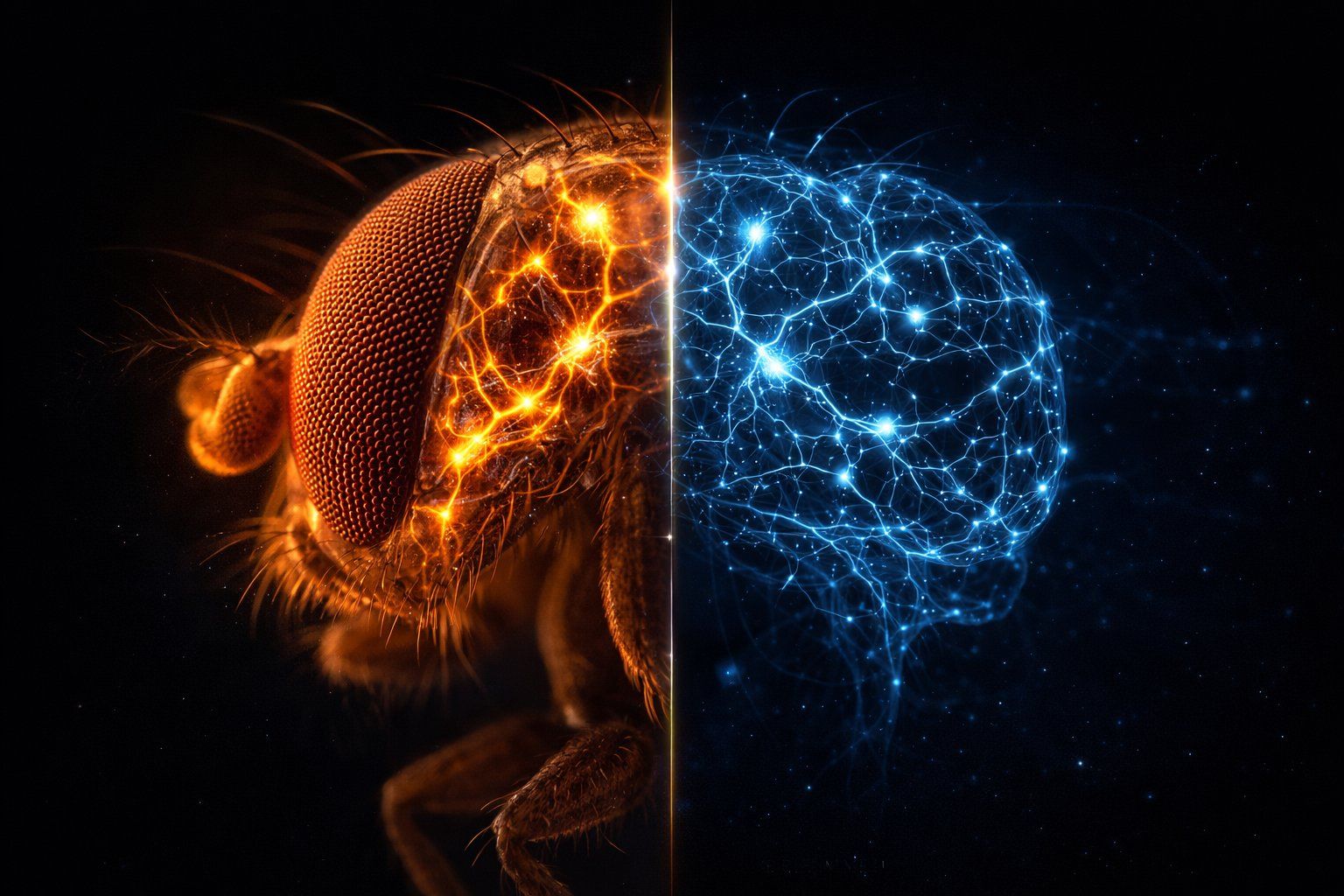








Have you ever noticed how a single worry can suddenly appear in an otherwise happy moment? You might be laughing with friends, watching a beautiful sunset, or enjoying a quiet evening only for your mind to drift toward a possible mistake, a future problem, or something unresolved.
This mental shift can feel frustrating, almost like your brain is interrupting your happiness. But in reality, it reflects a powerful and deeply wired feature of human psychology known as brain negativity bias.
The brain negativity bias describes the tendency for negative experiences, threats, or unpleasant information to have a stronger impact on our attention, memory, and decision-making than equally positive events. In simple terms, bad experiences stick with us longer and influence our behavior more strongly than good ones.
Psychologists have repeatedly demonstrated this pattern across many areas of life. A single criticism can linger in your mind long after several compliments. One negative news story can overshadow many positive events. Even in relationships, a hurtful interaction often carries more emotional weight than multiple positive ones.
This is not simply pessimism or overthinking. Instead, brain negativity bias is an evolutionary survival mechanism. For our ancestors, quickly detecting danger such as predators, hostile rivals, or environmental threats was essential for survival. Missing a threat could be fatal, while missing a pleasant opportunity was usually less costly.
As a result, natural selection shaped the human brain to prioritize potential danger over comfort or pleasure. That ancient survival system still operates today, even though most modern worries involve deadlines, social conflicts, or financial concerns rather than predators in the wild.
Understanding how the brain negativity bias works can help explain why our minds often focus on problems even when life is objectively going well.

The Evolutionary Blueprint: Why “Bad” Had to Win
In ancestral environments, rapid detection of threats was literally life-or-death. Missing a predator meant extinction; missing a food source or social opportunity merely meant another day of hunger or solitude. Natural selection therefore favored brains that prioritized danger over delight. Developmental evidence reinforces this: even infants and young children display a pronounced negativity bias in emotional learning, quickly acquiring aversions far more readily than preferences. The bias is not a modern glitch it is an ancient safety program still running on 21st-century hardware.
The Amygdala: Your Brain’s Ancient Threat Detector
At the neural core of this system sits the amygdala, a small, almond-shaped structure deep in the temporal lobes (see Figure 1). This region acts as a constant sentinel, rapidly evaluating sensory input for emotional salience especially potential harm.
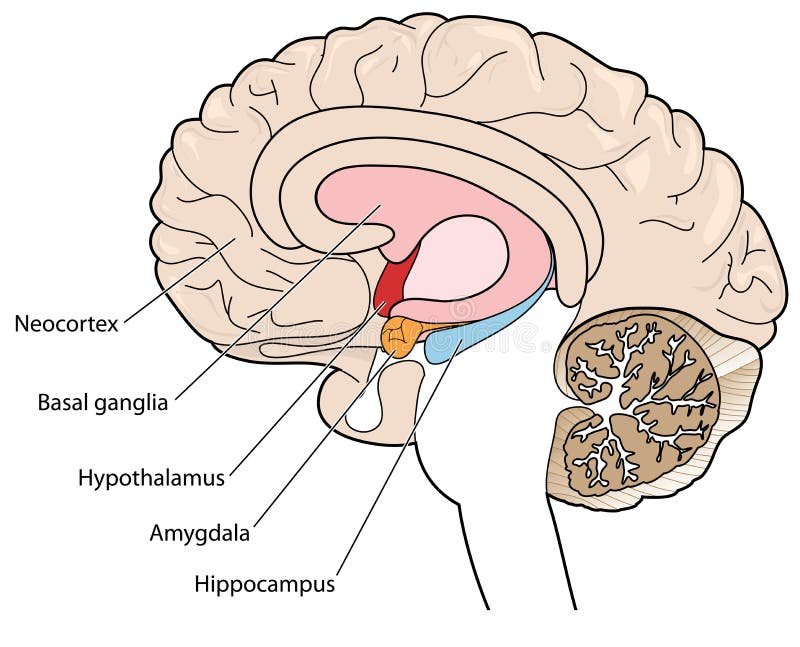
Figure 1. Sagittal brain cross-section highlighting the amygdala (in orange/yellow) alongside neighboring structures. Its position allows lightning-fast integration of sensory and emotional signals.
Functional neuroimaging consistently reveals that the amygdala responds more intensely and rapidly to negative stimuli than to positive ones of equivalent arousal. In everyday terms, your brain allocates greater neural real estate and processing priority to potential problems—even when life is objectively going well.
Quantifying the Bias: Evidence from Cognitive Neuroscience
Controlled experiments make the asymmetry strikingly visible. When participants view morphing facial expressions that blend happy and sad features, they require far less “sadness” intensity to label the face as negative than “happiness” intensity to label it positive—a behavioral signature of negativity bias quantified via the point of subjective equality (PSE). Reaction times peak and confidence bottoms out precisely at ambiguous stimuli, reflecting the cognitive tug-of-war.
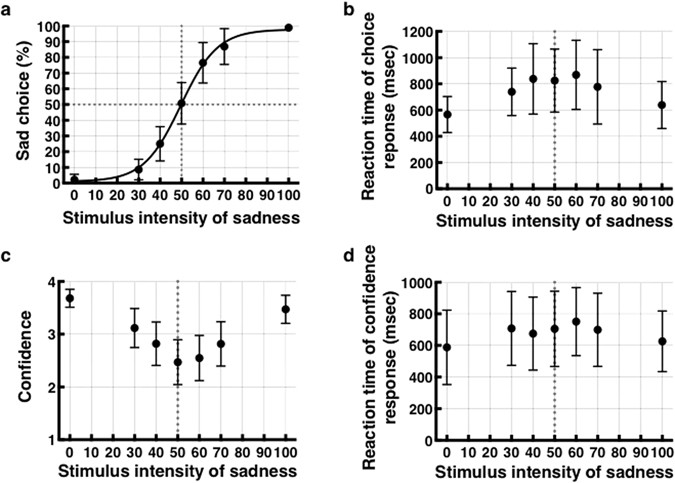
Figure 2 (panels a–d from Ito et al., 2017). Behavioral markers of negativity bias in ambiguous faces: (a) sigmoidal choice curve showing more “sad” responses than expected at 50% intensity; (b) inverted-U reaction times longest for ambiguity; (c) U-shaped confidence lowest for ambiguity; (d) corresponding response-time pattern. These patterns illustrate how negative valence disproportionately influences perception.
At the brain level, this bias correlates with heightened activity in the bilateral pregenual anterior cingulate cortex (pgACC) a hub for affective conflict monitoring—and, crucially, the amygdala itself. Functional connectivity between the pgACC and regions involved in vigilance (dorsal ACC and thalamus) further predicts individual differences in hopelessness, suggesting the circuitry that tilts perception toward threat in ambiguous situations.
When the Ancient Program Goes Awry: Depression and Persistent Hyperactivity
In major depressive disorder, the negativity bias becomes amplified and entrenched. Recent high-resolution studies using mouse models of chronic stress (mimicking depression via corticosterone) reveal precise circuit-level disruptions within the basolateral amygdala (BLA). Neurons projecting to the nucleus accumbens (normally encoding positive valence) become under-recruited, while those projecting to the central amygdala (encoding negative valence) become overactive. Inputs from the paraventricular thalamus that normally orchestrate balanced valence assignment are also altered. These changes produce a measurable olfactory negativity bias depressed mice (and humans) rate pleasant odors as less appealing and aversive ones as more repellent directly paralleling clinical symptoms.
Even more telling: longitudinal fMRI work shows that amygdala hyperactivity to subliminally presented sad faces persists for at least two years, regardless of whether patients relapse or achieve full remission. This hyperactivity during automatic (pre-conscious) processing appears to be a trait marker of vulnerability rather than a transient state effect suggesting the safety program never fully powers down.
Not a Bug, but an Old Safety Feature – And How to Manage It
The takeaway is both reassuring and analytically precise. When your mind scans for problems during otherwise good moments, it is not sabotaging your happiness; it is executing an evolutionarily honed subroutine designed to keep you alive. Cognitive neuroscience has quantified this asymmetry at every level from milliseconds of amygdala BOLD response, to behavioral choice curves, to long-term circuit plasticity in depression.
Understanding the mechanism empowers us. Awareness alone can attenuate its grip: mindfulness practices, cognitive reappraisal, and targeted interventions that strengthen positive-valence pathways (e.g., chemogenetic or pharmacological boosting of BLA-to-accumbens circuits in preclinical models) all show promise. The ancient program remains essential; our task is to update its parameters for a world where tigers are rare but opportunities and joys are abundant.
References
• Baumeister, R. F., Bratslavsky, E., Finkenauer, C., & Vohs, K. D. (2001). Bad is stronger than good. Review of General Psychology, 5(4), 323–370. https://doi.org/10.1037/1089-2680.5.4.323 (foundational synthesis; widely cited across neuroscience and psychology).
• Ito, T., et al. (2017). Neural basis of negativity bias in the perception of ambiguous facial expression. Scientific Reports (Nature Portfolio). https://www.nature.com/articles/s41598-017-00502-3
• Bigot, M., et al. (2024). Disrupted basolateral amygdala circuits support negative valence bias in depressive states. Translational Psychiatry (Nature Portfolio). https://www.nature.com/articles/s41398-024-03085-6
• Klug, M., et al. (2024). Persistence of amygdala hyperactivity to subliminal negative emotion processing in the long-term course of depression. Molecular Psychiatry (Nature Portfolio). https://www.nature.com/articles/s41380-024-02429-4