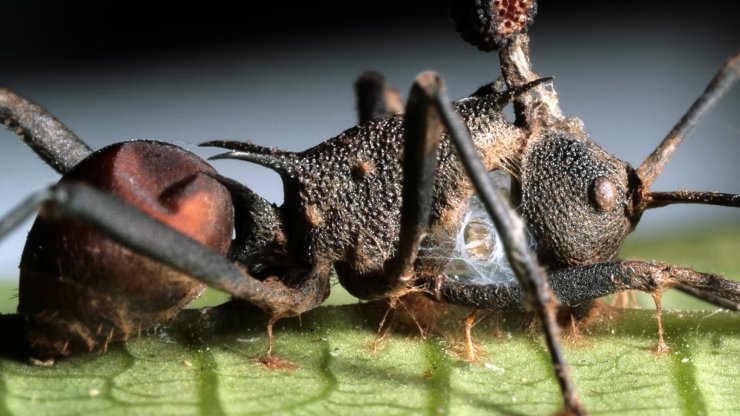

For over 48 million years, the Ophiocordyceps unilateralis fungus has refined its role as a master of biological manipulation. Scientists discovered evidence of this ancient “death grip” in fossilized leaves from Germany’s Messel pit. These fossils show the unmistakable dumb-bell-shaped scars left by infected ants. This find confirms the fungus manipulated host behavior long before the Himalayas rose. It evolved a precise strategy to bypass “social immunity,” the colony’s ability to detect and expel sick members.

The nightmare begins when a microscopic spore lands on a carpenter ant. The spore breaches the ant’s protective exoskeleton using enzymes and physical pressure. Inside, the fungus enters an incubation period. The ant appears perfectly healthy and continues its colony duties. During this phase, the fungus carefully avoids the brain. It grows around the organ rather than attacking it directly.
Recent research using fluorescent microscopy reveals that the fungus acts as a “colonial organism.” Fungal cells form a cooperative, tubular network. This network wraps around the ant’s muscle bundles. These cells connect through specialized tubes to communicate and exchange nutrients.
The fungus then floods the host with bioactive and alkaloid chemicals. This interference hijacks the ant’s nervous system. Essentially, the fungus takes control of the muscles to drive the ant’s body like a mechanical puppet.
When the infection reaches the “zombie phase,” the fungus compels the ant to abandon its nest. The ant seeks a specific microclimate that favors fungal growth. With eerie precision, the fungus forces the ant to climb exactly 25 centimeters (10 inches) above the forest floor.
At this height, temperature and humidity levels are optimal. The fungus drives the ant to the underside of a leaf, often on the north side. There, the ant sinks its mandibles into a central vein in a permanent “death grip.”
Once the ant is immobile, the fungus consumes the insect’s internal organs. Several days after death, a fungal stalk (fruiting body) erupts from the base of the ant’s head. This stalk acts as a biological cannon. It jettisons spores at a staggering rate of up to 30,000 per second. Because the ant died directly above a foraging trail, these spores rain down on nestmates to continue the cycle.
While this parasite is 100% lethal to individuals, it rarely destroys entire populations. The ecosystem maintains a delicate balance. Hyperparasites—fungi that prey on other fungi—often infect the Ophiocordyceps. This keeps the population in check.
Over 600 species of Cordyceps exist worldwide, each adapted to different hosts:
- Ghost Moth Caterpillars: Targeted by species prized in traditional medicine.
- Cicadas: Some fungi pump cicadas with hallucinogenic drugs. This causes them to procreate until their abdomens fall off.
To understand this process, imagine the ant is a car and the fungus is a hacker:
Instead of trying to convince the driver (the brain) where to go, the fungus simply hacks into the steering and engine (the muscles). It takes the wheel and drives the vehicle to its final destination while the driver sits helplessly in the seat.