
Sunday, May 17, 2026
SAVED POSTS
  • Login
  • Register
RathBiotaClan
No Result
View All Result
  • HOME
  • HEALTH SCIENCE

    TRENDING ON HEALTH (TOP)

    Cycling Linked to Lower Dementia Risk in Study of Nearly 480,000 Adults

    First oral GLP-1 weight-loss pill approved a new era for accessible treatment

    Chewing gum releases thousands of microplastic particles directly into your mouth with every piece you chew

    Single-Cell Study of Over a Million Immune Cells Reveals Why Women Are More Prone to Autoimmune Disease

    NOW ON AIR (RBC)

    A new study has found that men’s brains shrink faster than women’s as they age.
    NEUROSCIENCE

    12,638 MRI Scans Confirm Men’s Brains Shrink Faster in PNAS Study

    May 14, 2026
    ENVIRONMENTAL SCIENCE

    Volcanic Eruptions Can Destroy Their Own Methane — Tonga’s Plume Shows How

    May 13, 2026
    3 men standing on rocky shore during daytime
    MOLECULAR BIOLOGY

    For Future Space Missions, Molecular Ecology Finally Offers a Clear Biosignature Target

    May 12, 2026
    Babies Yawn in the Womb
    DEVELOPMENTAL BIOLOGY

    Scientists Say Babies May Learn to Yawn Before Birth

    May 11, 2026
  • NEUROSCIENCE
    • PHYSIOLOGY
    • IMMUNOLOGY
    • CANCER
  • DISCOVERIES
    • SPOTLIGHTS
    • STUDENT PORTAL
    • SCIENCE FEATURED
  • MOLECULAR BIOLOGY
    • GENETICS
    • BIOTECHNOLOGY
    • BIOINFORMATICS
    • BIOCHEMISTRY
    • BIOPHYSICS
  • ZOOLOGY & ECOLOGY
    • ENVIRONMENTAL SCIENCE
    • ECOLOGY
    • EVOLUTION
  • MICRO & PLANT SCIENCE
    • MICROBIOLOGY
    • CELL BIOLOGY
    • DEVELOPMENTAL BIOLOGY
  • PSYCHOLOGY
RathBiotaClan
RathBiotaClan
No Result
View All Result
Home BIOPHYSICS

Human Sperm Ignores Newton’s Third Law to Swim Like Superheroes

Shibasis Rath by Shibasis Rath
February 13, 2026
in BIOPHYSICS, NEWS
Reading Time: 5 mins read
0
A A
0
Scientists Caught Sperm Ignoring a Major Physical Law

In the macroscopic world, Sir Isaac Newton’s third law of motion is inescapable: if you push a wall, it pushes back. Forces come in equal and opposite pairs. But in the chaotic, microscopic fluids where human life begins, these rules appear to bend.

Study published in PRX Life has provided a comprehensive mathematical framework termed “Odd Elastohydrodynamics” to explain how human sperm and single-celled algae (Chlamydomonas) effectively bypass Newton’s third law. By analyzing the “non-reciprocal” interactions within their flagella, researchers have identified a new material property called the odd-elastic modulus, which allows these cells to generate propulsion in highly viscous fluids without provoking the equal “push back” that standard physics predicts.

The Scallop Theorem and the Viscosity Trap

Image Credit: Wikipedia

To understand the magnitude of this feat, one must understand the environment. Microscopic swimmers like sperm operate at a “low Reynolds number,” a regime where fluid viscosity (thickness) dominates over inertia.

In this world, water feels as thick as corn syrup. If a swimmer stops moving, they stop instantly; there is no gliding. Furthermore, simple back-and-forth movements are useless. This is known as the “Scallop Theorem“: a scallop opening and closing its shell in honey would simply move back and forth in place. To move forward, a microswimmer must deform its body in a “non-reciprocal” way—performing a motion that looks different when played in reverse, like a traveling wave moving down a whip.

ADVERTISEMENT

The Engine of Violation: Odd Elasticity

Standard elastic materials (like a rubber band) are “conservative.” If you deform them, they store energy and release it reciprocally. This is “even elasticity”.

READ ALSO

12,638 MRI Scans Confirm Men’s Brains Shrink Faster in PNAS Study

For Future Space Missions, Molecular Ecology Finally Offers a Clear Biosignature Target

However, living cells are “active matter.” They burn chemical energy to generate internal forces. The researchers discovered that sperm flagella exhibit “odd elasticity,” a phenomenon where the internal interactions are non-symmetrical. When a sperm tail bends, it doesn’t just react to the fluid; it injects energy into the system, creating a self-sustained wave that drives against the fluid’s drag.

ADVERTISEMENT

To quantify this, the team introduced the Odd-Elastic Modulus, a complex mathematical function defined by a spatial Fourier transform. It decomposes the cell’s mechanics into two distinct parts:

  • The Real Part (Even Elasticity): This represents the passive stiffness of the flagellum—its natural tendency to return to a straight line.
  • The Imaginary Part (Odd Elasticity): This represents the active, non-reciprocal forces. It measures how the flagellum generates the “odd” loops of energy required to swim.

Crucially, the study found that the imaginary part is what sustains the wave. In their models, the odd elasticity effectively “pumps” energy into the deformation cycle to overcome fluid damping.

Modeling Life: From Spheres to Sperm

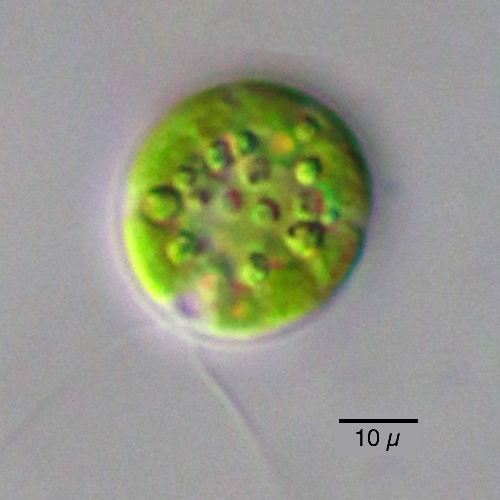
Green algae (Chlamydomonas globosa) with two flagella just visible at bottom left. (Wikimedia Commons)

The researchers validated this theory using several distinct models:

ADVERTISEMENT

1. The Sphere-Spring System They began with a simplified theoretical model: a chain of spheres connected by springs. In an “overdamped” environment (high viscosity), they found that a standard spring could not sustain a wave. To keep a wave moving, the springs required “odd” behavior specifically, an antisymmetric elasticity matrix that injects energy to counter the drag.

2. The Chlamydomonas Breaststroke Moving to biology, they modeled Chlamydomonas, an algae that swims using two flagella in a breaststroke pattern. By clamping the model at one end, they observed that the “odd” component of the elasticity peaked exactly at the wavenumber of the flagellum’s beat. This confirmed that odd elasticity was the driving force behind the algae’s asymmetric stroke.

3. Human Sperm and the “Noisy Limit Cycle” Using experimental data from human sperm, the team used Principal Component Analysis (PCA) to map the flagellum’s complex motion into a simpler 2D “shape space”.

They found that the sperm’s beat forms a “limit cycle” a stable, repeating loop in this shape space. However, biological systems are messy. The sperm data showed a “noisy limit cycle,” where the beat pattern fluctuates due to internal biological noise.

Thermodynamics of the Microscopic

The study went even deeper, linking this “odd” mechanics to the laws of thermodynamics. By applying gauge-field formulation (a concept borrowed from particle physics), they calculated that the swimming velocity is proportional to the “flux” or area enclosed by this limit cycle in shape space.

When they factored in the “noise” of the sperm’s beat, they discovered a link to entropy. The “odd elasticity” is directly responsible for the system’s entropy production the thermodynamic cost of breaking the symmetry of equilibrium. Essentially, the sperm “pays” for its violation of Newton’s law with entropy, generated by the metabolic energy it consumes.

Why It Matters

This research offers a unified framework for “active matter physics”. It proves that the chaotic swimming of a sperm cell and the theoretical motion of odd-elastic materials are governed by the same non-reciprocal mathematics.

The implications extend beyond biology. Engineers designing micro-robots for drug delivery face the same “viscosity trap” as sperm. By programming “odd elasticity” into artificial materials—creating soft robots that internally cycle energy we could build microscopic machines that swim through our bloodstream with the efficiency of nature’s most persistent travelers.


REFERENCES:

Ishimoto, K., Moreau, C., & Yasuda, K. (2023). Odd Elastohydrodynamics: Non-Reciprocal Living Material in a Viscous Fluid. PRX Life, 1, 023002. DOI: 10.1103/PRXLife.1.023002
  • Share on WhatsApp (Opens in new window) WhatsApp
  • Share on Facebook (Opens in new window) Facebook
  • Share on Reddit (Opens in new window) Reddit
  • Share on X (Opens in new window) X
  • Print (Opens in new window) Print
Shibasis Rath

Shibasis Rath

"𝓒𝓸𝓷𝓷𝓮𝓬𝓽𝓲𝓷𝓰 𝓡𝓮𝓼𝓮𝓪𝓻𝓬𝓱 𝓣𝓸 𝓡𝓮𝓪𝓵𝓲𝓽𝔂" 𝓲𝓼𝓷'𝓽 𝓙𝓾𝓼𝓽 𝓪 𝓜𝓸𝓽𝓽𝓸 - 𝓘𝓽'𝓼 𝓜𝔂 𝓜𝓲𝓼𝓼𝓲𝓸𝓷

Related Posts

A new study has found that men’s brains shrink faster than women’s as they age.
NEUROSCIENCE

12,638 MRI Scans Confirm Men’s Brains Shrink Faster in PNAS Study

May 14, 2026
3 men standing on rocky shore during daytime
MOLECULAR BIOLOGY

For Future Space Missions, Molecular Ecology Finally Offers a Clear Biosignature Target

May 12, 2026
Global Sperm Counts Have Dropped 50% in 50 Years Now 128 Men Are Racing Their Way to a $100,000 Prize to Prove the Point
NEWS

Global Sperm Counts Have Dropped 50% in 50 Years Now 128 Men Are Racing Their Way to a $100,000 Prize to Prove the Point

May 5, 2026

POPULAR NEWS

Chewing gum releases thousands of microplastic particles directly into your mouth with every piece you chew

Chewing gum releases thousands of microplastic particles directly into your mouth with every piece you chew

by Shibasis Rath
May 8, 2026
0

Microplastics are turning up in places researchers never expected: deep-sea sediments, Arctic ice, and human blood. Now, a UCLA pilot...

Yelling Isn’t Just Yelling: How a Hostile Home Rewires a Child’s Brain for Constant Alert

Yelling Isn’t Just Yelling: How a Hostile Home Rewires a Child’s Brain for Constant Alert

by Shibasis Rath
March 8, 2026
0

To a parent in the heat of the moment, a raised voice may feel like simple frustration. To a child...

a group of gen Z kids walking down a street

Is Gen Z the First Generation Less Intelligent Than Their Parents?

by Shibasis Rath
February 5, 2026
0

Gen Z intelligence decline is emerging as a serious concern among neuroscientists and education researchers. For over a century, each...

Whole Brain Emulation Achieved: Scientists Run a Fruit Fly Brain in Simulation

by Shibasis Rath
March 9, 2026
0

Scientists have copied an entire biological brain neuron by neuron and synapse by synapse and made it control a simulated...

Global Sperm Counts Have Dropped 50% in 50 Years Now 128 Men Are Racing Their Way to a $100,000 Prize to Prove the Point

Global Sperm Counts Have Dropped 50% in 50 Years Now 128 Men Are Racing Their Way to a $100,000 Prize to Prove the Point

by Staff Writer
May 5, 2026
0

A group of technology entrepreneurs is staging a competitive event in San Francisco in which semen samples from 128 men...

EDITOR CHOICE‘S

  • All
  • NEWS
  • SPOTLIGHTS
A new study has found that men’s brains shrink faster than women’s as they age.

12,638 MRI Scans Confirm Men’s Brains Shrink Faster in PNAS Study

by Staff Writer
May 14, 2026
0

A large-scale analysis of brain scans taken over time has found that men's brains shrink faster than women's across a...

Volcanic Eruptions Can Destroy Their Own Methane — Tonga’s Plume Shows How

Volcanic Eruptions Can Destroy Their Own Methane — Tonga’s Plume Shows How

by Shibasis Rath
May 13, 2026
0

A study published in Nature Communications analyzed the Hunga Tonga-Hunga Ha'apai volcano eruption's impact on methane in the atmosphere. It...

3 men standing on rocky shore during daytime

For Future Space Missions, Molecular Ecology Finally Offers a Clear Biosignature Target

by Shibasis Rath
May 12, 2026
0

When the next generation of probes scoops up dust from the icy shell of Europa or the surface of Mars,...

Babies Yawn in the Womb

Scientists Say Babies May Learn to Yawn Before Birth

by Shibasis Rath
May 11, 2026
0

Mothers can spread yawns to their yet-to-be-born offspring during pregnancy, researchers report May 5 in Current Biology  the first empirical evidence...

ADVERTISEMENT

RathBiotaClan – RBC

RathBiotaClan – Connecting Research To Reality

Your trusted source for life science news, biology research & discoveries. Covering neuroscience, genetics, ecology, and more — connecting research to reality.

Privacy Policies

Contact Us

About Us

Editorial Standards

Latest Posts

  • 12,638 MRI Scans Confirm Men’s Brains Shrink Faster in PNAS Study
  • Volcanic Eruptions Can Destroy Their Own Methane — Tonga’s Plume Shows How
  • For Future Space Missions, Molecular Ecology Finally Offers a Clear Biosignature Target
  • Scientists Say Babies May Learn to Yawn Before Birth

SHIBASIS RATH

Contact Mail

rathbiotaclan@gmail.com

No Result
View All Result
MSME (Udyam) Certified Science Platform
Govt. of India

Get Us On PlayStore

playstore app for rathbiotaclan
  • About Us
  • Advertise With Us
  • Cancellation and Refund Policy
  • Contact Us
  • Contribute
  • Editorial Standards
  • Home
  • Pricing Details
  • Privacy Policies
  • Shipping Policy
  • Terms & Conditions

© 2026 RathBiotaClan. All rights reserved.

Welcome Back!

Sign In with Google
OR

Login to your account below

Forgotten Password? Sign Up

Create New Account!

Sign Up with Google
OR

Fill the forms bellow to register

*By registering into our website, you agree to the Terms & Conditions and Privacy Policy.
All fields are required. Log In

Retrieve your password

Please enter your username or email address to reset your password.

Log In

Add New Playlist

No Result
View All Result
  • HOME
  • HEALTH SCIENCE
  • NEUROSCIENCE
    • PHYSIOLOGY
    • IMMUNOLOGY
    • CANCER
  • DISCOVERIES
    • SPOTLIGHTS
    • STUDENT PORTAL
    • SCIENCE FEATURED
  • MOLECULAR BIOLOGY
    • GENETICS
    • BIOTECHNOLOGY
    • BIOINFORMATICS
    • BIOCHEMISTRY
    • BIOPHYSICS
  • ZOOLOGY & ECOLOGY
    • ENVIRONMENTAL SCIENCE
    • ECOLOGY
    • EVOLUTION
  • MICRO & PLANT SCIENCE
    • MICROBIOLOGY
    • CELL BIOLOGY
    • DEVELOPMENTAL BIOLOGY
  • PSYCHOLOGY
  • Login
  • Sign Up
SAVED POSTS

© 2026 RathBiotaClan. All rights reserved.

This website uses cookies. By continuing to use this website you are giving consent to cookies being used. Visit our Privacy and Cookie Policy.