

Tuesday, June 16, 2026
SAVED POSTS
  • Login
  • Register
RathBiotaClan
No Result
View All Result
  • HOME
  • HEALTH SCIENCE

    TRENDING ON HEALTH (TOP)

    For People Antidepressants Never Helped, a 30-Minute Home Session Is Now FDA-Approved

    Scientists Say Your Next Tube of Toothpaste Could Be Made From Human Hair

    Your Lungs, Liver, and Pancreas Also Age Faster When You Sleep Wrong

    Cycling Linked to Lower Dementia Risk in Study of Nearly 480,000 Adults

    NOW ON AIR (RBC)

    NEWS

    A Father’s Touch in Infancy Can Shape a Child’s Health for Years, New Science Explains Why

    June 9, 2026
    MutExpress
    BIOINFORMATICS

    South Asian Patients Have Been Left Out of Cancer Genomics for Decades & MutExpress-India Is Changing That

    June 8, 2026
    Biodiversity Loss
    ECOLOGY

    Biodiversity Loss Could Bankrupt Nations And Wall Street Hasn’t Noticed Yet

    June 5, 2026
    Soprano pipistrelle (Pipistrellus pygmaeus) emerging from a tree hollow at the moment of take-off.
    ECOLOGY

    Human-generated electromagnetic noise has long lasting effects on light orientation in bats

    June 4, 2026
  • NEUROSCIENCE
    • PHYSIOLOGY
    • IMMUNOLOGY
    • CANCER
  • DISCOVERIES
    • SPOTLIGHTS
    • STUDENT PORTAL
    • SCIENCE FEATURED
  • MOLECULAR BIOLOGY
    • GENETICS
    • BIOTECHNOLOGY
    • BIOINFORMATICS
    • BIOCHEMISTRY
    • BIOPHYSICS
  • ZOOLOGY & ECOLOGY
    • ENVIRONMENTAL SCIENCE
    • ECOLOGY
    • EVOLUTION
  • MICRO & PLANT SCIENCE
    • MICROBIOLOGY
    • CELL BIOLOGY
    • DEVELOPMENTAL BIOLOGY
  • PSYCHOLOGY
RathBiotaClan
RathBiotaClan
No Result
View All Result
Home GENETICS

Principles of transcriptional regulation In tryptophan operon

Shibasis Rath by Shibasis Rath
September 28, 2024
in GENETICS, MOLECULAR BIOLOGY, STUDENT PORTAL
Reading Time: 6 mins read
0
A A
0
Diagram showing the mechanism of trp operon regulation: tryptophan binds to the repressor, activating it to bind the operator and block RNA polymerase from transcribing trp operon genes, repressing gene expression.

The tryptophan (trp) operon of Escherichia coli is a paradigm example of a repressed, negatively controlled operon. This operon involves the biosynthesis of the amino acid tryptophan. A negatively controlled operon is one in which a regulatory protein, known as a repressor, depresses the operon by reacting to the availability of the product of the operon, in this case, tryptophan.

Structure of the Operon

The five structural genes of the trp operon are given as follows:

trpE

trpD

ADVERTISEMENT

trpC

READ ALSO

Childhood Trauma Leaves Distinct Marks on Fathers’ Sperm, Study Shows

Parents Blame Lip-Ties for Nursing Struggles, But Study Highlights Maternal Experience

trpB

ADVERTISEMENT

trpA

ADVERTISEMENT

The five structural genes encode enzymes that catalyze sequential reactions leading to the formation of tryptophan, the final product of the pathway. A promoter (P) is the site for the binding of RNA polymerase to start transcription. The operator (O) overlaps the promoter, and it is the repressor-binding site. The leader region or the trpL encodes the leader peptide, which is involved in transcriptional attenuation.

Mechanism of Repression

The trp operon is regulated by the Trp repressor, whose gene is coded for by the gene trpR. In its inactive form known as the aporepressor the protein cannot bind to the operator sequence and hence the operon is transcribed, that is, tryptophan can be synthesized.

In the absence of tryptophan, the aporepressor is inactive and not able to bind to the operator. Thus, RNA polymerase may initiate transcription of the structural genes, with enzymes being produced that will later be necessary for the synthesis of tryptophan.

In the presence of tryptophan: Tryptophan acts as a corepressor which binds to the aporepressor causing some conformational change, and thus converting it into an active holorepressor. The holorepressor then goes on to bind with the operator, thereby blocking the transcription of the operon by RNA polymerase. This is considered as feedback inhibition whereby tryptophan is futilely synthesized when its concentration in the environment is already adequate.

Transcriptional Attenuation

Apart from repression by the Trp repressor, the trp operon is controlled by a second level of control termed transcriptional attenuation. This controls the continuation of the transcription after it has been initiated; this mechanism is reliant on prokaryotic coupling between transcription and translation .

Leader Peptide and Attenuator

The leader sequence of the operon, trpL, contains a short open reading frame that carries two adjacent codons specifying tryptophan. It is an important region for attenuation, since translation there contributes to sensing the tryptophan levels. Transcriptional attenuation is contingent upon the ability of the ribosome to translate the leader peptide. It is the direct object because it actually alters the RNA secondary structures that arise during transcription.

Low Tryptophan Concentration:

If tryptophan is limiting, the ribosomes stall at the codons for tryptophan in the leader sequence. This stalling prevents the transcription-terminating stem-loop sequence – a hairpin structure within the messenger RNA – from forming, which would stop RNA polymerase elongation past the operon and prevent transcribing downstream structural genes. Instead, enzymes for tryptophan biosynthesis are produced, and the operon remains active.

High Tryptophan Levels:

When tryptophan is present, the ribosomes translate the leader peptide very rapidly without slowing down. This rapid translation facilitates the formation of a stem-loop that acts as a terminator for transcription. The stem-loop terminator structure halts RNA polymerase, thereby halting transcription of the structural genes. This ensures that there is no excessive production of extra tryptophan biosynthetic enzymes.

Summary of Mechanism

1. When Tryptophan is Low:

The ribosomes become locked permanently at the two tryptophan codons in the leader sequence so that the terminator loop cannot be formed. The entire operon is transcribed unhindered.

2. When Tryptophan is High:

The ribosomes translate the leader sequence without stopping and allow formation of the terminator stem-loop which will terminate transcription of the operon.

Attenuation mediated by RNA-binding Protein

While E. coli employs translation mediated attenuation, other bacteria such as Bacillus subtilis regulate the trp operon by means of another approach: TRAP (Trp RNA-binding Attenuation Protein).

TRAP

Structure and Function: TRAP exists as a multimer of 11 subunits, where each binds one tryptophan molecule. Upon the binding of tryptophan, TRAP is activated, and it goes on to bind a sequence in the leader region of the mRNA. Binding to this sequence promotes a terminator hairpin, which causes premature termination of transcription.

Low Tryptophan: Here in the absence of tryptophan, TRAP cannot bind to its mRNA, and this alternative structure somehow dinsn’t allow the terminator hairpin to form, therefore, it allows complete transcription of the operon.

Anti-TRAP Regulation: The activity of TRAP is controlled by anti-TRAP proteins. It binds to TRAP, hence preventing it from down-regulating the operon during tryptophan starvation. In this manner, when the cell requires tryptophan, biosynthesis will take place.

The leader sequence of the trp operon consists of 162 base pairs and specifies a 14-amino acid leader peptide, two of which being the tryptophan codons. The two consecutive tryptophan codons are the significant ones in the sensing of tryptophan availability. It is found between the operator and the structural genes and is essential in whether the transcription will carry on or stop through the varied secondary structures of mRNA that will be developed as a consequence of its various melting regions.

When the levels of tryptophan are low, then the whole operon is transcribed to mRNA. However, if the levels of tryptophan are already high, then only the first 140 nucleotides of the leader sequence are transcribed before being stopped at the attenuator region. This function stops the structural genes from being expressed and therefore prevents the formation of tryptophan biosynthetic enzymes.

Conclusion

The control of the trp operon in E. coli can be regarded as a two-fold control mechanism:

1. Induction by the tryptophan-activated Trp repressor.

2. Attenuation, in which the fine-tuning of the operon activity is responsive to the translation of the leader peptide.

In B. subtilis, however, it is RNA-binding proteins like TRAP that take the lead in controlling the process of transcription. Both mechanisms show how bacterial cells can tune gene expression effectively to changes in environmental conditions, thereby helping to ensure metabolic efficiency and resource conservation.

Image Illustration
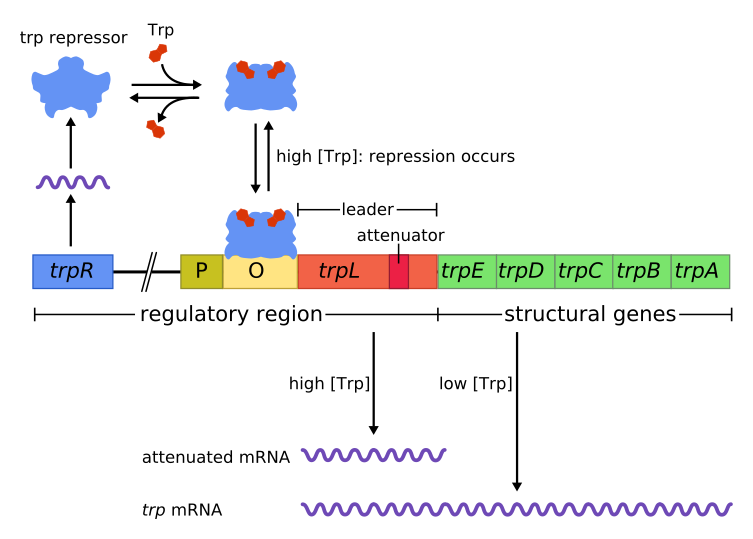
trp_operon.jpg

Image credit to @wikipedia

Engage with Us:

Stay tuned for more captivating insights and News. Visit our Blogs , Science paper , Study Portal and Follow Us on social media to never miss an update. Together, let’s unravel the mysteries of the natural world.

  • Share on WhatsApp (Opens in new window) WhatsApp
  • Share on Facebook (Opens in new window) Facebook
  • Share on Reddit (Opens in new window) Reddit
  • Share on X (Opens in new window) X
  • Print (Opens in new window) Print
Shibasis Rath

Shibasis Rath

"𝓒𝓸𝓷𝓷𝓮𝓬𝓽𝓲𝓷𝓰 𝓡𝓮𝓼𝓮𝓪𝓻𝓬𝓱 𝓣𝓸 𝓡𝓮𝓪𝓵𝓲𝓽𝔂" 𝓲𝓼𝓷'𝓽 𝓙𝓾𝓼𝓽 𝓪 𝓜𝓸𝓽𝓽𝓸 - 𝓘𝓽'𝓼 𝓜𝔂 𝓜𝓲𝓼𝓼𝓲𝓸𝓷

Related Posts

Childhood Trauma Leaves Distinct Marks on Fathers’ Sperm, Study Shows
GENETICS

Childhood Trauma Leaves Distinct Marks on Fathers’ Sperm, Study Shows

May 22, 2026
Parents Blame Lip-Ties for Nursing Struggles, But Study Highlights Maternal Experience
GENETICS

Parents Blame Lip-Ties for Nursing Struggles, But Study Highlights Maternal Experience

May 18, 2026
3 men standing on rocky shore during daytime
MOLECULAR BIOLOGY

For Future Space Missions, Molecular Ecology Finally Offers a Clear Biosignature Target

May 12, 2026

POPULAR NEWS

Chewing gum releases thousands of microplastic particles directly into your mouth with every piece you chew

Chewing gum releases thousands of microplastic particles directly into your mouth with every piece you chew

by Shibasis Rath
May 8, 2026
0

Microplastics are turning up in places researchers never expected: deep-sea sediments, Arctic ice, and human blood. Now, a UCLA pilot...

New Studys Says Gen Z is the least sexually active young cohort in modern recorded history

New Studys Says Gen Z is the least sexually active young cohort in modern recorded history

by Shibasis Rath
January 24, 2026
0

A generation that grew up with dating apps in their pockets, pornography a tap away, and sex discussed more openly...

Yelling Isn’t Just Yelling: How a Hostile Home Rewires a Child’s Brain for Constant Alert

Yelling Isn’t Just Yelling: How a Hostile Home Rewires a Child’s Brain for Constant Alert

by Shibasis Rath
March 8, 2026
0

To a parent in the heat of the moment, a raised voice may feel like simple frustration. To a child...

a group of gen Z kids walking down a street

Is Gen Z the First Generation Less Intelligent Than Their Parents?

by Shibasis Rath
February 5, 2026
0

Gen Z intelligence decline is emerging as a serious concern among neuroscientists and education researchers. For over a century, each...

Whole Brain Emulation Achieved: Scientists Run a Fruit Fly Brain in Simulation

by Shibasis Rath
March 9, 2026
0

Scientists have copied an entire biological brain neuron by neuron and synapse by synapse and made it control a simulated...

EDITOR CHOICE‘S

  • All
  • NEWS
  • SPOTLIGHTS
A Father’s Touch in Infancy Can Shape a Child’s Health for Years, New Science Explains Why

A Father’s Touch in Infancy Can Shape a Child’s Health for Years, New Science Explains Why

by Staff Writer
June 9, 2026
0

A study from Penn State University has revealed something startling beneath that simplicity those early interactions carry biological consequences that...

MutExpress

South Asian Patients Have Been Left Out of Cancer Genomics for Decades & MutExpress-India Is Changing That

by Staff Writer
June 8, 2026
0

The databases that underpin modern cancer genomics have a geography problem. The gnomAD database the gold standard for allele frequency...

Biodiversity Loss

Biodiversity Loss Could Bankrupt Nations And Wall Street Hasn’t Noticed Yet

by Staff Writer
June 5, 2026
0

Every year, governments borrow trillions of dollars to function. The interest rate they pay depends almost entirely on their credit...

Soprano pipistrelle (Pipistrellus pygmaeus) emerging from a tree hollow at the moment of take-off.

Human-generated electromagnetic noise has long lasting effects on light orientation in bats

by Shibasis Rath
June 4, 2026
0

A new study has found that soprano pipistrelle bats exposed to low-intensity broadband radiofrequency noise fly in random directions when...

ADVERTISEMENT

RathBiotaClan – RBC

RathBiotaClan – Connecting Research To Reality

Your trusted source for life science news, biology research & discoveries. Covering neuroscience, genetics, ecology, and more — connecting research to reality.

About Us

Privacy Policies

Contact Us

Editorial Standard

Latest Posts

  • A Father’s Touch in Infancy Can Shape a Child’s Health for Years, New Science Explains Why
  • South Asian Patients Have Been Left Out of Cancer Genomics for Decades & MutExpress-India Is Changing That
  • Biodiversity Loss Could Bankrupt Nations And Wall Street Hasn’t Noticed Yet
  • Human-generated electromagnetic noise has long lasting effects on light orientation in bats

SHIBASIS RATH

Contact Mail

rathbiotaclan@gmail.com

No Result
View All Result
MSME (Udyam) Certified Science Platform
Govt. of India

Get Us On PlayStore

playstore app for rathbiotaclan
  • About Us
  • Advertise With Us
  • Cancellation and Refund Policy
  • Contact Us
  • Contribute
  • Editorial Standards
  • Home
  • Pricing Details
  • Privacy Policies
  • Shipping Policy
  • Terms & Conditions

© 2026 RathBiotaClan. All rights reserved.

Welcome Back!

Sign In with Google
OR

Login to your account below

Forgotten Password? Sign Up

Create New Account!

Sign Up with Google
OR

Fill the forms bellow to register

*By registering into our website, you agree to the Terms & Conditions and Privacy Policy.
All fields are required. Log In

Retrieve your password

Please enter your username or email address to reset your password.

Log In

Add New Playlist

No Result
View All Result
  • HOME
  • HEALTH SCIENCE
  • NEUROSCIENCE
    • PHYSIOLOGY
    • IMMUNOLOGY
    • CANCER
  • DISCOVERIES
    • SPOTLIGHTS
    • STUDENT PORTAL
    • SCIENCE FEATURED
  • MOLECULAR BIOLOGY
    • GENETICS
    • BIOTECHNOLOGY
    • BIOINFORMATICS
    • BIOCHEMISTRY
    • BIOPHYSICS
  • ZOOLOGY & ECOLOGY
    • ENVIRONMENTAL SCIENCE
    • ECOLOGY
    • EVOLUTION
  • MICRO & PLANT SCIENCE
    • MICROBIOLOGY
    • CELL BIOLOGY
    • DEVELOPMENTAL BIOLOGY
  • PSYCHOLOGY
  • Login
  • Sign Up
SAVED POSTS

© 2026 RathBiotaClan. All rights reserved.

This website uses cookies. By continuing to use this website you are giving consent to cookies being used. Visit our Privacy and Cookie Policy.