



Tuesday, April 28, 2026
No Result
View All Result
RathBiotaClan
  • Login
  • Register
  • HOME
  • HEALTH SCIENCE
    • NEUROSCIENCE
    • PHYSIOLOGY
    • IMMUNOLOGY
    • CANCER
  • DISCOVERIES
    • SPOTLIGHTS
    • STUDENT PORTAL
    • SCIENCE FEATURED
  • MOLECULAR BIOLOGY
    • GENETICS
    • BIOTECHNOLOGY
    • BIOINFORMATICS
    • BIOCHEMISTRY
    • BIOPHYSICS
  • ZOOLOGY & ECOLOGY
    • ENVIRONMENTAL SCIENCE
    • ECOLOGY
    • EVOLUTION
  • MICRO & PLANT SCIENCE
    • MICROBIOLOGY
    • CELL BIOLOGY
    • DEVELOPMENTAL BIOLOGY
  • PSYCHOLOGY
  • e Store
SAVED POSTS
No Result
View All Result
RathBiotaClan
SAVED POSTS
Home ECOLOGY

The Arctic Has Officially Entered a New Era of Extreme Weather

Shibasis Rath by Shibasis Rath
January 26, 2026
in ECOLOGY, ENVIRONMENTAL SCIENCE, SCIENCE FEATURED
0
0
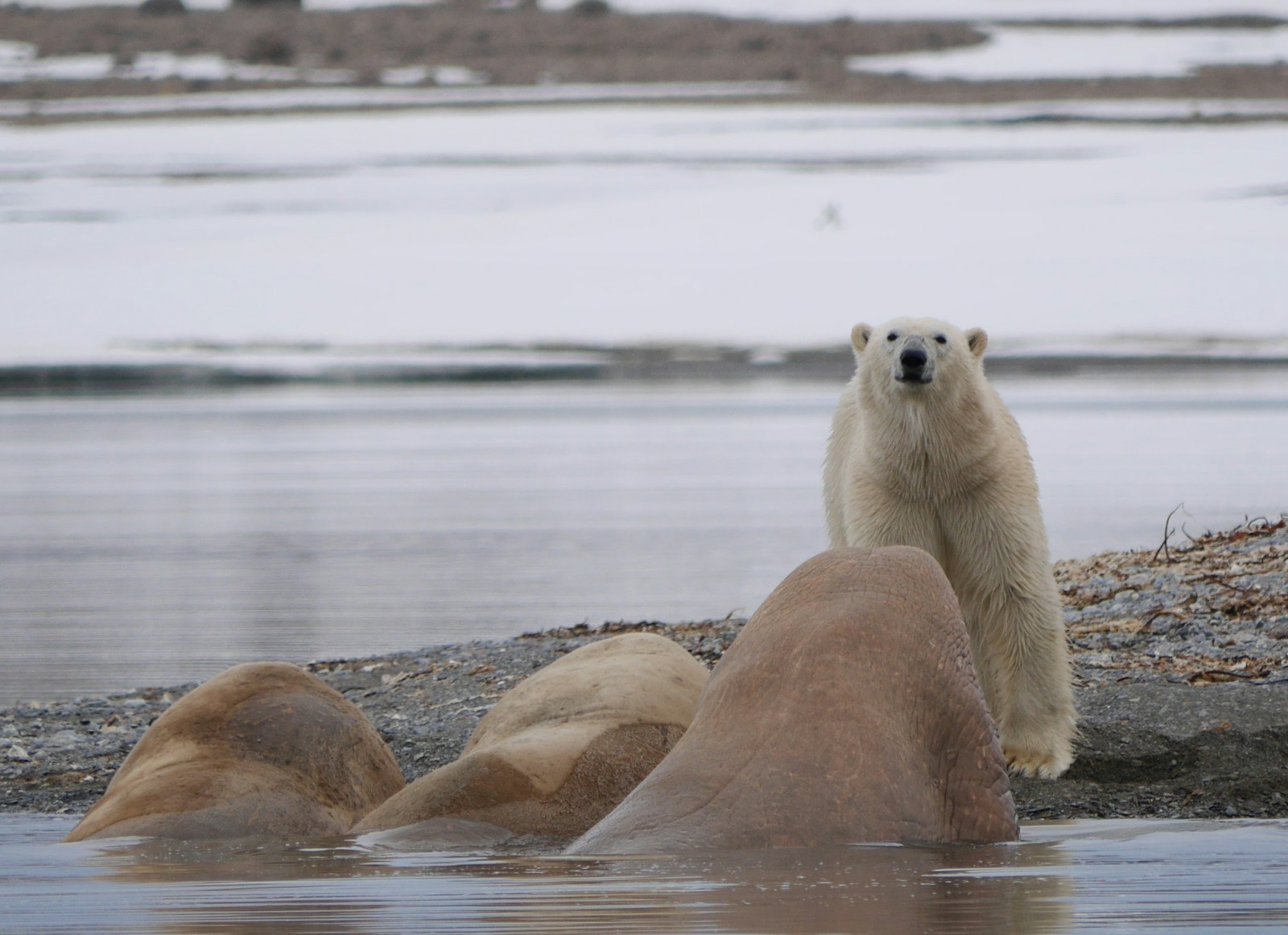
polar bear standing in front of three walrus on water
0
SHARES
Share on FacebookShare on Twitter
ADVERTISEMENT

If you follow climate news, you already know the Arctic is warming about four times faster than the global average. A major study published in Science Advances in January 2026, however, delivers a sharper warning. The Arctic has not simply become warmer; it has entered a new era defined by bioclimatic extremes.

For the first time, scientists have mapped not just rising average temperatures, but the sharp spike in short-term, acute weather events like heatwaves, droughts, and rain falling on snow that can devastate ecosystems in a matter of days.

READ ALSO

Strict Parenting Linked to Increased Deceptive Behavior in Children, Study Suggests.

Chimpanzee Group Split Turns Violent in Uganda Study

For years, we have mostly measured Arctic climate change using “means” average annual temperatures or precipitation levels. While useful, these averages hide the violent, short-term swings that actually kill plants and animals.
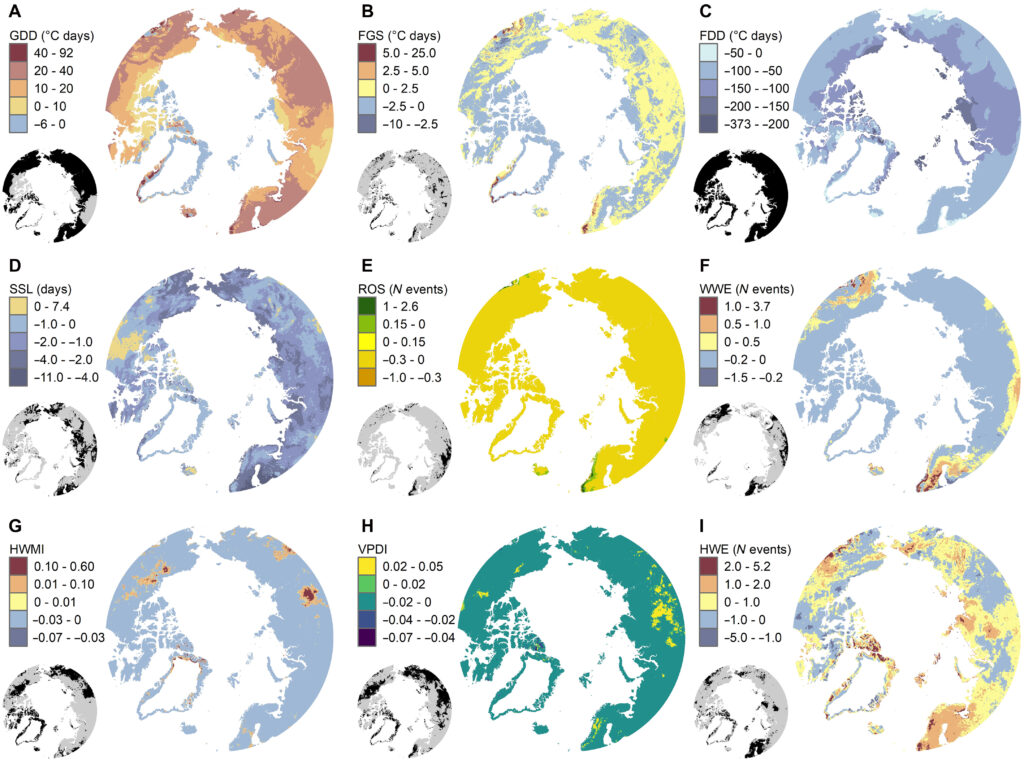
(A) growing degree days (GDD; °C·days), (B) freezing degree sum (FGS; °C·days), (C) freezing degree days (FDD; °C·days), (D) snow season length (SSL; days), (E) rain-on-snow events (ROS; number of events), (F) winter warming events (WWE; number of events), (G) heat wave magnitude index (HWMI), (H) vapor pressure deficit index (VPDI), and (I) heat wave events (HWE; number of events). Temporal trends were quantified using the nonparametric Sen’s slope estimator. Black shading in the inset maps denotes grid cells with statistically significant trends (P ≤ 0.05), as determined by the Mann–Kendall trend test.
Image: (A) growing degree days (GDD; °C·days), (B) freezing degree sum (FGS; °C·days), (C) freezing degree days (FDD; °C·days), (D) snow season length (SSL; days), (E) rain-on-snow events (ROS; number of events), (F) winter warming events (WWE; number of events), (G) heat wave magnitude index (HWMI), (H) vapor pressure deficit index (VPDI), and (I) heat wave events (HWE; number of events). Temporal trends were quantified using the nonparametric Sen’s slope estimator. Black shading in the inset maps denotes grid cells with statistically significant trends (P ≤ 0.05), as determined by the Mann–Kendall trend test. Credit: Science Advance

Researchers led by Juha Aalto and Miska Luoto analysed over 70 years of data (1950–2022) using a high-resolution dataset known as ERA5-Land. Their findings are stark:

ADVERTISEMENT
  • The frequency of extreme events has increased sharply, particularly in the last 30 years (1993–2022).
  • Across one-third of the entire Arctic, these extreme events have only recently begun to occur. This means vast swathes of the region are experiencing weather conditions that were effectively non-existent there between 1950 and 1979.
  • The total land area affected by heatwaves has increased by 3.4-fold, and the area affected by drought has increased by 3.0-fold since 1950.

The “Bioclimate”: Why Weather Matters to Life

The study focuses on “bioclimatic” variables. These are specific weather conditions that dictate whether life survives or dies. It is not just about a warm day; it is about specific thresholds that trigger biological disasters.

Here are the specific extremes the Arctic is now facing:

1. Rain-on-Snow (ROS) Events

This is one of the most dangerous phenomena for Arctic wildlife. It occurs when rain falls on existing snowpack and then freezes, creating an impenetrable layer of ice.

  • The Impact on Herbivores like reindeer and caribou cannot dig through the ice to reach the lichen below, leading to mass starvation.
  • While ROS events were once rare in many areas, they are becoming frequent in the European Arctic (like Scandinavia and Western Russia) and coastal Alaska. The area affected by these events has expanded by 1.7-fold.

2. Winter-Warming Events (WWE)

A WWE is defined as a day where the mean temperature shoots above +2°C while the ground is still covered in snow.

  • The Shift in events are historically rare in the High Arctic or Eastern Siberia, but they are expanding into more continental regions.
  • When midwinter warming reduces or disrupts the insulating snow cover, plant shoots become exposed to damaging cold, and dormant vegetation may prematurely resume growth, only to be destroyed when freezing conditions return.

3. Heatwaves and “Flash” Droughts

The study utilised the Heatwave Magnitude Index (HWMI) and Vapor Pressure Deficit Index (VPDI) to measure heat and dryness.

  • Hotspots are Canadian High-Arctic Archipelago and Northern Greenland are seeing the fastest increase in strong heatwaves.
  • There is a simultaneous increase in heat and drought across the Circum-Arctic coastal tundra. This combination is a known driver of “Arctic browning”—where vegetation dies off rather than growing greener.

Geographic Hotspots: Where is it Worst?

The changes are not uniform. The researchers identified specific “hotspots” where the climate is unravelling fastest:

  • Western Scandinavia: Seeing a massive overlap of both seasonal warming and extreme events.
  • Central Siberia: Heavily impacted by new extremes.
  • Canadian High Arctic & Coastal Greenland: These areas are losing their sea-ice buffer. As the ice retreats, it exposes these coastlines to rapid summer warming and autumn heatwaves that were previously impossible.
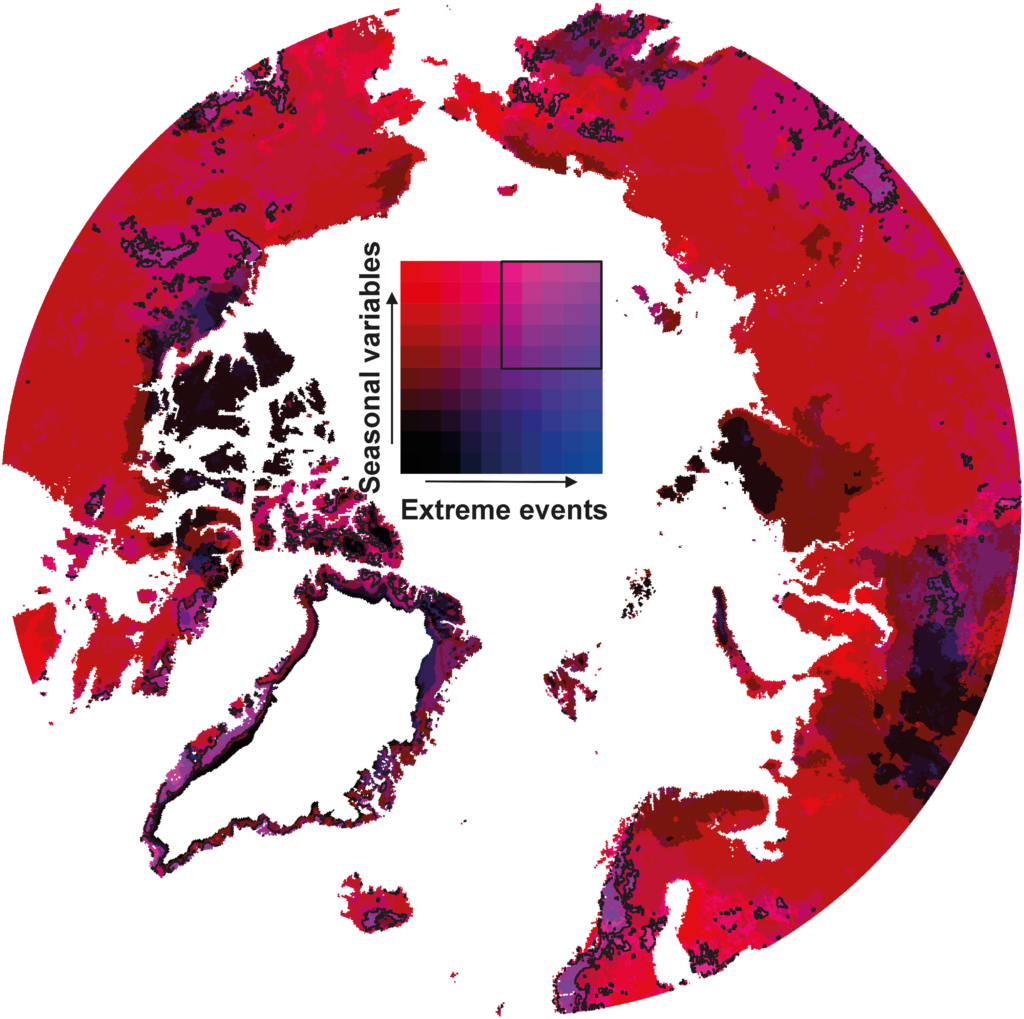
Image: The map shows, for each pixel, the proportion (0–1) of bioclimatic variables exhibiting statistically significant change (P ≤ 0.05) between two 30-year periods: 1950–1979 and 1993–2023. Colors represent two dimensions: seasonally integrated variables (GDD, FDD, SSL, SWI) and extreme-event variables (FGS, ROS, WWE, HWMI, VPDI, HWE). Contours highlight regions where ≥50% of variables in both groups show significant change.

Why This is a “New Era”

The most striking detail from this report is the concept of novelty. We are not just seeing “more of the same”; we are seeing weather regimes that the local biology has never adapted to.

The researchers found that 29.8% of the terrestrial Arctic is now being exposed to extreme events that simply did not happen in those locations during the 1950–1979 baseline period. As ecologist Gareth Phoenix noted, this pushes the Arctic into a “novel era” with likely severe consequences for ecosystems that evolved under stable, cold conditions.

The Arctic is experiencing a “borealization” of its weather shifting towards more volatile, southern-like instability, but without the ecosystem resilience to handle it. The plants and animals there are adapted to cold consistency, not icesheets forming over their food or flash droughts in the tundra.

As geoscientist Miska Luoto summarises: “Arctic ecosystems will be increasingly exposed to climate conditions they have never experienced before”. We are no longer looking at a future prediction; the data confirms this new era began roughly 30 years ago, and it is accelerating.

  • Share on WhatsApp (Opens in new window) WhatsApp
  • Share on Facebook (Opens in new window) Facebook
  • Share on Reddit (Opens in new window) Reddit
  • Share on X (Opens in new window) X
  • Print (Opens in new window) Print

Get real time update about this post categories directly on your device, subscribe now.

Unsubscribe

Related Posts

Strict Parenting Linked to Increased Deceptive Behavior in Children, Study Suggests.
PSYCHOLOGY

Strict Parenting Linked to Increased Deceptive Behavior in Children, Study Suggests.

April 25, 2026
Chimpanzees of the Ngogo community in Uganda divided into two groups that clashed aggressively with each other.PHOTO: A. A. SANDEL ET AL.
ECOLOGY

Chimpanzee Group Split Turns Violent in Uganda Study

April 27, 2026
great white shark
ENVIRONMENTAL SCIENCE

Mesothermic fish face rising energy stress and overheating risk in warming oceans

April 20, 2026
fuel your passion text
PSYCHOLOGY

77% of Workers Are Disengaged. Research Points to Why “Follow Your Passion” Makes It Worse

April 27, 2026
a white toy with a black nose
SCIENCE FEATURED

How Human And AI Judgements Differs

April 20, 2026
SCIENCE FEATURED

Russia Records First Birth of Identical (Monochorionic) Quadruplet Girls

April 27, 2026
RathBiotaClan LOGO
  • All
  • SCIENCE FEATURED
end-of-life dreams

Dreams about loved ones can bring comfort before death

by Shibasis Rath
April 28, 2026
0

A study of palliative care professionals in Italy found that terminally ill patients commonly report vivid dreams and visions involving...

every photo you take lose your memory

Every Photo You Take May Be a Memory You Lose

by Editorial Team
April 27, 2026
0

Science has quietly been building a case against our most cherished digital habit. The more we photograph our lives, the...

Strict Parenting Linked to Increased Deceptive Behavior in Children, Study Suggests.

Strict Parenting Linked to Increased Deceptive Behavior in Children, Study Suggests.

by Editorial Team
April 25, 2026
0

A naturalistic study comparing children at two schools with sharply different disciplinary cultures found that 3 and 4 year-olds at...

Mammals Might Be Able to Regenerate Tissue Under the Right Conditions

Mammals Might Be Able to Regenerate Tissue Under the Right Conditions

by Shibasis Rath
April 22, 2026
0

Two recent Science studies challenge an old assumption. They show that mammalian regenerative failure does not stem from genetics alone. Instead, it...

Load More

Advertisement

RathBiotaClan – RBC

RathBiotaClan – Connecting Research To Reality

Your trusted source for life science news, biology research & discoveries. Covering neuroscience, genetics, ecology, and more — connecting research to reality.

Privacy Policies

Shipping Policy

Cancellation & Refund Policy

Pricing Details

Contact Us

Latest Posts

  • Dreams about loved ones can bring comfort before death
  • Every Photo You Take May Be a Memory You Lose
  • Strict Parenting Linked to Increased Deceptive Behavior in Children, Study Suggests.
  • Mammals Might Be Able to Regenerate Tissue Under the Right Conditions

SHIBASIS RATH

Contact Mail

rathbiotaclan@gmail.com

No Result
View All Result
MSME (Udyam) Certified Science Platform
Govt. of India

Get Us On PlayStore

playstore app for rathbiotaclan
  • About Us
  • Advertise With Us
  • Cancellation and Refund Policy
  • Contact Us
  • Contribute
  • Editorial Standards
  • Home
  • Pricing Details
  • Privacy Policies
  • Shipping Policy
  • Terms & Conditions

© 2026 RathBiotaClan. All rights reserved.

Welcome Back!

Sign In with Google
OR

Login to your account below

Forgotten Password? Sign Up

Create New Account!

Sign Up with Google
OR

Fill the forms below to register

All fields are required. Log In

Retrieve your password

Please enter your username or email address to reset your password.

Log In
RathBiotaClan
Manage Consent
To provide the best experiences, we use technologies like cookies to store and/or access device information. Consenting to these technologies will allow us to process data such as browsing behavior or unique IDs on this site. Not consenting or withdrawing consent, may adversely affect certain features and functions.
Functional Always active
The technical storage or access is strictly necessary for the legitimate purpose of enabling the use of a specific service explicitly requested by the subscriber or user, or for the sole purpose of carrying out the transmission of a communication over an electronic communications network.
Preferences
The technical storage or access is necessary for the legitimate purpose of storing preferences that are not requested by the subscriber or user.
Statistics
The technical storage or access that is used exclusively for statistical purposes. The technical storage or access that is used exclusively for anonymous statistical purposes. Without a subpoena, voluntary compliance on the part of your Internet Service Provider, or additional records from a third party, information stored or retrieved for this purpose alone cannot usually be used to identify you.
Marketing
The technical storage or access is required to create user profiles to send advertising, or to track the user on a website or across several websites for similar marketing purposes.
  • Manage options
  • Manage services
  • Manage {vendor_count} vendors
  • Read more about these purposes
View preferences
  • {title}
  • {title}
  • {title}
No Result
View All Result
  • HOME
  • HEALTH SCIENCE
    • NEUROSCIENCE
    • PHYSIOLOGY
    • IMMUNOLOGY
    • CANCER
  • DISCOVERIES
    • SPOTLIGHTS
    • STUDENT PORTAL
    • SCIENCE FEATURED
  • MOLECULAR BIOLOGY
    • GENETICS
    • BIOTECHNOLOGY
    • BIOINFORMATICS
    • BIOCHEMISTRY
    • BIOPHYSICS
  • ZOOLOGY & ECOLOGY
    • ENVIRONMENTAL SCIENCE
    • ECOLOGY
    • EVOLUTION
  • MICRO & PLANT SCIENCE
    • MICROBIOLOGY
    • CELL BIOLOGY
    • DEVELOPMENTAL BIOLOGY
  • PSYCHOLOGY
  • e Store
  • Login
  • Sign Up

© 2026 RathBiotaClan. All rights reserved.

Are you sure want to unlock this post?
Unlock left : 0
Are you sure want to cancel subscription?
Go to mobile version