





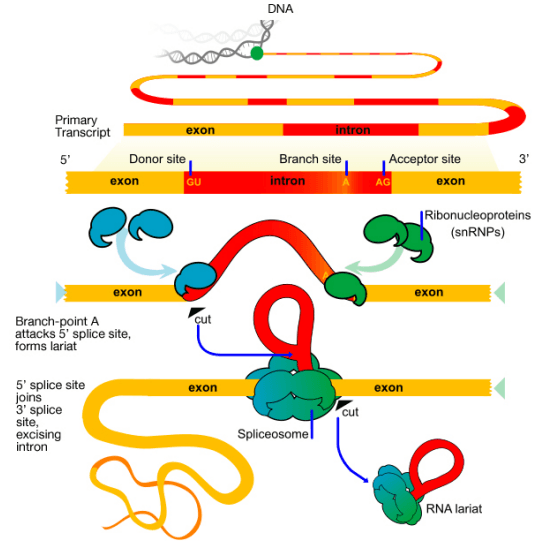
RNA splicing is one of the major mechanisms for RNA processing, which involves getting the precursor messenger RNA-pre-mRNA-to its mature form. This usually occurs by the removal of non-coding regions known as introns and the splicing back together of exons, which are coding segments. Usually, in the eukaryotic cell, this splicing occurs within the nucleus, either during or immediately after transcription.
- This modification is needed to make raw raw RNA matured into a functional, translatable strand. Prokaryotic cells do not require this post-transcriptional alteration unlike their eukaryotic cousins. The intricate splicing control of RNA is so fine-tuned by specific ribonucleoproteins that the process might occur only in the most accurate way possible in gene expression.
Intron Splicing
- Noncoding DNA is also found within most eukaryotic genes.
- Such genes have a split structure in which segments of coding sequence called expressing sequences or exons are separated by noncoding sequences intervening sequences or introns.
- The entire gene is transcribed to yield a long RNA molecule and the introns are then removed by splicing, so only exons are included in the mRNA.
- The process of excising the sequences in RNA that correspond to introns and joining of sequences corresponding to exons is called RNA splicing.
- Mechanism of RNA splicing varies depending on the types of introns.
- There are many types of pre-mRNA introns. Two types- the GU-AG and AU-AC trains are found in eukaryotic nuclear protein-coding genes.
Splicing Of GU-AG intron
- In GU-AG intron, the 5′ end of the intron includes the consensus sequence 5′-GU-3′ and the last two nucleotides sequence at the 3′ end includes the consensus sequence 5′-AG-3′ (GU-AG rule, the coding strand sequence of DNA has GT-AG).
- These two sites are referred to as 5′ splice site (also called the left or donor site) and the 3 splice site (also called the right or acceptor site), respectively. A branch point, located anywhere from 18 to 40 nucleotides upstream from the 3′ end of an intron.
- The branch point contains an adenine containing nucleotide. A pyrimidine-rich region, called polypyrimidine tract, near the 3′ end of the intron is found in most cases.
- In addition to the majority of pre-mRNAs introns that follow the GU-AG rule, few pre-mRNA contain AU-AC introns.
- AU-AC intron is a rare class of introns as the conserved 5′ GU and 3′ AG dinucleotides are replaced by AU and AC, respectively.
Transesterification Reactions
1. Transesterification is the conversion of one carboxylic acid ester into a different carboxylic acid ester.
2. The splicing of GU-AG intron from pre-mRNA involves two transesterification reactions.
3. The first transesterification reaction involves cleavage of the 5′ splice site, promoted by the hydroxyl group attached to the 2′ carbon of an adenosine nucleotide located within the intron sequence.
4. The hydroxyl group attack leads to cleavage of the phosphodiester bond at the 5′ splice site, forming a new 5′-2′ phosphodiester bond.
5. This bond links the first nucleotide of the intron (the G of the 5′-GU-3′ motif) with the internal adenosine.
6. The intron loops back on itself to create a lariat structure.
7. The second transesterification reaction involves cleavage of the 3′ splice site and joining of the exons.
8. The 3′-OH group attached to the end of the upstream exon promotes this reaction by attacking the phosphodiester bond at the 3′ splice site.
9. The intron is released as a lariat structure, which is later converted back to a linear RNA and degraded.
10. The 3′ end of the upstream exon joins the newly formed 5′ end of the downstream exon, completing the splicing process.
11. A large amount of ATP is consumed during the splicing reaction, but this energy is required for the assembly of the splicing apparatus, not for the chemical reactions.
12. A dedicated debranching enzyme recognizes the branch point and linearizes the lariat, promoting its rapid degradation.
13. Most lariats are destroyed within minutes in the cell nucleus.
14. Some intronic RNAs are exported to the cytoplasm, where they remain as stable circular molecules.
15. The biological significance of these lariat RNAs is not clear.
Splicing Apparatus:
The splicing apparatus for GU-AG introns consists of snRNAs named U1, U2, U4, U5, and U6.
These snRNAs are short RNA molecules (<250 nucleotides) that combine with proteins to form small nuclear ribonucleoproteins (snRNPs), commonly called “snurps.”
Cajal bodies in the nucleus are centers for the post-transcriptional modification of snRNAs and the assembly of snRNPs.
The snRNPs, along with other non-snRNP proteins, bind to the transcript, forming a series of complexes that lead to the creation of the spliceosome. The spliceosome is the structure where splicing reactions occur.
Assembly of snRNPs and Protein Factors:
The splicing activity starts with the formation of the commitment complex (E complex).
U1-snRNP binds to the 5′ splice site through RNA-RNA base pairing.
Branch point binding protein (BBP) binds to the branch point.
The splicing factor U2AF binds to the polypyrimidine tract.
Members of the SR protein family, named due to their Arg-Ser-rich region, interact with each other and RNA.
U1-snRNP binding to the 5′ splice site is the first step of splicing.
The E complex is converted to the A complex when U2-snRNP binds to the branch site.
The pre-spliceosome complex (A complex) consists of the E complex plus U2-snRNP bound to the branch site.
At this point, U1-snRNP and U2-snRNP bring the 5′ splice site close to the branch point.
Formation of the Spliceosome:
The spliceosome forms when U4/U6-snRNP (a single snRNP containing two snRNAs) and U5-snRNP attach to the pre-spliceosome complex.
Following the formation of the A complex, other snRNPs (U4/U6 and U5) join in a defined order.
The B1 complex is formed when U5 and U4/U6-snRNPs bind to the A complex, which now contains all the components needed for splicing.
U1-snRNP is released, converting the B1 complex to the B2 complex.
The release of U1-snRNP allows U6-snRNP to interact with the 5′ splice site.
The catalytic splicing reaction is triggered by the release of U4-snRNP, which requires ATP hydrolysis.
Once U4 is dissociated, U6-snRNA pairs with U2-snRNA, forming the catalytic active site (C complex).
This brings the 3′ splice site, the 5′ splice site, and the branch point into close proximity.
The two transesterification reactions occur in a linked manner, likely catalyzed by U6-snRNP, completing the splicing process.
ATP is needed for spliceosome assembly but is not required for the transesterification reactions themselves.
Splicing in Different Organisms:
Exon Definition (Vertebrates): In vertebrates, genes usually have short exons separated by longer introns.
Splicing factors recognize exon boundaries and remove the introns between them, a process called exon definition.
This occurs when introns are longer than 250 nucleotides, and the splice sites are weak.
The spliceosome components are recruited around exons, not introns.
After recruitment, the components near one exon pair with those near an adjacent exon to remove the intron between them.
Intron Definition (Lower Eukaryotes): In lower eukaryotes, genes have long exons and short introns.
Splice sites are recognized directly at the ends of the introns, a process called intron definition.
Intron removal involves pairing splice sites at both ends of the intron, without needing sequences outside the intron.
Splicing Specificity:
Splicing specificity is determined by the sequences at the 5′ splice site, 3′ splice site, and branch point.
Cis-acting splicing regulatory elements further influence splicing.
These regulatory elements include:
- Exonic splicing enhancers (ESEs) and Exonic splicing silencers (ESSs).
- Intronic splicing enhancers (ISEs) and Intronic splicing silencers (ISSs).
- ESEs and ESSs act from exon regions, promoting or inhibiting exon inclusion.
- ISEs and ISSs act from intronic regions, enhancing or suppressing splice site usage.
- These splicing regulatory elements function by recruiting trans-acting splicing factors that activate or suppress splice site recognition or spliceosome assembly.