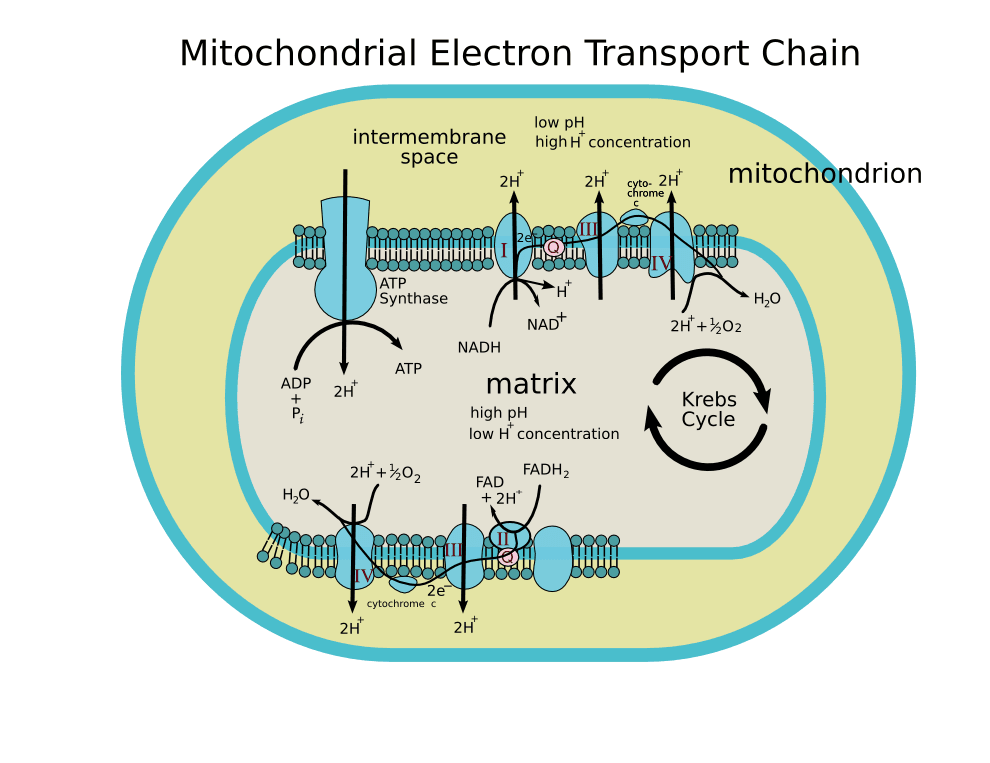







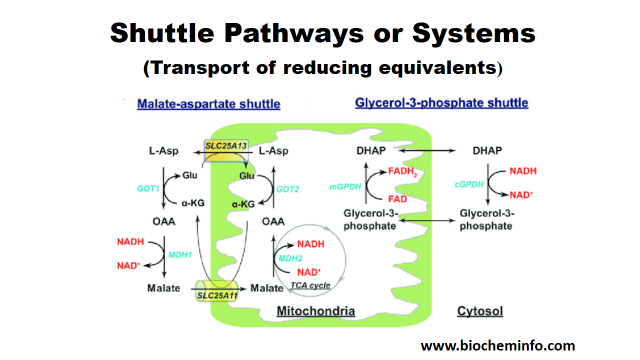
Shuttle systems play a critical role in metabolism by facilitating the transfer of electrons from NADH to the electron transport chain. This process is essential for oxidative phosphorylation, particularly during glycolysis, since the inner mitochondrial membrane is impermeable to NADH.
The inner mitochondrial membrane does not let NADH through. This is a problem, because glycolysis produces NADH in the cytosol, and that NADH needs to donate its electrons to the electron transport chain (ETC) inside the mitochondria to generate ATP. The solution is shuttle systems indirect pathways that transfer the reducing equivalents (the electrons) across the membrane without physically moving NADH itself.
There are two major shuttle systems:
- Malate-Aspartate Shuttle
- Glycerol-3-Phosphate Shuttle
They do the same job but with different efficiency. Which one a tissue uses determines whether glycolysis yields 38 ATP or 36 ATP per glucose.
Malate-Aspartate Shuttle
This is the more efficient of the two. It operates in the liver, kidney, and heart.
Key enzyme: Malate dehydrogenase (exists in both cytosolic and mitochondrial forms)
Two transport proteins in the inner mitochondrial membrane:
- Malate–α-ketoglutarate transporter
- Glutamate–aspartate transporter
How it works, step by step:
Step 1 — Cytosol: Cytosolic malate dehydrogenase uses NADH to reduce oxaloacetate (OAA) → malate. NADH is oxidised to NAD⁺.
Step 2 — Into the matrix: Malate enters the mitochondrial matrix via the malate–α-ketoglutarate transporter. α-ketoglutarate exits to the cytosol in exchange.
Step 3 — Inside the matrix: Mitochondrial malate dehydrogenase converts malate back to OAA, reducing NAD⁺ → NADH. This NADH is now inside the mitochondria and feeds directly into the ETC.
Step 4 — OAA can’t leave. OAA cannot cross the inner mitochondrial membrane, so it is transaminated to aspartate by mitochondrial aspartate aminotransferase. Glutamate donates the amino group and becomes α-ketoglutarate.
Step 5 — Out of the matrix: Aspartate exits via the glutamate–aspartate transporter. Glutamate enters the matrix in exchange.
Step 6 — Back in the cytosol: Cytosolic aspartate aminotransferase converts aspartate back to OAA, completing the cycle.
The net result: one cytosolic NADH is effectively converted to one mitochondrial NADH. Since mitochondrial NADH yields 2.5 ATP through the ETC, this shuttle is efficient.
ATP yield: 38 ATP per glucose when this shuttle is used.
Glycerol-3-Phosphate Shuttle
This shuttle is simpler but less efficient. It operates in skeletal muscle and the brain.
Key enzyme: Glycerol-3-phosphate dehydrogenase (two forms — one cytosolic, one on the outer face of the inner mitochondrial membrane)
How it works:
Step 1 — Cytosol: Cytosolic glycerol-3-phosphate dehydrogenase oxidises NADH to NAD⁺, reducing dihydroxyacetone phosphate (DHAP) → glycerol-3-phosphate.
Step 2 — At the inner membrane: Glycerol-3-phosphate travels to the outer surface of the inner mitochondrial membrane, where the mitochondrial glycerol-3-phosphate dehydrogenase oxidises it back to DHAP — but this time, the electrons are passed to FAD, not NAD⁺, forming FADH₂.
Step 3: DHAP returns to the cytosol and the cycle continues.
Step 4: FADH₂ donates its electrons to the ETC, yielding only 1.5 ATP (compared to 2.5 ATP from NADH).
ATP yield: 36 ATP per glucose — 2 fewer than the malate-aspartate shuttle, because FADH₂ enters the ETC at a lower point than NADH.
Side-by-Side Comparison
| Feature | Malate-Aspartate | Glycerol-3-Phosphate |
|---|---|---|
| Electron acceptor in mitochondria | NAD⁺ → NADH | FAD → FADH₂ |
| ATP yield per cytosolic NADH | ~2.5 ATP | ~1.5 ATP |
| Total ATP per glucose | 38 | 36 |
| Tissues | Liver, kidney, heart | Skeletal muscle, brain |
| Reversibility | Reversible | Irreversible |
Why This Matters for CSIR NET
The exam almost always tests:
- Which shuttle gives 38 ATP vs 36 ATP
- Which tissues use which shuttle
- Why OAA has to be converted to aspartate (it cannot cross the membrane directly)
- The role of FAD vs NAD⁺ in determining ATP yield
The core logic to remember: the malate-aspartate shuttle regenerates NADH inside the mitochondria; the glycerol-3-phosphate shuttle only generates FADH₂, which enters the ETC at Complex II and produces less ATP.