

Monday, July 20, 2026
SAVED POSTS
  • Login
  • Register
RathBiotaClan
No Result
View All Result
  • HOME
  • HEALTH SCIENCE

    TRENDING ON HEALTH (TOP)

    Fick Method Underestimates Heart Problems in Children After Heart Transplant, Study Finds

    For Women on Antidepressants, Creatine Showed a Possible Extra Boost

    Did the iPhone Quietly Reshape When and Whether Americans Have Children?

    For People Antidepressants Never Helped, a 30-Minute Home Session Is Now FDA-Approved

    NOW ON AIR (RBC)

    Oona McGee, "Japan now has human refrigerators inspired by Japanese vending machines," SoraNews24, July 17–18, 2026, citing Yahoo! News Japan.
    NEWS

    Japan built a ‘human refrigerator’ that cools your body in just 5 minutes, and it could transform how workers beat extreme heat

    July 20, 2026
    AI CRISPR Gene
    BIOTECHNOLOGY

    AI Designs Better CRISPR Gene Editors Than Nature, Doudna Team Reports

    July 20, 2026
    The parsimony criterion
    BIOINFORMATICS

    The Parsimony Criterion in Phylogenetics: Morphological & Molecular Methods

    July 15, 2026
    maximum-likelihood-criterion
    BIOINFORMATICS

    Maximum Likelihood Criterion in Phylogenetic Tree Reconstruction

    July 15, 2026
  • NEUROSCIENCE
    • PHYSIOLOGY
    • IMMUNOLOGY
    • CANCER
  • DISCOVERIES
    • SPOTLIGHTS
    • STUDENT PORTAL
    • SCIENCE FEATURED
  • MOLECULAR BIOLOGY
    • GENETICS
    • BIOTECHNOLOGY
    • BIOINFORMATICS
    • BIOCHEMISTRY
    • BIOPHYSICS
  • ZOOLOGY & ECOLOGY
    • ENVIRONMENTAL SCIENCE
    • ECOLOGY
    • EVOLUTION
  • MICRO & PLANT SCIENCE
    • MICROBIOLOGY
    • CELL BIOLOGY
    • DEVELOPMENTAL BIOLOGY
  • PSYCHOLOGY
RathBiotaClan
RathBiotaClan
No Result
View All Result
Home EVOLUTION

Life’s Frozen Ingredients Found Beyond the Milky Way for the First Time by JWST

Shibasis Rath by Shibasis Rath
October 25, 2025
in EVOLUTION, MOLECULAR BIOLOGY, NEWS
Reading Time: 5 mins read
0
A A
0
cluster of star illustration

For the first time ever, astronomers have observed the chemical building blocks of life trapped in ice beyond the confines of our own Milky Way galaxy. This landmark discovery, made using the James Webb Space Telescope (JWST), suggests that the essential chemistry required to give birth to life is not unique to our galactic neighbourhood but is instead widespread and robust across the entire cosmos.

The findings, led by astrophysicist Marta Sewiło, mark a significant step forward in understanding how complex chemistry emerges in the Universe.

What Are the Frozen Chemical Building Blocks of Life Found Outside the Milky Way?

The molecules detected are classified as Complex Organic Molecules (COMs), these are defined by an astrophysical context as molecules containing at least six atoms, with at least one being carbon. These molecules are of immense interest to scientists because they are known to be the chemical precursors to essential biomolecules, such as amino acids, sugars, and nucleobases.

The researchers identified a mixture of COMs trapped in ice swirling around a newborn star located in the Large Magellanic Cloud (LMC). The specific compounds found include:

ADVERTISEMENT
CompoundChemical FormulaAstrochemical SignificanceFirst Detection Outside Milky Way in Ice?
EthanolCH₃CH₂OHSimple alcoholYes
AcetaldehydeCH₃CHOPrecursor to amino acidsYes
Methyl formateHCOOCH₃Used in the synthesis of more complex moleculesYes
Acetic AcidCH₃COOHCarboxylic acid, component of vinegarYes, first conclusive detection in ice anywhere in space

These three compounds (Ethanol, Acetaldehyde, and Methyl formate) have never before been spotted in ice form outside the Milky Way.

READ ALSO

Japan built a ‘human refrigerator’ that cools your body in just 5 minutes, and it could transform how workers beat extreme heat

AI Designs Better CRISPR Gene Editors Than Nature, Doudna Team Reports

In addition, the study confirmed the presence of acetic acid ($CH₃COOH$). This detection is particularly notable, as acetic acid has never before been conclusively identified in ice anywhere in space. Prior to this observation, acetic acid had only been found in space in its vapour form.

ADVERTISEMENT

Can Life’s Precursor Molecules Form in Metal-Poor Galaxies Like the LMC?

The discovery was made toward a young star called ST6, which is situated approximately 160,000 light-years from Earth, near the famous Tarantula Nebula. ST6 resides within the Large Magellanic Cloud (LMC), which is the nearest star-forming satellite galaxy to the Milky Way.

ADVERTISEMENT

The LMC provides an environment vastly different from our own galaxy, allowing scientists to investigate COM formation under extreme conditions:

  1. Low Metallicity: The LMC has a subsolar metallicity, meaning it possesses only about one-third to one-half the abundance of “heavy metals” (elements heavier than helium, such as carbon, oxygen, and silicon) compared to the Milky Way. This results in fewer C, O, and N atoms available for chemical reactions.
  2. Less Shielding and High Radiation: The LMC has much less dust to block light and features relatively intense star formation, which floods the galaxy with strong ultraviolet (UV) radiation.

Despite these challenging conditions, which might typically hinder complex molecule formation, the discovery of these COMs in ST6 provides strong evidence that they are products of grain-surface chemistry. This process involves the formation of thin ice coatings on interstellar dust grains, where chemical reactions are driven and aided by radiation. The results confirm that this process can still take place efficiently, even in the metal-poor conditions lashed with radiation characteristic of the LMC.

How Did JWST’s MIRI Instrument Detect Life’s Icy Ingredients?

To achieve this breakthrough, researchers turned the JWST’s highly sensitive instruments toward ST6. They utilised the Medium Resolution Spectrograph (MRS) of the Mid-Infrared Instrument (MIRI).

The scientists “soaked up” the mid-infrared light emanating from the icy material around the star. They then compared the resulting spectra to a known “COM fingerprint”. These “fingerprints” are databases of signatures representing various COMs, which absorb light at specific wavelengths, producing measurable shadowy lines that scientists can match to known molecules.

The detection of acetic acid in its frozen form particularly supports computer models and laboratory experiments that suggested this molecule participates in the grain-surface reactions believed to build prebiotic compounds in space.

What Does the LMC Discovery Tell Us About Life’s Chemistry in the Early Universe?

The LMC’s low-metallicity environment is similar to that of galaxies observed during earlier cosmological epochs. Thus, these results offer a valuable glimpse into the chemical complexity present in star-forming regions during the early stages of the Universe.

While the fractional abundances of COMs relative to water ice measured toward ST6 appear generally lower than those observed in Galactic protostars, researchers suggest this might reflect the differences in metallicity and UV flux between the two galaxies. For example, the underabundance of solid methanol (CH₃OH) could be explained by a “warm ice chemistry” model, where high dust temperatures (common in the LMC due to strong radiation) make the conversion of carbon monoxide (CO) into methanol less efficient.

The current conclusions are based on data from a single LMC source (ST6) and only four comparable Galactic sources. Researchers plan to expand their observations to more young stars in the LMC to determine if this robust chemistry takes place across the entire dwarf galaxy or if ST6 is an outlier. Further laboratory ice spectra of COMs are also needed to improve the accuracy of interpreting observed mid-infrared spectra.

REFERENCE

Published in The Astrophysical Journal Letters.
  • Share on WhatsApp (Opens in new window) WhatsApp
  • Share on Facebook (Opens in new window) Facebook
  • Share on Reddit (Opens in new window) Reddit
  • Share on X (Opens in new window) X
  • Print (Opens in new window) Print
Shibasis Rath

Shibasis Rath

"𝓒𝓸𝓷𝓷𝓮𝓬𝓽𝓲𝓷𝓰 𝓡𝓮𝓼𝓮𝓪𝓻𝓬𝓱 𝓣𝓸 𝓡𝓮𝓪𝓵𝓲𝓽𝔂" 𝓲𝓼𝓷'𝓽 𝓙𝓾𝓼𝓽 𝓪 𝓜𝓸𝓽𝓽𝓸 - 𝓘𝓽'𝓼 𝓜𝔂 𝓜𝓲𝓼𝓼𝓲𝓸𝓷

Related Posts

Oona McGee, "Japan now has human refrigerators inspired by Japanese vending machines," SoraNews24, July 17–18, 2026, citing Yahoo! News Japan.
NEWS

Japan built a ‘human refrigerator’ that cools your body in just 5 minutes, and it could transform how workers beat extreme heat

July 20, 2026
AI CRISPR Gene
BIOTECHNOLOGY

AI Designs Better CRISPR Gene Editors Than Nature, Doudna Team Reports

July 20, 2026
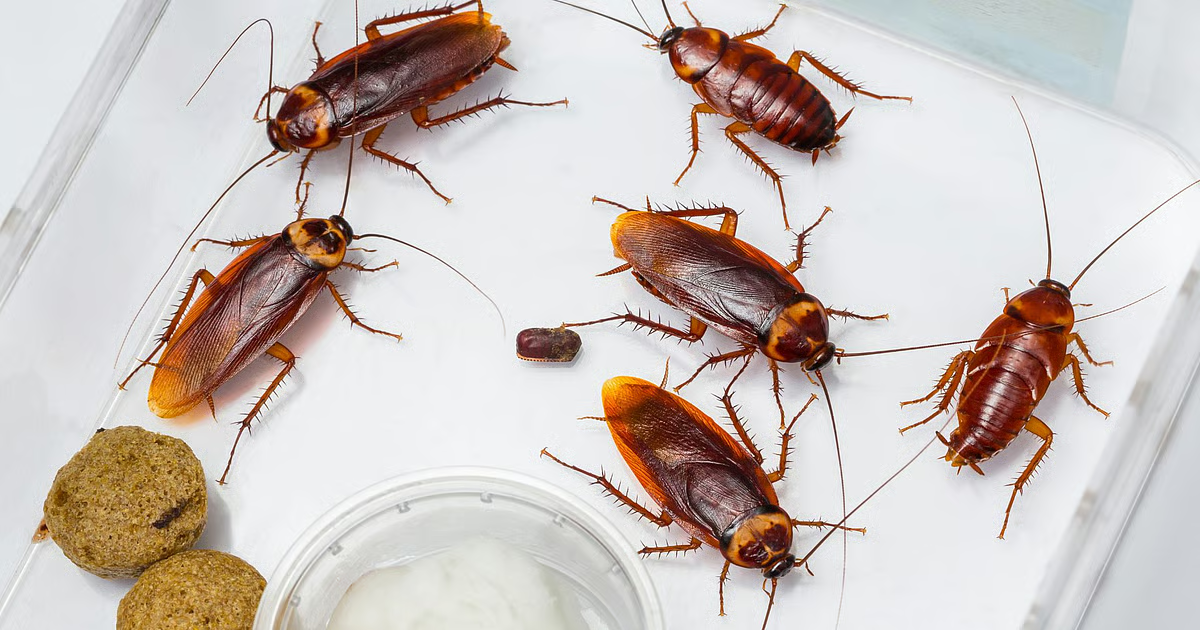
Scientists say cockroach milk is 3x more nutritious than human breast milk
NEWS

Scientists say cockroach milk is 3x more nutritious than human breast milk

July 12, 2026

POPULAR NEWS

Chewing gum releases thousands of microplastic particles directly into your mouth with every piece you chew

Chewing gum releases thousands of microplastic particles directly into your mouth with every piece you chew

by Shibasis Rath
May 8, 2026
0

Microplastics are turning up in places researchers never expected: deep-sea sediments, Arctic ice, and human blood. Now, a UCLA pilot...

grayscale photo of girl in polka dot long sleeve shirt

Yelling Isn’t Just Yelling: How a Hostile Home Rewires a Child’s Brain for Constant Alert

by Shibasis Rath
March 8, 2026
0

To a parent in the heat of the moment, a raised voice may feel like simple frustration. To a child...

72-Hour Fasting Can Reset Your Entire Immune System, USC Study Shows

72-Hour Fasting Can Reset Your Entire Immune System, USC Study Shows

by Shibasis Rath
February 28, 2026
0

A 72-hour fast can trigger a powerful immune system reset. Scientists call this stem cell regeneration. The process clears old...

woman in white tank top lying on bed

New Studys Says Gen Z is the least sexually active young cohort in modern recorded history

by Shibasis Rath
January 24, 2026
0

A generation that grew up with dating apps in their pockets, pornography a tap away, and sex discussed more openly...

a group of gen Z kids walking down a street

Is Gen Z the First Generation Less Intelligent Than Their Parents?

by Shibasis Rath
February 5, 2026
0

Gen Z intelligence decline is emerging as a serious concern among neuroscientists and education researchers. For over a century, each...

EDITOR CHOICE‘S

  • All
  • NEWS
  • SPOTLIGHTS
Oona McGee, "Japan now has human refrigerators inspired by Japanese vending machines," SoraNews24, July 17–18, 2026, citing Yahoo! News Japan.

Japan built a ‘human refrigerator’ that cools your body in just 5 minutes, and it could transform how workers beat extreme heat

by Shibasis Rath
July 20, 2026
0

Japan's summers have grown severe enough that the government recently coined new terminology just to describe days when temperatures climb...

AI CRISPR Gene

AI Designs Better CRISPR Gene Editors Than Nature, Doudna Team Reports

by Shibasis Rath
July 20, 2026
0

Researchers at UC Berkeley used artificial intelligence to design new versions of a small CRISPR enzyme called TnpB. Several of...

The parsimony criterion

The Parsimony Criterion in Phylogenetics: Morphological & Molecular Methods

by Shibasis Rath
July 15, 2026
0

The parsimony criterion is one of the oldest and most widely used methods of constructing phylogenetic trees, having its roots...

maximum-likelihood-criterion

Maximum Likelihood Criterion in Phylogenetic Tree Reconstruction

by Shibasis Rath
July 15, 2026
0

The maximum-likelihood (ML) criterion is one of the most important and statistically rigorous approaches used for phylogenetic tree reconstruction, first...

ADVERTISEMENT

RathBiotaClan – RBC

RathBiotaClan – Connecting Research To Reality

Your trusted source for life science news, biology research & discoveries. Covering neuroscience, genetics, ecology, and more — connecting research to reality.

About Us

Privacy Policies

Contact Us

Editorial Standard

Latest Posts

  • Japan built a ‘human refrigerator’ that cools your body in just 5 minutes, and it could transform how workers beat extreme heat
  • AI Designs Better CRISPR Gene Editors Than Nature, Doudna Team Reports
  • The Parsimony Criterion in Phylogenetics: Morphological & Molecular Methods
  • Maximum Likelihood Criterion in Phylogenetic Tree Reconstruction

SHIBASIS RATH

Contact Mail

rathbiotaclan@gmail.com

No Result
View All Result
MSME (Udyam) Certified Science Platform
Govt. of India

Get Us On PlayStore

playstore app for rathbiotaclan
  • About Us
  • Advertise With Us
  • Cancellation and Refund Policy
  • Contact Us
  • Contribute
  • Editorial Standards
  • Home
  • Pricing Details
  • Privacy Policies
  • Shipping Policy
  • Terms & Conditions

© 2026 RathBiotaClan. All rights reserved.

Welcome Back!

Sign In with Google
OR

Login to your account below

Forgotten Password? Sign Up

Create New Account!

Sign Up with Google
OR

Fill the forms below to register

*By registering into our website, you agree to the Terms & Conditions and Privacy Policy.
All fields are required. Log In

Retrieve your password

Please enter your username or email address to reset your password.

Log In

Add New Playlist

No Result
View All Result
  • HOME
  • HEALTH SCIENCE
  • NEUROSCIENCE
    • PHYSIOLOGY
    • IMMUNOLOGY
    • CANCER
  • DISCOVERIES
    • SPOTLIGHTS
    • STUDENT PORTAL
    • SCIENCE FEATURED
  • MOLECULAR BIOLOGY
    • GENETICS
    • BIOTECHNOLOGY
    • BIOINFORMATICS
    • BIOCHEMISTRY
    • BIOPHYSICS
  • ZOOLOGY & ECOLOGY
    • ENVIRONMENTAL SCIENCE
    • ECOLOGY
    • EVOLUTION
  • MICRO & PLANT SCIENCE
    • MICROBIOLOGY
    • CELL BIOLOGY
    • DEVELOPMENTAL BIOLOGY
  • PSYCHOLOGY
  • Login
  • Sign Up
SAVED POSTS

© 2026 RathBiotaClan. All rights reserved.

This website uses cookies. By continuing to use this website you are giving consent to cookies being used. Visit our Privacy and Cookie Policy.