



Monday, May 4, 2026
SAVED POSTS
  • Login
  • Register
RathBiotaClan
No Result
View All Result
  • HOME
  • HEALTH SCIENCE

    TRENDING ON HEALTH (TOP)

    Dreams about loved ones can bring comfort before death

    Male G-Spot Found: New Study Identifies Frenular Delta as Penis’s Most Sensitive Area

    New Stem Cell Therapy Rebuilds Bone in Osteoporosis, Shows 30% Density Gain

    Walnut Extract May Help Control Blood Sugar Naturally, New Study Finds

    NOW ON AIR (RBC)

    Smiling Female Child Showing Success While Writing Homework In Front Of Parents
    PSYCHOLOGY

    Recent Study Indicates Constant Praise May Actually Lower a Child’s Academic Risk-Taking.

    May 3, 2026
    SLC38A4 expression was confirmed by western blot in multiple tumor cell lines. In mouse models, liver tissue imaging (H&E staining) showed that overexpression of SLC38A4 reduced metastatic tumor areas, while knockdown increased them across Hepa1-6, MC38, and B16F10 cells. Results were consistent in both immunocompetent and nude mice, with statistically significant differences.
    MOLECULAR BIOLOGY

    Scientists Find Molecule That Wipes Out Liver Cancer

    May 2, 2026
    DISCOVERIES

    Fossil Penguins From New Zealand Reveal Stages of the Birds’ Long Evolutionary History

    May 1, 2026
    Bluebuck antelope with silvery-blue coat and curved horns running across open South African grassland, representing extinct species targeted for de-extinction by scientists
    MOLECULAR BIOLOGY

    Colossal Biosciences Announces De-Extinction of Bluebuck Antelope, 226 Years After Its Extinction

    May 1, 2026
  • NEUROSCIENCE
    • PHYSIOLOGY
    • IMMUNOLOGY
    • CANCER
  • DISCOVERIES
    • SPOTLIGHTS
    • STUDENT PORTAL
    • SCIENCE FEATURED
  • MOLECULAR BIOLOGY
    • GENETICS
    • BIOTECHNOLOGY
    • BIOINFORMATICS
    • BIOCHEMISTRY
    • BIOPHYSICS
  • ZOOLOGY & ECOLOGY
    • ENVIRONMENTAL SCIENCE
    • ECOLOGY
    • EVOLUTION
  • MICRO & PLANT SCIENCE
    • MICROBIOLOGY
    • CELL BIOLOGY
    • DEVELOPMENTAL BIOLOGY
  • PSYCHOLOGY
RBC Interactive Sticky Bar
RathBiotaClan Logo
Shop Resources
Life Science Whole Spectrum Focus
24/7 Digital Access
Pro Resources For Students & Researchers
Premium Articles
Research-backed insights for the curious mind.
eBooks
Digital books covering lab protocols.
RBC Magazines
Deep dives and science innovations.
Research Guides
Methodologies and application frameworks.
Pro Notes PDF
High-yield study notes for quick review.
View All Resources
Browse the complete digital library.
RathBiotaClan Seal

Connecting Research to Reality

Science is our safest secret. Explore the life science spectrum with insights for the curious mind.

RathBiotaClan
No Result
View All Result
Home DISCOVERIES

In India DRDO Create Indigenous BioFET Chip to Detect Heart Attack Risk in Soldiers

Staff Writer by Staff Writer
April 2, 2026
in DISCOVERIES, HEALTH SCIENCE
Reading Time: 5 mins read
0
A A
0
BioFET sensor India featured img

In the icy heights of the Himalayas, where temperatures plunge below freezing and oxygen is scarce, Indian soldiers stand guard against more than just external threats. Silent killers like sudden heart attacks, triggered by extreme cold and stress, have claimed lives in these unforgiving terrains. But now, a groundbreaking “Made in India” innovation is poised to change that. Developed through a unique collaboration between the Defence Research and Development Organisation (DRDO) and Delhi’s Miranda House College, the BioFET sensor a portable biological chip promises to provide early warnings of impending cardiac events. This device, blending cutting-edge biosensor technology with practical field needs, could save countless lives by detecting risks before symptoms strike.

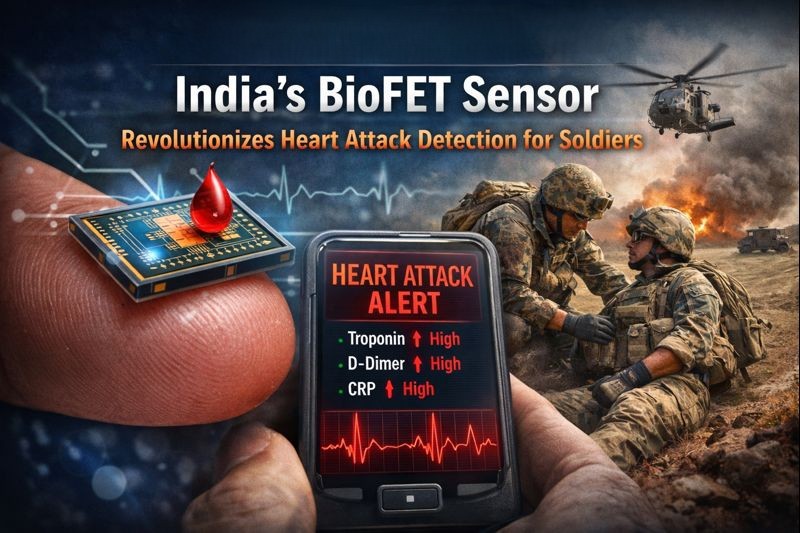
Imagine a tiny chip, no larger than a fingertip, that analyzes a drop of blood serum and flags danger in minutes. That’s the BioFET in action. As Professor Monika Tomar, the lead researcher from Miranda House, explains, “The device that we have developed is BioFET, which can detect three biomolecules from a blood sample at once.” These molecules are not ordinary signals. They act as critical biomarkers directly linked to cardiac arrest. Their levels rise sharply when the heart experiences extreme stress.

This technology is no science fiction. Indian researchers have delivered the device to DRDO for field trials, marking a clear triumph of indigenous engineering and academic innovation.

A BioFET (Biological Field-Effect Transistor) is a nanoscale biosensor that translates biological interactions into electrical signals. Unlike conventional lab-based assays, BioFETs offer:
Ultra-sensitive biomarker detection
Fast response times
Compact form factor
Low power requirements
These features make BioFET ideal for point-of-care and field applications

What Is a BioFET Sensor?

The DRDO, India’s premier defense research agency, is no stranger to high-stakes innovations. From missiles to advanced materials, it has long focused on equipping the armed forces with homegrown technology. But this project highlights an unusual partnership: teaming up with Miranda House, a women’s college under Delhi University renowned for its science programs. Founded in 1948, Miranda House has a legacy of fostering female scientists, and under Professor Tomar’s guidance, a team of faculty and students turned a lab concept into a deployable prototype.

ADVERTISEMENT

This collaboration underscores India’s push for self-reliance in defense tech. By fabricating instruments in-house, the team slashed costs by 50-60% compared to imported alternatives, making the BioFET not just innovative but economically viable. It’s a model of how academia and defense can converge to solve real problems, especially in a country where military personnel face unique health challenges.

READ ALSO

Fossil Penguins From New Zealand Reveal Stages of the Birds’ Long Evolutionary History

Dreams about loved ones can bring comfort before death

Why Soldiers Need This Now

Cardiac issues are a growing concern for the Indian Army, particularly in high-altitude postings like Siachen Glacier. Extreme cold causes blood to thicken, promoting clot formation that can lead to sudden heart attacks—often without warning. Factors like low oxygen, physical strain, and mental stress amplify these risks, making cardiovascular disease a leading non-combat cause of death among troops.

ADVERTISEMENT

Traditional diagnostics rely on bulky lab equipment, impractical in remote outposts. Soldiers might not get timely help, leading to tragic outcomes. The BioFET addresses this gap by enabling on-the-spot testing, allowing for rapid evacuation to medical facilities. As Professor Tomar notes, “We know that the soldiers of our army work in such difficult conditions.” This chip could be a game-changer, not just for icy mountains but also for deserts and other harsh environments where heart stress spikes.

How BioFET Works ?

At its core, the BioFET is a bio-field-effect transistor, a highly sensitive biosensor based on semiconductor physics. It functions like a tiny electrical gate that reacts to chemical changes on its surface.

When a blood serum sample is applied—similar to a finger-prick glucose test—the chip comes into contact with specific biomarkers. These biomolecular interactions change the local electrical field. The device converts this change into a measurable electrical signal. That signal reflects the concentration of the target biomarker.

ADVERTISEMENT

The sensor is designed to detect three key biomolecules linked to cardiac risk. Their exact identities have not been publicly disclosed. However, they likely include clot-related markers such as D-dimer and inflammation indicators like C-reactive protein (CRP), both commonly used in heart attack diagnostics.

When biomarker levels rise above preset safety thresholds, the device triggers an alert on its display. The thresholds are carefully calibrated to reduce false positives.

Unlike conventional laboratory tests that can take hours, the BioFET delivers results within minutes. It also offers exceptional sensitivity. Similar BioFET-based sensors have detected cardiac troponin, the gold-standard heart attack biomarker, at femtogram-level concentrations.

Here’s a quick review of common cardiac biomarkers and their roles:

BiomarkerRole in Heart HealthWhy It Matters for Soldiers
Cardiac Troponin I (cTnI)Released when heart muscle is damaged; gold standard for detecting myocardial infarction.Early rise signals impending attack in stress-induced scenarios.
D-DimerIndicates blood clot formation; elevates in thrombosis.Critical in cold-induced clotting risks.
BNP/NT-proBNPHormones signaling heart strain; rise with fluid overload or failure.Detects stress from altitude and exertion.

The BioFET’s portability is key: “This is the whole device. This means that it is easy to carry as well,” says Professor Tomar. It operates in ambient conditions but needs a controlled environment for accuracy, a minor hurdle for field medics.

The Journey from Lab to Battlefield

Developing BioFET was no easy feat. The project took nearly five years to complete. Initially, researchers spent two to three years on foundational work. Then, the effort intensified through collaboration with DRDO.

Along the way, the team faced major challenges. Most notably, they had to scale a delicate laboratory sensor into a rugged, field-ready chip. At the same time, they needed to ensure consistent performance under highly variable conditions.

According to Professor Tomar, the process was “very difficult and very challenging.” However, those obstacles did not slow progress. Ultimately, the team delivered a cost-effective working prototype. As a result, DRDO now holds the device and has begun field trials.

Broader Impacts Beyond the Borders

This isn’t just about soldiers BioFET exemplifies India’s biotech prowess. It reduces import dependency, boosts women’s roles in STEM, and could adapt for broader CVD monitoring, where early detection saves lives globally. With cardiovascular diseases killing millions annually, portable biosensors like this could democratize health tech.

As field trials progress, the BioFET stands as a beacon of hope: a small chip with massive potential to protect those who protect us.

“Science + Defence = Strong India.”

It’s a reminder that innovation, born from collaboration, can conquer even the coldest frontiers.


  • Share on WhatsApp (Opens in new window) WhatsApp
  • Share on Facebook (Opens in new window) Facebook
  • Share on Reddit (Opens in new window) Reddit
  • Share on X (Opens in new window) X
  • Print (Opens in new window) Print

Did you like this read? Turn on notifications so we can let you know the second a new post goes live.

Turn off Alerts
Staff Writer

Staff Writer

Related Posts

Fossil Penguins From New Zealand Reveal Stages of the Birds’ Long Evolutionary History
DISCOVERIES

Fossil Penguins From New Zealand Reveal Stages of the Birds’ Long Evolutionary History

May 1, 2026
end-of-life dreams
HEALTH SCIENCE

Dreams about loved ones can bring comfort before death

April 28, 2026
Male G-spot isn’t where we thought it was
HEALTH SCIENCE

Male G-Spot Found: New Study Identifies Frenular Delta as Penis’s Most Sensitive Area

April 27, 2026

POPULAR NEWS

Yelling Isn’t Just Yelling: How a Hostile Home Rewires a Child’s Brain for Constant Alert

Yelling Isn’t Just Yelling: How a Hostile Home Rewires a Child’s Brain for Constant Alert

by Shibasis Rath
March 9, 2026
0

To a parent in the heat of the moment, a raised voice may feel like simple frustration. To a child...

a group of gen Z kids walking down a street

Is Gen Z the First Generation Less Intelligent Than Their Parents?

by Shibasis Rath
March 14, 2026
0

Gen Z intelligence decline is emerging as a serious concern among neuroscientists and education researchers. For over a century, each...

Whole Brain Emulation Achieved: Scientists Run a Fruit Fly Brain in Simulation

by Shibasis Rath
March 9, 2026
0

Scientists have copied an entire biological brain neuron by neuron and synapse by synapse and made it control a simulated...

Male G-spot isn’t where we thought it was

Male G-Spot Found: New Study Identifies Frenular Delta as Penis’s Most Sensitive Area

by Staff Writer
April 27, 2026
0

The study found that human penile innervation develops in distinct fetal stages and shows region-specific patterns in adults, with the...

BioFET sensor India featured img

In India DRDO Create Indigenous BioFET Chip to Detect Heart Attack Risk in Soldiers

by Staff Writer
April 2, 2026
0

In the icy heights of the Himalayas, where temperatures plunge below freezing and oxygen is scarce, Indian soldiers stand guard...

EDITOR CHOICE‘S

  • All
  • NEWS
  • SPOTLIGHTS
Recent Study Indicates Constant Praise May Actually Lower a Child’s Academic Risk-Taking.

Recent Study Indicates Constant Praise May Actually Lower a Child’s Academic Risk-Taking.

by Staff Writer
May 3, 2026
0

Recent studies on types of praise and children's academic motivation show that constantly praising a child's fixed traits, such as their intelligence...

SLC38A4 expression was confirmed by western blot in multiple tumor cell lines. In mouse models, liver tissue imaging (H&E staining) showed that overexpression of SLC38A4 reduced metastatic tumor areas, while knockdown increased them across Hepa1-6, MC38, and B16F10 cells. Results were consistent in both immunocompetent and nude mice, with statistically significant differences.

Scientists Find Molecule That Wipes Out Liver Cancer

by Shibasis Rath
May 2, 2026
0

Researchers investigated this question because metastasis causes most cancer deaths, and the liver is a frequent site of spread for...

Fossil Penguins From New Zealand Reveal Stages of the Birds’ Long Evolutionary History

Fossil Penguins From New Zealand Reveal Stages of the Birds’ Long Evolutionary History

by Shibasis Rath
May 1, 2026
0

The discovery of four new species of fossil penguins in New Zealand in 2025 sheds light on the long evolutionary...

Bluebuck antelope with silvery-blue coat and curved horns running across open South African grassland, representing extinct species targeted for de-extinction by scientists

Colossal Biosciences Announces De-Extinction of Bluebuck Antelope, 226 Years After Its Extinction

by Staff Writer
May 1, 2026
0

It has been 226 years since humans last saw a living bluebuck, an elegant antelope species native to South Africa...

ADVERTISEMENT

RathBiotaClan – RBC

RathBiotaClan – Connecting Research To Reality

Your trusted source for life science news, biology research & discoveries. Covering neuroscience, genetics, ecology, and more — connecting research to reality.

Privacy Policies

Shipping Policy

Cancellation & Refund Policy

Pricing Details

Contact Us

Latest Posts

  • Recent Study Indicates Constant Praise May Actually Lower a Child’s Academic Risk-Taking.
  • Scientists Find Molecule That Wipes Out Liver Cancer
  • Fossil Penguins From New Zealand Reveal Stages of the Birds’ Long Evolutionary History
  • Colossal Biosciences Announces De-Extinction of Bluebuck Antelope, 226 Years After Its Extinction

SHIBASIS RATH

Contact Mail

rathbiotaclan@gmail.com

No Result
View All Result
MSME (Udyam) Certified Science Platform
Govt. of India

Get Us On PlayStore

playstore app for rathbiotaclan
  • About Us
  • Advertise With Us
  • Cancellation and Refund Policy
  • Contact Us
  • Contribute
  • Editorial Standards
  • Home
  • Pricing Details
  • Privacy Policies
  • Shipping Policy
  • Terms & Conditions

© 2026 RathBiotaClan. All rights reserved.

Welcome Back!

Sign In with Google
OR

Login to your account below

Forgotten Password? Sign Up

Create New Account!

Sign Up with Google
OR

Fill the forms below to register

*By registering into our website, you agree to the Terms & Conditions and Privacy Policy.
All fields are required. Log In

Retrieve your password

Please enter your username or email address to reset your password.

Log In
No Result
View All Result
  • HOME
  • HEALTH SCIENCE
  • NEUROSCIENCE
    • PHYSIOLOGY
    • IMMUNOLOGY
    • CANCER
  • DISCOVERIES
    • SPOTLIGHTS
    • STUDENT PORTAL
    • SCIENCE FEATURED
  • MOLECULAR BIOLOGY
    • GENETICS
    • BIOTECHNOLOGY
    • BIOINFORMATICS
    • BIOCHEMISTRY
    • BIOPHYSICS
  • ZOOLOGY & ECOLOGY
    • ENVIRONMENTAL SCIENCE
    • ECOLOGY
    • EVOLUTION
  • MICRO & PLANT SCIENCE
    • MICROBIOLOGY
    • CELL BIOLOGY
    • DEVELOPMENTAL BIOLOGY
  • PSYCHOLOGY
  • Login
  • Sign Up
SAVED POSTS

© 2026 RathBiotaClan. All rights reserved.

This website uses cookies. By continuing to use this website you are giving consent to cookies being used. Visit our Privacy and Cookie Policy.
Are you sure want to unlock this post?
Unlock left : 0
Are you sure want to cancel subscription?