




Thursday, June 18, 2026
SAVED POSTS
  • Login
  • Register
RathBiotaClan
No Result
View All Result
  • HOME
  • HEALTH SCIENCE

    TRENDING ON HEALTH (TOP)

    For People Antidepressants Never Helped, a 30-Minute Home Session Is Now FDA-Approved

    Scientists Say Your Next Tube of Toothpaste Could Be Made From Human Hair

    Your Lungs, Liver, and Pancreas Also Age Faster When You Sleep Wrong

    Cycling Linked to Lower Dementia Risk in Study of Nearly 480,000 Adults

    NOW ON AIR (RBC)

    NEUROSCIENCE

    Step-Synchronized Brain Stimulation Reduces Falls in Small Parkinson’s Trial

    June 16, 2026
    NEWS

    A Father’s Touch in Infancy Can Shape a Child’s Health for Years, New Science Explains Why

    June 9, 2026
    MutExpress
    BIOINFORMATICS

    South Asian Patients Have Been Left Out of Cancer Genomics for Decades & MutExpress-India Is Changing That

    June 8, 2026
    Biodiversity Loss
    ECOLOGY

    Biodiversity Loss Could Bankrupt Nations And Wall Street Hasn’t Noticed Yet

    June 5, 2026
  • NEUROSCIENCE
    • PHYSIOLOGY
    • IMMUNOLOGY
    • CANCER
  • DISCOVERIES
    • SPOTLIGHTS
    • STUDENT PORTAL
    • SCIENCE FEATURED
  • MOLECULAR BIOLOGY
    • GENETICS
    • BIOTECHNOLOGY
    • BIOINFORMATICS
    • BIOCHEMISTRY
    • BIOPHYSICS
  • ZOOLOGY & ECOLOGY
    • ENVIRONMENTAL SCIENCE
    • ECOLOGY
    • EVOLUTION
  • MICRO & PLANT SCIENCE
    • MICROBIOLOGY
    • CELL BIOLOGY
    • DEVELOPMENTAL BIOLOGY
  • PSYCHOLOGY
RathBiotaClan
RathBiotaClan
No Result
View All Result
Home CANCER

How Pancreatic Cancer Outsmarts the Immune System

Shibasis Rath by Shibasis Rath
June 9, 2025
in CANCER, SCIENCE FEATURED
Reading Time: 6 mins read
0
A A
0
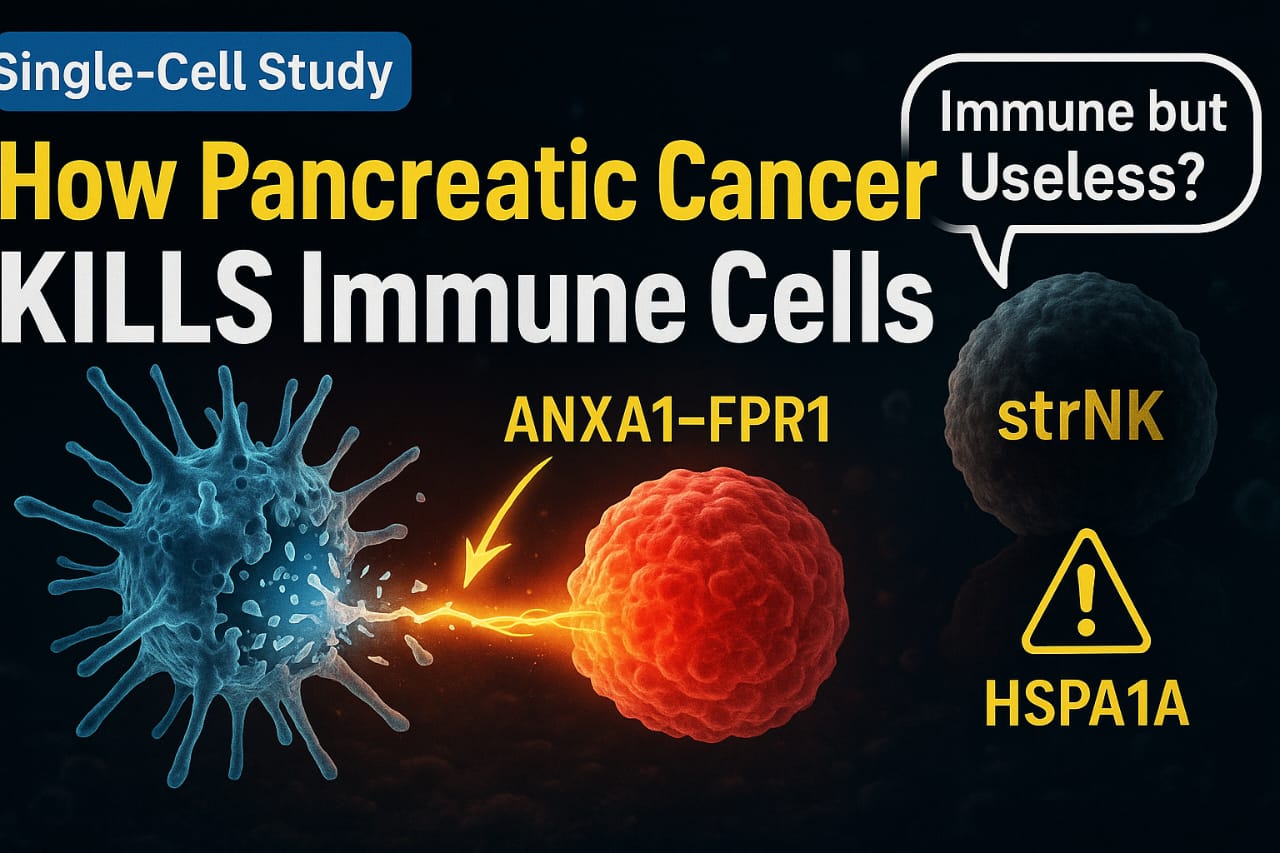
Illustration showing a cancer cell attacking an immune cell with text: How Pancreatic Cancer KILLS Immune Cells, highlighting terms ANXA1–FPR1, strNK, HSPA1A, and questioning if immune cells are Immune but Useless?.

Pancreatic ductal adenocarcinoma (PDAC) presents a significant challenge in oncology, accounting for approximately 8.5% of all cancer-related mortality and having a 5-year survival rate below 12%. Treating PDAC is tough, mostly ‘cause it just doesn’t respond to immunotherapies like other cancers do. Part of the problem is the tumor’s environment—it’s all complicated and kinda shuts down the immune system. There aren’t enough of the right immune cells around, and the whole setup makes it super hard for the body to fight back against the tumor.

A study utilized single-cell transcriptional analysis to dissect the evolving immunosuppressive TME during PDAC metastasis. So they looked at over 130,000 individual cells from 51 samples—like, healthy pancreas, early tumors, advanced ones, and even spread liver tumors from the same patients. Mixed their new data with existing stuff to get a bigger picture, right? Had to toss out sketchy cells and fix batch differences so everything played nice together. Ended up mapping how cell types shift, what they’re doing wrong functionally, and how they chat (or don’t) as the cancer goes from “meh” to full-on metastatic. Pretty wild how much changes once it starts spreading, honestly.

Pancreatic Cancer’s Stealth Moves: Directly Killing Key Immune Cells and Activating Harmful “Stress-Response” NK Cells to Escape Detection

The study revealed two critical mechanisms by which PDAC systematically evades the host immune system during its malignant transformation.

1. Direct Apoptosis of Dendritic Cells (DCs) via ANXA1-FPR1/3 Interaction:

ADVERTISEMENT

Dendritic cells (DCs) are crucial antigen-presenting cells (APCs) responsible for capturing tumor-derived neoantigens and presenting them to CD8+ T cells, thereby initiating adaptive anti-tumor immune responses. However, PDAC TMEs consistently exhibit remarkably low infiltration levels of DCs.

READ ALSO

Psychology Study Says, Why People Who Enjoy Being Alone Often Build Stronger Minds and Deeper Connections

Volcanic Eruptions Can Destroy Their Own Methane — Tonga’s Plume Shows How

The research identified a novel, direct mechanism by which PDAC tumor cells trigger the programmed cell death (apoptosis) of DCs. This occurs through a specific molecular interaction: ANXA1 (Annexin A1) expressed on epithelial tumor cells binds to FPR1 (Formyl Peptide Receptor 1) and FPR3 (Formyl Peptide Receptor 3) found on DCs.

ADVERTISEMENT

The expression of ANXA1 on epithelial tumor cells gradually increases from healthy tissue to non-metastatic primary tumors and further to metastatic primary tumors. This escalating ANXA1 expression was also significantly correlated with worse overall survival in PDAC patients, suggesting its role as a prognostic biomarker.

ADVERTISEMENT

In vitro experiments provided strong validation for this mechanism. When activated bone marrow-derived DCs (BMDCs) were treated with varying doses of ANXA1 protein, a significant induction of apoptosis was observed. This was further confirmed by western blot analysis, which showed that ANXA1 effectively upregulated the apoptotic marker cleaved caspase-3 while concurrently downregulating the anti-apoptotic markers MCL-1 and BCL-2.

The In vivo function of ANXA1 was further substantiated using both subcutaneous and orthotopic mouse PDAC models.

ANXA1 overexpression promoted tumor progression and led to a decrease in the density of both CD8+ T cells and CD11c+ DCs within the tumors.

Conversely, ANXA1 knockdown exhibited potent anti-tumor efficacy, significantly inhibiting tumor growth. Importantly, this anti-tumor effect was further enhanced when combined with anti-PD-1 blockade immunotherapy, which also increased the density of CD8+ T cells and CD11c+ DCs.

So, this study really drives home the point that when tumor cells directly trigger apoptosis in dendritic cells—not just through cytokines or other cells, like people thought before—it’s actually a big deal for creating that “immune exemptional microenvironment” in PDAC. Basically, as more and more DCs die off, their function just tanks, and that’s a major factor in why the immune system can’t do its job right around these tumors lead to a dampened activation and infiltration of cytotoxic CD8+ T cells**, thereby compromising the adaptive anti-tumor immune response.

2. Unveiling of Pro-Tumor “Stress-Response” NK Cells (strNK):

Natural Killer (NK) cells are vital components of the innate immune system involved in tumor surveillance. The study identified a novel subtype of NK cells, termed “stress-response NK cells” (strNK), characterized by the high expression of specific stress-related heat shock genes, such as HSPA1A, HSPA1B, HSPA6, and HSPB1.

Despite exhibiting robust proliferative properties, these strNK cells were found to possess diminished cytolytic (cell-killing) capabilities. Their cytolytic function was shown to be deficient, as indicated by a lower cell killing score and downregulated cytotoxicity-related genes.

Instead of contributing to tumor elimination, strNK cells play a role in *negative immune regulation and immune suppression** . This suppressive function is further supported by their high expression of certain Treg-related genes, including FOXP3, CTLA4, ICOS, and TNFRSF18. This suggests that these NK cells may contribute to immunosuppression within the PDAC TME, similar to how stress-response T cells (Tstr) are linked to immunotherapy resistance.

Clinically, a *high presence of strNK cells is significantly associated with a poor prognosis** in PDAC patients, implying a pro-tumor function and further undermining immune surveillance . The trajectory analysis also indicated that strNK cells have a relatively “independent” developmental roadmap compared to conventional NK (cNK) cells, which are rich in cytotoxicity-related genes and exhibit strong immune surveillance function.

In Conclusion, this comprehensive single-cell transcriptional study provides crucial insights into the sophisticated mechanisms PDAC employs to evade the immune system. By directly eliminating critical immune cells like DCs through the ANXA1-FPR1/3 axis and by co-opting other immune populations, such as strNK cells, into a pro-tumor, immunosuppressive role, PDAC creates an environment conducive to its progression and metastasis. These findings offer promising avenues for developing more effective immunotherapeutic strategies for PDAC by targeting the ANXA1-FPR1/3 interaction to reinforce DC function and by exploring ways to rejuvenate dysfunctional NK cell populations. While the study acknowledges limitations such as cohort size and potential compositional differences in public datasets, the validation of key conclusions through in vitro and in vivo experiments underscores their biological relevance.

Reference

Source: Nature

“Single-cell transcriptional dissection illuminates an evolution of immunosuppressive microenvironment during pancreatic ductal adenocarcinoma metastasis“

  • Share on WhatsApp (Opens in new window) WhatsApp
  • Share on Facebook (Opens in new window) Facebook
  • Share on Reddit (Opens in new window) Reddit
  • Share on X (Opens in new window) X
  • Print (Opens in new window) Print
Shibasis Rath

Shibasis Rath

"𝓒𝓸𝓷𝓷𝓮𝓬𝓽𝓲𝓷𝓰 𝓡𝓮𝓼𝓮𝓪𝓻𝓬𝓱 𝓣𝓸 𝓡𝓮𝓪𝓵𝓲𝓽𝔂" 𝓲𝓼𝓷'𝓽 𝓙𝓾𝓼𝓽 𝓪 𝓜𝓸𝓽𝓽𝓸 - 𝓘𝓽'𝓼 𝓜𝔂 𝓜𝓲𝓼𝓼𝓲𝓸𝓷

Related Posts

woman in black jacket sitting on gray concrete wall during daytime
PSYCHOLOGY

Psychology Study Says, Why People Who Enjoy Being Alone Often Build Stronger Minds and Deeper Connections

May 21, 2026
Volcanic Eruptions Can Destroy Their Own Methane — Tonga’s Plume Shows How
ENVIRONMENTAL SCIENCE

Volcanic Eruptions Can Destroy Their Own Methane — Tonga’s Plume Shows How

May 13, 2026
Babies Yawn in the Womb
DEVELOPMENTAL BIOLOGY

Scientists Say Babies May Learn to Yawn Before Birth

May 11, 2026

POPULAR NEWS

Chewing gum releases thousands of microplastic particles directly into your mouth with every piece you chew

Chewing gum releases thousands of microplastic particles directly into your mouth with every piece you chew

by Shibasis Rath
May 8, 2026
0

Microplastics are turning up in places researchers never expected: deep-sea sediments, Arctic ice, and human blood. Now, a UCLA pilot...

New Studys Says Gen Z is the least sexually active young cohort in modern recorded history

New Studys Says Gen Z is the least sexually active young cohort in modern recorded history

by Shibasis Rath
January 24, 2026
0

A generation that grew up with dating apps in their pockets, pornography a tap away, and sex discussed more openly...

Yelling Isn’t Just Yelling: How a Hostile Home Rewires a Child’s Brain for Constant Alert

Yelling Isn’t Just Yelling: How a Hostile Home Rewires a Child’s Brain for Constant Alert

by Shibasis Rath
March 8, 2026
0

To a parent in the heat of the moment, a raised voice may feel like simple frustration. To a child...

a group of gen Z kids walking down a street

Is Gen Z the First Generation Less Intelligent Than Their Parents?

by Shibasis Rath
February 5, 2026
0

Gen Z intelligence decline is emerging as a serious concern among neuroscientists and education researchers. For over a century, each...

Whole Brain Emulation Achieved: Scientists Run a Fruit Fly Brain in Simulation

by Shibasis Rath
March 9, 2026
0

Scientists have copied an entire biological brain neuron by neuron and synapse by synapse and made it control a simulated...

EDITOR CHOICE‘S

  • All
  • NEWS
  • SPOTLIGHTS
Step-Synchronized Brain Stimulation Reduces Falls in Small Parkinson’s Trial

Step-Synchronized Brain Stimulation Reduces Falls in Small Parkinson’s Trial

by Staff Writer
June 16, 2026
0

Researchers have reported encouraging results from a small feasibility study testing a new form of adaptive deep brain stimulation (aDBS)...

A Father’s Touch in Infancy Can Shape a Child’s Health for Years, New Science Explains Why

A Father’s Touch in Infancy Can Shape a Child’s Health for Years, New Science Explains Why

by Staff Writer
June 9, 2026
0

A study from Penn State University has revealed something startling beneath that simplicity those early interactions carry biological consequences that...

MutExpress

South Asian Patients Have Been Left Out of Cancer Genomics for Decades & MutExpress-India Is Changing That

by Staff Writer
June 8, 2026
0

The databases that underpin modern cancer genomics have a geography problem. The gnomAD database the gold standard for allele frequency...

Biodiversity Loss

Biodiversity Loss Could Bankrupt Nations And Wall Street Hasn’t Noticed Yet

by Staff Writer
June 5, 2026
0

Every year, governments borrow trillions of dollars to function. The interest rate they pay depends almost entirely on their credit...

ADVERTISEMENT

RathBiotaClan – RBC

RathBiotaClan – Connecting Research To Reality

Your trusted source for life science news, biology research & discoveries. Covering neuroscience, genetics, ecology, and more — connecting research to reality.

About Us

Privacy Policies

Contact Us

Editorial Standard

Latest Posts

  • Step-Synchronized Brain Stimulation Reduces Falls in Small Parkinson’s Trial
  • A Father’s Touch in Infancy Can Shape a Child’s Health for Years, New Science Explains Why
  • South Asian Patients Have Been Left Out of Cancer Genomics for Decades & MutExpress-India Is Changing That
  • Biodiversity Loss Could Bankrupt Nations And Wall Street Hasn’t Noticed Yet

SHIBASIS RATH

Contact Mail

rathbiotaclan@gmail.com

No Result
View All Result
MSME (Udyam) Certified Science Platform
Govt. of India

Get Us On PlayStore

playstore app for rathbiotaclan
  • About Us
  • Advertise With Us
  • Cancellation and Refund Policy
  • Contact Us
  • Contribute
  • Editorial Standards
  • Home
  • Pricing Details
  • Privacy Policies
  • Shipping Policy
  • Terms & Conditions

© 2026 RathBiotaClan. All rights reserved.

Welcome Back!

Sign In with Google
OR

Login to your account below

Forgotten Password? Sign Up

Create New Account!

Sign Up with Google
OR

Fill the forms below to register

*By registering into our website, you agree to the Terms & Conditions and Privacy Policy.
All fields are required. Log In

Retrieve your password

Please enter your username or email address to reset your password.

Log In

Add New Playlist

No Result
View All Result
  • HOME
  • HEALTH SCIENCE
  • NEUROSCIENCE
    • PHYSIOLOGY
    • IMMUNOLOGY
    • CANCER
  • DISCOVERIES
    • SPOTLIGHTS
    • STUDENT PORTAL
    • SCIENCE FEATURED
  • MOLECULAR BIOLOGY
    • GENETICS
    • BIOTECHNOLOGY
    • BIOINFORMATICS
    • BIOCHEMISTRY
    • BIOPHYSICS
  • ZOOLOGY & ECOLOGY
    • ENVIRONMENTAL SCIENCE
    • ECOLOGY
    • EVOLUTION
  • MICRO & PLANT SCIENCE
    • MICROBIOLOGY
    • CELL BIOLOGY
    • DEVELOPMENTAL BIOLOGY
  • PSYCHOLOGY
  • Login
  • Sign Up
SAVED POSTS

© 2026 RathBiotaClan. All rights reserved.

This website uses cookies. By continuing to use this website you are giving consent to cookies being used. Visit our Privacy and Cookie Policy.