




Wednesday, June 3, 2026
SAVED POSTS
  • Login
  • Register
RathBiotaClan
No Result
View All Result
  • HOME
  • HEALTH SCIENCE

    TRENDING ON HEALTH (TOP)

    For People Antidepressants Never Helped, a 30-Minute Home Session Is Now FDA-Approved

    Scientists Say Your Next Tube of Toothpaste Could Be Made From Human Hair

    Your Lungs, Liver, and Pancreas Also Age Faster When You Sleep Wrong

    Cycling Linked to Lower Dementia Risk in Study of Nearly 480,000 Adults

    NOW ON AIR (RBC)

    PubMed Research Finder for Life Science Students
    BIOINFORMATICS

    PubMed Research Finder for Life Science Students

    May 26, 2026
    person behind fog glass
    HEALTH SCIENCE

    For People Antidepressants Never Helped, a 30-Minute Home Session Is Now FDA-Approved

    May 26, 2026
    GENETICS

    Childhood Trauma Leaves Distinct Marks on Fathers’ Sperm, Study Shows

    May 22, 2026
    woman in black jacket sitting on gray concrete wall during daytime
    PSYCHOLOGY

    Psychology Study Says, Why People Who Enjoy Being Alone Often Build Stronger Minds and Deeper Connections

    May 21, 2026
  • NEUROSCIENCE
    • PHYSIOLOGY
    • IMMUNOLOGY
    • CANCER
  • DISCOVERIES
    • SPOTLIGHTS
    • STUDENT PORTAL
    • SCIENCE FEATURED
  • MOLECULAR BIOLOGY
    • GENETICS
    • BIOTECHNOLOGY
    • BIOINFORMATICS
    • BIOCHEMISTRY
    • BIOPHYSICS
  • ZOOLOGY & ECOLOGY
    • ENVIRONMENTAL SCIENCE
    • ECOLOGY
    • EVOLUTION
  • MICRO & PLANT SCIENCE
    • MICROBIOLOGY
    • CELL BIOLOGY
    • DEVELOPMENTAL BIOLOGY
  • PSYCHOLOGY
RathBiotaClan
RathBiotaClan
No Result
View All Result
Home NEWS

Early Theories of Emotion: James–Lange and Cannon–Bard Shaped

Shibasis Rath by Shibasis Rath
March 31, 2025
in NEWS, PSYCHOLOGY, SCIENCE FEATURED
Reading Time: 4 mins read
0
A A
0

Emotions love, hate, happiness, sadness, fear, anxiety, and so on are feelings we all experience at one time or another.

In the nineteenth century, several highly regarded scientists, including Darwin and Freud, considered the role of the brain in the expression of emotion.

Later in the nineteenth and twentieth centuries, scientists developed theories for the physiological basis of emotion and the relationship between emotional expression and experience.

Introduction to the James–Lange Theory of Emotion

One of the first well-articulated theories of emotion was proposed in 1884 by the renowned American psychologist and philosopher William James. Similar ideas were proposed by Danish psychologist Carl Lange.

ADVERTISEMENT

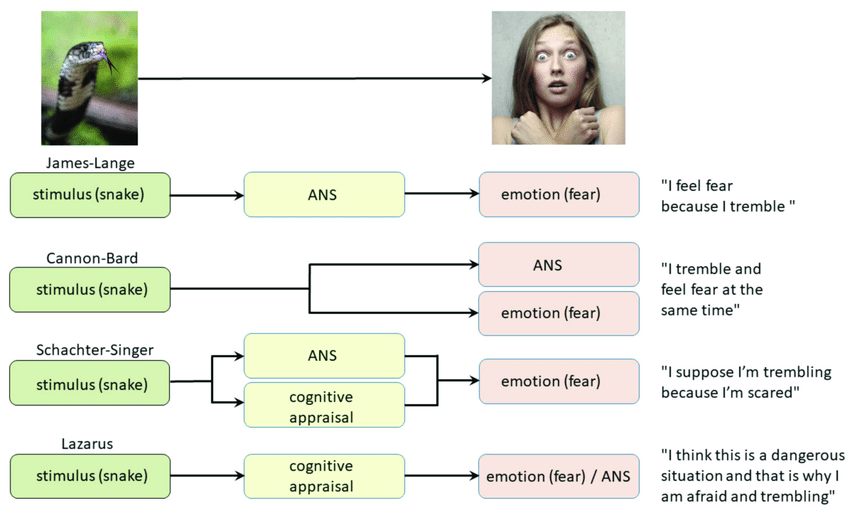
This theory, commonly known as the James–Lange theory of emotion, proposed that we experience emotion in response to physiological changes in our body. The emotion you experience consists of your feelings that result from the changes in the body. The James–Lange theory is the exact opposite of the common conception that an emotion is evoked by a situation and the body changes in response to the emotion.

READ ALSO

Psychology Study Says, Why People Who Enjoy Being Alone Often Build Stronger Minds and Deeper Connections

12,638 MRI Scans Confirm Men’s Brains Shrink Faster in PNAS Study

Physiological Basis and Implications of the James–Lange Theory

Even if it is true that emotion follows from changes in the body’s physiological state, this doesn’t mean that emotion cannot be felt in the absence of obvious physiological signs.

ADVERTISEMENT

But for strong emotions that are typically associated with physical change, the James–Lange theory says the bodily changes cause the emotion rather than the other way around.

ADVERTISEMENT

Cannon–Bard Theory: A Response to James–Lange

In 1927, American physiologist Walter Cannon published a paper that offered several compelling criticisms of the James–Lange theory and proposed a new theory.

Cannon’s theory was modified by Philip Bard and became known as the Cannon–Bard theory of emotion.

It proposed that emotional experience can occur independently of emotional expression.

Cannon noted human cases in which a transected spinal cord did not diminish emotion.

If emotional experience occurs when the brain senses physiological changes in the body, as the James–Lange theory proposed, then eliminating sensation should also eliminate emotions, and this did not appear to be the case.

Role of the Thalamus in Emotional Processing

Cannon’s new theory focused on the idea that the thalamus plays a special role in emotional sensations. Emotions are produced when signals reach the thalamus either directly from the sensory receptors or by descending cortical input.

According to Cannon’s theory, you don’t have to cry to feel sad; there simply has to be the appropriate activation of your thalamus in response to the situation. Many theories of emotion have been proposed since the days of the James–Lange and Cannon–Bard theories.

Challenges and Revisions to Early Emotion Theories

Research has also shown that to some extent we can be aware of our body’s autonomic function, a key component of the James–Lange theory. Another interesting challenge to the Cannon–Bard theory, demonstrated by later studies, is that emotion is sometimes affected by damage to the spinal cord. In one study of adult men with spinal injuries, there was a correlation between the extent of sensory loss and reported decreases in emotional experiences. Several related experiments were conducted by Arne Öhman, Ray Dolan, and their colleagues in Sweden and England. These findings indicate that the subjects responded to the angry expressions on the aversive face stimuli even though they were not perceptually aware of seeing the faces at all.

Unconscious Emotional Responses: Experimental Evidence

For now, the important point to remember is that measures of both autonomic response and amygdala activity correlate with the presentation of angry faces that are conditioned to be unpleasant despite the fact that the faces are not perceived. If sensory signals can have emotional impact on the brain without our being aware of it, this seems to rule out theories of emotion in which emotional experience is a prerequisite for emotional expression.

Implications for Brain Pathways and Emotional Processing

We now turn to the pathways in the brain that link sensations (inputs) to the behavioral responses (outputs) that characterize emotional experience. Different emotions may depend on different neural circuits, but some parts of the brain are important for multiple emotions.
early theories of emotion
 
  • Share on WhatsApp (Opens in new window) WhatsApp
  • Share on Facebook (Opens in new window) Facebook
  • Share on Reddit (Opens in new window) Reddit
  • Share on X (Opens in new window) X
  • Print (Opens in new window) Print
Shibasis Rath

Shibasis Rath

"𝓒𝓸𝓷𝓷𝓮𝓬𝓽𝓲𝓷𝓰 𝓡𝓮𝓼𝓮𝓪𝓻𝓬𝓱 𝓣𝓸 𝓡𝓮𝓪𝓵𝓲𝓽𝔂" 𝓲𝓼𝓷'𝓽 𝓙𝓾𝓼𝓽 𝓪 𝓜𝓸𝓽𝓽𝓸 - 𝓘𝓽'𝓼 𝓜𝔂 𝓜𝓲𝓼𝓼𝓲𝓸𝓷

Related Posts

woman in black jacket sitting on gray concrete wall during daytime
PSYCHOLOGY

Psychology Study Says, Why People Who Enjoy Being Alone Often Build Stronger Minds and Deeper Connections

May 21, 2026
A new study has found that men’s brains shrink faster than women’s as they age.
NEUROSCIENCE

12,638 MRI Scans Confirm Men’s Brains Shrink Faster in PNAS Study

May 14, 2026
Volcanic Eruptions Can Destroy Their Own Methane — Tonga’s Plume Shows How
ENVIRONMENTAL SCIENCE

Volcanic Eruptions Can Destroy Their Own Methane — Tonga’s Plume Shows How

May 13, 2026

POPULAR NEWS

Chewing gum releases thousands of microplastic particles directly into your mouth with every piece you chew

Chewing gum releases thousands of microplastic particles directly into your mouth with every piece you chew

by Shibasis Rath
May 8, 2026
0

Microplastics are turning up in places researchers never expected: deep-sea sediments, Arctic ice, and human blood. Now, a UCLA pilot...

Yelling Isn’t Just Yelling: How a Hostile Home Rewires a Child’s Brain for Constant Alert

Yelling Isn’t Just Yelling: How a Hostile Home Rewires a Child’s Brain for Constant Alert

by Shibasis Rath
March 8, 2026
0

To a parent in the heat of the moment, a raised voice may feel like simple frustration. To a child...

a group of gen Z kids walking down a street

Is Gen Z the First Generation Less Intelligent Than Their Parents?

by Shibasis Rath
February 5, 2026
0

Gen Z intelligence decline is emerging as a serious concern among neuroscientists and education researchers. For over a century, each...

Whole Brain Emulation Achieved: Scientists Run a Fruit Fly Brain in Simulation

by Shibasis Rath
March 9, 2026
0

Scientists have copied an entire biological brain neuron by neuron and synapse by synapse and made it control a simulated...

COCKROACH JANTA PARTY OFFICIAL LOGO

‘Cockroach Janta Party’: Judge’s comment triggers online satire and protest movement in India

by Staff Writer
May 20, 2026
0

⚖️ Editorial Note — RathBiotaClan: We are a science and science-education platform. We are not aligned with any political party....

EDITOR CHOICE‘S

  • All
  • NEWS
  • SPOTLIGHTS
PubMed Research Finder for Life Science Students

PubMed Research Finder for Life Science Students

by Shibasis Rath
May 26, 2026
0

Finding reliable research papers shouldn't be hard for any life science student.Whether you are preparing for CSIR-NET, writing your M.Sc...

person behind fog glass

For People Antidepressants Never Helped, a 30-Minute Home Session Is Now FDA-Approved

by Shibasis Rath
May 26, 2026
0

For the roughly one in three people with depression whose symptoms persist through antidepressants, the standard next step has typically...

Childhood Trauma Leaves Distinct Marks on Fathers’ Sperm, Study Shows

Childhood Trauma Leaves Distinct Marks on Fathers’ Sperm, Study Shows

by Shibasis Rath
May 22, 2026
0

About one in five adults in Europe and the United States grew up with some form of childhood maltreatment and...

woman in black jacket sitting on gray concrete wall during daytime

Psychology Study Says, Why People Who Enjoy Being Alone Often Build Stronger Minds and Deeper Connections

by Staff Writer
May 21, 2026
0

Psychologists have noticed for years that spending time alone stirs up all kinds of conflicting results. Daily tracking studies often...

ADVERTISEMENT

RathBiotaClan – RBC

RathBiotaClan – Connecting Research To Reality

Your trusted source for life science news, biology research & discoveries. Covering neuroscience, genetics, ecology, and more — connecting research to reality.

About Us

Privacy Policies

Contact Us

Editorial Standard

Latest Posts

  • PubMed Research Finder for Life Science Students
  • For People Antidepressants Never Helped, a 30-Minute Home Session Is Now FDA-Approved
  • Childhood Trauma Leaves Distinct Marks on Fathers’ Sperm, Study Shows
  • Psychology Study Says, Why People Who Enjoy Being Alone Often Build Stronger Minds and Deeper Connections

SHIBASIS RATH

Contact Mail

rathbiotaclan@gmail.com

No Result
View All Result
MSME (Udyam) Certified Science Platform
Govt. of India

Get Us On PlayStore

playstore app for rathbiotaclan
  • About Us
  • Advertise With Us
  • Cancellation and Refund Policy
  • Contact Us
  • Contribute
  • Editorial Standards
  • Home
  • Pricing Details
  • Privacy Policies
  • Shipping Policy
  • Terms & Conditions

© 2026 RathBiotaClan. All rights reserved.

Welcome Back!

Sign In with Google
OR

Login to your account below

Forgotten Password? Sign Up

Create New Account!

Sign Up with Google
OR

Fill the forms bellow to register

*By registering into our website, you agree to the Terms & Conditions and Privacy Policy.
All fields are required. Log In

Retrieve your password

Please enter your username or email address to reset your password.

Log In

Add New Playlist

No Result
View All Result
  • HOME
  • HEALTH SCIENCE
  • NEUROSCIENCE
    • PHYSIOLOGY
    • IMMUNOLOGY
    • CANCER
  • DISCOVERIES
    • SPOTLIGHTS
    • STUDENT PORTAL
    • SCIENCE FEATURED
  • MOLECULAR BIOLOGY
    • GENETICS
    • BIOTECHNOLOGY
    • BIOINFORMATICS
    • BIOCHEMISTRY
    • BIOPHYSICS
  • ZOOLOGY & ECOLOGY
    • ENVIRONMENTAL SCIENCE
    • ECOLOGY
    • EVOLUTION
  • MICRO & PLANT SCIENCE
    • MICROBIOLOGY
    • CELL BIOLOGY
    • DEVELOPMENTAL BIOLOGY
  • PSYCHOLOGY
  • Login
  • Sign Up
SAVED POSTS

© 2026 RathBiotaClan. All rights reserved.

This website uses cookies. By continuing to use this website you are giving consent to cookies being used. Visit our Privacy and Cookie Policy.