

Saturday, July 25, 2026
SAVED POSTS
  • Login
  • Register
RathBiotaClan
No Result
View All Result
  • HOME
  • HEALTH SCIENCE

    TRENDING ON HEALTH (TOP)

    Fick Method Underestimates Heart Problems in Children After Heart Transplant, Study Finds

    For Women on Antidepressants, Creatine Showed a Possible Extra Boost

    Did the iPhone Quietly Reshape When and Whether Americans Have Children?

    For People Antidepressants Never Helped, a 30-Minute Home Session Is Now FDA-Approved

    NOW ON AIR (RBC)

    Oona McGee, "Japan now has human refrigerators inspired by Japanese vending machines,"ย SoraNews24, July 17โ€“18, 2026, citing Yahoo! News Japan.
    NEWS

    Japan built a ‘human refrigerator’ that cools your body in just 5 minutes, and it could transform how workers beat extreme heat

    July 20, 2026
    AI CRISPR Gene
    BIOTECHNOLOGY

    AI Designs Better CRISPR Gene Editors Than Nature, Doudna Team Reports

    July 20, 2026
    The parsimony criterion
    BIOINFORMATICS

    The Parsimony Criterion in Phylogenetics: Morphological & Molecular Methods

    July 15, 2026
    maximum-likelihood-criterion
    BIOINFORMATICS

    Maximum Likelihood Criterion in Phylogenetic Tree Reconstruction

    July 15, 2026
  • NEUROSCIENCE
    • PHYSIOLOGY
    • IMMUNOLOGY
    • CANCER
  • DISCOVERIES
    • SPOTLIGHTS
    • STUDENT PORTAL
    • SCIENCE FEATURED
  • MOLECULAR BIOLOGY
    • GENETICS
    • BIOTECHNOLOGY
    • BIOINFORMATICS
    • BIOCHEMISTRY
    • BIOPHYSICS
  • ZOOLOGY & ECOLOGY
    • ENVIRONMENTAL SCIENCE
    • ECOLOGY
    • EVOLUTION
  • MICRO & PLANT SCIENCE
    • MICROBIOLOGY
    • CELL BIOLOGY
    • DEVELOPMENTAL BIOLOGY
  • PSYCHOLOGY
RathBiotaClan
RathBiotaClan
No Result
View All Result
Home NEUROSCIENCE

How Your Brain Recognizes Patterns Without You Realizing

Shibasis Rath by Shibasis Rath
March 17, 2025
in NEUROSCIENCE, NEWS, SCIENCE FEATURED
Reading Time: 4 mins read
0
A A
0
a close up of a coral with a blue background

The human brain is always in the background, processing gigantic and intricately interlinked data about our surroundings-unseen, unconscious. A landmark study now published in Nature reveals how our brain does pattern discrimination and predicts events before they even happen-even to the subconscious surprise of us. Not only was there proof in such a study about the power to organize huge volumes of complex information but also pointed out the hidden capabilities of it for the betterment of how we memorize and use our cognitive abilities.

The Great Betrayer of the Human Mind: Hippocampus and the Entorhinal Cortex

Two regions in the brain, consisting of intricate complexity, make it possible for a person to live life, as events are stored in memory. These structures encode time and space; they act as a sort of internal clock and GPS in the brain. They are highly significant to memory as loci of memory formation in the hippocampus and as mapping spatial environments and sequences of events in the entorhinal cortex. The case is this dynamic duo; key to helping us make sense of our experiences, because it helps us store information and retrieve it as we need.

In the experiment, researchers recorded brain activity in 17 epilepsy patients who had electrodes implanted in their brains for medical purposes. The scientists directly monitored the neurons in those areas to analyze the basic process by which the brain organizes real-time information, just reporting on how we make sense of what happens and when. It showed that the hippocampus and the entorhinal cortex just integrate ‘what’ and ‘when’ information, thereby enabling the brain to pick up patterns that are otherwise hidden.

Deep in the human brain, lies the key to man’s unconscious detection of patterns.

ADVERTISEMENT

The experiment achieved this by presenting faces in a specific sequence governed by an unknown rule. Although participants were fully occupied with unrelated questions, their brains still worked actively to detect the underlying pattern in the image sequence over time.

READ ALSO

Japan built a ‘human refrigerator’ that cools your body in just 5 minutes, and it could transform how workers beat extreme heat

AI Designs Better CRISPR Gene Editors Than Nature, Doudna Team Reports

As the experiment progressed, some neurons would fire when presented with a given face; however, over time, those same neurons fired to not only the given image but also the images associated with the given image in the context. In this manner, the results demonstrated that the brain could learn to unconsciously anticipate the image following the one presently perceived. Moreover, the subjects themselves did not realize these patterns, which is why it proves that the brain is continuously recognizing and organizing information at a sub-conscious level of awareness.

ADVERTISEMENT

Neurons That Predict the Future

What has made this particular study all the more remarkable is the discovery of neurons in the hippocampus and entorhinal cortex predicting future events from past patterns. They observed that these neurons fired in preparation for the next image or in other words “predicted” what was about to happen, based on the sequence they learned. This ability of neurons to anticipate forthcoming events has far-reaching implications, pointing to the fact that our brain is capable of forecasting future outcomes without conscious effort.

ADVERTISEMENT

Furthermore, during the breaks of the experiment, when the participants were not being probed, their brains’ neurons were replaying the learned patterns, which consolidate the information sequences being learned. This replaying mechanism is crucial for consolidation in memory to reinforce those connections that are relevant for learning and retrieval.

Implications for Learning and Memory

The study is great potential in improving our understanding of the mysteries of learning and memory. Research may one day uncover the development of novel therapies for memory enhancement, thus slowing the progression of cognitive decline in an ailment such as Alzheimer’s disease. For example, memory-enhancement treatments might be focused on strengthening specific patterns in the neurons necessary for sequences of information. If these patterns were strengthened, our ability to recall relevant information could be enhanced while learning would be improved.

Another element linked to our evolutionary improvement is the monitoring of latent patterns. In many ways, pattern recognition is a survival tool, allowing us to anticipate outcomes by relating prior experiences with either discovering danger in the wild or articulating how to navigate social arenas. The implicit learning process demonstrated in this experiment outlines the fact that pattern detection plays a crucial role in our everyday lives, even if we do not realize that it is taking place.

The Limitless Potential of the Brain

With such research conducted on the human brain’s complexities, studies such as this clearly prove how great and adaptive it is. That our brain is capable of reading patterns which are hidden and anticipating what may be ahead of it, with reinforcement of learning without conscious thought, brings out its complexity and efficiency. Where, as with our conscious decision, pride may lie in being intelligent, the subconscious powers of the brain are arguably far more impressive: performing millions of tasks that help us learn, predict, and adapt in real time.

This new appreciation of how our brain detects patterns opens a promising path forward for neuroscience, especially in memory-related diseases and cognitive enhancements. Underlying these mechanisms are future therapies that will unlock new levels of brain performance, thus enabling improvements in memory, learning, even creativity. Incredible as it is, even more secrets of the hidden talent of the brain still surprise and inspire us.
  • Share on WhatsApp (Opens in new window) WhatsApp
  • Share on Facebook (Opens in new window) Facebook
  • Share on Reddit (Opens in new window) Reddit
  • Share on X (Opens in new window) X
  • Print (Opens in new window) Print
Shibasis Rath

Shibasis Rath

"๐“’๐“ธ๐“ท๐“ท๐“ฎ๐“ฌ๐“ฝ๐“ฒ๐“ท๐“ฐ ๐“ก๐“ฎ๐“ผ๐“ฎ๐“ช๐“ป๐“ฌ๐“ฑ ๐“ฃ๐“ธ ๐“ก๐“ฎ๐“ช๐“ต๐“ฒ๐“ฝ๐”‚" ๐“ฒ๐“ผ๐“ท'๐“ฝ ๐“™๐“พ๐“ผ๐“ฝ ๐“ช ๐“œ๐“ธ๐“ฝ๐“ฝ๐“ธ - ๐“˜๐“ฝ'๐“ผ ๐“œ๐”‚ ๐“œ๐“ฒ๐“ผ๐“ผ๐“ฒ๐“ธ๐“ท

Related Posts

Oona McGee, "Japan now has human refrigerators inspired by Japanese vending machines,"ย SoraNews24, July 17โ€“18, 2026, citing Yahoo! News Japan.
NEWS

Japan built a ‘human refrigerator’ that cools your body in just 5 minutes, and it could transform how workers beat extreme heat

July 20, 2026
AI CRISPR Gene
BIOTECHNOLOGY

AI Designs Better CRISPR Gene Editors Than Nature, Doudna Team Reports

July 20, 2026
Scientists say cockroach milk is 3x more nutritious than human breast milk
NEWS

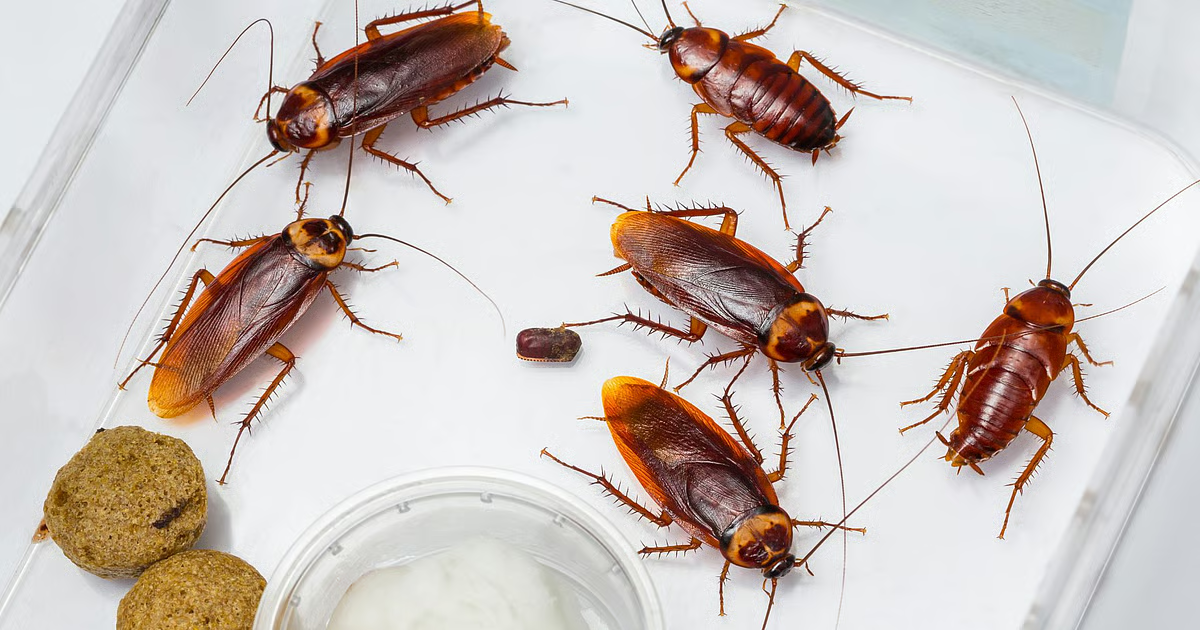
Scientists say cockroach milk is 3x more nutritious than human breast milk

July 12, 2026

POPULAR NEWS

Chewing gum releases thousands of microplastic particles directly into your mouth with every piece you chew

Chewing gum releases thousands of microplastic particles directly into your mouth with every piece you chew

by Shibasis Rath
May 8, 2026
0

Microplastics are turning up in places researchers never expected: deep-sea sediments, Arctic ice, and human blood. Now, a UCLA pilot...

grayscale photo of girl in polka dot long sleeve shirt

Yelling Isnโ€™t Just Yelling: How a Hostile Home Rewires a Childโ€™s Brain for Constant Alert

by Shibasis Rath
March 8, 2026
0

To a parent in the heat of the moment, a raised voice may feel like simple frustration. To a child...

72-Hour Fasting Can Reset Your Entire Immune System, USC Study Shows

72-Hour Fasting Can Reset Your Entire Immune System, USC Study Shows

by Shibasis Rath
February 28, 2026
0

A 72-hour fast can trigger a powerful immune system reset. Scientists call this stem cell regeneration. The process clears old...

woman in white tank top lying on bed

New Studys Says Gen Z is the least sexually active young cohort in modern recorded history

by Shibasis Rath
January 24, 2026
0

A generation that grew up with dating apps in their pockets, pornography a tap away, and sex discussed more openly...

a group of gen Z kids walking down a street

Is Gen Z the First Generation Less Intelligent Than Their Parents?

by Shibasis Rath
February 5, 2026
0

Gen Z intelligence decline is emerging as a serious concern among neuroscientists and education researchers. For over a century, each...

EDITOR CHOICEโ€˜S

  • All
  • NEWS
  • SPOTLIGHTS
Oona McGee, "Japan now has human refrigerators inspired by Japanese vending machines,"ย SoraNews24, July 17โ€“18, 2026, citing Yahoo! News Japan.

Japan built a ‘human refrigerator’ that cools your body in just 5 minutes, and it could transform how workers beat extreme heat

by Shibasis Rath
July 20, 2026
0

Japan's summers have grown severe enough that the government recently coined new terminology just to describe days when temperatures climb...

AI CRISPR Gene

AI Designs Better CRISPR Gene Editors Than Nature, Doudna Team Reports

by Shibasis Rath
July 20, 2026
0

Researchers at UC Berkeley used artificial intelligence to design new versions of a small CRISPR enzyme called TnpB. Several of...

The parsimony criterion

The Parsimony Criterion in Phylogenetics: Morphological & Molecular Methods

by Shibasis Rath
July 15, 2026
0

The parsimony criterion is one of the oldest and most widely used methods of constructing phylogenetic trees, having its roots...

maximum-likelihood-criterion

Maximum Likelihood Criterion in Phylogenetic Tree Reconstruction

by Shibasis Rath
July 15, 2026
0

The maximum-likelihood (ML) criterion is one of the most important and statistically rigorous approaches used for phylogenetic tree reconstruction, first...

ADVERTISEMENT

RathBiotaClan – RBC

RathBiotaClan – Connecting Research To Reality

Your trusted source for life science news, biology research & discoveries. Covering neuroscience, genetics, ecology, and more โ€” connecting research to reality.

About Us

Privacy Policies

Contact Us

Editorial Standard

Latest Posts

  • Japan built a ‘human refrigerator’ that cools your body in just 5 minutes, and it could transform how workers beat extreme heat
  • AI Designs Better CRISPR Gene Editors Than Nature, Doudna Team Reports
  • The Parsimony Criterion in Phylogenetics: Morphological & Molecular Methods
  • Maximum Likelihood Criterion in Phylogenetic Tree Reconstruction

SHIBASIS RATH

Contact Mail

rathbiotaclan@gmail.com

No Result
View All Result
MSME (Udyam) Certified Science Platform
Govt. of India

Get Us On PlayStore

playstore app for rathbiotaclan
  • About Us
  • Advertise With Us
  • Cancellation and Refund Policy
  • Contact Us
  • Contribute
  • Editorial Standards
  • Home
  • Pricing Details
  • Privacy Policies
  • Shipping Policy
  • Terms & Conditions

ยฉ 2026 RathBiotaClan. All rights reserved.

Welcome Back!

Sign In with Google
OR

Login to your account below

Forgotten Password? Sign Up

Create New Account!

Sign Up with Google
OR

Fill the forms below to register

*By registering into our website, you agree to the Terms & Conditions and Privacy Policy.
All fields are required. Log In

Retrieve your password

Please enter your username or email address to reset your password.

Log In

Add New Playlist

No Result
View All Result
  • HOME
  • HEALTH SCIENCE
  • NEUROSCIENCE
    • PHYSIOLOGY
    • IMMUNOLOGY
    • CANCER
  • DISCOVERIES
    • SPOTLIGHTS
    • STUDENT PORTAL
    • SCIENCE FEATURED
  • MOLECULAR BIOLOGY
    • GENETICS
    • BIOTECHNOLOGY
    • BIOINFORMATICS
    • BIOCHEMISTRY
    • BIOPHYSICS
  • ZOOLOGY & ECOLOGY
    • ENVIRONMENTAL SCIENCE
    • ECOLOGY
    • EVOLUTION
  • MICRO & PLANT SCIENCE
    • MICROBIOLOGY
    • CELL BIOLOGY
    • DEVELOPMENTAL BIOLOGY
  • PSYCHOLOGY
  • Login
  • Sign Up
SAVED POSTS

ยฉ 2026 RathBiotaClan. All rights reserved.

This website uses cookies. By continuing to use this website you are giving consent to cookies being used. Visit our Privacy and Cookie Policy.