




Tuesday, June 9, 2026
SAVED POSTS
  • Login
  • Register
RathBiotaClan
No Result
View All Result
  • HOME
  • HEALTH SCIENCE

    TRENDING ON HEALTH (TOP)

    For People Antidepressants Never Helped, a 30-Minute Home Session Is Now FDA-Approved

    Scientists Say Your Next Tube of Toothpaste Could Be Made From Human Hair

    Your Lungs, Liver, and Pancreas Also Age Faster When You Sleep Wrong

    Cycling Linked to Lower Dementia Risk in Study of Nearly 480,000 Adults

    NOW ON AIR (RBC)

    NEWS

    A Father’s Touch in Infancy Can Shape a Child’s Health for Years, New Science Explains Why

    June 9, 2026
    MutExpress
    BIOINFORMATICS

    South Asian Patients Have Been Left Out of Cancer Genomics for Decades & MutExpress-India Is Changing That

    June 8, 2026
    Biodiversity Loss
    ECOLOGY

    Biodiversity Loss Could Bankrupt Nations And Wall Street Hasn’t Noticed Yet

    June 5, 2026
    Soprano pipistrelle (Pipistrellus pygmaeus) emerging from a tree hollow at the moment of take-off.
    ECOLOGY

    Human-generated electromagnetic noise has long lasting effects on light orientation in bats

    June 4, 2026
  • NEUROSCIENCE
    • PHYSIOLOGY
    • IMMUNOLOGY
    • CANCER
  • DISCOVERIES
    • SPOTLIGHTS
    • STUDENT PORTAL
    • SCIENCE FEATURED
  • MOLECULAR BIOLOGY
    • GENETICS
    • BIOTECHNOLOGY
    • BIOINFORMATICS
    • BIOCHEMISTRY
    • BIOPHYSICS
  • ZOOLOGY & ECOLOGY
    • ENVIRONMENTAL SCIENCE
    • ECOLOGY
    • EVOLUTION
  • MICRO & PLANT SCIENCE
    • MICROBIOLOGY
    • CELL BIOLOGY
    • DEVELOPMENTAL BIOLOGY
  • PSYCHOLOGY
RathBiotaClan
RathBiotaClan
No Result
View All Result
Home ECOLOGY

Billions of Sea Stars Are Disappearing Now We Know What’s Behind It

Shibasis Rath by Shibasis Rath
August 17, 2025
in ECOLOGY, MICROBIOLOGY, NEWS, SCIENCE FEATURED
Reading Time: 5 mins read
0
A A
0
closeup photo of red star fish beside seashore

Scientists have identified Vibrio pectenicida strain FHCF-3 as the bacterial pathogen causing the devastating illness that wiped out billions of sea stars, offering hope for recovery efforts.

For over ten years now, sea star wasting disease (SSWD) has been basically melting sea stars into goop — their spiny bodies just kinda turning into piles of disintegrating flesh. Researchers had first noticed and reported this strange and really destructive illness back in November 2013. Since then, it’s thrown ecosystems along the west coast of North America into a bit of chaos. And apparently, similar cases have popped up all over the world too, with more than 40 species hit.

Now, an international group of scientists say they’ve finally figured out the exact pathogen behind this whole thing. After four years digging through gene sequences and doing a ton of lab work, they’ve named it Vibrio pectenicida. More specifically, the strain FHCF-3 was shown to actually be causing SSWD. This discovery — which was recently published in Nature Ecology & Evolution — is kind of a big deal. It’s a key step toward (hopefully) figuring out how to help sea stars bounce back, and protect the ecosystems that kinda depend on them.

Devastating Impact of Sea Star Wasting Disease
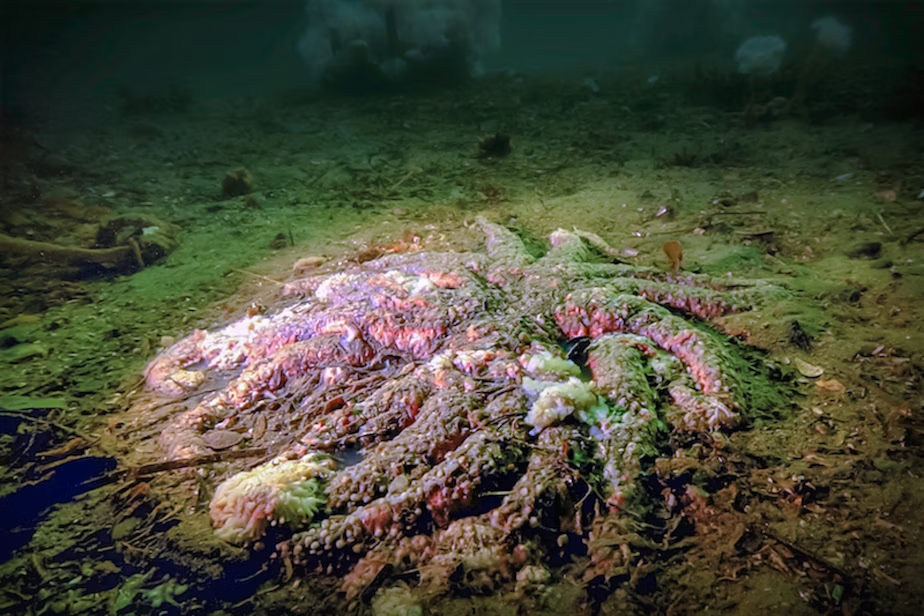
A wasting sunflower sea star has nearly melted away off British Columbia’s Calvert Island in 2015.
Hakai Institute/Grant Callegari

The disease manefests with alarming speed and severety. At first, leisons usually show up on the sea stars’ bumpy outsides. Then, their mussels start to break down, making arms twist weirdly and sometimes even drop off. Deaths often happen just days after these signs show up.

ADVERTISEMENT

SSWD hit the sunflower sea star (Pycnopodia helianthoides) especially hard. This big, multi-armed creature can grow up to 24 legs and comes in bright orange and purple colors. These “dinner-plate starfishes” dropped by more than 90% in the first few years of the outbreak. So by 2015, they were pretty much gone from the West Coast beaches, from Alaska all the way down to Mexico. This huge loss made the International Union for Conservation of Nature to list sunflower sea stars as critically endangered in 2020.

READ ALSO

A Father’s Touch in Infancy Can Shape a Child’s Health for Years, New Science Explains Why

Biodiversity Loss Could Bankrupt Nations And Wall Street Hasn’t Noticed Yet

Ecological Consequences of Sea Star Decline
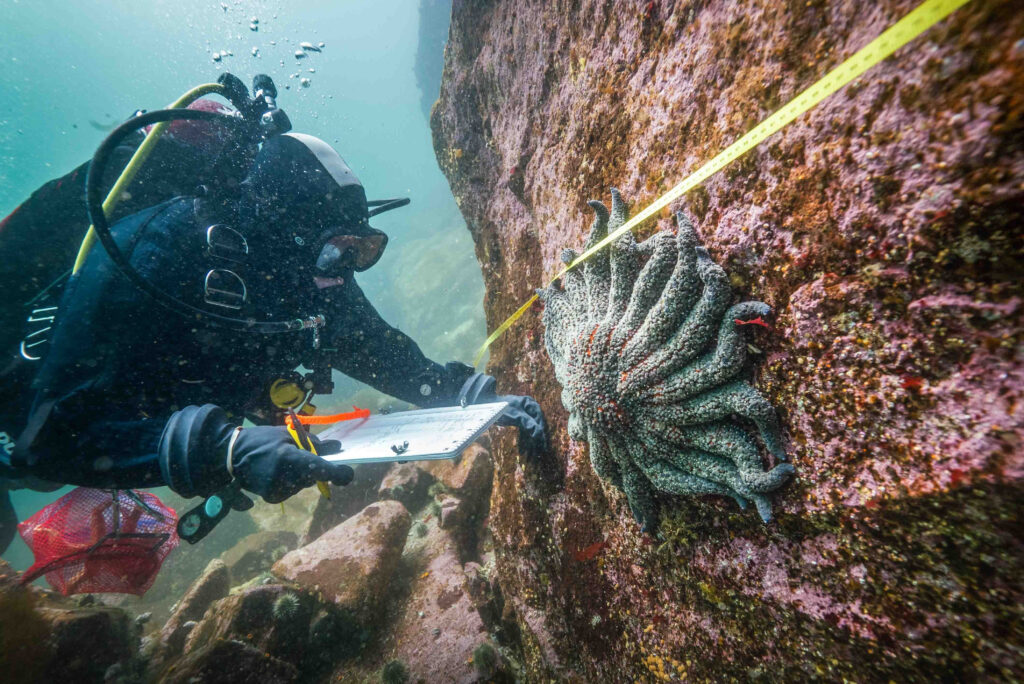
The ecological implications of SSWD are profound. Sea stars play an important role in their ecosystems. For instance, they primarily eat sea urchins, which feed on kelp roots. With sea stars absent, urchin populations have tripled, which has transformed once-lush, multi-story kelp forests into barren wastelands.

ADVERTISEMENT

Kelp forests are critical habitats. Indeed, they support many ecologically, culturally, and commercially valuable species. These include sea otters, seals, porpoises, fish, lobsters, crabs, and shrimp. Kelp forests also produce oxygen through photosynthesis, helping to reduce methane levels in the atmosphere. Furthermore, they protect shorelines from tidal erosion. The ripple effects of sea star decline highlight the urgency of finding a vaccine and implementing recovery efforts

ADVERTISEMENT

The Challenging Search for the Pathogen

Identifying the pathogen proved significant challenging. Initially, scientists, including marine ecologist Drew Harvell, suspected a virus. However, the actual culprit, Vibrio pectenicida, acts as a “sneaky critter”. Specifically, it show up on histology like no other bacteria. This might be due to its ability to produce an immune-inhibit toxins.

Harvell, a member of the international team, noted that they initially thought a virus caused the disease. Therefore, finding the pathogen in a more common group bacteria.. BTW, other hurdles hindered this bacterium’s identification. These included difficulty finding disease-free starfish for comparison, an apparent lack of visible pathogens in diseased tissue, and a general scarcity of knowledge regarding marine infectious diseases.

Identifying the Bacterial Culprit

Evolutionary ecologist Melanie Prentice was the one who led the breakthrough. Her team did a bunch of careful, controlled exposure experiments using sunflower sea stars that were bred in quarantine tanks. In these tests, they exposed healthy sea stars to tissue or fluids from infected ones. Pretty soon, the healthy stars started falling apart—arms twisting, then eventually dying off.

One of the most important experiments involved filtering or heat-treating the diseased stuff before exposing it. The starfish that got the filtered or heated material didn’t get sick at all. That was a huge clue—it meant the cause was probably bacterial, not viral, since viruses usually pass through filters or survive heat. (At least that’s what the team figured.)

They also did RNA sequencing on infected sea star samples from both the lab and the wild. Every time, they found V. pectenicida hanging around. Scientists already knew this bacteria as something that messes with scallop larvae and oysters, so it wasn’t totally new.

The final step was kind of the clincher. They isolated a strain called FHCF-3 from the sick sea stars and used it to infect healthy ones. Sure enough, the healthy stars started showing the same symptoms—legs twisting, melting, just falling apart. That’s when the team realized they’d nailed it. Marine disease ecologist Alyssa Gehman said the moment gave them “chills,” which honestly, yeah, sounds about right.

Climate Change: A Contributing Factor?

Researchers now know the immediate cause. However, they suspect that climate change might play a significant role in the outbreak. This is because they know Vibrio bacteria proliferate in warmer waters.

Some sunflower sea star populations still cling to life in British Columbia’s cold-water fjords. These areas may have temperatures too low for the bacteria to take hold effectively. This observation, therefore, supports the climate change hypothesis. Scientists like Gehman emphasize the need for further investigation into this temperature dependence.

Hope for Recovery

Figuring out the pathogen is honestly just the first step toward getting things back on track. With this discovery, scientists can now start doing culture-based experiments in the lab. Plus, they’ll be able to run wide-scale screenings to check how much of the pathogen is out there—both in labs and out in the field. Having this kind of info gives us a way better shot at saving starfish populations around the globe. In the end, it helps make sure they can keep doing what they do best: keeping marine ecosystems healthy and balanced, which, let’s be real, we all kinda rely on.


REFERENCE SOURCE

Nature Ecology & Evolution

  • Share on WhatsApp (Opens in new window) WhatsApp
  • Share on Facebook (Opens in new window) Facebook
  • Share on Reddit (Opens in new window) Reddit
  • Share on X (Opens in new window) X
  • Print (Opens in new window) Print
Shibasis Rath

Shibasis Rath

"𝓒𝓸𝓷𝓷𝓮𝓬𝓽𝓲𝓷𝓰 𝓡𝓮𝓼𝓮𝓪𝓻𝓬𝓱 𝓣𝓸 𝓡𝓮𝓪𝓵𝓲𝓽𝔂" 𝓲𝓼𝓷'𝓽 𝓙𝓾𝓼𝓽 𝓪 𝓜𝓸𝓽𝓽𝓸 - 𝓘𝓽'𝓼 𝓜𝔂 𝓜𝓲𝓼𝓼𝓲𝓸𝓷

Related Posts

A Father’s Touch in Infancy Can Shape a Child’s Health for Years, New Science Explains Why
NEWS

A Father’s Touch in Infancy Can Shape a Child’s Health for Years, New Science Explains Why

June 9, 2026
Biodiversity Loss
ECOLOGY

Biodiversity Loss Could Bankrupt Nations And Wall Street Hasn’t Noticed Yet

June 5, 2026
Soprano pipistrelle (Pipistrellus pygmaeus) emerging from a tree hollow at the moment of take-off.
ECOLOGY

Human-generated electromagnetic noise has long lasting effects on light orientation in bats

June 4, 2026

POPULAR NEWS

Chewing gum releases thousands of microplastic particles directly into your mouth with every piece you chew

Chewing gum releases thousands of microplastic particles directly into your mouth with every piece you chew

by Shibasis Rath
May 8, 2026
0

Microplastics are turning up in places researchers never expected: deep-sea sediments, Arctic ice, and human blood. Now, a UCLA pilot...

Yelling Isn’t Just Yelling: How a Hostile Home Rewires a Child’s Brain for Constant Alert

Yelling Isn’t Just Yelling: How a Hostile Home Rewires a Child’s Brain for Constant Alert

by Shibasis Rath
March 8, 2026
0

To a parent in the heat of the moment, a raised voice may feel like simple frustration. To a child...

New Studys Says Gen Z is the least sexually active young cohort in modern recorded history

New Studys Says Gen Z is the least sexually active young cohort in modern recorded history

by Shibasis Rath
January 24, 2026
0

A generation that grew up with dating apps in their pockets, pornography a tap away, and sex discussed more openly...

a group of gen Z kids walking down a street

Is Gen Z the First Generation Less Intelligent Than Their Parents?

by Shibasis Rath
February 5, 2026
0

Gen Z intelligence decline is emerging as a serious concern among neuroscientists and education researchers. For over a century, each...

Whole Brain Emulation Achieved: Scientists Run a Fruit Fly Brain in Simulation

by Shibasis Rath
March 9, 2026
0

Scientists have copied an entire biological brain neuron by neuron and synapse by synapse and made it control a simulated...

EDITOR CHOICE‘S

  • All
  • NEWS
  • SPOTLIGHTS
A Father’s Touch in Infancy Can Shape a Child’s Health for Years, New Science Explains Why

A Father’s Touch in Infancy Can Shape a Child’s Health for Years, New Science Explains Why

by Staff Writer
June 9, 2026
0

A study from Penn State University has revealed something startling beneath that simplicity those early interactions carry biological consequences that...

MutExpress

South Asian Patients Have Been Left Out of Cancer Genomics for Decades & MutExpress-India Is Changing That

by Staff Writer
June 8, 2026
0

The databases that underpin modern cancer genomics have a geography problem. The gnomAD database the gold standard for allele frequency...

Biodiversity Loss

Biodiversity Loss Could Bankrupt Nations And Wall Street Hasn’t Noticed Yet

by Staff Writer
June 5, 2026
0

Every year, governments borrow trillions of dollars to function. The interest rate they pay depends almost entirely on their credit...

Soprano pipistrelle (Pipistrellus pygmaeus) emerging from a tree hollow at the moment of take-off.

Human-generated electromagnetic noise has long lasting effects on light orientation in bats

by Shibasis Rath
June 4, 2026
0

A new study has found that soprano pipistrelle bats exposed to low-intensity broadband radiofrequency noise fly in random directions when...

ADVERTISEMENT

RathBiotaClan – RBC

RathBiotaClan – Connecting Research To Reality

Your trusted source for life science news, biology research & discoveries. Covering neuroscience, genetics, ecology, and more — connecting research to reality.

About Us

Privacy Policies

Contact Us

Editorial Standard

Latest Posts

  • A Father’s Touch in Infancy Can Shape a Child’s Health for Years, New Science Explains Why
  • South Asian Patients Have Been Left Out of Cancer Genomics for Decades & MutExpress-India Is Changing That
  • Biodiversity Loss Could Bankrupt Nations And Wall Street Hasn’t Noticed Yet
  • Human-generated electromagnetic noise has long lasting effects on light orientation in bats

SHIBASIS RATH

Contact Mail

rathbiotaclan@gmail.com

No Result
View All Result
MSME (Udyam) Certified Science Platform
Govt. of India

Get Us On PlayStore

playstore app for rathbiotaclan
  • About Us
  • Advertise With Us
  • Cancellation and Refund Policy
  • Contact Us
  • Contribute
  • Editorial Standards
  • Home
  • Pricing Details
  • Privacy Policies
  • Shipping Policy
  • Terms & Conditions

© 2026 RathBiotaClan. All rights reserved.

Welcome Back!

Sign In with Google
OR

Login to your account below

Forgotten Password? Sign Up

Create New Account!

Sign Up with Google
OR

Fill the forms bellow to register

*By registering into our website, you agree to the Terms & Conditions and Privacy Policy.
All fields are required. Log In

Retrieve your password

Please enter your username or email address to reset your password.

Log In

Add New Playlist

No Result
View All Result
  • HOME
  • HEALTH SCIENCE
  • NEUROSCIENCE
    • PHYSIOLOGY
    • IMMUNOLOGY
    • CANCER
  • DISCOVERIES
    • SPOTLIGHTS
    • STUDENT PORTAL
    • SCIENCE FEATURED
  • MOLECULAR BIOLOGY
    • GENETICS
    • BIOTECHNOLOGY
    • BIOINFORMATICS
    • BIOCHEMISTRY
    • BIOPHYSICS
  • ZOOLOGY & ECOLOGY
    • ENVIRONMENTAL SCIENCE
    • ECOLOGY
    • EVOLUTION
  • MICRO & PLANT SCIENCE
    • MICROBIOLOGY
    • CELL BIOLOGY
    • DEVELOPMENTAL BIOLOGY
  • PSYCHOLOGY
  • Login
  • Sign Up
SAVED POSTS

© 2026 RathBiotaClan. All rights reserved.

This website uses cookies. By continuing to use this website you are giving consent to cookies being used. Visit our Privacy and Cookie Policy.