

Friday, July 17, 2026
SAVED POSTS
  • Login
  • Register
RathBiotaClan
No Result
View All Result
  • HOME
  • HEALTH SCIENCE

    TRENDING ON HEALTH (TOP)

    Fick Method Underestimates Heart Problems in Children After Heart Transplant, Study Finds

    For Women on Antidepressants, Creatine Showed a Possible Extra Boost

    Did the iPhone Quietly Reshape When and Whether Americans Have Children?

    For People Antidepressants Never Helped, a 30-Minute Home Session Is Now FDA-Approved

    NOW ON AIR (RBC)

    The parsimony criterion
    BIOINFORMATICS

    The Parsimony Criterion in Phylogenetics: Morphological & Molecular Methods

    July 15, 2026
    maximum-likelihood-criterion
    BIOINFORMATICS

    Maximum Likelihood Criterion in Phylogenetic Tree Reconstruction

    July 15, 2026
    Tree Optimization Criteria and Search Methods in Phylogenetics – NNI, SPR, TBR Explained
    BIOINFORMATICS

    Tree Optimization Criteria and Tree Search Methods in Phylogenetics

    July 15, 2026
    Bootstrapping in Phylogenetics
    BIOINFORMATICS

    Bootstrapping in Phylogenetics – Tree Reliability, Resampling & Bootstrap Values

    July 15, 2026
  • NEUROSCIENCE
    • PHYSIOLOGY
    • IMMUNOLOGY
    • CANCER
  • DISCOVERIES
    • SPOTLIGHTS
    • STUDENT PORTAL
    • SCIENCE FEATURED
  • MOLECULAR BIOLOGY
    • GENETICS
    • BIOTECHNOLOGY
    • BIOINFORMATICS
    • BIOCHEMISTRY
    • BIOPHYSICS
  • ZOOLOGY & ECOLOGY
    • ENVIRONMENTAL SCIENCE
    • ECOLOGY
    • EVOLUTION
  • MICRO & PLANT SCIENCE
    • MICROBIOLOGY
    • CELL BIOLOGY
    • DEVELOPMENTAL BIOLOGY
  • PSYCHOLOGY
RathBiotaClan
RathBiotaClan
No Result
View All Result
Home HEALTH SCIENCE

Autonomous Robotic Surgery Just Got Real

Shibasis Rath by Shibasis Rath
July 9, 2025
in HEALTH SCIENCE, NEWS, PHYSIOLOGY
Reading Time: 4 mins read
0
A A
0
robotics surgery

In a world-first, a surgical robot has not only removed gallbladders entirely on its own, but it also did so while listening and responding to spoken commands — like a junior surgeon learning from their senior. Except, this junior is made of metal and wires, and it doesn’t blink.

The breakthrough came from a team led by Ji Woong “Brian” Kim, and it’s being hailed as a milestone in surgical autonomy. Until now, surgical robots mostly relied on rigid, pre-programmed actions. But this one? It learned by watching. Then, it listened. Finally, it adapted.

And when something went wrong — like an unexpected tissue shift or a new color added to confuse its visual system — it didn’t panic. It made a decision, recalibrated, and carried on. Just like a real surgeon would.

 “This is a major leap from earlier robotic systems,” Kim said. “We’re not just automating one step — we’re showing that autonomous surgery is actually viable in the real world.”

How Did They Teach It Surgery?

The idea of training a robot to perform a full-on surgery sounds unbelievably hard. It’s not just about showing it what to cut — it needs to know what not to touch (like major blood vessels), where to place clips, how deep to make an incision, and how to recover when things go off track.

ADVERTISEMENT

As Dr. Mathias Unberath from Johns Hopkins put it bluntly:

READ ALSO

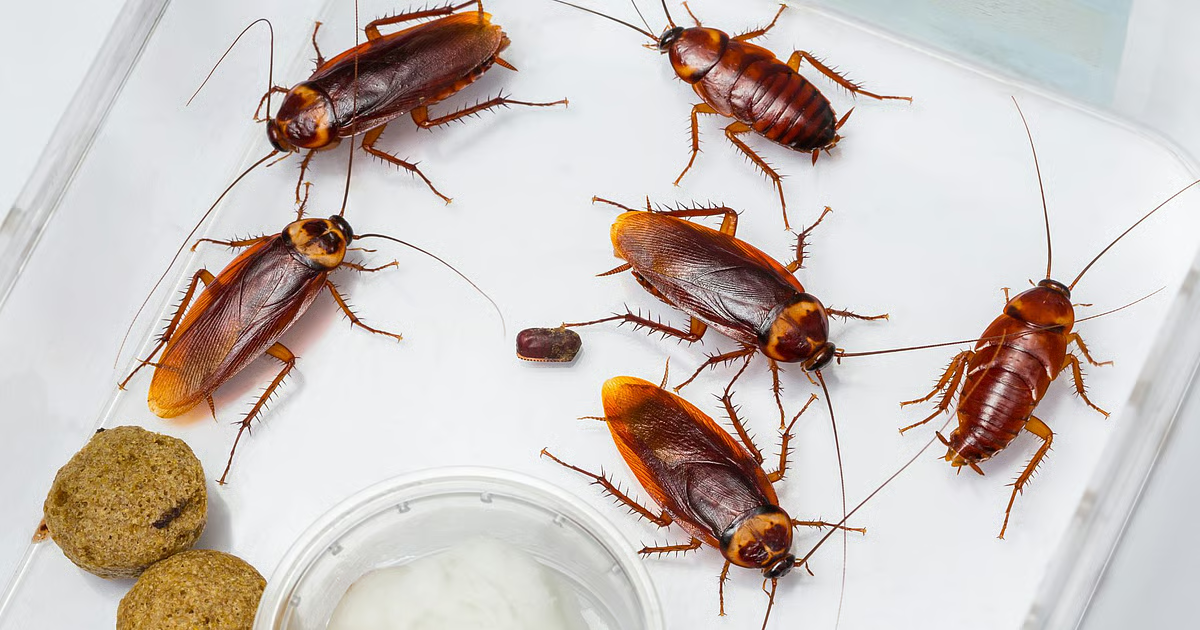
Scientists say cockroach milk is 3x more nutritious than human breast milk

Negotiating with women builds more trust, even in anonymous online chats, Study finds

 “How do you even write that in code?”

ADVERTISEMENT

Well, instead of spelling it all out line-by-line, the researchers turned to imitation learning — letting the robot watch human surgeons do the procedure through annotated video tutorials.

ADVERTISEMENT

Under the supervision of Professor Axel Krieger, the robot learned by watching humans perform gallbladder removals (cholecystectomies) on pig cadavers. That’s no walk in the park — it involves 17 complex steps like locating and identifying tissues, making accurate incisions, placing clips, and more.

Yet after the training, the robot — known as SRT-H (Surgical Robot Transformer-Hierarchy) — pulled it off eight times in a row. Fully autonomous. No human intervention. And it didn’t just repeat a routine — it actually thought on the spot.

Not a GPS, But a Self-Driving Surgeon

What sets SRT-H apart from previous surgical bots is that it’s not simply following a script.

Krieger compared older models to a robot driving a fixed route on a GPS map. But SRT-H? It’s more like a driver that figures things out in real time — taking detours, dodging potholes, and handling rain on a dirt road.

Thanks to language-based AI (similar to the tech behind ChatGPT), the robot could even follow spoken instructions mid-surgery like “move your arm a little to the left.” It didn’t just obey — it learned from it. The ability to combine natural language with hands-on precision makes this system an incredibly powerful assistant — or perhaps one day, a full-fledged surgical operator.

Even Curveballs Couldn’t Stop It

To really test the robot’s skill, the team started messing with it — shifting its position mid-procedure, or changing tissue colors using dyes. These curveballs would throw off most systems trained in fixed conditions.

But SRT-H adapted instantly, corrected its movements, and carried on. That’s huge, because real surgeries are never predictable. Human bodies are messy. Things move. Blood gets in the way. Lighting changes.

And yet, this robot handled it all.

“This shows that complex surgeries can be done autonomously,” said Krieger. “This system isn’t just smart — it’s resilient.”

Robots in Surgery: No Longer Sci-Fi

We’re entering a world where AI-powered machines can perform complete surgical operations — no joystick, no direct control, just learning, planning, and responding like a human in the OR.

“What used to feel like science fiction is now very real,” said Kim. “Autonomous surgical systems are no longer a future goal — they’re happening now.”

Sure, it’s still early days. The surgeries were done ex vivo (outside the body) and on pig organs. But as a proof-of-concept? It’s solid, and it opens a path toward fully autonomous human surgeries in the not-so-distant future.

One thing's clear: surgery will never be the same again.

Reference:

SRT-H: A hierarchical framework for autonomous surgery via language-conditioned imitation learning

https://doi.org/10.1126/scirobotics.adt5254

Published In Science Robotics
  • Share on WhatsApp (Opens in new window) WhatsApp
  • Share on Facebook (Opens in new window) Facebook
  • Share on Reddit (Opens in new window) Reddit
  • Share on X (Opens in new window) X
  • Print (Opens in new window) Print
Shibasis Rath

Shibasis Rath

"𝓒𝓸𝓷𝓷𝓮𝓬𝓽𝓲𝓷𝓰 𝓡𝓮𝓼𝓮𝓪𝓻𝓬𝓱 𝓣𝓸 𝓡𝓮𝓪𝓵𝓲𝓽𝔂" 𝓲𝓼𝓷'𝓽 𝓙𝓾𝓼𝓽 𝓪 𝓜𝓸𝓽𝓽𝓸 - 𝓘𝓽'𝓼 𝓜𝔂 𝓜𝓲𝓼𝓼𝓲𝓸𝓷

Related Posts

Scientists say cockroach milk is 3x more nutritious than human breast milk
NEWS

Scientists say cockroach milk is 3x more nutritious than human breast milk

July 12, 2026
Negotiating with women builds more trust, even in anonymous online chats, Study finds
NEWS

Negotiating with women builds more trust, even in anonymous online chats, Study finds

July 3, 2026
fick principle
HEALTH SCIENCE

Fick Method Underestimates Heart Problems in Children After Heart Transplant, Study Finds

July 2, 2026

POPULAR NEWS

Chewing gum releases thousands of microplastic particles directly into your mouth with every piece you chew

Chewing gum releases thousands of microplastic particles directly into your mouth with every piece you chew

by Shibasis Rath
May 8, 2026
0

Microplastics are turning up in places researchers never expected: deep-sea sediments, Arctic ice, and human blood. Now, a UCLA pilot...

grayscale photo of girl in polka dot long sleeve shirt

Yelling Isn’t Just Yelling: How a Hostile Home Rewires a Child’s Brain for Constant Alert

by Shibasis Rath
March 8, 2026
0

To a parent in the heat of the moment, a raised voice may feel like simple frustration. To a child...

72-Hour Fasting Can Reset Your Entire Immune System, USC Study Shows

72-Hour Fasting Can Reset Your Entire Immune System, USC Study Shows

by Shibasis Rath
February 28, 2026
0

A 72-hour fast can trigger a powerful immune system reset. Scientists call this stem cell regeneration. The process clears old...

woman in white tank top lying on bed

New Studys Says Gen Z is the least sexually active young cohort in modern recorded history

by Shibasis Rath
January 24, 2026
0

A generation that grew up with dating apps in their pockets, pornography a tap away, and sex discussed more openly...

a group of gen Z kids walking down a street

Is Gen Z the First Generation Less Intelligent Than Their Parents?

by Shibasis Rath
February 5, 2026
0

Gen Z intelligence decline is emerging as a serious concern among neuroscientists and education researchers. For over a century, each...

EDITOR CHOICE‘S

  • All
  • NEWS
  • SPOTLIGHTS
The parsimony criterion

The Parsimony Criterion in Phylogenetics: Morphological & Molecular Methods

by Shibasis Rath
July 15, 2026
0

The parsimony criterion is one of the oldest and most widely used methods of constructing phylogenetic trees, having its roots...

maximum-likelihood-criterion

Maximum Likelihood Criterion in Phylogenetic Tree Reconstruction

by Shibasis Rath
July 15, 2026
0

The maximum-likelihood (ML) criterion is one of the most important and statistically rigorous approaches used for phylogenetic tree reconstruction, first...

Tree Optimization Criteria and Search Methods in Phylogenetics – NNI, SPR, TBR Explained

Tree Optimization Criteria and Tree Search Methods in Phylogenetics

by Shibasis Rath
July 15, 2026
0

Distance-matrix clustering methods such as UPGMA and Neighbor-Joining construct a phylogenetic tree directly through a fixed, well-defined algorithm, without explicitly...

Bootstrapping in Phylogenetics

Bootstrapping in Phylogenetics – Tree Reliability, Resampling & Bootstrap Values

by Shibasis Rath
July 15, 2026
0

Bootstrapping is a statistical method used to assess the reliability of a phylogenetic tree, introduced by Felsenstein in 1985. Since...

ADVERTISEMENT

RathBiotaClan – RBC

RathBiotaClan – Connecting Research To Reality

Your trusted source for life science news, biology research & discoveries. Covering neuroscience, genetics, ecology, and more — connecting research to reality.

About Us

Privacy Policies

Contact Us

Editorial Standard

Latest Posts

  • The Parsimony Criterion in Phylogenetics: Morphological & Molecular Methods
  • Maximum Likelihood Criterion in Phylogenetic Tree Reconstruction
  • Tree Optimization Criteria and Tree Search Methods in Phylogenetics
  • Bootstrapping in Phylogenetics – Tree Reliability, Resampling & Bootstrap Values

SHIBASIS RATH

Contact Mail

rathbiotaclan@gmail.com

No Result
View All Result
MSME (Udyam) Certified Science Platform
Govt. of India

Get Us On PlayStore

playstore app for rathbiotaclan
  • About Us
  • Advertise With Us
  • Cancellation and Refund Policy
  • Contact Us
  • Contribute
  • Editorial Standards
  • Home
  • Pricing Details
  • Privacy Policies
  • Shipping Policy
  • Terms & Conditions

© 2026 RathBiotaClan. All rights reserved.

Welcome Back!

Sign In with Google
OR

Login to your account below

Forgotten Password? Sign Up

Create New Account!

Sign Up with Google
OR

Fill the forms below to register

*By registering into our website, you agree to the Terms & Conditions and Privacy Policy.
All fields are required. Log In

Retrieve your password

Please enter your username or email address to reset your password.

Log In

Add New Playlist

No Result
View All Result
  • HOME
  • HEALTH SCIENCE
  • NEUROSCIENCE
    • PHYSIOLOGY
    • IMMUNOLOGY
    • CANCER
  • DISCOVERIES
    • SPOTLIGHTS
    • STUDENT PORTAL
    • SCIENCE FEATURED
  • MOLECULAR BIOLOGY
    • GENETICS
    • BIOTECHNOLOGY
    • BIOINFORMATICS
    • BIOCHEMISTRY
    • BIOPHYSICS
  • ZOOLOGY & ECOLOGY
    • ENVIRONMENTAL SCIENCE
    • ECOLOGY
    • EVOLUTION
  • MICRO & PLANT SCIENCE
    • MICROBIOLOGY
    • CELL BIOLOGY
    • DEVELOPMENTAL BIOLOGY
  • PSYCHOLOGY
  • Login
  • Sign Up
SAVED POSTS

© 2026 RathBiotaClan. All rights reserved.

This website uses cookies. By continuing to use this website you are giving consent to cookies being used. Visit our Privacy and Cookie Policy.