





Monday, May 18, 2026
SAVED POSTS
  • Login
  • Register
RathBiotaClan
No Result
View All Result
  • HOME
  • HEALTH SCIENCE

    TRENDING ON HEALTH (TOP)

    Cycling Linked to Lower Dementia Risk in Study of Nearly 480,000 Adults

    First oral GLP-1 weight-loss pill approved a new era for accessible treatment

    Chewing gum releases thousands of microplastic particles directly into your mouth with every piece you chew

    Single-Cell Study of Over a Million Immune Cells Reveals Why Women Are More Prone to Autoimmune Disease

    NOW ON AIR (RBC)

    A new study has found that men’s brains shrink faster than women’s as they age.
    NEUROSCIENCE

    12,638 MRI Scans Confirm Men’s Brains Shrink Faster in PNAS Study

    May 14, 2026
    ENVIRONMENTAL SCIENCE

    Volcanic Eruptions Can Destroy Their Own Methane — Tonga’s Plume Shows How

    May 13, 2026
    3 men standing on rocky shore during daytime
    MOLECULAR BIOLOGY

    For Future Space Missions, Molecular Ecology Finally Offers a Clear Biosignature Target

    May 12, 2026
    Babies Yawn in the Womb
    DEVELOPMENTAL BIOLOGY

    Scientists Say Babies May Learn to Yawn Before Birth

    May 11, 2026
  • NEUROSCIENCE
    • PHYSIOLOGY
    • IMMUNOLOGY
    • CANCER
  • DISCOVERIES
    • SPOTLIGHTS
    • STUDENT PORTAL
    • SCIENCE FEATURED
  • MOLECULAR BIOLOGY
    • GENETICS
    • BIOTECHNOLOGY
    • BIOINFORMATICS
    • BIOCHEMISTRY
    • BIOPHYSICS
  • ZOOLOGY & ECOLOGY
    • ENVIRONMENTAL SCIENCE
    • ECOLOGY
    • EVOLUTION
  • MICRO & PLANT SCIENCE
    • MICROBIOLOGY
    • CELL BIOLOGY
    • DEVELOPMENTAL BIOLOGY
  • PSYCHOLOGY
RathBiotaClan
RathBiotaClan
No Result
View All Result
Home SCIENCE FEATURED

How Does Deep-sea Bioluminescence Work?

Shibasis Rath by Shibasis Rath
June 24, 2024
in SCIENCE FEATURED, ZOOLOGY
Reading Time: 4 mins read
0
A A
0
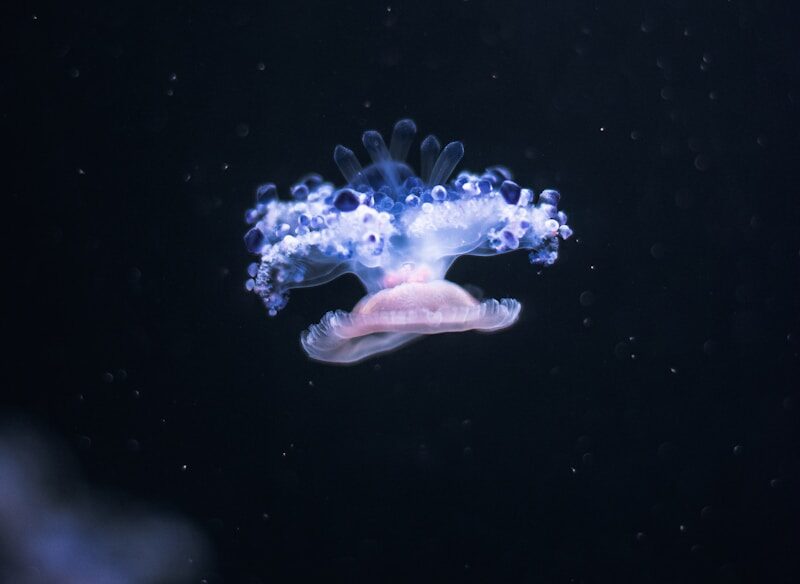
jellyfish underwater

Bioluminescence is a captivating natural phenomenon. It involves the production and emission of light by living organisms. Unlike fluorescence or phosphorescence, which rely on external light sources, bioluminescence is produced internally. This ability appears across a wide range of species in both land and marine environments.
In this article, we explore the mechanisms, diversity, and ecological roles of bioluminescence, especially in marine ecosystems where it is most abundant.

Historical Overview and Discovery

Bioluminescence has fascinated humans for centuries. Ancient civilizations described glowing seas and luminous organisms with awe and mystery. However, scientific understanding began to grow during the 19th and 20th centuries.
Researchers such as Sir John Harvey-Jones and Osamu Shimomura made major contributions. They identified and characterized the molecules responsible for light production. Their work paved the way for modern bioluminescence research.

Mechanisms of Bioluminescence

Bioluminescence begins with a chemical reaction between luciferin and luciferase. Luciferin is the light-emitting molecule, while luciferase acts as the enzyme that triggers the reaction.
Because different organisms use unique forms of these molecules, they produce lights of many colors.

Specialized cells or organelles store the machinery needed for light production. In some organisms, these cells occur across the entire body. Others concentrate them in specific organs or maintain symbiotic relationships, as seen in many deep-sea fish and jellyfish.

ADVERTISEMENT

Diversity of Bioluminescent Organisms

The marine world holds the greatest diversity of bioluminescent life. Microscopic plankton such as dinoflagellates create glowing displays often called “sea sparkle.” Larger organisms, including jellyfish, squid, and deep-sea fish like the anglerfish, use light for survival in many ways.

READ ALSO

Volcanic Eruptions Can Destroy Their Own Methane — Tonga’s Plume Shows How

Scientists Say Babies May Learn to Yawn Before Birth

Although less common on land, several species still glow. Fireflies, bioluminescent fungi, and some bacteria use this ability for communication, reproduction, or survival. Their light production reflects unique ecological pressures found in terrestrial environments.

ADVERTISEMENT

Ecological Roles of Bioluminescence

Many species use bioluminescence to defend themselves. Some jellyfish release glowing clouds to confuse predators. Others signal toxicity with bright flashes. These strategies increase survival in the dark ocean.

Several predators use bioluminescence to hunt. The anglerfish, for instance, uses a glowing lure to attract prey in the deep sea. The prey mistakes the light for a small organism and moves closer.

Some species rely on counter-illumination. They emit light from their bellies to match the faint glow above them. As a result, predators below cannot detect their silhouettes. Hatchetfish are among the best examples of this technique.

ADVERTISEMENT

Bioluminescence also supports communication. Many deep-sea fish and squid use glowing patterns to attract mates, signal threats, or coordinate group movements.

Bioluminescence in Scientific Research

Luciferase has become a powerful tool in modern science. Researchers use luciferase-based assays to study gene expression, detect biomolecules, and observe real-time cellular changes.

Because bioluminescent organisms respond to environmental changes, they act as indicators of ecosystem health. Monitoring their patterns helps scientists track water quality, nutrient levels, and climate-related changes in marine habitats.

Conservation and Threats

Many bioluminescent species face threats such as habitat loss, pollution, climate change, and overharvesting. Therefore, protecting their ecosystems is essential for preserving this natural wonder.

The use of bioluminescent organisms in research raises ethical concerns. These include questions about sustainability, biodiversity loss, and animal welfare. Responsible regulations help ensure ethical scientific practices.

Future Path

Scientists continue to uncover new bioluminescent species and mechanisms. Modern tools such as genetic engineering and advanced imaging accelerate discoveries. These advancements also expand bioluminescence applications in fields like bioimaging and biosensing.

Future conservation efforts will focus on expanding protected areas and promoting responsible bioluminescent tourism. International collaboration and public education will also strengthen global conservation initiatives.

Bioluminescence showcases nature’s ingenuity and adaptability. It illuminates the darkest ecosystems and deepens our understanding of life’s complexity. As we move forward, protecting bioluminescent habitats remains essential. Preserving them is both a scientific and moral responsibility for future generations.


  • Share on WhatsApp (Opens in new window) WhatsApp
  • Share on Facebook (Opens in new window) Facebook
  • Share on Reddit (Opens in new window) Reddit
  • Share on X (Opens in new window) X
  • Print (Opens in new window) Print
Shibasis Rath

Shibasis Rath

"𝓒𝓸𝓷𝓷𝓮𝓬𝓽𝓲𝓷𝓰 𝓡𝓮𝓼𝓮𝓪𝓻𝓬𝓱 𝓣𝓸 𝓡𝓮𝓪𝓵𝓲𝓽𝔂" 𝓲𝓼𝓷'𝓽 𝓙𝓾𝓼𝓽 𝓪 𝓜𝓸𝓽𝓽𝓸 - 𝓘𝓽'𝓼 𝓜𝔂 𝓜𝓲𝓼𝓼𝓲𝓸𝓷

Related Posts

Volcanic Eruptions Can Destroy Their Own Methane — Tonga’s Plume Shows How
ENVIRONMENTAL SCIENCE

Volcanic Eruptions Can Destroy Their Own Methane — Tonga’s Plume Shows How

May 13, 2026
Babies Yawn in the Womb
DEVELOPMENTAL BIOLOGY

Scientists Say Babies May Learn to Yawn Before Birth

May 11, 2026
Low Sexual Frequency Linked to Worse Cardiovascular Outcomes, Two US Studies Find
SCIENCE FEATURED

Low Sexual Frequency Linked to Worse Cardiovascular Outcomes, Two US Studies Find

May 5, 2026

POPULAR NEWS

Chewing gum releases thousands of microplastic particles directly into your mouth with every piece you chew

Chewing gum releases thousands of microplastic particles directly into your mouth with every piece you chew

by Shibasis Rath
May 8, 2026
0

Microplastics are turning up in places researchers never expected: deep-sea sediments, Arctic ice, and human blood. Now, a UCLA pilot...

Yelling Isn’t Just Yelling: How a Hostile Home Rewires a Child’s Brain for Constant Alert

Yelling Isn’t Just Yelling: How a Hostile Home Rewires a Child’s Brain for Constant Alert

by Shibasis Rath
March 8, 2026
0

To a parent in the heat of the moment, a raised voice may feel like simple frustration. To a child...

a group of gen Z kids walking down a street

Is Gen Z the First Generation Less Intelligent Than Their Parents?

by Shibasis Rath
February 5, 2026
0

Gen Z intelligence decline is emerging as a serious concern among neuroscientists and education researchers. For over a century, each...

Whole Brain Emulation Achieved: Scientists Run a Fruit Fly Brain in Simulation

by Shibasis Rath
March 9, 2026
0

Scientists have copied an entire biological brain neuron by neuron and synapse by synapse and made it control a simulated...

Global Sperm Counts Have Dropped 50% in 50 Years Now 128 Men Are Racing Their Way to a $100,000 Prize to Prove the Point

Global Sperm Counts Have Dropped 50% in 50 Years Now 128 Men Are Racing Their Way to a $100,000 Prize to Prove the Point

by Staff Writer
May 5, 2026
0

A group of technology entrepreneurs is staging a competitive event in San Francisco in which semen samples from 128 men...

EDITOR CHOICE‘S

  • All
  • NEWS
  • SPOTLIGHTS
A new study has found that men’s brains shrink faster than women’s as they age.

12,638 MRI Scans Confirm Men’s Brains Shrink Faster in PNAS Study

by Staff Writer
May 14, 2026
0

A large-scale analysis of brain scans taken over time has found that men's brains shrink faster than women's across a...

Volcanic Eruptions Can Destroy Their Own Methane — Tonga’s Plume Shows How

Volcanic Eruptions Can Destroy Their Own Methane — Tonga’s Plume Shows How

by Shibasis Rath
May 13, 2026
0

A study published in Nature Communications analyzed the Hunga Tonga-Hunga Ha'apai volcano eruption's impact on methane in the atmosphere. It...

3 men standing on rocky shore during daytime

For Future Space Missions, Molecular Ecology Finally Offers a Clear Biosignature Target

by Shibasis Rath
May 12, 2026
0

When the next generation of probes scoops up dust from the icy shell of Europa or the surface of Mars,...

Babies Yawn in the Womb

Scientists Say Babies May Learn to Yawn Before Birth

by Shibasis Rath
May 11, 2026
0

Mothers can spread yawns to their yet-to-be-born offspring during pregnancy, researchers report May 5 in Current Biology  the first empirical evidence...

ADVERTISEMENT

RathBiotaClan – RBC

RathBiotaClan – Connecting Research To Reality

Your trusted source for life science news, biology research & discoveries. Covering neuroscience, genetics, ecology, and more — connecting research to reality.

Privacy Policies

Contact Us

About Us

Editorial Standards

Latest Posts

  • 12,638 MRI Scans Confirm Men’s Brains Shrink Faster in PNAS Study
  • Volcanic Eruptions Can Destroy Their Own Methane — Tonga’s Plume Shows How
  • For Future Space Missions, Molecular Ecology Finally Offers a Clear Biosignature Target
  • Scientists Say Babies May Learn to Yawn Before Birth

SHIBASIS RATH

Contact Mail

rathbiotaclan@gmail.com

No Result
View All Result
MSME (Udyam) Certified Science Platform
Govt. of India

Get Us On PlayStore

playstore app for rathbiotaclan
  • About Us
  • Advertise With Us
  • Cancellation and Refund Policy
  • Contact Us
  • Contribute
  • Editorial Standards
  • Home
  • Pricing Details
  • Privacy Policies
  • Shipping Policy
  • Terms & Conditions

© 2026 RathBiotaClan. All rights reserved.

Welcome Back!

Sign In with Google
OR

Login to your account below

Forgotten Password? Sign Up

Create New Account!

Sign Up with Google
OR

Fill the forms bellow to register

*By registering into our website, you agree to the Terms & Conditions and Privacy Policy.
All fields are required. Log In

Retrieve your password

Please enter your username or email address to reset your password.

Log In

Add New Playlist

No Result
View All Result
  • HOME
  • HEALTH SCIENCE
  • NEUROSCIENCE
    • PHYSIOLOGY
    • IMMUNOLOGY
    • CANCER
  • DISCOVERIES
    • SPOTLIGHTS
    • STUDENT PORTAL
    • SCIENCE FEATURED
  • MOLECULAR BIOLOGY
    • GENETICS
    • BIOTECHNOLOGY
    • BIOINFORMATICS
    • BIOCHEMISTRY
    • BIOPHYSICS
  • ZOOLOGY & ECOLOGY
    • ENVIRONMENTAL SCIENCE
    • ECOLOGY
    • EVOLUTION
  • MICRO & PLANT SCIENCE
    • MICROBIOLOGY
    • CELL BIOLOGY
    • DEVELOPMENTAL BIOLOGY
  • PSYCHOLOGY
  • Login
  • Sign Up
SAVED POSTS

© 2026 RathBiotaClan. All rights reserved.

This website uses cookies. By continuing to use this website you are giving consent to cookies being used. Visit our Privacy and Cookie Policy.