

Friday, July 24, 2026
SAVED POSTS
  • Login
  • Register
RathBiotaClan
No Result
View All Result
  • HOME
  • HEALTH SCIENCE

    TRENDING ON HEALTH (TOP)

    Fick Method Underestimates Heart Problems in Children After Heart Transplant, Study Finds

    For Women on Antidepressants, Creatine Showed a Possible Extra Boost

    Did the iPhone Quietly Reshape When and Whether Americans Have Children?

    For People Antidepressants Never Helped, a 30-Minute Home Session Is Now FDA-Approved

    NOW ON AIR (RBC)

    Oona McGee, "Japan now has human refrigerators inspired by Japanese vending machines," SoraNews24, July 17–18, 2026, citing Yahoo! News Japan.
    NEWS

    Japan built a ‘human refrigerator’ that cools your body in just 5 minutes, and it could transform how workers beat extreme heat

    July 20, 2026
    AI CRISPR Gene
    BIOTECHNOLOGY

    AI Designs Better CRISPR Gene Editors Than Nature, Doudna Team Reports

    July 20, 2026
    The parsimony criterion
    BIOINFORMATICS

    The Parsimony Criterion in Phylogenetics: Morphological & Molecular Methods

    July 15, 2026
    maximum-likelihood-criterion
    BIOINFORMATICS

    Maximum Likelihood Criterion in Phylogenetic Tree Reconstruction

    July 15, 2026
  • NEUROSCIENCE
    • PHYSIOLOGY
    • IMMUNOLOGY
    • CANCER
  • DISCOVERIES
    • SPOTLIGHTS
    • STUDENT PORTAL
    • SCIENCE FEATURED
  • MOLECULAR BIOLOGY
    • GENETICS
    • BIOTECHNOLOGY
    • BIOINFORMATICS
    • BIOCHEMISTRY
    • BIOPHYSICS
  • ZOOLOGY & ECOLOGY
    • ENVIRONMENTAL SCIENCE
    • ECOLOGY
    • EVOLUTION
  • MICRO & PLANT SCIENCE
    • MICROBIOLOGY
    • CELL BIOLOGY
    • DEVELOPMENTAL BIOLOGY
  • PSYCHOLOGY
RathBiotaClan
RathBiotaClan
No Result
View All Result
Home NEUROSCIENCE

Neuroscience of Love: How Oxytocin and Vasopressin Shape Human Bonding and Relationships

Shibasis Rath by Shibasis Rath
February 24, 2025
in NEUROSCIENCE, SCIENCE FEATURED, SPOTLIGHTS
Reading Time: 3 mins read
0
A A
0
a heart shaped hole in the snow

Love, Commitment, and Human Brain Chemistry

The vole saga is a thriller that gives insight into the impact of brain chemistry on behavior.

But what does this tiny rodent have to say about human love, commitment, and relationships?

Although it’s premature to make definitive claims, encouraging evidence suggests vole studies could teach us about human emotions and bonding. Studies indicate that human oxytocin levels increase during breastfeeding in women and sexual intercourse in men and women, implying its function in enhancing bonding.

Andreas Bartels and Semir Zeki at University College London have investigated human bonding through functional magnetic resonance imaging (fMRI).

ADVERTISEMENT

In a study of maternal love, mothers viewed pictures of their children and other familiar children while their brains were scanned. Another research compared brain activity when people looked at pictures of romantic partners as opposed to friends. It showed higher activity in regions such as the anterior cingulate cortex, caudate nucleus, and striatum when looking at loved ones. Responses to the partner and children overlapped significantly, although some areas responded differently to each relationship. The majority of these regions are associated with the brain’s reward system, which confirms the significance of close emotional relationships. Notably, the same brain areas responsible for attachment in humans are dense with oxytocin and vasopressin receptors, as in voles.

READ ALSO

Japan built a ‘human refrigerator’ that cools your body in just 5 minutes, and it could transform how workers beat extreme heat

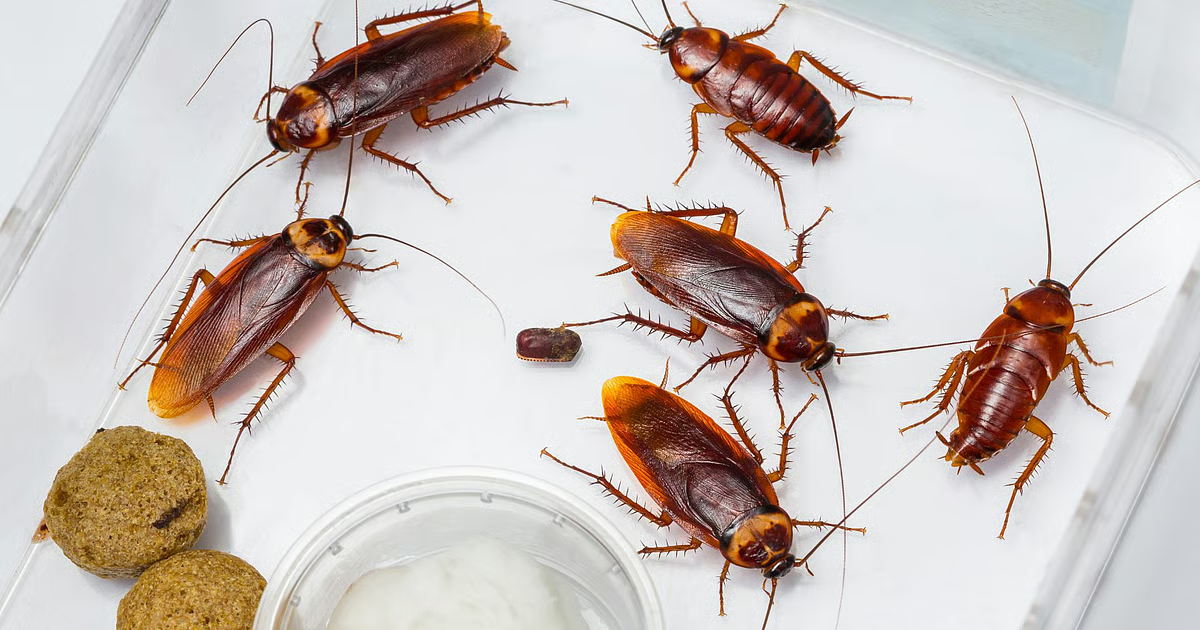
Scientists say cockroach milk is 3x more nutritious than human breast milk

These fMRI findings suggest that oxytocin and vasopressin may be significant in human attachment, as in voles. But human monogamy is more complicated than in rodents. Although human relationships are defined by many different social and psychological forces, some surprising genetic links to bonding have been found. One investigation, by Hasse Walum with 552 Swedish twin pairs in long-term relationships, determined whether genetic variation in vasopressin receptors had an influence on commitment. The genes in montane and prairie voles, coding for the vasopressin receptors, are nearly identical. Prairie voles, however, are monogamous and contain another DNA sequence close to the receptor gene that controls their social life.

ADVERTISEMENT

Brain imaging reveals maternal and romantic love activation patterns. Brain regions are highlighted in (a) sagittal, (b) horizontal, and (c, d) two coronal views. Yellow areas indicate increased activity when mothers viewed images of their own child compared to other familiar children. Red areas showed greater activation in response to romantic partners than to friends. Key highlighted regions include the periaqueductal gray (PAG), anterior cingulate cortex (aC), hippocampus (hi), insula (I), caudate nucleus (C), and striatum (S). (Source: Bartels and Zeki, 2004.)

ADVERTISEMENT

In the study of human twins, researchers considered whether the identical genetic variations affected monogamy. Among women, there was no clear link between relationship quality and vasopressin genes. However, among men, a curious pattern. They, who had a certain gene variant, were scoring lower on tests of marital quality and were twice as likely to have indicated relationship crises over the previous year. The wives of these men also were less satisfied in their relationships. Even though no one can say exactly how this variant of the gene works, these findings suggest that vasopressin receptors can influence bonding even in human beings.
  • Share on WhatsApp (Opens in new window) WhatsApp
  • Share on Facebook (Opens in new window) Facebook
  • Share on Reddit (Opens in new window) Reddit
  • Share on X (Opens in new window) X
  • Print (Opens in new window) Print
Shibasis Rath

Shibasis Rath

"𝓒𝓸𝓷𝓷𝓮𝓬𝓽𝓲𝓷𝓰 𝓡𝓮𝓼𝓮𝓪𝓻𝓬𝓱 𝓣𝓸 𝓡𝓮𝓪𝓵𝓲𝓽𝔂" 𝓲𝓼𝓷'𝓽 𝓙𝓾𝓼𝓽 𝓪 𝓜𝓸𝓽𝓽𝓸 - 𝓘𝓽'𝓼 𝓜𝔂 𝓜𝓲𝓼𝓼𝓲𝓸𝓷

Related Posts

Oona McGee, "Japan now has human refrigerators inspired by Japanese vending machines," SoraNews24, July 17–18, 2026, citing Yahoo! News Japan.
NEWS

Japan built a ‘human refrigerator’ that cools your body in just 5 minutes, and it could transform how workers beat extreme heat

July 20, 2026
Scientists say cockroach milk is 3x more nutritious than human breast milk
NEWS

Scientists say cockroach milk is 3x more nutritious than human breast milk

July 12, 2026
37% of US Teens Face Cyberbullying
SCIENCE FEATURED

Shocking New Study Reveals More Than a Third of US Teens Are Being Cyberbullied — And What’s Happening Online Is Worse Than Parents Think

June 30, 2026

POPULAR NEWS

Chewing gum releases thousands of microplastic particles directly into your mouth with every piece you chew

Chewing gum releases thousands of microplastic particles directly into your mouth with every piece you chew

by Shibasis Rath
May 8, 2026
0

Microplastics are turning up in places researchers never expected: deep-sea sediments, Arctic ice, and human blood. Now, a UCLA pilot...

grayscale photo of girl in polka dot long sleeve shirt

Yelling Isn’t Just Yelling: How a Hostile Home Rewires a Child’s Brain for Constant Alert

by Shibasis Rath
March 8, 2026
0

To a parent in the heat of the moment, a raised voice may feel like simple frustration. To a child...

72-Hour Fasting Can Reset Your Entire Immune System, USC Study Shows

72-Hour Fasting Can Reset Your Entire Immune System, USC Study Shows

by Shibasis Rath
February 28, 2026
0

A 72-hour fast can trigger a powerful immune system reset. Scientists call this stem cell regeneration. The process clears old...

woman in white tank top lying on bed

New Studys Says Gen Z is the least sexually active young cohort in modern recorded history

by Shibasis Rath
January 24, 2026
0

A generation that grew up with dating apps in their pockets, pornography a tap away, and sex discussed more openly...

a group of gen Z kids walking down a street

Is Gen Z the First Generation Less Intelligent Than Their Parents?

by Shibasis Rath
February 5, 2026
0

Gen Z intelligence decline is emerging as a serious concern among neuroscientists and education researchers. For over a century, each...

EDITOR CHOICE‘S

  • All
  • NEWS
  • SPOTLIGHTS
Oona McGee, "Japan now has human refrigerators inspired by Japanese vending machines," SoraNews24, July 17–18, 2026, citing Yahoo! News Japan.

Japan built a ‘human refrigerator’ that cools your body in just 5 minutes, and it could transform how workers beat extreme heat

by Shibasis Rath
July 20, 2026
0

Japan's summers have grown severe enough that the government recently coined new terminology just to describe days when temperatures climb...

AI CRISPR Gene

AI Designs Better CRISPR Gene Editors Than Nature, Doudna Team Reports

by Shibasis Rath
July 20, 2026
0

Researchers at UC Berkeley used artificial intelligence to design new versions of a small CRISPR enzyme called TnpB. Several of...

The parsimony criterion

The Parsimony Criterion in Phylogenetics: Morphological & Molecular Methods

by Shibasis Rath
July 15, 2026
0

The parsimony criterion is one of the oldest and most widely used methods of constructing phylogenetic trees, having its roots...

maximum-likelihood-criterion

Maximum Likelihood Criterion in Phylogenetic Tree Reconstruction

by Shibasis Rath
July 15, 2026
0

The maximum-likelihood (ML) criterion is one of the most important and statistically rigorous approaches used for phylogenetic tree reconstruction, first...

ADVERTISEMENT

RathBiotaClan – RBC

RathBiotaClan – Connecting Research To Reality

Your trusted source for life science news, biology research & discoveries. Covering neuroscience, genetics, ecology, and more — connecting research to reality.

About Us

Privacy Policies

Contact Us

Editorial Standard

Latest Posts

  • Japan built a ‘human refrigerator’ that cools your body in just 5 minutes, and it could transform how workers beat extreme heat
  • AI Designs Better CRISPR Gene Editors Than Nature, Doudna Team Reports
  • The Parsimony Criterion in Phylogenetics: Morphological & Molecular Methods
  • Maximum Likelihood Criterion in Phylogenetic Tree Reconstruction

SHIBASIS RATH

Contact Mail

rathbiotaclan@gmail.com

No Result
View All Result
MSME (Udyam) Certified Science Platform
Govt. of India

Get Us On PlayStore

playstore app for rathbiotaclan
  • About Us
  • Advertise With Us
  • Cancellation and Refund Policy
  • Contact Us
  • Contribute
  • Editorial Standards
  • Home
  • Pricing Details
  • Privacy Policies
  • Shipping Policy
  • Terms & Conditions

© 2026 RathBiotaClan. All rights reserved.

Welcome Back!

Sign In with Google
OR

Login to your account below

Forgotten Password? Sign Up

Create New Account!

Sign Up with Google
OR

Fill the forms below to register

*By registering into our website, you agree to the Terms & Conditions and Privacy Policy.
All fields are required. Log In

Retrieve your password

Please enter your username or email address to reset your password.

Log In

Add New Playlist

No Result
View All Result
  • HOME
  • HEALTH SCIENCE
  • NEUROSCIENCE
    • PHYSIOLOGY
    • IMMUNOLOGY
    • CANCER
  • DISCOVERIES
    • SPOTLIGHTS
    • STUDENT PORTAL
    • SCIENCE FEATURED
  • MOLECULAR BIOLOGY
    • GENETICS
    • BIOTECHNOLOGY
    • BIOINFORMATICS
    • BIOCHEMISTRY
    • BIOPHYSICS
  • ZOOLOGY & ECOLOGY
    • ENVIRONMENTAL SCIENCE
    • ECOLOGY
    • EVOLUTION
  • MICRO & PLANT SCIENCE
    • MICROBIOLOGY
    • CELL BIOLOGY
    • DEVELOPMENTAL BIOLOGY
  • PSYCHOLOGY
  • Login
  • Sign Up
SAVED POSTS

© 2026 RathBiotaClan. All rights reserved.

This website uses cookies. By continuing to use this website you are giving consent to cookies being used. Visit our Privacy and Cookie Policy.