
Transamination
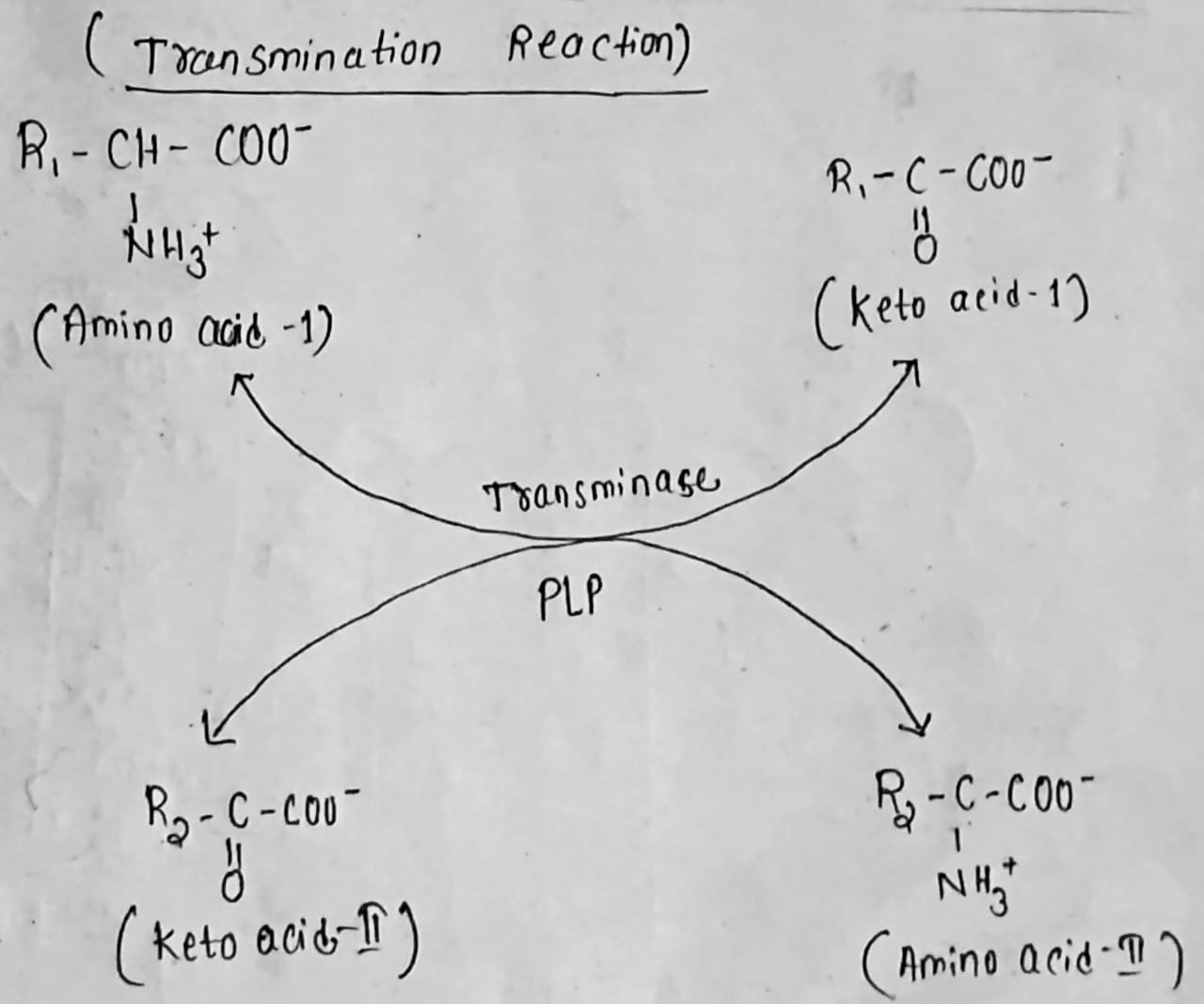
The transfer of an amino (NH₂) group from an amino acid to a keto acid is known as transamination.
This process involves the interconversion of a pair of amino acids and a pair of keto acids, catalyzed by a group of enzymes called transaminases.
Amino Acid Metabolism: An Overview 🧬
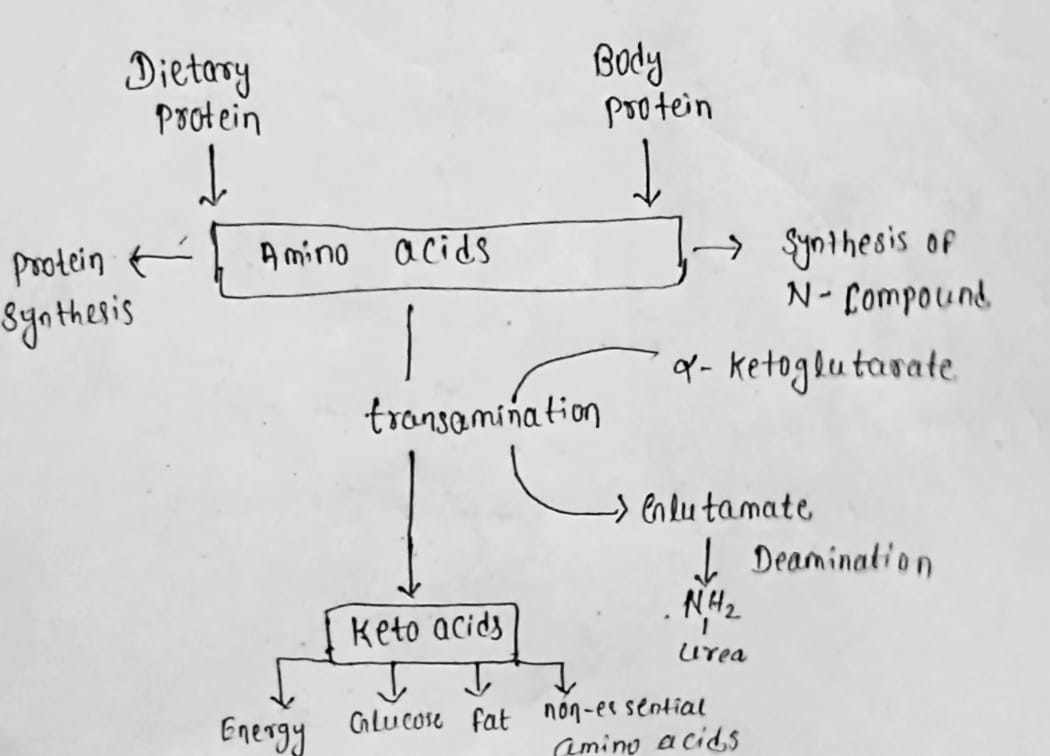
Amino acid metabolism involves the breakdown of amino acids into two primary components: the nitrogen-containing amino group and the non-nitrogenous carbon skeleton (keto acid).
The General Pathway
- Transamination and Deamination: Amino acids first undergo transamination (transfer of $\text{NH}_2$), followed by deamination (removal of $\text{NH}_2$), which ultimately releases ammonia.
- Urea Formation: The toxic ammonia ($\text{NH}_3$) is detoxified by being converted to urea, a waste product excreted primarily by the kidney. This process largely occurs in the liver.
- Keto Acid Conversion: The carbon skeleton of the amino acid is converted into $\alpha$-keto acids through transamination.
Fates of Keto Acids (The Carbon Skeleton)
Once formed, the alpha-keto acids enter central metabolic pathways for various purposes:
- Energy Generation: Keto acids can be broken down completely for the production of {ATP} (energy).
- Glucose Synthesis: They can be used to synthesize glucose (gluconeogenesis).
- Fat or Ketone Body Formation: They can be converted into fat or ketone bodies.
- Non-Essential Amino Acid Production: They can be recycled to produce non-essential amino acids as needed.
Silent Features of Transamination
Transamination is the highly important initial step in amino acid catabolism and anabolism, characterized by the following features:
Diagnostic and Prognostic Importance: Aspartate transaminase {AST} and alanine transaminase {ALT} are important for diagnostic and prognostic purposes in medical practice (e.g., in liver function tests).
Coenzyme Requirement: All transaminases require Pyridoxal Phosphate {PLP}, a coenzyme derived from Vitamin B.
Specific Transaminases: Specific transaminases exist for each pair of amino acids and alpha-keto acids. However, only a few, namely aspartate transaminase and alanine transaminase, make a significant contribution to transamination.
No Fixed Identity: Only the transfer of the amino group occurs; the alpha keto acid generated does not have a fixed metabolic identity initially.
Transamination is Reversible: This allows the process to function in both the breakdown (catabolism) and synthesis (anabolism) of amino acids.
Importance: Transamination is crucial for the redistribution of amino groups and the production of non-essential amino acids, depending on the needs of the body. It involves both the catabolism and anabolism of amino acids.
Energy Generation: Transamination diverts excess amino acids towards energy generation by removing their nitrogen and preparing the carbon skeleton.
Nitrogen Concentration in Glutamate: Most amino acids undergo transamination to primarily concentrate nitrogen in glutamate. Glutamate is the only amino acid that significantly contributes to the liberation of a free amino group for subsequent reactions (like the urea cycle).
Participation of Amino Acids: All amino acids except lysine, threonine, proline, and hydroxyproline participate in transamination.
Not Restricted to alpha-Amino Group: The reaction is not restricted to the alpha-amino group; for instance, the amino group of ornithine is transaminated.
Mechanism of Transamination
Transamination is a two-step reversible process involving the transfer of an amino group, fundamentally operating via the Ping Pong Bi Bi mechanism.
1. Amino Group Transfer
- The amino group ($\text{NH}_2$) is transferred from the donor amino acid to the coenzyme pyridoxal phosphate (PLP), resulting in the formation of the intermediate pyridoxamine phosphate.
- This constitutes the first half-reaction of the Ping Pong mechanism, where the first product ($\alpha$-keto acid) leaves the active site.
2. Amino Group Transfer to Keto Acid
- The amino group of pyridoxamine phosphate is then transferred to a recipient keto acid.
- This generates a new amino acid and simultaneously regenerates the enzyme with the original PLP coenzyme, ready for the next catalytic cycle.
The Role of Pyridoxal Phosphate (PLP)
The entire process hinges on the versatile chemistry of PLP, a derivative of Vitamin B
Reaction Mechanism: The transamination reaction involves a series of intermediates, as proposed by the Ping Pong mechanism, where the enzyme alternates between its PLP-bound (aldehyde) and pyridoxamine-bound ($\text{NH}_2$) forms.
Role of PLP: All transaminases require PLP, a derivative of Vitamin B
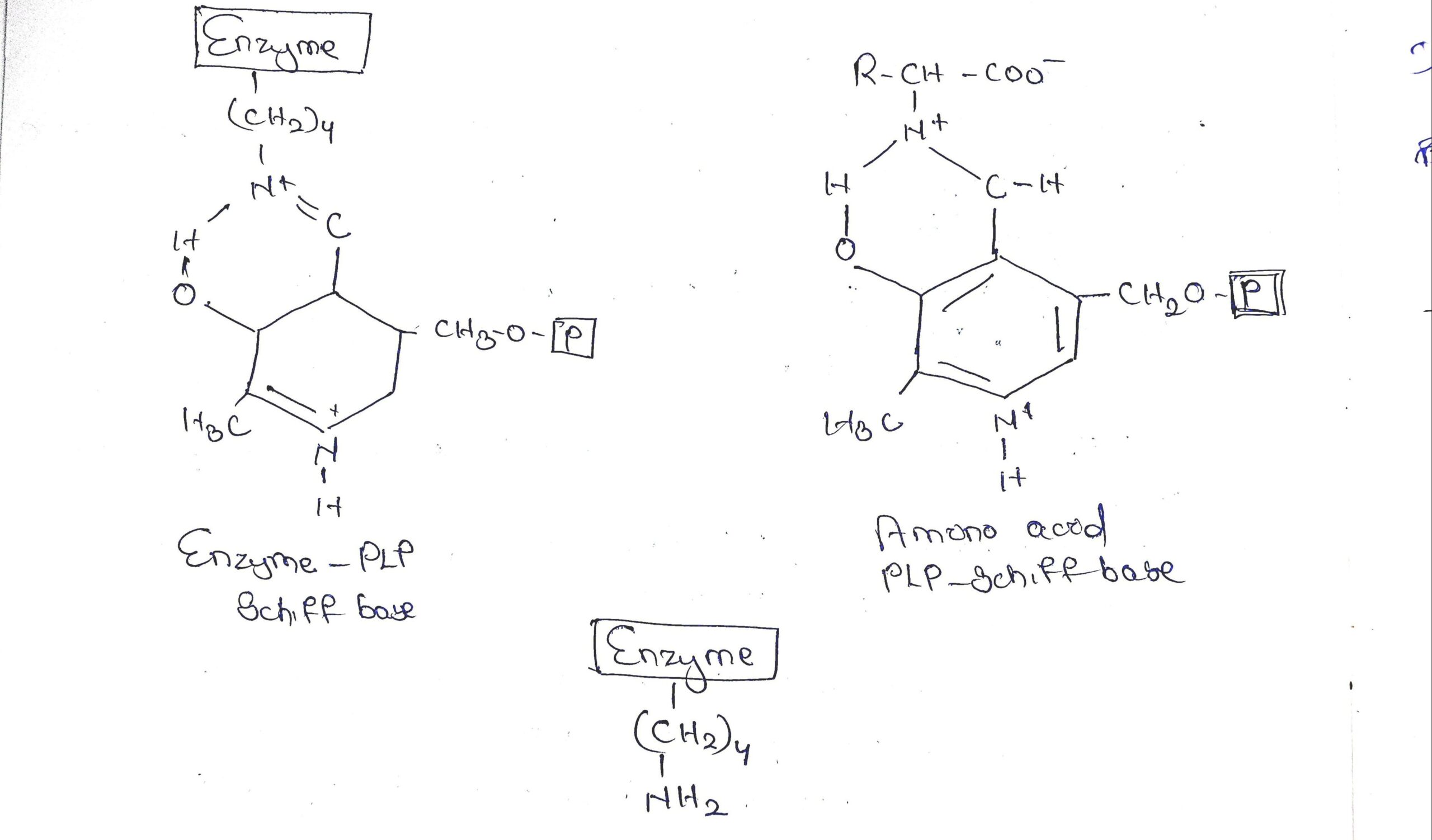
Schiff Base Formation: The aldehyde group of PLP initially forms a Schiff base with the $\epsilon$-amino group of a lysine residue at the enzyme’s active site.
Substrate Binding: When an amino acid substrate contacts the enzyme, it displaces lysine, forming a new Schiff base linkage with the PLP molecule.
Binding of PLP: The amino acid-PLP complex binds tightly to the enzyme via non-covalent forces.
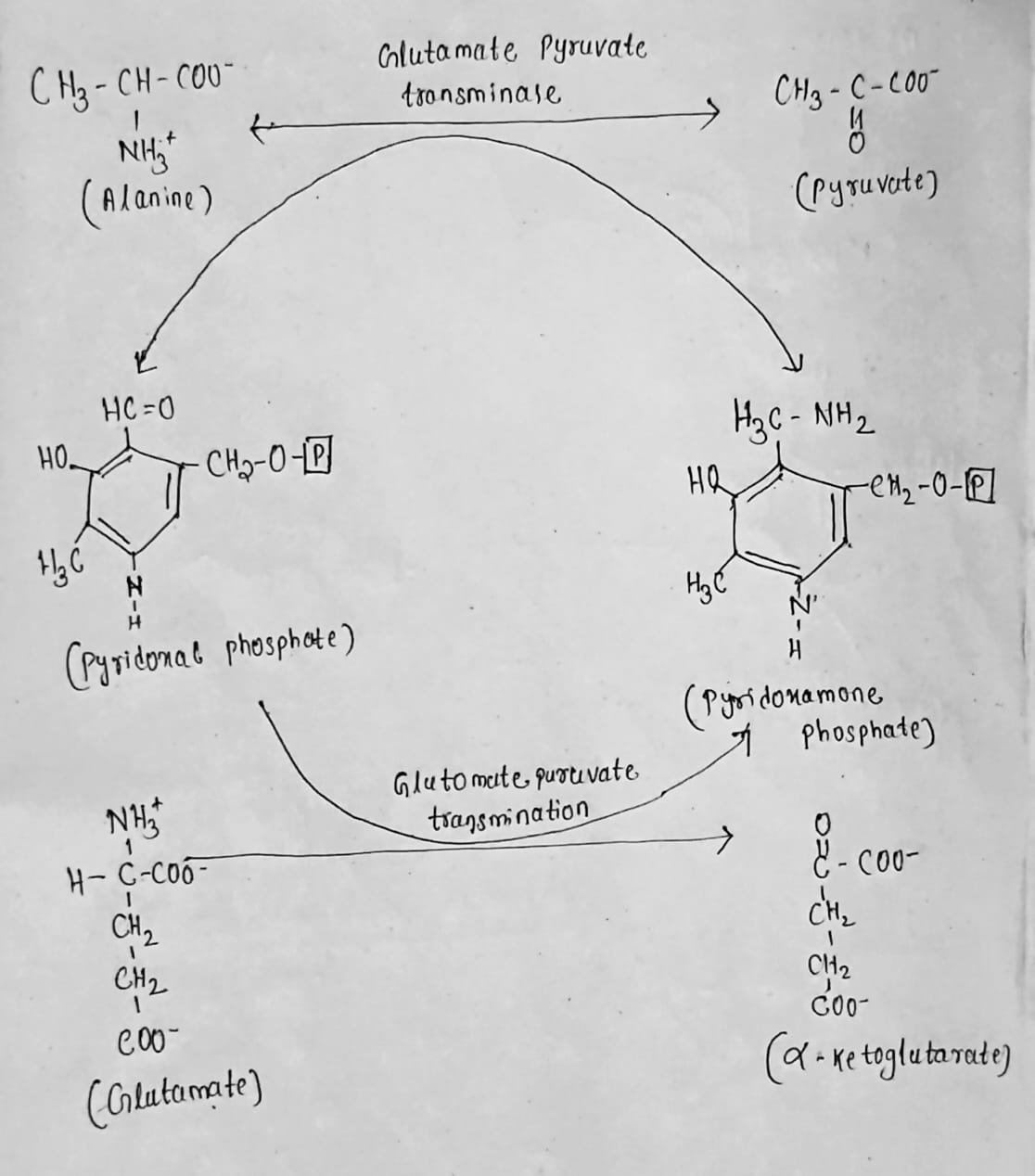
A. INVOLVEMENT OF PYRIDOXAL PHOSPHATE IN THE TRANSFER OF AMINO GROUP :
B. FORMATION OF ENZYME-PLP-SCHIFF BASE AND AMINO ACID PLP-SCHIFF BASE
Deamination
Deamination is a critical catabolic process in amino acid metabolism.
- Removal of an amino group ($\text{NH}_2$) from amino acids.
- Results in the formation of ammonia ($\text{NH}_3$) and $\alpha$-keto acids.
- Simultaneously, it often involves glutamate as the central molecule.
Types of Deamination
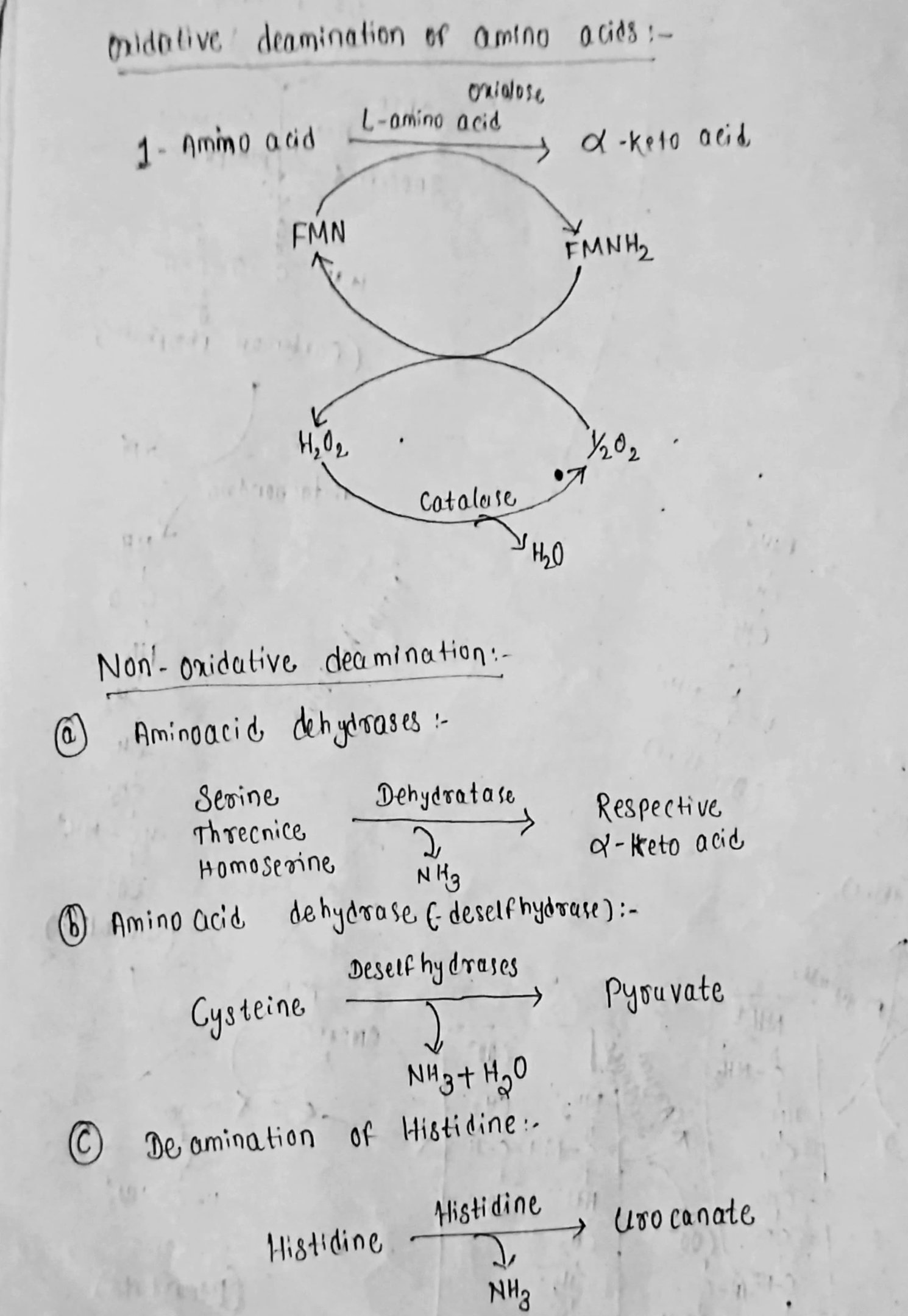
Oxidative Deamination
Oxidative deamination is the principal mechanism for removing nitrogen from amino acids, primarily taking place in the liver and kidney.
- Involves the removal of ammonia from the amino group through oxidation.
- Uses glutamate as a substrate and can utilize $\text{NAD}^+$ or $\text{NADP}^+$ as a coenzyme. Its activity is regulated by allosteric regulation.
- This primary process occurs in the kidney and liver.
- L-amino acid oxidase and D-amino acid oxidase act on the corresponding amino acid to produce an $\alpha$-keto acid and $\text{NH}_3$ for various reactions, including energy generation.
- D-amino acid oxidase: Found in plants and microorganisms, converts D-amino acids to respective keto acids.
Non-Oxidative Deamination
Non-oxidative deamination removes the amino group without requiring a direct oxidation step.
Removes ammonia without oxidation.
PLP-dependent dehydratases act on serine, threonine, and homoserine and are catalysts for non-oxidative deamination.