




Wednesday, June 3, 2026
SAVED POSTS
  • Login
  • Register
RathBiotaClan
No Result
View All Result
  • HOME
  • HEALTH SCIENCE

    TRENDING ON HEALTH (TOP)

    For People Antidepressants Never Helped, a 30-Minute Home Session Is Now FDA-Approved

    Scientists Say Your Next Tube of Toothpaste Could Be Made From Human Hair

    Your Lungs, Liver, and Pancreas Also Age Faster When You Sleep Wrong

    Cycling Linked to Lower Dementia Risk in Study of Nearly 480,000 Adults

    NOW ON AIR (RBC)

    PubMed Research Finder for Life Science Students
    BIOINFORMATICS

    PubMed Research Finder for Life Science Students

    May 26, 2026
    person behind fog glass
    HEALTH SCIENCE

    For People Antidepressants Never Helped, a 30-Minute Home Session Is Now FDA-Approved

    May 26, 2026
    GENETICS

    Childhood Trauma Leaves Distinct Marks on Fathers’ Sperm, Study Shows

    May 22, 2026
    woman in black jacket sitting on gray concrete wall during daytime
    PSYCHOLOGY

    Psychology Study Says, Why People Who Enjoy Being Alone Often Build Stronger Minds and Deeper Connections

    May 21, 2026
  • NEUROSCIENCE
    • PHYSIOLOGY
    • IMMUNOLOGY
    • CANCER
  • DISCOVERIES
    • SPOTLIGHTS
    • STUDENT PORTAL
    • SCIENCE FEATURED
  • MOLECULAR BIOLOGY
    • GENETICS
    • BIOTECHNOLOGY
    • BIOINFORMATICS
    • BIOCHEMISTRY
    • BIOPHYSICS
  • ZOOLOGY & ECOLOGY
    • ENVIRONMENTAL SCIENCE
    • ECOLOGY
    • EVOLUTION
  • MICRO & PLANT SCIENCE
    • MICROBIOLOGY
    • CELL BIOLOGY
    • DEVELOPMENTAL BIOLOGY
  • PSYCHOLOGY
RathBiotaClan
RathBiotaClan
No Result
View All Result
Home BIOTECHNOLOGY

The ‘Pregnancy Robot’ Is Fake But Could Artificial Wombs Be Real?

Shibasis Rath by Shibasis Rath
August 23, 2025
in BIOTECHNOLOGY, SCIENCE FEATURED
Reading Time: 5 mins read
0
A A
0
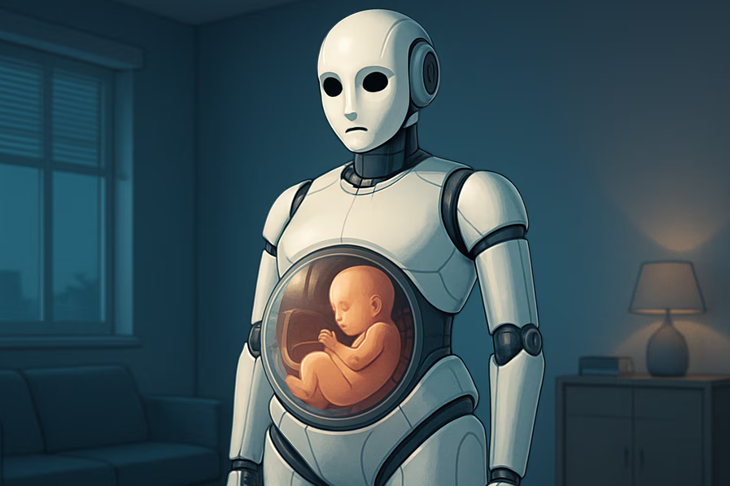
A humanoid robot stands in a dimly lit room with a transparent panel on its torso, revealing a human baby curled up inside—suggesting artificial wombs be real. The room contains a sofa, a window, and a lamp on a table.

Artificial womb technology is no longer just science fiction. A viral hoax about a $14,000 pregnancy robot from China stirred up debate, but behind the fake headlines lies a very real and growing field of research. So, how close are we to creating real artificial wombs and what challenges stand in the way?

Recently, it latched on to a story about a supposed “$14,000 pregnancy robot from China.” The tale spread fast across social media. It featured images of shiny chrome robots with wiring visible, each carrying plump human babies inside transparent bellies. At the center of the reports was a man named Zhang Qifeng. He was described in conflicting ways—sometimes as the CEO of Guangzhou-based Kaiwa Technology, other times as a PhD graduate of Singapore’s Nanyang Technological University (NTU). Zhang allegedly promised a working prototype by 2026, priced under 100,000 yuan (around $13,900). He claimed the robot would allow people to have children without marriage or the hardships of pregnancy.

But there was one big problem: none of it was true.

Fact-checkers at Live Science and Snopes quickly debunked the story. There is no Kaiwa Technology. NTU confirmed no PhD graduate named Zhang Qifeng is working on such research. No evidence existed of the so-called pregnancy bots. Still, the hoax managed to spark serious discussion about artificial wombs—what’s real, what’s possible, and what remains pure science fiction.

ADVERTISEMENT

Where science actually stands: Artificial wombs for premature babies

While a full pregnancy robot is fantasy for now, real scientists are actively developing artificial womb-like systems but for a very different purpose. At the Children’s Hospital of Philadelphia (CHOP), researchers are working on EXTEND (extra-uterine environment for newborn development).

READ ALSO

Psychology Study Says, Why People Who Enjoy Being Alone Often Build Stronger Minds and Deeper Connections

Scientists Say Your Next Tube of Toothpaste Could Be Made From Human Hair

The goal isn’t to grow babies from scratch. It’s to help extremely premature infants, those born between 23 and 28 weeks of gestation. These tiny babies face high risks of chronic lung disease, brain development problems, and death. EXTEND uses a sealed bag filled with lab-made amniotic fluid rich in nutrients and growth factors. An external oxygenator acts like a partial placenta, exchanging oxygen and carbon dioxide. The system shields the baby from dangerous shifts in light, temperature, pressure, and exposure to germs.

ADVERTISEMENT

Results in animal testing look promising. Lambs supported in EXTEND for about a month continued normal development, including preserved brain gene activity. Human trials are expected. However, scientists caution that current neonatal intensive care technology already helps many premature survive. So, ethics and medical necessity will be key to be deciding how and when to test this method.

ADVERTISEMENT

As Dr. Lusine Aghajanova from Stanford Medicine said, it’s a concept that can work, but it’s “more complicated than we think.” BTW; EXTEND is not designed to replace pregnancy from conception to birth. It acts only as a temporary bridge for premature babies.

Why a full “pregnancy robot” is almost impossible today

To go from embryo to full baby in a machine would mean solving some extreme biological and engineering challenges. Experts highlight several almost impossible hurdles:

Implantation: The embryo must attach to uterine tissue to begin pregnancy. Dr. Harvey Kliman of Yale suggests a “hydroponics” approach suspending the embryo in fluid without attachment. But Dr. Aghajanova disagrees, stressing that implantation is critical, like “the seed and the soil.” Without it, normal placental and fetal development could fail.

Oxygen and nutrient control: Early pregnancy requires a low-oxygen environment to protect DNA. Later, it shifts to high oxygen as the fetus grows. A machine would need to reproduce this delicate transition perfectly. It must constantly adjust to changing metabolic demands.

Infection risks: Keeping a fetus free from infection for nine months in a complex artificial system is, as Kliman says, “the biggest problem.”

Immune system support: In the womb, mothers pass antibodies through the umbilical cord. A robot need to simulate this possibly with donated blood or synthetic antibodies. But the protective maternal immune role is still irreplaceable.

Microbiome influence: Babies also benefit from exposure to the vaginal microbiome, which shapes long-term health. Replicating this, when we still don’t fully understand it is another roadblock.

Material safety: Aghajanova warns that plastics or synthetic parts in a robot might disrupt development in unpredictable ways.

THE UNASWERED QUESTIONS !

Even if someone built a prototype, the unanswered questions are staggering.

Where would the eggs and sperm come from?

Would fertilization happen inside the machine or via IVF?

How would the birth process work?

Who regulates and tests such a device ethically?

What if babies raised this way missed unknown benefits of natural pregnancy?

The viral robot story was fake. But it highlighted how people are fascinated by the idea of “outsource” pregnancy. The reality is that science is nowhere close to gestating babies in machines. As Kliman said, it mostly shows “what a miracle a pregnancy is.” Natural gestation, despite its risks, remains far more reliable than anything technology that can deliver.

In countries like the U.S., where fertility treatments, egg/sperm donation, and surrogacy are already available. Experts agree that we aren’t desperate for pregnancy robots.

What we are doing instead is making steady, careful progress in saving premature babies. And that is where artificial womb technology really matters.


The information provided in this article is for educational purposes only and does not substitute professional medical guidance.

RathBiotaClan
  • Share on WhatsApp (Opens in new window) WhatsApp
  • Share on Facebook (Opens in new window) Facebook
  • Share on Reddit (Opens in new window) Reddit
  • Share on X (Opens in new window) X
  • Print (Opens in new window) Print
Shibasis Rath

Shibasis Rath

"𝓒𝓸𝓷𝓷𝓮𝓬𝓽𝓲𝓷𝓰 𝓡𝓮𝓼𝓮𝓪𝓻𝓬𝓱 𝓣𝓸 𝓡𝓮𝓪𝓵𝓲𝓽𝔂" 𝓲𝓼𝓷'𝓽 𝓙𝓾𝓼𝓽 𝓪 𝓜𝓸𝓽𝓽𝓸 - 𝓘𝓽'𝓼 𝓜𝔂 𝓜𝓲𝓼𝓼𝓲𝓸𝓷

Related Posts

woman in black jacket sitting on gray concrete wall during daytime
PSYCHOLOGY

Psychology Study Says, Why People Who Enjoy Being Alone Often Build Stronger Minds and Deeper Connections

May 21, 2026
toothbrush, toothpaste, dental care, clean, dental hygiene, oral hygiene, oral care, tube, paste, brushing, dentistry, toothbrush, toothbrush, toothbrush, toothpaste, toothpaste, toothpaste, toothpaste, toothpaste
BIOTECHNOLOGY

Scientists Say Your Next Tube of Toothpaste Could Be Made From Human Hair

May 19, 2026
Volcanic Eruptions Can Destroy Their Own Methane — Tonga’s Plume Shows How
ENVIRONMENTAL SCIENCE

Volcanic Eruptions Can Destroy Their Own Methane — Tonga’s Plume Shows How

May 13, 2026

POPULAR NEWS

Chewing gum releases thousands of microplastic particles directly into your mouth with every piece you chew

Chewing gum releases thousands of microplastic particles directly into your mouth with every piece you chew

by Shibasis Rath
May 8, 2026
0

Microplastics are turning up in places researchers never expected: deep-sea sediments, Arctic ice, and human blood. Now, a UCLA pilot...

Yelling Isn’t Just Yelling: How a Hostile Home Rewires a Child’s Brain for Constant Alert

Yelling Isn’t Just Yelling: How a Hostile Home Rewires a Child’s Brain for Constant Alert

by Shibasis Rath
March 8, 2026
0

To a parent in the heat of the moment, a raised voice may feel like simple frustration. To a child...

a group of gen Z kids walking down a street

Is Gen Z the First Generation Less Intelligent Than Their Parents?

by Shibasis Rath
February 5, 2026
0

Gen Z intelligence decline is emerging as a serious concern among neuroscientists and education researchers. For over a century, each...

Whole Brain Emulation Achieved: Scientists Run a Fruit Fly Brain in Simulation

by Shibasis Rath
March 9, 2026
0

Scientists have copied an entire biological brain neuron by neuron and synapse by synapse and made it control a simulated...

COCKROACH JANTA PARTY OFFICIAL LOGO

‘Cockroach Janta Party’: Judge’s comment triggers online satire and protest movement in India

by Staff Writer
May 20, 2026
0

⚖️ Editorial Note — RathBiotaClan: We are a science and science-education platform. We are not aligned with any political party....

EDITOR CHOICE‘S

  • All
  • NEWS
  • SPOTLIGHTS
PubMed Research Finder for Life Science Students

PubMed Research Finder for Life Science Students

by Shibasis Rath
May 26, 2026
0

Finding reliable research papers shouldn't be hard for any life science student.Whether you are preparing for CSIR-NET, writing your M.Sc...

person behind fog glass

For People Antidepressants Never Helped, a 30-Minute Home Session Is Now FDA-Approved

by Shibasis Rath
May 26, 2026
0

For the roughly one in three people with depression whose symptoms persist through antidepressants, the standard next step has typically...

Childhood Trauma Leaves Distinct Marks on Fathers’ Sperm, Study Shows

Childhood Trauma Leaves Distinct Marks on Fathers’ Sperm, Study Shows

by Shibasis Rath
May 22, 2026
0

About one in five adults in Europe and the United States grew up with some form of childhood maltreatment and...

woman in black jacket sitting on gray concrete wall during daytime

Psychology Study Says, Why People Who Enjoy Being Alone Often Build Stronger Minds and Deeper Connections

by Staff Writer
May 21, 2026
0

Psychologists have noticed for years that spending time alone stirs up all kinds of conflicting results. Daily tracking studies often...

ADVERTISEMENT

RathBiotaClan – RBC

RathBiotaClan – Connecting Research To Reality

Your trusted source for life science news, biology research & discoveries. Covering neuroscience, genetics, ecology, and more — connecting research to reality.

About Us

Privacy Policies

Contact Us

Editorial Standard

Latest Posts

  • PubMed Research Finder for Life Science Students
  • For People Antidepressants Never Helped, a 30-Minute Home Session Is Now FDA-Approved
  • Childhood Trauma Leaves Distinct Marks on Fathers’ Sperm, Study Shows
  • Psychology Study Says, Why People Who Enjoy Being Alone Often Build Stronger Minds and Deeper Connections

SHIBASIS RATH

Contact Mail

rathbiotaclan@gmail.com

No Result
View All Result
MSME (Udyam) Certified Science Platform
Govt. of India

Get Us On PlayStore

playstore app for rathbiotaclan
  • About Us
  • Advertise With Us
  • Cancellation and Refund Policy
  • Contact Us
  • Contribute
  • Editorial Standards
  • Home
  • Pricing Details
  • Privacy Policies
  • Shipping Policy
  • Terms & Conditions

© 2026 RathBiotaClan. All rights reserved.

Welcome Back!

Sign In with Google
OR

Login to your account below

Forgotten Password? Sign Up

Create New Account!

Sign Up with Google
OR

Fill the forms bellow to register

*By registering into our website, you agree to the Terms & Conditions and Privacy Policy.
All fields are required. Log In

Retrieve your password

Please enter your username or email address to reset your password.

Log In

Add New Playlist

No Result
View All Result
  • HOME
  • HEALTH SCIENCE
  • NEUROSCIENCE
    • PHYSIOLOGY
    • IMMUNOLOGY
    • CANCER
  • DISCOVERIES
    • SPOTLIGHTS
    • STUDENT PORTAL
    • SCIENCE FEATURED
  • MOLECULAR BIOLOGY
    • GENETICS
    • BIOTECHNOLOGY
    • BIOINFORMATICS
    • BIOCHEMISTRY
    • BIOPHYSICS
  • ZOOLOGY & ECOLOGY
    • ENVIRONMENTAL SCIENCE
    • ECOLOGY
    • EVOLUTION
  • MICRO & PLANT SCIENCE
    • MICROBIOLOGY
    • CELL BIOLOGY
    • DEVELOPMENTAL BIOLOGY
  • PSYCHOLOGY
  • Login
  • Sign Up
SAVED POSTS

© 2026 RathBiotaClan. All rights reserved.

This website uses cookies. By continuing to use this website you are giving consent to cookies being used. Visit our Privacy and Cookie Policy.