GLYCOGENESIS
Glycogenesis is the process where the body synthesizes glycogen from glucose. It occurs mainly in the liver and muscles, and it requires ATP and UTP for activation. Additionally, it helps maintain blood glucose levels during times of excess energy.
1. Synthesis of UDP-Glucose
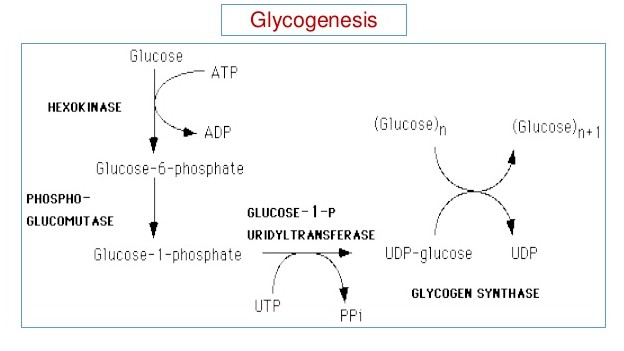
First, hexokinase and glucokinase convert glucose into glucose-6-phosphate. Next, phosphoglucomutase shifts glucose-6-phosphate to glucose-1-phosphate. Then, UDP-glucose pyrophosphorylase produces UDP-glucose from glucose-1-phosphate and UTP. As a result, the cell forms the activated glucose needed for glycogen synthesis.
2. Primer Requirement
To begin glycogenesis, the cell needs a primer. Usually, a small fragment of existing glycogen plays this role. However, when no glycogen exists, the protein glycogenin starts the chain. It accepts glucose from UDP-glucose and forms the initial short chain. Afterward, glycogen synthase continues the elongation of the glycogen molecule.
3. Elongation by Glycogen Synthase
Glycogen synthase adds glucose molecules to the non-reducing ends of the chain. It forms α-1,4-glycosidic linkages, and with each addition, the glycogen chain grows longer. This step is the main control point of glycogenesis.
4. Formation of Branches
As the chain grows, it must branch to increase solubility and accessibility. Although glycogen synthase forms straight chains, the branching enzyme (amylo-1,6-glucosidase) introduces branches.
This enzyme moves a small block of 5–8 glucose residues to another site, creating a new α-1,6-linkage. Consequently, a fresh non-reducing end forms, allowing rapid synthesis and breakdown. Together, glycogen synthase and the branching enzyme build a highly branched, efficient glycogen molecule.
Regulation of Glycogenesis and Glycogenolysis
The body regulates glycogen synthesis and breakdown mainly through allosteric, hormonal, and calcium-dependent mechanisms.
A. Allosteric Regulation
Various metabolites influence glycogen synthase and glycogen phosphorylase:
- When energy is high, glycogen synthesis increases.
- When glucose and ATP fall, glycogen breakdown rises.
B. Hormonal Regulation
Hormones regulate glycogen metabolism by phosphorylating or dephosphorylating enzymes:
- Insulin promotes glycogenesis.
- Glucagon and epinephrine promote glycogenolysis.
C. Influence of Calcium
During muscle contraction, the sarcoplasmic reticulum releases Ca²⁺ ions. These ions bind to calmodulin, which directly activates phosphorylase kinase, even without cAMP. Thus, calcium quickly stimulates glycogen breakdown during exercise.
D. cAMP as a Second Messenger
Hormones like epinephrine and glucagon activate adenylate cyclase, increasing cAMP levels. Next, cAMP activates protein kinase A (PKA), which phosphorylates enzymes involved in glycogen metabolism.
Effect on Glycogen Synthesis
cAMP-activated PKA phosphorylates glycogen synthase, decreasing its activity.
Effect on Glycogen Breakdown
PKA activates phosphorylase kinase, which then activates glycogen phosphorylase, accelerating glycogenolysis.
E. Overall Hormonal Effect
- Glucagon + Epinephrine → Increase glycogen breakdown
- Insulin → Increases glycogen synthesis
GLYCOGENOLYSIS
Glycogenolysis is the breakdown of stored glycogen in the liver and muscle cells. It occurs in the cytosol and supplies glucose during fasting, exercise, and stress.
Steps of Glycogen Degradation
1. Action of Glycogen Phosphorylase
This enzyme removes glucose units from non-reducing ends by cleaving α-1,4-glycosidic bonds. As a result, it produces glucose-1-phosphate. It requires pyridoxal phosphate (Vitamin B6) as a cofactor.
2. Debranching Enzyme
It has two activities:
a) Glycosyltransferase
Moves a block of glucose residues to a nearby chain.
b) α-1,6-Glucosidase
Hydrolyzes α-1,6 bonds at branch points, releasing free glucose.
After this, the chain becomes accessible for further breakdown.
3. Conversion to Glucose-6-Phosphate
Glucose-1-phosphate is converted to glucose-6-phosphate by phosphoglucomutase.
- In the liver, glucose-6-phosphate becomes free glucose.
- In muscle, it enters glycolysis for energy.
Final Summary
Glycogenesis builds glycogen, whereas glycogenolysis breaks it down. Both processes rely on coordinated enzyme control, hormonal signals, and cellular energy needs. Together, they ensure stable blood glucose levels and efficient energy supply.